
7 Industrial Business Ideas Near HPCL Pachpadra Refinery That Can Earn ₹1 Crore/Year
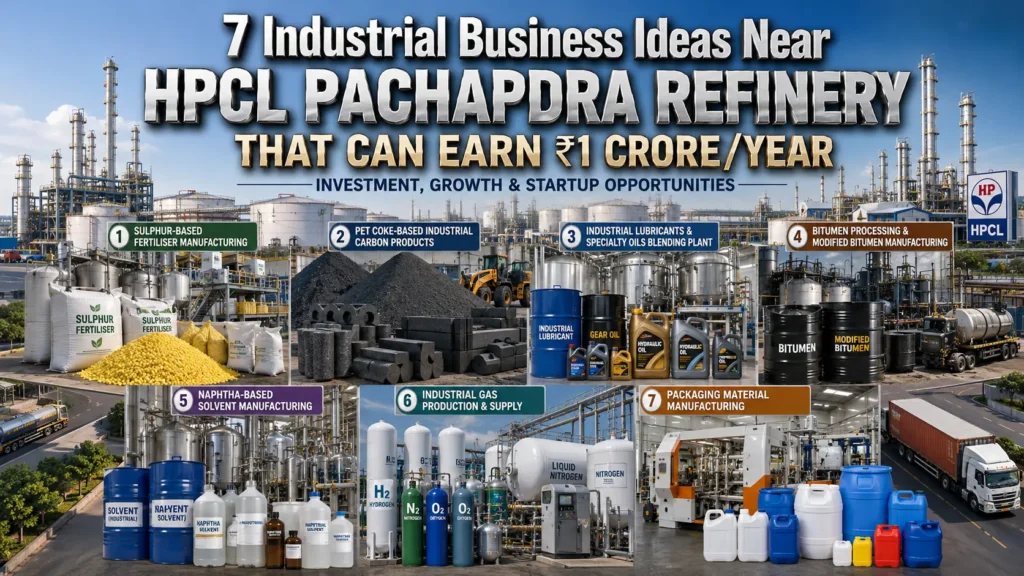
Business Ideas Near Pachpadra Refinery A Refinery That Changes the Map One of the biggest industrial events in the remote memory of western India is the commissioning of HPCL (Rajasthan) Refinery at Pachpadra, Balotra-Barmer belt. A greenfield crude oil refinery of this magnitude isn’t just a manufacturing plant for fuel; it’s a whole new environment of entrepreneurial concepts that savvy business people can exploit today. The supply chains, workforce and infrastructure that a mega-refinery attracts benefits all of the above. The Pachpadra corridor is undoubtedly the most enticing industrial opportunity in the country right now if you are a startup founder, MSME investor or first-generation entrepreneur seeking an opportune industrial entry into the nation. This article takes a detailed look at this opportunity – the sector logic, where the government support is available, some ideas for projects, trade dynamics and models of success to learn from. Understanding the HPCL Pachpadra Refinery and Its Industrial Significance The project for the HPCL Refinery Limited (HRRL) is a joint venture between Hindustan Petroleum Corporation Limited (HPCL) and the Government of Rajasthan at Pachpadra. It is meant to process locally available crude oil from Rajasthan, which is mainly from Barmer oil fields, with a capacity of 9 million metric tonnes per annum (MMTPA). Thus, it is one of the bigger greenfield refinery projects being undertaken during India’s recent industrial history. But it is not just the refinery that is significant for entrepreneurs. It’s the industry that develops around the refinery, and what it makes. Modern crude oil refinery produces more than petrol and diesel. They include naptha, liquefied petroleum gas (LPG), aviation turbine fuel (ATF), sulphur, petroleum coke (pet coke), bitumen, propylene, and other hydrocarbon streams, which are generated as by-products or co-products. These are each a separate “downstream” manufacturing value chain. Plus, because it’s such a large refinery, it requires massive amounts of support infrastructure: industrial gases and packaging materials, logistics, maintenance services, chemical intermediates, and so on. Thus, the business opportunity is direct (in the processing of the refinery outputs) and indirect (in provision of services and materials required by the refinery and its employees). Information about the refinery project can be obtained from HPCL official corporate website. Why the Petrochemical and Ancillary Manufacturing Sector Is a Strong Bet Right Now The Indian Petrochemical industry is in structural growth mode. Demand of polymers, plastics, synthetic fibres and specialty chemicals have been on the ascent in the domestic market. This demand is sustained by rising activity in the construction, food and drinks packaging, automotive and agriculture industries. India is currently importing considerable quantity of petrochemical intermediates which presents an opportunity for domestic manufacturers to meet the demand through import substitution. In addition, the state of Rajasthan is relatively underpenetrated industrially in terms of its resource base and size. The state government has made a conscious effort to make it an attractive industrial location through the Rajasthan Investment Promotion Scheme (RIPS) and dedicated industrial areas. The process of the Pachpadra refinery coming to life is also an anchor investment, which normally leads to an ancillary unit, workforce settlement and service industries coming into the area. One of the biggest costs benefits a manufacturer can have is its proximity to the raw material source, from a profitability perspective. Companies set up near Pachpadra refinery will benefit from reduced logistics costs for feedstocks, quicker response of supply chain and possible preferential access to by-product streams. The benefits directly impact on operating margins. The Ministry of Chemicals and Petrochemicals, Government of India is an authoritative source for industry level data and statistics for the petrochemical industry. Export Potential from the Pachpadra Industrial Belt The Indian petrochemical exports have been on the rise, and major markets in Southeast Asia, Africa and Middle East are actively looking for competitively priced petrochemical intermediates as well as finished products from India. The geo-location factor also proves to be advantageous for Rajasthan. The manufacturing sector has easy access to the sea through proximity of Mundra and Kandla ports located in Gujarat, which is essential for export-oriented industries. It is possible for an entrepreneur to start a petrochemical/ specialty chemical unit which can be export oriented from day one near Pachpadra, provided the product is in line with the global demand patterns such as agrochemicals, packaging polymers, industrial lubricants etc. Government Policies and Incentives Supporting New Manufacturing Businesses The policy landscape for new manufacturing enterprises that are located in the vicinity of an anchor industrial project, such as HRRL Pachpadra, is truly conducive at the moment. There are a few schemes at both central and state levels that offer capital subsidy, tax exemption, institutional support and thereby mitigate the financial risk for the first time investors. Central Government Schemes Production Linked Incentive (PLI) Scheme has been introduced by the Ministry of Chemicals and Petrochemicals for certain chemicals and petrochemicals. It provides incentives based on incremental production, which is especially appealing for manufacturers expanding production. The MSME Credit Guarantee Fund Trust (CGTMSE) scheme provides credit support of up to ₹2 crore to eligible MSMEs without the need for collateral.The MSME Credit Guarantee Fund Trust (CGTMSE) scheme is an important facilitator for the small manufacturing setups for providing credit support without collaterals to MSMEs. Besides, the Ministry of MSME also operates PMEGP (Prime Minister’s Employment Generation Programme) that offers capital subsidy of up to 35% for manufacturing industries in rural and semi-urban areas. Pachpadra is considered as semi-urban area, which is very relevant for small manufacturing entrepreneurs for the implementation of PMEGP. Likewise, the Technology Upgradation Fund Scheme (TUFS) is applicable in the case of investment by business in modern and efficient manufacturing equipment. Rajasthan State Incentives Rajasthan Investment Promotion Scheme (RIPS) is the state’s key industrial incentive scheme. Provides subsidies on investments, exemption from electricity duty, rebate on conversion of land charges, and waiver of stamp duty for qualified industries. Typically, the sectors including units for Petrochemicals and Chemicals are considered as priority sectors for RIPS incentives. Further, the Rajasthan MSME Act provides
How to Start a Power Transformer & Distribution Transformer Manufacturing Business: A Complete Guide
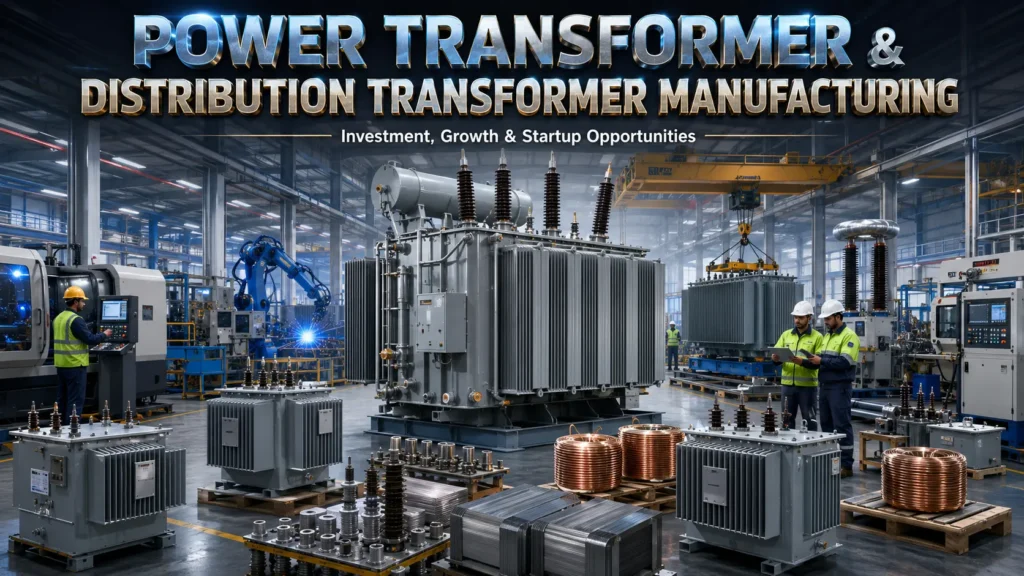
Power Transformer Manufacturing Business and distribution transformer manufacturing is among the most robust and sought-after manufacturing business ideas in India’s industrial landscape and that is one of the reasons why electricity is never in demand. Transformers are used in every new factory, solar farm, residential township, railway line, data centre or irrigation pump. This reality can make transformer manufacturing a viable business idea and structurally sound long duration opportunity for first generation entrepreneur and MSME investors. India is undergoing a large-scale electricity infrastructure build-out. The government’s thrust on 24×7 power supply, modernization of the grid and integration of renewable energy sources are driving transformer demand to a new high. The government’s thrust on 24×7 power supply, modernization of the grid, and integration of renewable energy sources are driving transformer demand to new heights. At the same time, the changes in the global value chain are opening export opportunities that India manufacturers could not have envisioned 10 years ago. Covering investment structure, raw materials, government incentives, project models, and real-world success stories, this article delves into all facets of this manufacturing enterprise. Why the Transformer Manufacturing Sector Is a Smart Business Entry Demand Fundamentals Are Unusually Strong The market for transformers in India (both distribution transformer and power transformer) is more than Rs.30,000 crore and is increasing at a compound annual growth rate of approximately 8 to 10 percent. State electricity distribution companies (DISCOMs) buy hundreds of thousands of distribution transformers annually for electrification in rural areas, feeder separation and for replacing old transformers. Other demand drivers include private industrial estates, commercial real estate developers and renewable energy project developers. Finally, the transition to renewables is a key layer. Step up transformers are used for connecting the generation to the grid in every solar and wind energy park. As India aims to install 500 GW of renewable energy upcoming, transformer demand is likely to be huge from this stream. The market offers volume (distribution transformers) and margin (power and specialty transformers) to a new manufacturing company entering the market. Get Detailed Insights from This Book: Solar PV Power and Solar Products Handbook Export Opportunity and Import Substitution India is currently importing some of its power transformer requirement especially of the High Voltage transformers of the greater than 220 KV range. This presents a clear opportunity for import substitution: to have locally produced manufacturers ready to invest in advanced capabilities. Besides, India’s ability to become a rightful and cost-competing electrical equipment exporter is improving. African DISCOMs, grid companies in Southeast Asia, and Middle Eastern EPC companies are actively seeking transformers from Indian manufacturers, especially those that are IEC and IS certified. The Make in India initiative (https://www.makeinindia.com/sector/electrical-machinery) also helped to build trust among global buyers and Indian manufacturers that India is not only an opportunistic vendor but can also become a long-term supply partner. It’s a paradigm change which a well-positioned new manufacturing company can benefit from early. Government Policies and Incentives Supporting This Manufacturing Business Production Linked Incentive (PLI) and Capital Goods Schemes The ministry of heavy industries (https://heavyindustries.gov.in/) has been managing the following schemes that are of interest to the transformer manufacturers. The PLI scheme for white goods and electrical equipment is based on incentives for sales growth, thus incentivizing incremental investments in manufacturing. The schemes for capital goods can provide financial assistance for upgradation of technology and establishment of new plants — both of which can be directly applied for the business of making transformers. MSME Schemes: Credit, Cluster, and Subsidy Benefits There are a number of schemes run by the Ministry of MSME (https://msme.gov.in/) which directly impact the new transformer manufacturers. Credit Guarantee Fund Trust for Micro and Small Enterprises (CGTMSE) offers collateral free loans of Rs.2 crore, especially helpful in the case of small distribution transformer units. For small manufacturers, there are two schemes, namely Technology Upgradation Fund Scheme (TUPS) and Credit-Linked Capital Subsidy Scheme (CLCSS), which provide support for machinery investment. In addition, MSME Clusters have been developed in various states such as Gujarat, Maharashtra, Rajasthan, Uttar Pradesh, etc. for electrical equipment. Establishing within a cluster provides a new business with shared test infrastructure, shared facility centres and quicker clearances. Manufacturing startups can also avail of other tax exemptions and self-certification benefits provided by the DPIIT Start Up Recognition (https://www.startupindia.gov.in/), portal. BIS and Standards Compliance as a Business Moat BIS certification of the product under IS 1180 (distribution transformer) and IS 2026 (power transformer) is not just a regulatory requirement but also an edge. The one biggest buyer group is the State DISCOMs which procure only BIS certified transformers. A new manufacturer which gets BIS certified in a relatively short period of time is given a channel of procurement of thousands of crores of rupees for the year. The Bureau of Indian Standards (BIS) (https://www.bis.gov.in/) offers transparent certification processes for new applicants. Get Detailed Project Report (DPR): Transformer Manufacturing Handbook State-Level Incentives Gujarat, Telengana, Tamil Nadu, Rajasthan and Madhya Pradesh have active industrial policies that provide additional incentives for electrical equipment manufacturing. This includes stamp duty exemptions, electricity tariff concession, defrayal of GST for a specified term and employment subsidies. State-level industrial policies need to be considered prior to site selection by an entrepreneur. Specific Business Ideas in Power and Distribution Transformer Manufacturing Business Idea 1: Small Distribution Transformer Manufacturing Unit (Up to 200 KVA) It is the easiest and the most convenient start point for the first-generation entrepreneurs and MSME investors. The distribution transformer having a rating of 25 KVA to 200 KVA is the workhorse of the rural / semi-urban electricity distribution system. State DISCOMs procure these in bulk — often through annual rate contracts. The capital investment for a small unit having capacity of 500 to 1000 transformers per year is around Rs.2 to Rs.4 crore, which includes a fabrication shed, core cutting and winding machine, tank fabrication set up, oil impregnation machine and a testing station. The margin profile is good, usually between 18-24% at the operating level, with a well-defined