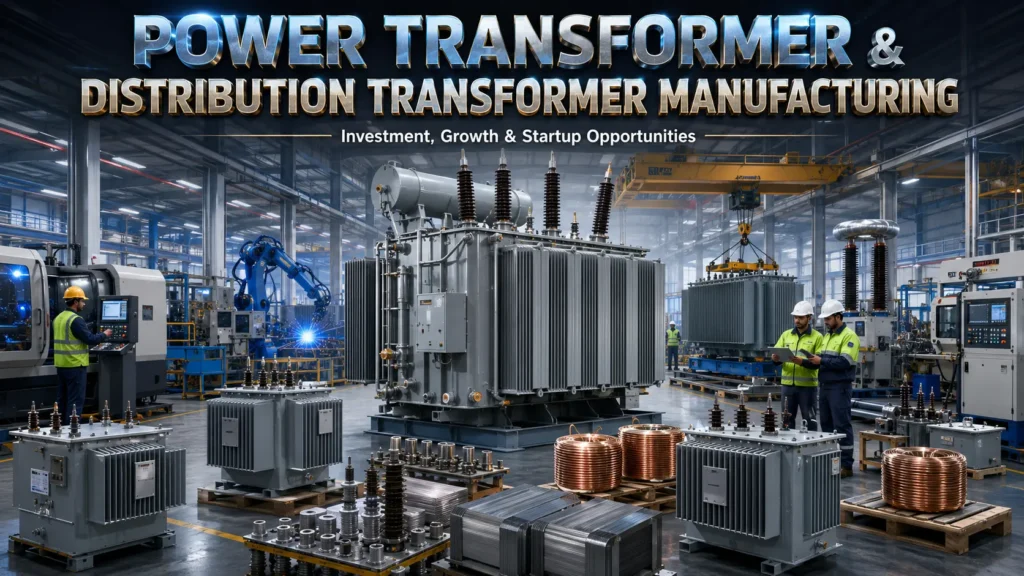

Power Transformer Manufacturing Business and distribution transformer manufacturing is among the most robust and sought-after manufacturing business ideas in India’s industrial landscape and that is one of the reasons why electricity is never in demand. Transformers are used in every new factory, solar farm, residential township, railway line, data centre or irrigation pump. This reality can make transformer manufacturing a viable business idea and structurally sound long duration opportunity for first generation entrepreneur and MSME investors.
India is undergoing a large-scale electricity infrastructure build-out. The government’s thrust on 24×7 power supply, modernization of the grid and integration of renewable energy sources are driving transformer demand to a new high. The government’s thrust on 24×7 power supply, modernization of the grid, and integration of renewable energy sources are driving transformer demand to new heights. At the same time, the changes in the global value chain are opening export opportunities that India manufacturers could not have envisioned 10 years ago. Covering investment structure, raw materials, government incentives, project models, and real-world success stories, this article delves into all facets of this manufacturing enterprise.
Why the Transformer Manufacturing Sector Is a Smart Business Entry
Demand Fundamentals Are Unusually Strong
The market for transformers in India (both distribution transformer and power transformer) is more than Rs.30,000 crore and is increasing at a compound annual growth rate of approximately 8 to 10 percent. State electricity distribution companies (DISCOMs) buy hundreds of thousands of distribution transformers annually for electrification in rural areas, feeder separation and for replacing old transformers. Other demand drivers include private industrial estates, commercial real estate developers and renewable energy project developers.
Finally, the transition to renewables is a key layer. Step up transformers are used for connecting the generation to the grid in every solar and wind energy park. As India aims to install 500 GW of renewable energy upcoming, transformer demand is likely to be huge from this stream. The market offers volume (distribution transformers) and margin (power and specialty transformers) to a new manufacturing company entering the market.
Get Detailed Insights from This Book: Solar PV Power and Solar Products Handbook
Export Opportunity and Import Substitution
India is currently importing some of its power transformer requirement especially of the High Voltage transformers of the greater than 220 KV range. This presents a clear opportunity for import substitution: to have locally produced manufacturers ready to invest in advanced capabilities. Besides, India’s ability to become a rightful and cost-competing electrical equipment exporter is improving. African DISCOMs, grid companies in Southeast Asia, and Middle Eastern EPC companies are actively seeking transformers from Indian manufacturers, especially those that are IEC and IS certified.
The Make in India initiative (https://www.makeinindia.com/sector/electrical-machinery) also helped to build trust among global buyers and Indian manufacturers that India is not only an opportunistic vendor but can also become a long-term supply partner. It’s a paradigm change which a well-positioned new manufacturing company can benefit from early.
Government Policies and Incentives Supporting This Manufacturing Business
Production Linked Incentive (PLI) and Capital Goods Schemes
The ministry of heavy industries (https://heavyindustries.gov.in/) has been managing the following schemes that are of interest to the transformer manufacturers. The PLI scheme for white goods and electrical equipment is based on incentives for sales growth, thus incentivizing incremental investments in manufacturing. The schemes for capital goods can provide financial assistance for upgradation of technology and establishment of new plants — both of which can be directly applied for the business of making transformers.
MSME Schemes: Credit, Cluster, and Subsidy Benefits
There are a number of schemes run by the Ministry of MSME (https://msme.gov.in/) which directly impact the new transformer manufacturers. Credit Guarantee Fund Trust for Micro and Small Enterprises (CGTMSE) offers collateral free loans of Rs.2 crore, especially helpful in the case of small distribution transformer units. For small manufacturers, there are two schemes, namely Technology Upgradation Fund Scheme (TUPS) and Credit-Linked Capital Subsidy Scheme (CLCSS), which provide support for machinery investment.
In addition, MSME Clusters have been developed in various states such as Gujarat, Maharashtra, Rajasthan, Uttar Pradesh, etc. for electrical equipment. Establishing within a cluster provides a new business with shared test infrastructure, shared facility centres and quicker clearances. Manufacturing startups can also avail of other tax exemptions and self-certification benefits provided by the DPIIT Start Up Recognition (https://www.startupindia.gov.in/), portal.
BIS and Standards Compliance as a Business Moat
BIS certification of the product under IS 1180 (distribution transformer) and IS 2026 (power transformer) is not just a regulatory requirement but also an edge. The one biggest buyer group is the State DISCOMs which procure only BIS certified transformers. A new manufacturer which gets BIS certified in a relatively short period of time is given a channel of procurement of thousands of crores of rupees for the year. The Bureau of Indian Standards (BIS) (https://www.bis.gov.in/) offers transparent certification processes for new applicants.
Get Detailed Project Report (DPR): Transformer Manufacturing Handbook
State-Level Incentives
Gujarat, Telengana, Tamil Nadu, Rajasthan and Madhya Pradesh have active industrial policies that provide additional incentives for electrical equipment manufacturing. This includes stamp duty exemptions, electricity tariff concession, defrayal of GST for a specified term and employment subsidies. State-level industrial policies need to be considered prior to site selection by an entrepreneur.
Specific Business Ideas in Power and Distribution Transformer Manufacturing
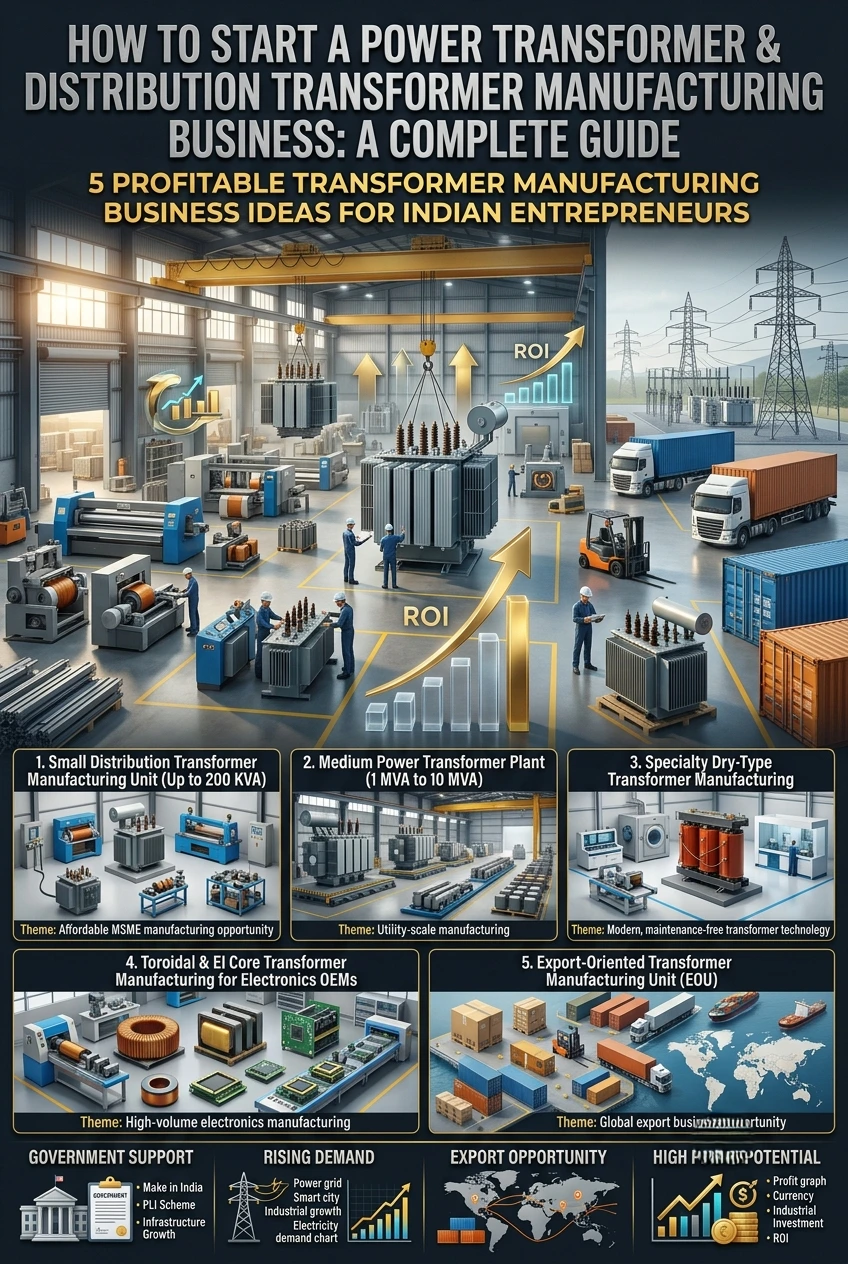
Business Idea 1: Small Distribution Transformer Manufacturing Unit (Up to 200 KVA)
It is the easiest and the most convenient start point for the first-generation entrepreneurs and MSME investors. The distribution transformer having a rating of 25 KVA to 200 KVA is the workhorse of the rural / semi-urban electricity distribution system. State DISCOMs procure these in bulk — often through annual rate contracts. The capital investment for a small unit having capacity of 500 to 1000 transformers per year is around Rs.2 to Rs.4 crore, which includes a fabrication shed, core cutting and winding machine, tank fabrication set up, oil impregnation machine and a testing station.
The margin profile is good, usually between 18-24% at the operating level, with a well-defined bill of materials and optimised procurement via local vendor networks. In this segment, however, quality discipline is essential — BIS certification is not an option and DISCOM quality audits are a reality. Entrepreneurs who establish themselves a reputation for low failure rate transformers can be given premium positioning in repeat procurement contracts. Central Power Research Institute (CPRI) (https://www.cpri.in/) offers new entrants testing and certification.
Business Idea 2: Medium Power Transformer Plant (1 MVA to 10 MVA)
Medium power transformers are used in industrial parks, commercial complexes, large agricultural pump sets, railway electrification sub-stations and small renewable energy installations. This segment has higher margins than mass-produced distribution transformers, and it has more complicated engineering — so it’s less competitive. Precision winding machines, vacuum drying ovens, impulse testing equipment, oil testing labs are some of the investments required for a plant with an annual production capacity of 100 to 300 units – which will cost Rs.8 to Rs.15 crore.
The beauty of this business idea is that it’s diversified in terms of customers. Medium power transformer buyers comprise EPC contractors, infrastructure developers and private industrial buyers, compared to the distribution segment that is nearly all DISCOM driven. This diversity of buyers minimizes reliance on any one sourcing method, and gives increased predictability of revenue. Moreover, there are areas of viable export potential, particularly in the medium power market in Sub-Saharan Africa and Southeast Asia.
Business Idea 3: Specialty Dry-Type Transformer Manufacturing
Dry-type transformer is a transformer that does not use transformer oil to insulate and cool. Rather, they employ air or resin. They are paving the way for indoor use where fire is a major concern, such as metro rail stations, hospitals, data centres, airports, high-rises and underground installations. The specialty dry-type segment is witnessing a phenomenal growth in India, where the country’s urbanisation and scale-up of critical infrastructure are expected to drive the market.India’s urbanisation and scale-up of critical infrastructure are anticipated to accelerate the specialty dry-type segment as the country is rapidly urbanising.
The investment cost for focused dry type transformer unit (300-600 unit per year capacity) is around Rs.3cr to Rs.6 cr. Importantly, margins are also wider in this segment – typically 20-28 percent – as customers care more about product performance and safety compliance than price. New players in the market need to invest in vacuum pressure impregnation (VPI) technology and develop design capacity of cast resin transformers (CRT) in dry type transformers, the top segment of the dry type market. Because of the competition here is not as fierce as in the oil-cooled mass market, it is a smart business idea for technically savvy promoters.
Turn your budget into a successful business plan
Business Idea 4: Toroidal and EI Core Transformer Manufacturing for Electronics OEMs
This is a small but expanding manufacturing sector idea, but not for the power utility industry, but for the OEMs (Original Equipment Manufacturers) of the electronics/electrical equipment industry. The industrial automation equipment, medical devices, power conditioning, audio electronics and renewable energy inverters use Toroidal transformers and EI core transformers. As India’s electronics manufacturing base continues to grow, the demand under the PLI scheme for electronics is on the rise.
The investment is much lesser, Rs.75 lakh to Rs.2 crore for a production unit with focused production process and less capital intensive as compared to the power transformers. But accuracy is key. The OEM buyer expects tight tolerances, quality and reliable delivery. This is a high margin, low cyclicality business for entrepreneurs who can be able to sign long-term supply deals with electronics OEM clusters in Pune, Bengaluru, Chennai or Noida. The segment also gains from the trend of import substitution for components, whereby electronics OEMs are looking to buy domestic transformers.
Business Idea 5: Export-Oriented Transformer Manufacturing Unit (EOU)
Under the Foreign Trade Policy, Transformer manufacturers with a focus on global markets can set up as Export Oriented Units (EOU) which provides them a unique business model from the outset. One of the significant advantages of EOUs is that it offers duty free import of raw materials and capital goods, which is important because CRGO steel which is used in the cores of transformers has a high import duty. This input cost advantage enables EOUs to make competitive prices in international markets and have healthy margins.
The customer groups of an EOU transformer manufacturer are clearly identified. Countries in Africa are aggressively expanding their electricity grid — especially Nigeria, Kenya, Ethiopia, Tanzania, and Ghana. There are also active markets in Bangladesh, Sri Lanka, Nepal and a few ASEAN countries. When it comes to this business model, IEC 60076 certification (which is the international transformer standard) is as crucial as BIS, and the entrepreneur has to establish documentation of the products, test reports, and even after-sales support according to the international customers’ expectations. Capital investment is in the range of Rs.10 crore to Rs.20 crore for a 200-500 unit per year investment unit for both distribution and medium power range.
Import-Export Opportunity Analysis for Transformer Manufacturers
India’s trade position of transformers is interesting and changing. India imports high capacity EHV transformers (above 220 KV) from China, South Korea and Europe, especially as very specialised capabilities have not been developed by domestic players to produce these transformers. This offers a well-defined opportunity for well-entrenched entrepreneurs in India who are willing to invest in cutting-edge testing and design capabilities and create an import alternative.
In terms of exports, the Indian transformer makers have been making a mark in the developing countries’ markets. Indian electrical equipment exporters are actively assisted by the Engineering Export Promotion Council (EEPC) (https://www.eepcindia.org/) with market development assistance, buyer-seller meets and attending international trade fairs. The members of EEPC can help new manufacturers to get market intelligence and make initial buyer contacts at target geographies.
The Directorate General of Foreign Trade (DGFT) (https://www.dgft.gov.in/) has introduced the Advance Authorisation Schemes which EOU manufacturers can avail to further enhance the cost competitiveness in export markets. Further, India has negotiated bilateral trade agreements (SAFTA and ASFTA) with the South Asian countries and the ASEAN countries which facilitate duty preference to the exports of Indian transformers.
From the raw materials side, CRGO silicon steel is the most import-dependent raw material. The production of CRGO steel in India is not on a large scale. This material is mainly imported from Japan, South Korea, Russia and China. When making their plan to buy raw materials, entrepreneurs need to take into account the import duty, freight, and currency risk. Industry connections with existing CRGO steel importers and stockists in key trading centres, such as Mumbai, Surat and Ludhiana, can aid in the management of lead times and costs.
Related Article: Start a Profitable Business of LV Control and Power Cables, MV Cables
Indian MSME Success Stories in Transformer Manufacturing
Transformers and Electricals Kerala Ltd (TELK) — A Public Sector Model with MSME Lessons
TELK, established in Kerala with technical collaboration from ABB of Sweden, became one of India’s pioneering manufacturers of large power transformers. While it operates in the public sector, the lessons for private MSME entrepreneurs are clear: technical collaboration with established global players dramatically accelerates the learning curve. Private entrepreneurs entering the medium-to-large power transformer space should explore technology licensing or joint venture arrangements with established European or Japanese transformer manufacturers — not just to gain technology, but to gain credibility with large Indian utility buyers who insist on proven designs.
Voltamp Transformers Limited — The MSME-to-Listed Company Journey
Arguably the most famous, yet still MSME-origin, success story for a transformer firm in India is Voltamp Transformers. Founded by the Bhatt family in Vadodara, Gujarat, from a small-scale distribution transformer manufacturing unit, Voltamp progressed systematically, entering power transformers (up to 100MVA) and niche power transformer categories. Today the firm is listed both on NSE and BSE and consistently maintains healthy return ratios. Key lessons: focus on quality and BIS compliance from inception, cultivation of DISCOM relationship through timely execution, a focus towards the industrial and private customers for divesting reliance from DISCOMs and investment on testing capabilities prior to scaling into higher rating segments.
Indo Tech Transformers — Chennai’s Distribution Transformer Champion
Indo Tech Transformers, based in Chennai, built its business entirely around the distribution transformer segment — and became a preferred supplier to southern state DISCOMs. The company’s success model was built on two pillars: consistent quality that minimised field failure rates, and a disciplined approach to DISCOM tender management. For new entrepreneurs, Indo Tech’s journey illustrates that geographic focus — becoming the go-to supplier for one or two state DISCOMs before expanding nationally — is a viable and sustainable growth strategy in this manufacturing business.
How NPCS Can Help You Launch Your Transformer Manufacturing Business
The construction of a transformer manufacturing plant can be quite expensive as well as be of great depth in technical and regulatory matters. A DPR is of prime importance as only a foolhardy investor goes against it as it highlights your road to smart and profitable investment. Niir Project Consultancy Services (NPCS) is a renowned consultant providing assistance with the project-based market survey, detailed techno economic and feasibility report for the establishment of new industry or business ventures.
Our reports on manufacturing projects for transformers include manufacturing process documentation, market research and demand assessment with DISCOM procurement, core cutting, winding, assembly and transformer testing process flow diagram (PFD), product mix and capacity planning with relevant target segments, raw material and machinery requirement with sourcing for CRGO steel and copper, and project financial with profitability analysis and payback period calculation.
Our aim is simple. To give businesses the ability to assess the true feasibility, realistic profits and sustainable growth of their investment before parting with any capital. Be it setting up a small distribution transformer plant (Rs 2 Crore) to a moderately large power transformer (Rs 15 crore) Our DPR provides the thoroughness of an expert consultant’s report at a fraction of his engagement fees.
Transformer Manufacturing Business: Project Scale and Financial Overview
| Segment | Project Cost | Capacity/Year | Margin | End-Users |
| Small Distribution Transformer Unit (upto 200 KVA) | Rs.2-4 Crore | 500-1,000 units | 18-24% | DISCOMs, Rural Electrification |
| Medium Power Transformer Plant (upto 10 MVA) | Rs.8-15 Crore | 100-300 units | 15-22% | Industrial Estates, Infra Projects |
| Large Power Transformer Facility (33-220 KV) | Rs.25-60 Crore | 30-80 units | 14-20% | Transmission Utilities, EPC Contractors |
| Specialty / Dry-Type Transformer Unit | Rs.3-6 Crore | 300-600 units | 20-28% | Metro, Hospitals, Data Centres |
| Export-Oriented Unit (EOU) | Rs.10-20 Crore | 200-500 units | 20-26% | Africa, SE Asia, Middle East |
Notes: All figures are estimated and based on typical industry rates. True costs & margins will vary depending upon the site, scale, technology & local conditions. A detailed feasibility report (DPR) is recommended before investment decisions.
Frequently Asked Questions (FAQ)
Q1. How much investment is needed to start a small distribution transformer manufacturing unit?
Small size units in the range of 500 – 1,000 Transformers/ annum These would need capital investment of Rs. 2-4 Crores includes (Land & Building, Core winding machine, Testing Equipment, Raw material –CRGO Steel, copper, insulating oil etc., and margin money /initial working capital). Further capital can be saved by opting to lease industrial Shed available in MSME clusters instead of purchasing.
Q2. Do I need a BIS certification to sell transformers in India?
Yes, there is a requirement of getting BIS certifications for all transformers. You will get IS 1180 standards for Distribution transformers and IS 2026 for power transformers, as it’s mandated by BIS (Bureau of Indian standards). In addition, there might be extra design and quality specs to adhere to in the tender document of individual DISCOM of your state. BIS certification should be in place well in time as its mandatory for government procurement.
Q3. Which raw materials are most critical in transformer manufacturing?
In terms of cost sensitive components in the manufacturing process, we use CRGO (cold-rolled grain-oriented silicon steel) for core (15 to 25%), as this represents one of the more costly raw materials along with our electrolyte grade Copper in the Winding (35 to 40%). The major inputs like Transformer oil, pressboard, and transformer tank sheet steel represent some of the costs.
Q4. Can a transformer manufacturer qualify for PLI benefits?
Yes. The Government of India’s PLI Scheme for White Goods and related electrical equipment offers incentives for eligible manufacturers. Additionally, the Ministry of Heavy Industries runs schemes supporting capital goods sectors, including transformers. Entrepreneurs should consult DPIIT and the Ministry of Heavy Industries for current eligibility criteria.
Q5. What is the realistic export potential for Indian transformer manufacturers?
India’s power equipment exports, including transformers, have been growing steadily. Key export destinations include African nations under the SAGAR policy, Southeast Asian emerging economies, and the Middle East. Manufacturers certified to IEC standards (the international equivalent of BIS) find it easier to access these markets. Export-Oriented Units (EOUs) also benefit from duty drawback and concessional import duty on key raw materials.
Q6. How long does it take to set up and commission a distribution transformer plant?
For a greenfield small and medium-size unit, the time taken to implement the project ranges from 18 to 30 months. This span includes land acquisition or sheds lease, civil construction, machinery procurement and installation, trial runs, IS certification, and the eventual commercial commencement. Entrepreneurs leasing ready-made industrial sheds on the outskirt of MSME parks may need just 12 to 18 months for the same project.
Conclusion: A Manufacturing Business Built on Structural Demand
Power and distribution transformer manufacturing is not a trend-dependent business. It is anchored in the physical reality that every unit of electricity generated in India must pass through a transformer before it reaches end-use. With India’s power infrastructure investment running into lakhs of crores annually — across generation, transmission, and distribution — transformer demand will remain elevated for decades.
The business opportunities that I have laid out in this article cover diverse investment scales, operational blueprints – all the way from affordable 2- crore distribution transformer businesses to lucrative specialty dry type plants and international-oriented export ventures. None of them are pie in the sky; every one of these are proven and viable proposals, perfect for first generation business owners and MSME investors who know the value of a good investment and a quality product-customer interface.
Wind in the back comes from the government support with the schemes in MSME, inBIS certification infrastructure in PLI linked incentives and through the export promotion set ups; and history shows by Vol tamp Indo tech and a few others that India can make a sustainable scaled transformer manufacturing business and build with the fundamentals of the product at the heart better than anybody else instead of ignoring.
So, if you are an entrepreneur that could conceivably seriously consider pursuing it. The feasibility study is money that a firm has made. It substitutes suppositions, enthusiasms or assumptions with logical choice that distinguish among business accomplishment and collapse, and accomplishment and business level development.
References and Useful Links
- Ministry of Heavy Industries: heavyindustries.gov.in (https://heavyindustries.gov.in/)
- Ministry of MSME, Government of India: msme.gov.in (https://msme.gov.in/)
- Make in India — Electrical Machinery: makeinindia.com (https://www.makeinindia.com/sector/electrical-machinery)
- Bureau of Indian Standards (BIS): bis.gov.in (https://www.bis.gov.in/)
- Startup India — DPIIT Recognition Portal: startupindia.gov.in (https://www.startupindia.gov.in/)
- Engineering Export Promotion Council (EEPC India): eepcindia.org (https://www.eepcindia.org/)
- Directorate General of Foreign Trade (DGFT): dgft.gov.in (https://www.dgft.gov.in/)