
Aluminium Ingots Manufacturing Business
MARKET INSIGHT
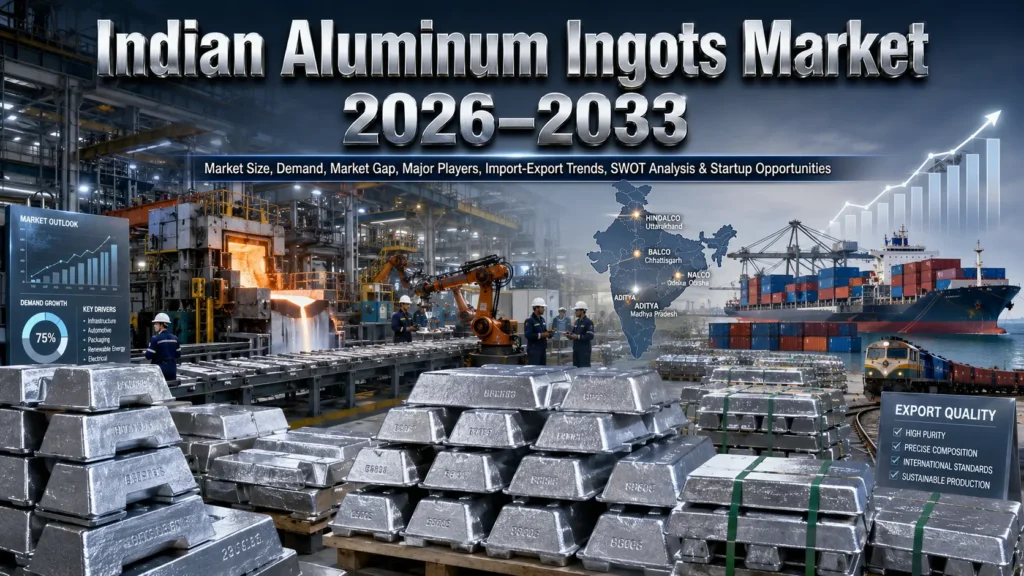
With a market size of USD 15.49 billion, India’s aluminum market is set to be valued at USD 25 billion by 2030 growing at a CAGR of ~7.8%. The primary production capacity stands at 4.1-4.2 million tonnes per annum and the domestic demand remains around 4.5 million tonnes per annum thus giving indications of growing demand outstripping the production growth, primarily driven by the downstream ingot consuming sectors.
Executive Overview: Why Aluminum Ingots Demand a Closer Look
Aluminum ingots are at the heart of India’s most promising industrial aspirations. Where they go, they are the feedstock that enters automotive die-casting workshops, power cable factories, curtain-wall factories in the construction industry, packaging factories, and now, with growing urgency, they enter the electric vehicle supply chain. Each and every structural aluminium window frame, each and every EV battery housing, each and every ACSR power conductor, and each and every beverage can starts its manufacturing life as a cast ingot. It’s not just an academic pursuit—it’s a business imperative for anyone looking to embark on a manufacturing journey in India’s booming metal landscape.
India finds itself in a very peculiar scenario in the aluminium value chain. It is the second largest primary aluminium producer in the world with production contributing nearly 6% of the world production. However, India is also one of the major importers of aluminium products. This dichotomy of high production capability coupled with increased import reliance in certain downstream areas, is an indication of structural gap that can be filled up by an entrepreneurial investor with a well-planned manufacturing unit.
Data recorded by Aluminium Association of India shows that the nation has about 3.29 billion tonnes of bauxite reserves, making it one of the world’s largest bauxite reserves. Based on this resource base, the future supply of raw material for domestic aluminum ingot manufacturers is more secure than in most competitors’ economies.
Market Size, Growth Trajectory, and Forecast 2026–2033
The India aluminium market was valued at USD 15.49 billion in volume terms of around 6,626 thousand metric tonnes. Independent market forecasts determine that the market will clearly grow to USD 25.03 billion by 2030 at a CAGR of 7.81%, while the volume will exceed 10,200 thousand metric tonnes by 2030. The cumulative growth pattern is also quite attractive over the long forecast period to 2033.
All forms of aluminium product—rolled sheet, extrusions, foils and ingots are included. But the base product from which all other aluminum products are derived is aluminum ingots. The global aluminum ingots market size is estimated to be more than USD 154 billion in 2023 and is expected to reach USD 205 billion by 2033 with a CAGR of 3.1%. The Indian share is growing very fast in this global market, fuelled by the combined forces of growth of domestic demand and participation in export markets for the downstream products.
The global aluminum ingots market was segmented on the basis of the source of their production into primary ingots and secondary ingots, with primary ingots constituting about 62% share of the market by volume. Secondary ingots – made from recycled aluminium scrap – are expanding even more rapidly at 5.32% CAGR, as the world moves towards the principles of a circular economy and the economics of recycling, which uses 95-98% less energy when compared to primary smelting.
Get Detailed Project Report (DPR): Complete Aluminium Manufacturing Guide
Key Market Indicators: India Aluminum Ingots Sector
| Indicator | Data Point |
| India Aluminum Market Value (Current) | USD 15.49 Billion |
| Projected Market Value (2030) | USD 25.03 Billion |
| Market CAGR (2025–2030) | ~7.81% |
| Primary Aluminum Production (Annual) | 4.1–4.2 Million Tonnes |
| Domestic Consumption | ~4.5 Million Tonnes per annum |
| India’s Global Production Share | Approx. 6% of World Output |
| Aluminium Ingot Imports (Alloyed, 2024) | ~240,000 Tonnes (45% surge YoY) |
| Secondary Aluminum Market CAGR | 5.32% (Global); 8.5% India Cast Alloys |
| India’s Aluminum Export Value | USD 7.25 Billion (COMTRADE) |
| India’s Aluminum Import Value | USD 7.67 Billion (COMTRADE) |
Demand–Supply Gap: The Core Business Opportunity
DEMAND–SUPPLY GAP HIGHLIGHT
In India, consumption of primary aluminium was 4.5 million tonnes while production was 4.15 million tonnes. The import of alloyed ingots grew by 45% in one year to 240,000 tonnes. This domestic demand of the unmet part is especially for secondary alloy ingots used in the die casting of automobiles, which are the most obvious sign of investment in the Indian non-ferrous metals market.
The demand-supply imbalance in Indian aluminium ingots does not exist in isolation, but rather at two different levels. India has 4.15 million tonnes of production of primary ingots, which is more than the country directly absorbs; a large number of primary ingots and unwrought aluminium are exported. But at the secondary and alloy ingot level, the local supply is so low that it is inadequate.
According to Big Mint data, and as reported by Al Circle, in just one month, India imported 38,700 tonnes of aluminium ingots, which is 70% higher than the previous year’s figure. The surge on the imports is almost entirely due to the automotive die-casting business, with particular emphasis on the ADC12 and A356 alloy ingots, which are used for EV battery enclosures, suspension components, engine blocks and transmission housings.
Some 1.2 million tonnes of aluminum were used in India for automotive applications in a year, and this demand has been rising drastically because of increased electrification of vehicles. EVs consume as much as 250 kg of aluminum per unit, whereas conventional internal combustion engine vehicles only require 150 kg of aluminum per unit. The demand curve of secondary aluminium alloy ingots is practically vertical in India, where the adoption of electric vehicles is expected to hit 30% mark by 2030.
This leaves a textbook disparity between supply and demand for entrepreneurs to deal with: there is a big demand for Indian-made alloy ingots of consistent specification from domestic OEMs die-casters and component manufacturers, but there is not a corresponding growth in secondary smelter capacity in India. The outcome is importing dependence: a signal for the market which identifies the need for new manufacturing capacity and its commercial viability.
SWOT Analysis: Indian Aluminum Ingots Sector
Strengths
India has the 5th largest bauxite reserves in the world (3.29 billion tonnes) which provides raw material security for primary ingot producers. This is the result of a well-established smelting and refining industry in the country, comprising integrated producers who have their own power plants and alumina refineries. Processing operations in India are more economically viable than in the western economies due to the advantages offered by the low labour cost.
There is a vibrant MSME ecosystem of secondary aluminium processors that are concentrated in NCR, auto belt of Maharashtra and Tamil Nadu, Gujarat that can provide an existing industrial base for expansion. Additionally, India is also gaining from the cancellation of export tax rebates for aluminium by China in December 2024, bolstering its competitive edge for aluminium exporters.
Weaknesses
The structural weakness is still the energy intensity. The primary aluminum smelting consumes 14 to 15 MW-hr per tonne of aluminum, and India uses coal-based captive power, which adds to the cost and carbon footprint. The secondary smelter segment is highly reliant on imported aluminum scrap, with a lower rate of aluminum scrap collection, and infrastructure, than are found internationally. The recycling rate for aluminium in India is around 25% which is far less than the global recycling rate, thereby reducing the availability of feed stocks for the secondary ingot producers. Small, unorganized units facing high OEM standards are still facing problems with the quality of recycled ingot production.
Get Detailed Insights from This Book: The Complete Technology Book on Aluminium and Aluminium Products
Opportunities
The biggest demand growth opportunity in the near term is the electrification of India’s vehicle fleet. The automobile usage of secondary aluminum alloys is expected to expand at a CAGR of 8.5% till 2032. Policy tailwinds also support: The Government of India’s Make in India initiative actively promotes aluminum downstream manufacturing and import substitution. The National Infrastructure Pipeline, which has an estimated investment of ₹111 lakh crores, is a demand multiplier for construction grade ingots. Further, China’s decision to do away with export rebates for aluminum has opened up export markets for ingot producers in India for Japan, EU and the Southeast Asian region.
Threats
The risk of scrap price volatility is the greatest for secondary ingot manufacturers because price changes for the input directly reduce margins. The Aluminium and Aluminium Alloy Products (Quality Control) Order, 2025 is a short-term compliance cost for micro and small businesses, as there are 17 categories that require compliance with the BIS Standard Mark. Strict new controls on smelter pollutant discharges and waste disposal will increase the cost of supporting the operation of existing facilities that use coal. Last, but not least, is the currency risk exposure of importers from the Middle East, Southeast Asia and the US for scrap aluminum.
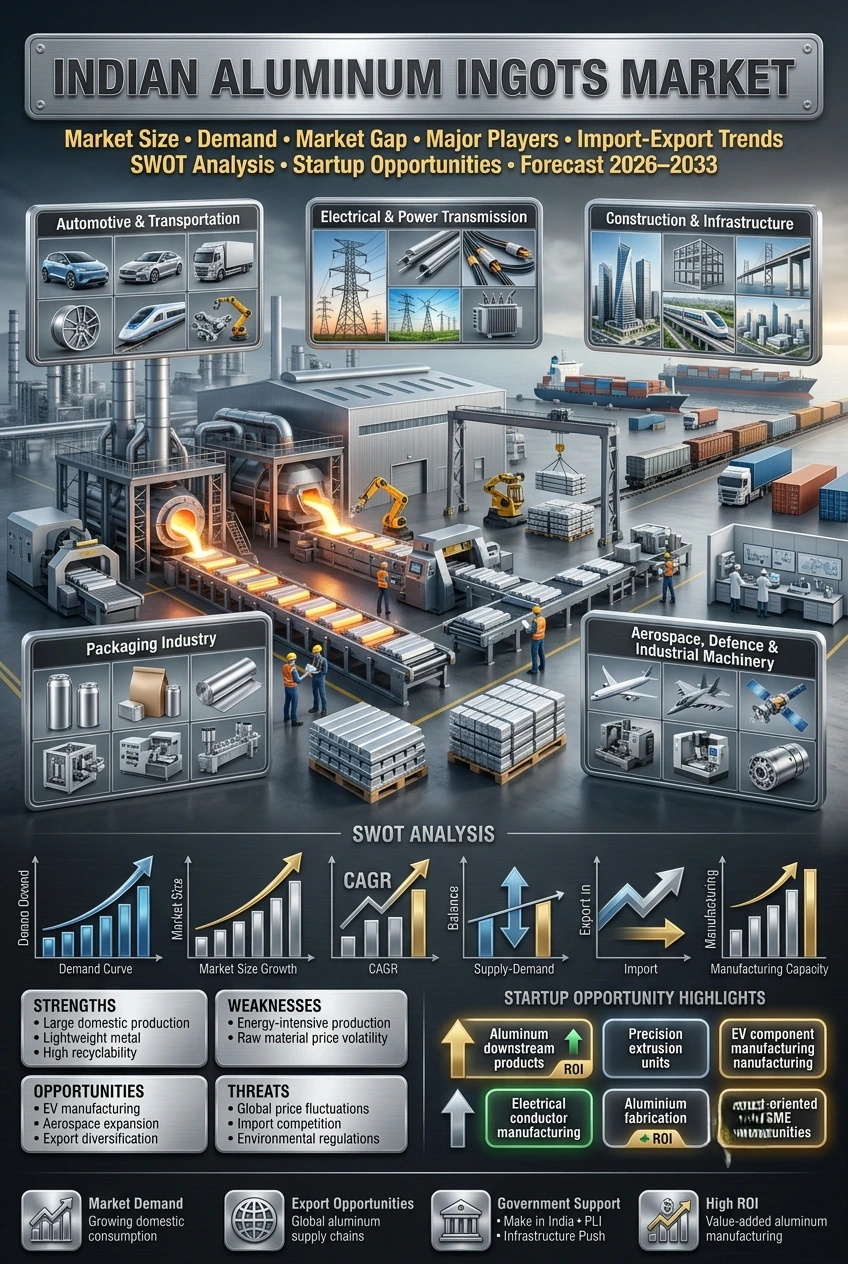
Application-Wise Analysis: Where Indian Aluminum Ingots Are Consumed
1 Automotive and Transportation (Largest and Fastest-Growing Segment)
Aluminum is primarily consumed by the automotive sector which uses around 45% of all of the second alloy ingot produced in the country. The secondary alloy ingots with the specific composition are essential for the production of aluminum parts such as engine components, gear housings, wheels and structural components by die casting. India has forecast to produce 35 million vehicles by 2025 according to Society of Indian Automobile Manufacturers (SIAM), and providing structural support to the demand of automotive grade ingot”, mentioned a company source, “Also EV production acts as a further boost. As each two, three and four-wheeler EV produced require aluminum-rich battery house, motor house and chassis structure that are all manufactured through cast aluminum alloy ingots.
2 Electrical and Power Transmission
When considering all products, the electrical industry consumes about 48% of the total aluminum consumption in India, which is the largest of any one sector. Commercial high-purity primary ingots are used to produce aluminum conductor steel-reinforced (ACSR) cables, busbar and transformer windings. In India’s fast-track transition towards renewable energy, the demand for aluminum has skyrocketed in solar mounting structures, transmission lines, and grid systems.The increased consumption of aluminum in solar mounting systems, transmission lines, and the grid infrastructure has been an additional demand in the rapidly progressing renewable energy deployment in India. A major pull demand for electrical grade aluminium arises from government infrastructure expenditure in a single fiscal year which touches ₹10 lakh crore.
3 Construction and Infrastructure
Construction industry uses about 40% of all the aluminum and more than 34% of the world’s aluminum ingot end-use. This is equivalent to demand for aluminum extrusion billets and ingots for window-frame, door-profile, curtain-wall, roof-sheet, cladding-panel and structure applications in India. The rate of urbanization is increasing with more than 600 million Indians expected to be living in urban areas by 2031 and a corresponding surge in construction-related demand for aluminum. This is a huge housing and urban infrastructure investment pipeline that is directly linked to the Smart Cities Mission, AMRUT 2.0 and PM Awaas Yojana.
4 Packaging
Commercial grade aluminum rolling ingots are the main raw materials used in packaging, which includes beverage cans, pharmaceutical blister packs, flexible packaging foils and food containers. This consumption base is growing with the rapid expansion of FMCG, pharmaceutical and food processing industries in India. The aluminium beverage can segment is experiencing a fast expansion pace, and the global compaction rate of cans is reaching 75%, which will also benefit the production of secondary ingots in India based on scrap.
5 Aerospace, Defence, and Industrial Machinery
The aerospace and defence manufacturing base is growing in India and uses high purity ingots and special grades of alloys. With the rising procurement by DRDO and HAL as well as the private sector’s emerging aerospace cluster around Bangalore, Hyderabad and Pune, the domestic defence and aerospace aluminium market is expanding.
Import–Export Trends: A Dual-Role Economy
India has a very unique dualistic position in the global aluminium trade. As per UN COMTRADE data accessed via Trading Economics, India is one of the world’s largest exporters and importers of aluminum products with annual aluminum export worth of USD 7.25 billion and imports worth of USD 7.67 billion. This looks like a paradox, but is indeed a reality of the Indian structure: India imports a huge amount of primary aluminium and semi-fabricated products from Japan, China, Bangladesh, the US, Germany, and the Netherlands, and exports fabricated and alloy-specific products, which it has not yet been able to produce competitively and at the required quality.
The import side reveals the most commercially significant intelligence. Alloyed ingot imports—particularly ADC12 die-casting alloy ingots used by the automotive industry—recorded a 45% surge to approximately 240,000 tonnes. ADC12 accounted for a significant portion of this, with A356 alloy (used for structural automotive castings) making up the balance. These imports arrive primarily from the UAE, Malaysia, and Qatar. The key insight is that India’s automobile OEMs and their tier-1 die-casters are willing to pay international prices for imported alloy ingots because the domestic supply of quality-consistent secondary alloy ingots is insufficient.
India leads the world in aluminum product export shipments, with over 114,000 shipments documented. However, the export mix is shifting from commodity-grade primary aluminum toward value-added downstream products—extruded profiles, cable conductors, rolled sheets, and fabricated components. This is a healthy structural evolution, but it also means that the domestic market for primary and secondary ingots remains robust, as the downstream conversion industry expands.
Identify high-growth industries before others do
Regional Analysis: Where the Industry is Concentrated
Odisha and Jharkhand — The Primary Production Belt
Odisha has the epicentre of the country’s main aluminum production with integrated operations of Vedanta Aluminium at Jharsuguda and Lanjigarh (home to one of Asia’s biggest alumina refineries) and NALCO at Damanjodi and Angul. The state is responsible for 90% of India’s primary ingots production. Hindalco has operations in Hindalco bauxite mines in Jharkhand with 27 mines. The belt enjoys captive bauxite mining, the use of coal based captive power, and logistics connectivity.
Chhattisgarh — BALCO’s Domain
BALCO has an installed capacity of 270,000 tonne smelter complex at Korba, Chhattisgarh, with a 1200 MW captive power plant. The region has a robust secondary processing base around the primary smelter, and is an important primary and secondary aluminum ingot production centre.
Gujarat — The Secondary Ingot Powerhouse
India’s largest cluster for secondary aluminum alloy ingot productions is located in Gujarat. In the Ahmedabad-Bhavnagar-Sanand region, hundreds of small and medium secondary aluminum smelters are working to convert dross from the local industry and imported aluminum scrap into alloy ingots for the automotive industry. Gujarat-based units have a logistics edge when it comes to importing scrap and exporting finished ingots as they have access to major ports, such as JNPT, Mundra and Pipavav. Gujarat is also the benchmark region of India for pricing the secondary alloy ingots.
NCR and Maharashtra — Auto-Driven Demand Centres
The dense network of auto component MSMEs in Gurgaon, Faridabad and Manesar with an abundance of aluminum scrap processors and secondary ingot distributors in the National Capital Region (Delhi-NCR) make it the largest region in the country for processing of aluminum scrap and supplying secondary ingots. The Pune-Nashik-Aurangabad route is important for the automotive consumption of alloy ingots with Hindalco, Nagpur, being an important supplier in the region.
Tamil Nadu and Andhra Pradesh — Southern Automotive Cluster
Industry analysts believe that this automotive dominance has been a boon for the alloy ingots market in Chennai, which is a key manufacturing hub in India.This dominance of the automotive industry has been beneficial for the automotive OEMs and tier-1 suppliers in the form of alloy ingots in Chennai which is one of the key automotive manufacturing hubs in India. Southern market currently lacks sufficient supply of secondary ingots, and is a real opportunity for new manufacturing units.
Major Indian Players: Organised Sector Landscape
MAJOR INDIAN PLAYERS
Primary production is mostly accounted for by Vedanta Aluminium, Hindalco Industries and NALCO. Secondary ingots include CMR Green Technologies, which is at the forefront in terms of production capacity with a fragmented MSME ecosystem covering 60% of the segment volumes.
| Company | Segment | Key Capacity/Focus | Location |
| Vedanta Aluminium Ltd. | Primary Ingots | 2.4 MTPA (Vedanta + BALCO combined); largest Indian primary producer | Jharsuguda (Odisha), Korba (Chhattisgarh) |
| Hindalco Industries Ltd. | Primary & Downstream Ingots | Over 1.3 MTPA primary; global leader in rolled products via Novelis | Renukoot (UP), Nagpur (MH), Odisha |
| NALCO (Govt. of India) | Primary Ingots | 4.60 lakh TPA smelter; Navratna PSU | Angul (Odisha) |
| BALCO (Vedanta subsidiary) | Primary + Alloy Ingots | 270,000 TPA smelter; specializes in alloy ingots for auto & aerospace | Korba (Chhattisgarh) |
| CMR Green Technologies Ltd. | Secondary Alloy Ingots | Largest private secondary ingot producer in India; JV with Japan’s Nippon Light Metal | Pan-India |
| Jindal Aluminium Ltd. | Extrusion Billets & Ingots | Leading extruder and billet producer | Bengaluru (Karnataka) |
The key fact that is to be noted for those entering the market is that about 60% of the volume of secondary alloy ingots in India is produced by unorganized or semi-organized MSMEs whose capacity ranges are between 400 and 5,000 tonnes of ingots per month. These units are servicing local clusters of auto-components but are suffering from issues of quality consistency, scrap procurement and BIS compliance – just the areas that can be exploited by a technically sound and organised start-up to gain OEM approvals and premium pricing.
Government Policy Framework and Regulatory Environment
Government of India has created a conducive policy framework for the investment in the aluminum industry. The National Mineral Policy of the Ministry of Mines is supportive of the raw material processing in the country to minimize raw material exports and localize the value addition. Import substitution is encouraged in the Aatmanirbhar Bharat, which is what new secondary ingot manufacturing units have achieved by substituting imported ADC12 and A356 ingots.
The ownership of a manufacturing unit is accessible to the first-generation entrepreneur as CGTMSE, a fund for the Ministry of MSME offers loans without any collateral. PLI scheme, while focused on manufacturing specialty steel and advanced battery, will indirectly increase demand for aluminum ingots given aluminum is used as a key input by those who fall under the PLI ambit of EVs, electronics, white goods etc.
This is a significant milestone for the market, as Aluminium and Aluminium Alloy Products (Quality Control) Order, 2025 has made BIS Standard Mark essential for 17 different categories of aluminum products. Though it imposes short-term compliance costs, it acts as a quality assurance buffer, works in favor of organized manufacturers and investment ready, and against the unorganized sector, as they are unable to meet the BIS standards and thus unable to access the OEM suppliers lists.
The Aluminium Association of India (AAI) has recommended to increase import duties on aluminum primary and secondary from 7.5% to 10%, if the levy is imposed, it would benefit the economics of the manufacturing of secondary ingots compared to the competitive imports. The DPIIT portal for investment facilitation offers a single window access to manufacturing approval and application for incentives.
Related Article: Aluminum and Chitin: The Ultimate Startup Guide for Next-Gen Sustainable Food Packaging
Startup and MSME Investment Opportunity Analysis
STARTUP OPPORTUNITY INSIGHT
The secondary aluminum alloy ingot industry, especially ADC12 and A356 grades used in the automotive industry in die casting, is a commercially proven and an import substitution industry that offers gross margin of 15-25%. Entry level plantation can be done at as low investment as ₹2-5 crore (micro scale) with scalable expansion possibilities. With the proper investment in metallurgical and quality management, OEM approvals can be obtained in 12–18 months after commissioning from automotive customers.
Why Entrepreneurs Should Enter This Sector Now
There are three independent reasons for the timing of new market entry into aluminum ingot production being quite advantageous. Firstly, the alloy ingot section is one of the most import-dependent segments and auto-component die-casters are actively exploring domestic materials to eliminate lead time, currency risk and logistics costs. Secondly, China’s elimination of export rebates on aluminum products has led to a global price adjustment, making Indian secondary ingots, which are manufactured using cheaper domestic scrap, competitive in the export markets, especially for shipments to Japan, EU and the Southeast countries.
Third, the secondary aluminium recycling industry is under-invested. However, the country’s recycling rate of 25% is much lower than the average for the world of more than 60%, highlighting the amount of recoverable aluminum scrap being exported in raw form or landfilled from construction demolition, automotive end-of-life, cable waste, and consumer durables. A startup that develops scrap aggregation networks at the same time as the secondary smelting plant is essentially “backward integrated” into the raw material, which avoids the price fluctuations experienced by import-dependent smelting plants.
Recommended Business Models for Startups
- Medium scale plant (1,000-5,000 TPA) for medium scale automotive die casting clusters especially the local ones, BIS certification as a differentiator.
- Aluminum Scrap Processing and Re-Melt Unit: Low entry price unit for sorting, cleaning and producing remelt ingot for smaller foundries.
- Higher margins, smaller volumes: High Quality Ingot Manufacturing for Special applications in Aerospace, Defence, LED lighting and Solar panels.
- Integrated Scrap Collection to Ingot: Backward integration into scrap aggregation with a secondary smelter, giving an advantage in the supply of raw materials.
- Automotive components, especially those destined for Japanese and European automotive purchasers who are actively looking for non-China suppliers in the field of aluminum alloy ingots, are considered to be the main products of the export-oriented ADC12 manufacturing process.
Techno-Economic Feasibility Snapshot for New Entrants
| Parameter | Micro/Small Unit | Medium-Scale Unit |
| Annual Capacity | 500–1,500 TPA | 3,000–10,000 TPA |
| Estimated Capital Investment | ₹2–8 Crore | ₹15–50 Crore |
| Key Equipment | Reverberatory/Rotary Furnace, Casting Machine, Dross Press | Multiple furnaces, Automated casting line, Spectrometer lab |
| Raw Material | Domestic scrap, dross, imported scrap | Balanced mix; scrap aggregation network |
| Gross Margin Range | 15–20% | 18–25% |
| Payback Period | 3–5 Years | 4–6 Years |
| Target Market | Local auto-component foundries | Tier-1 OEM suppliers, export buyers |
| Key Certification | BIS (mandatory from 2025/2026) | BIS + IATF 16949 for OEM approvals |
Energy cost management is the most critical operational variable. A well-maintained reverberatory or rotary furnace used by secondary aluminum smelter requires between 400 and 700 kWh per tonne of ingot produced. This is considerably lower than primary smelting, which requires between 14,000 and 15,000 kWh per tonne. Smelters located in Gujarat and Maharashtra have industrial electricity at competitive prices or have the availability of renewable power sources, making energy cost per tonne of secondary ingot well within affordable commercial limits.
Frequently Asked Questions (FAQ)
Q1. What is the difference between primary and secondary aluminum ingots?
High-quality aluminium ingots 99.5% min can be produced directly from bauxite. It involves mining of bauxite, refining it into alumina, then to primary aluminum by electrolytic method. The ingots with its excellent strength, electrical conductivity is widely used forpower cables, aerospace parts, etc. Secondary aluminum ingots are produced by melting and re-alloying aluminum scrap—from end-of-life vehicles, construction demolition, cable waste, and consumer durables. Secondary ingots are primarily alloy grades (ADC12, A356, LM-series) optimized for die casting and foundry applications. Secondary production consumes 95–98% less energy than primary and has significantly lower capital cost of entry.
Q2. Is India importing or exporting aluminum ingots?
Both. India’s exports of primary and fabricated (cables, extrusions, rolled products) aluminum products are of the value of 7.25 billion dollars each year. Conversely India’s imports of aluminum products amount to 7.67 billion dollars-the major portion being the import of alloy ingots (ADC12, A356), high grade rolled products and specialty foils. The net import position in secondary alloy ingots represents the central business opportunity for domestic manufacturers.
Q3. What are the key regulations a new aluminum ingot manufacturer must comply with?
The latest important piece of news is the Aluminium and Aluminium Alloy Products (Quality Control) Order, 2025, which mandates BIS Standard Mark certification on 17 product categories. These manufacturers have till Jan 2026 for SMEs, April 2026 for micro and then the rest of the product segments have longer time lines till June 2026. Manufacturers also need pollution control board (PCB) clearances for their smelter operations, GST registration and for better terms on finance need a Udyam Registration by the MSME ministry.
Export-oriented units will additionally need an Import Export Code (IEC) from the DGFT and may require other quality certifications from the buyer such as an IATF 16949 if they intend to become a supplier to automotive OEM manufacturers.
Q4. How can a first-generation entrepreneur finance an aluminum ingot plant?
There are a multitude of institutional financing options: CGTMSE offers unsecured loans up to Rs 2 crore to micro and small enterprises without personal guarantees; SIDBI (Small Industries Development Bank of India) offers term loans to build manufacturing capacity; state industrial development corporations (SIDCs) offers land in industrial parks with subsidised lease terms; MUDRA loans help to finance working capital for very early-stage micro units; to get equity, Startup India and startup programmes accredited by DPIIT give exposure to investor networks and angel funding. A detailed DPR or Techno-Economic Feasibility report is vital for lending agencies.
Q5. What are the export markets for Indian aluminum alloy ingots?
Indian exporters report Japanese auto part manufacturers sourcing huge volumes of Indian ADC12 alloy ingots to bypass the current manufacturing supply chains based out of South-East Asia, making Japan their biggest export destination for ADC12. Other significant export destinations include Bangladesh, the United Arab Emirates, and European automotive casting clusters. With China’s removal of export tax rebates on aluminum (effective December 2024), Indian exporters are competing more aggressively in global markets, particularly for automotive-grade alloy ingots. Secondary alloy ingots are being exported at USD 2,400–2,500 per tonne to Japanese buyers. The US, while currently having a 10% duty structure that limits direct impact, remains a long-term growth market for Indian aluminum product exports.
Q6. Which region in India is best for setting up a new secondary aluminum ingot plant?
Gujarat remains the chosen destination for secondary alloy ingot production given the access to ports for bringing in scrap, proximity to numerous auto-component consumers and existing industrial ecosystem (Ahmedabad-Sanand-Bhavnagar belt). Similar to this, Maharashtra’s Pune-Nashik belt would be a more suitable region for automobile-grade ingot makers who would be nearer to the end (OEM and tier-1) consumers. For export-oriented entities, proximity to major ports is the critical aspect. Odisha and Chhattisgarh could be suitable options for units targeting availability of primary aluminum and dross as input feedstock.
How NPCS Can Support Your Aluminum Ingots Manufacturing Project
Niir Project Consultancy Services (NPCS) is an industrially leading Indian consults and have prepared around three decades of Experience Market Survey cum Detailed Techno-Economic Feasibility Reports (DPRs) on various projects of Manufacturing sector projects such as of non-ferrous metals, chemicals, food processing, and engineering projects.
For an aluminum ingots manufacturing project, NPCS prepares a comprehensive DPR covering:
- Detailed manufacturing process: Step-by-step flowcharts (PFD/BFD) for both primary and secondary ingot production, covering raw material processing, furnace selection, fluxing and de-gassing, casting, and quality testing
- Market research and demand analysis: Sector-specific consumption data, import-export dependency mapping, OEM demand projections, and price trend analysis for target alloy grades
- Product mix and capacity planning: Optimized capacity recommendations based on regional demand, scrap availability, and customer segment targeting
- Machinery and raw material specifications: Equipment sourcing guidance for furnaces, casting machines, spectrometers, and allied plant utilities
- Import–export dependency analysis: Identification of the most viable alloy grades for import substitution and/or export market positioning
- Project financials and profitability evaluation: Capital cost estimation, working capital assessment, revenue projections, IRR and NPV calculations, and sensitivity analysis
NPCS consulting reports are designed to serve as the primary document for bank loan applications, investor presentations, and business plan finalization. The firm seeks to assist entrepreneurs in their decision to invest capital into a venture on the back of well-founded estimates around technical feasibility, financial feasibility, market demand, and scalability.
NPCS is offering a ready-to-use, authoritative project analysis, bridging the gap for an entrepreneur seeking the aluminum ingots making opportunity between public interest and making ready decision to Invest in it. Visit www.niir.org to explore available project reports and consulting services.
References and Authoritative Sources
- Aluminium Association of India (AAI) — Industry Data and Bauxite Reserve Statistics
- Ministry of Mines, Government of India — National Mineral Policy and Aluminum Sector Directives
- Society of Indian Automobile Manufacturers (SIAM) — Vehicle Production and Demand Statistics
- UN COMTRADE / Trading Economics — India Aluminum Import & Export Value Data
- Department for Promotion of Industry and Internal Trade (DPIIT) — Investment Facilitation and PLI Framework
- SEAISI — India’s Primary Aluminium Production and Consumption Growth Data