
Indian Aluminum Ingots: Market Size, Demand, Market Gap, Major Players, Import-Export Trends & SWOT Analysis, Startup Opportunities and Forecast 2026–2033
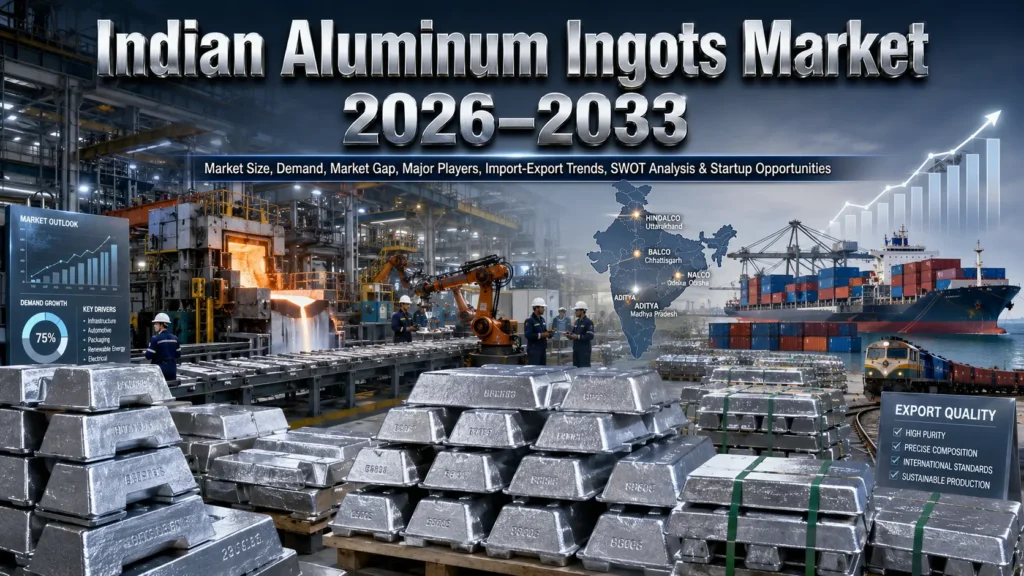
Aluminium Ingots Manufacturing Business MARKET INSIGHT With a market size of USD 15.49 billion, India’s aluminum market is set to be valued at USD 25 billion by 2030 growing at a CAGR of ~7.8%. The primary production capacity stands at 4.1-4.2 million tonnes per annum and the domestic demand remains around 4.5 million tonnes per annum thus giving indications of growing demand outstripping the production growth, primarily driven by the downstream ingot consuming sectors. Executive Overview: Why Aluminum Ingots Demand a Closer Look Aluminum ingots are at the heart of India’s most promising industrial aspirations. Where they go, they are the feedstock that enters automotive die-casting workshops, power cable factories, curtain-wall factories in the construction industry, packaging factories, and now, with growing urgency, they enter the electric vehicle supply chain. Each and every structural aluminium window frame, each and every EV battery housing, each and every ACSR power conductor, and each and every beverage can starts its manufacturing life as a cast ingot. It’s not just an academic pursuit—it’s a business imperative for anyone looking to embark on a manufacturing journey in India’s booming metal landscape. India finds itself in a very peculiar scenario in the aluminium value chain. It is the second largest primary aluminium producer in the world with production contributing nearly 6% of the world production. However, India is also one of the major importers of aluminium products. This dichotomy of high production capability coupled with increased import reliance in certain downstream areas, is an indication of structural gap that can be filled up by an entrepreneurial investor with a well-planned manufacturing unit. Data recorded by Aluminium Association of India shows that the nation has about 3.29 billion tonnes of bauxite reserves, making it one of the world’s largest bauxite reserves. Based on this resource base, the future supply of raw material for domestic aluminum ingot manufacturers is more secure than in most competitors’ economies. Market Size, Growth Trajectory, and Forecast 2026–2033 The India aluminium market was valued at USD 15.49 billion in volume terms of around 6,626 thousand metric tonnes. Independent market forecasts determine that the market will clearly grow to USD 25.03 billion by 2030 at a CAGR of 7.81%, while the volume will exceed 10,200 thousand metric tonnes by 2030. The cumulative growth pattern is also quite attractive over the long forecast period to 2033. All forms of aluminium product—rolled sheet, extrusions, foils and ingots are included. But the base product from which all other aluminum products are derived is aluminum ingots. The global aluminum ingots market size is estimated to be more than USD 154 billion in 2023 and is expected to reach USD 205 billion by 2033 with a CAGR of 3.1%. The Indian share is growing very fast in this global market, fuelled by the combined forces of growth of domestic demand and participation in export markets for the downstream products. The global aluminum ingots market was segmented on the basis of the source of their production into primary ingots and secondary ingots, with primary ingots constituting about 62% share of the market by volume. Secondary ingots – made from recycled aluminium scrap – are expanding even more rapidly at 5.32% CAGR, as the world moves towards the principles of a circular economy and the economics of recycling, which uses 95-98% less energy when compared to primary smelting. Get Detailed Project Report (DPR): Complete Aluminium Manufacturing Guide Key Market Indicators: India Aluminum Ingots Sector Indicator Data Point India Aluminum Market Value (Current) USD 15.49 Billion Projected Market Value (2030) USD 25.03 Billion Market CAGR (2025–2030) ~7.81% Primary Aluminum Production (Annual) 4.1–4.2 Million Tonnes Domestic Consumption ~4.5 Million Tonnes per annum India’s Global Production Share Approx. 6% of World Output Aluminium Ingot Imports (Alloyed, 2024) ~240,000 Tonnes (45% surge YoY) Secondary Aluminum Market CAGR 5.32% (Global); 8.5% India Cast Alloys India’s Aluminum Export Value USD 7.25 Billion (COMTRADE) India’s Aluminum Import Value USD 7.67 Billion (COMTRADE) Demand–Supply Gap: The Core Business Opportunity DEMAND–SUPPLY GAP HIGHLIGHT In India, consumption of primary aluminium was 4.5 million tonnes while production was 4.15 million tonnes. The import of alloyed ingots grew by 45% in one year to 240,000 tonnes. This domestic demand of the unmet part is especially for secondary alloy ingots used in the die casting of automobiles, which are the most obvious sign of investment in the Indian non-ferrous metals market. The demand-supply imbalance in Indian aluminium ingots does not exist in isolation, but rather at two different levels. India has 4.15 million tonnes of production of primary ingots, which is more than the country directly absorbs; a large number of primary ingots and unwrought aluminium are exported. But at the secondary and alloy ingot level, the local supply is so low that it is inadequate. According to Big Mint data, and as reported by Al Circle, in just one month, India imported 38,700 tonnes of aluminium ingots, which is 70% higher than the previous year’s figure. The surge on the imports is almost entirely due to the automotive die-casting business, with particular emphasis on the ADC12 and A356 alloy ingots, which are used for EV battery enclosures, suspension components, engine blocks and transmission housings. Some 1.2 million tonnes of aluminum were used in India for automotive applications in a year, and this demand has been rising drastically because of increased electrification of vehicles. EVs consume as much as 250 kg of aluminum per unit, whereas conventional internal combustion engine vehicles only require 150 kg of aluminum per unit. The demand curve of secondary aluminium alloy ingots is practically vertical in India, where the adoption of electric vehicles is expected to hit 30% mark by 2030. This leaves a textbook disparity between supply and demand for entrepreneurs to deal with: there is a big demand for Indian-made alloy ingots of consistent specification from domestic OEMs die-casters and component manufacturers, but there is not a corresponding growth in secondary smelter capacity in India. The outcome is importing dependence: a signal for the market which
India Cargo Shipping Containers Market 2026–2033: SWOT Analysis, Demand-Supply Gap, Startup Opportunities & Government Incentives
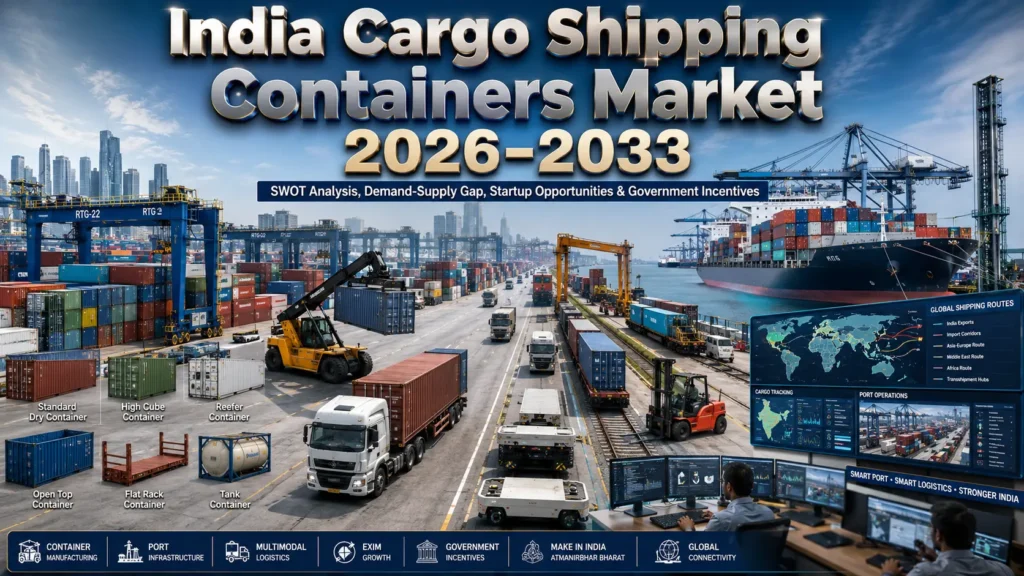
India Cargo Shipping Containers Market The India cargo shipping containers market is estimated to be valued at USD 20.5 billion and is projected to reach USD 31 billion by 2033 at a CAGR of 4.7%. The current annual handling capacity of India’s major ports is more than 14 million TEUs which is growing at 8–10% annually. Even with this demand scale, Indian exporters have critically low dependence on external sources if the amount of over 95% dry shipping containers used by Indian exporters has to be considered. If the amount of dry shipping containers used by Indian exporters is taken into consideration, then Indian exporters are critically dependent on external sources with an over 95% dependence rate. Domestic container production in India is close to zero and annually, there is a throughput demand of 14 million TEUs. Almost all dry freight containers are imported from China. Indian exporters faced freight rates up to 3-5 times higher, and even waited for weeks for containers in recent times of freight disruptions around the world. This structural deficiency has been reflected in Budget 2026 via the ₹10,000 crore Container Manufacturing Assistance Scheme (CMAS) – a meagre amount of domestic manufacturing capacity compared to actual demand – in 1 million TEU per year over 10 years. Why Shipping Containers Are the Backbone of India’s Trade Ambitions Talking about India becoming a global manufacturing hub is always accompanied by the words like port, freight corridors and logistics efficiency in New Delhi where the policymakers talk about becoming a manufacturing powerhouse. However, there is one infrastructure that does not get the attention it deserves despite its critical role in India’s trade with the world: The simple steel shipping container. Almost 90 percent of the world’s trade in merchandise goods is conducted by sea, and containers are the standard units of steel that enable this transportation. Availability, cost and origin of shipping containers are not logistics foot-notes in a country like India, where the ports process over 95% of the international trade by volume according to the Ministry of Ports, Shipping and Waterways (MoPSW). It is a national priority issue. This is the paradox of the India cargo shipping containers market: very high demand in a one of the fastest growing trading economies, with virtually all shipping containers coming from China. The market opportunity being analyzed is a paradox: high throughput and no domestic production. Get Detailed Project Report (DPR): Business Ideas for Steel Shipping Container Manufacturing India Cargo Shipping Containers Market: Size, Growth & Forecast 2026–2033 India cargo containers market is estimated to hit USD 20.5 billion by 2021 and is expected to grow at CAGR of 4.7% till 2033. If one focuses only on the shipping container manufacturing and leasing business alone, the market is estimated to be in the range of USD 389 – 403 million and will increase to approximately USD 546 – 563 million during the same period. These numbers, however, only tell part of the story. The far more significant measure is ‘containerized throughput’ – an estimated 14 million TEUs (Twenty-foot Equivalent Units) are handled through Indian ports each year, an increase of 8–10% year-on-year. The highest share is accounted for by JNPT, Mumbai near port and the port at Chennai, Mundra and Kolkata. The growth of deep-water terminals, particularly the Vizhinjam International Seaport in Kerala, reflects India’s plans for much greater volume of containers being processed in the coming decade. The India Brand Equity Foundation (IBEF) (www.ibef.org) has been emphasizing over and over that India’s port and logistics infrastructure is undergoing the most transformational shift since liberalisation, and that the port-led development policy is being given a top priority in the midst of this shift – the Sagarmala Programme. Market Segmentation at a Glance Segment Category Key Observation Market Share By Size 40 Feet Containers Dominant for bulk/industrial goods 57.7% By Size 20 Feet Containers Preferred by SMEs for frequent shipments ~35% By Application Consumer Goods Largest revenue share; urbanization-led Dominant By Application Food & Beverages Fastest growing; reefer container demand Fastest CAGR By Application Industrial Goods / Pharma / Healthcare Growing with export clusters Significant By Region Western India (Mumbai/JNPT/Mundra) Highest container throughput nationally Largest SWOT Analysis: India Cargo Shipping Containers Market Any entrepreneur or investor considering entering this industry will need a good SWOT analysis. The advantages are structural in nature and continuously gaining ground, the disadvantages are largely fixable with capital and policy intervention, the opportunities are among the most alluring found in Indian manufacturing and the threats are real but can be managed through strategic positioning. Strengths As one of the top-ten trading countries in the world, India has an in-built and continuous demand base for containers. The Sagarmala Programme is the country’s port infrastructure modernization initiative which is being implemented at a scale of lakhs of crores. Now, transit time has considerably been reduced through Dedicated Freight Corridors (DFCs) — Eastern and Western corridors — and intermodal container movement is much more economical. Moreover, India boasts a significant steel manufacturing ecosystem with steel producers such as SAIL, Tata Steel and JSW Steel that can provide raw materials at internationally competitive prices for the production of containers. Weaknesses The biggest drawback is the lack of domestic capacity to produce domestic containers. The number of containers that India makes is an insignificant percentage of the containers that it consumes, and more than 96% of the world’s container production is controlled by China. It is a vulnerability of the supply chain that became painfully apparent during the COVID-19 pandemic and subsequent global freight disruption, when Indian exporters paid a freight rate three to five times greater than normal rates and were forced to wait for weeks for shipments because containers were scarce. The industry also does not have a skilled fabrication labor force to assemble high volume of steel containers for marine applications. Opportunities Changing opportunities. In the Union Budget 2026–27, the Government announced a ₹10,000 crore Container Manufacturing Assistance Scheme (CMAS) for five years with a