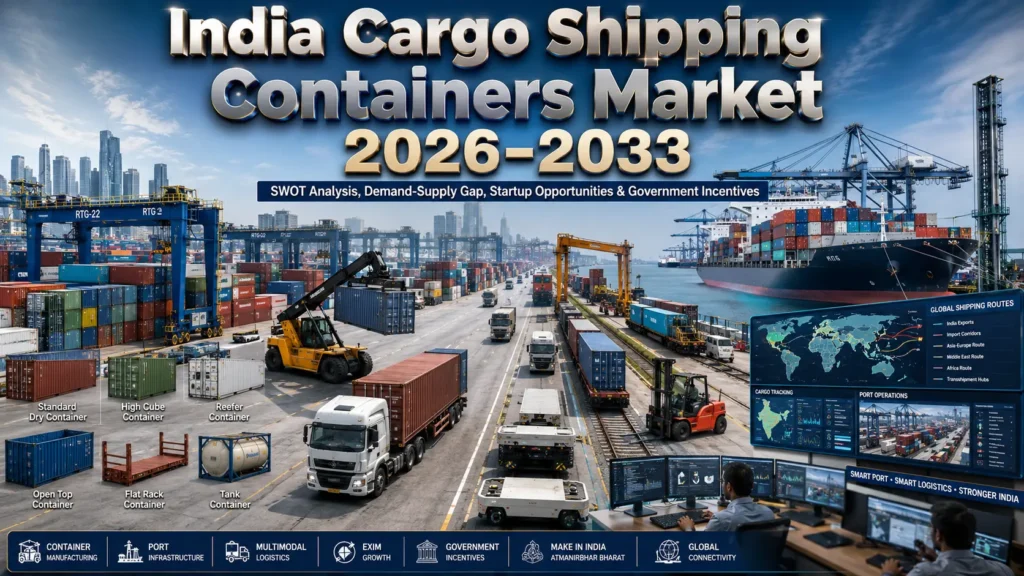

India Cargo Shipping Containers Market
The India cargo shipping containers market is estimated to be valued at USD 20.5 billion and is projected to reach USD 31 billion by 2033 at a CAGR of 4.7%. The current annual handling capacity of India’s major ports is more than 14 million TEUs which is growing at 8–10% annually. Even with this demand scale, Indian exporters have critically low dependence on external sources if the amount of over 95% dry shipping containers used by Indian exporters has to be considered. If the amount of dry shipping containers used by Indian exporters is taken into consideration, then Indian exporters are critically dependent on external sources with an over 95% dependence rate.
Domestic container production in India is close to zero and annually, there is a throughput demand of 14 million TEUs. Almost all dry freight containers are imported from China. Indian exporters faced freight rates up to 3-5 times higher, and even waited for weeks for containers in recent times of freight disruptions around the world. This structural deficiency has been reflected in Budget 2026 via the ₹10,000 crore Container Manufacturing Assistance Scheme (CMAS) – a meagre amount of domestic manufacturing capacity compared to actual demand – in 1 million TEU per year over 10 years.
Why Shipping Containers Are the Backbone of India’s Trade Ambitions
Talking about India becoming a global manufacturing hub is always accompanied by the words like port, freight corridors and logistics efficiency in New Delhi where the policymakers talk about becoming a manufacturing powerhouse. However, there is one infrastructure that does not get the attention it deserves despite its critical role in India’s trade with the world: The simple steel shipping container.
Almost 90 percent of the world’s trade in merchandise goods is conducted by sea, and containers are the standard units of steel that enable this transportation. Availability, cost and origin of shipping containers are not logistics foot-notes in a country like India, where the ports process over 95% of the international trade by volume according to the Ministry of Ports, Shipping and Waterways (MoPSW). It is a national priority issue.
This is the paradox of the India cargo shipping containers market: very high demand in a one of the fastest growing trading economies, with virtually all shipping containers coming from China. The market opportunity being analyzed is a paradox: high throughput and no domestic production.
Get Detailed Project Report (DPR): Business Ideas for Steel Shipping Container Manufacturing
India Cargo Shipping Containers Market: Size, Growth & Forecast 2026–2033
India cargo containers market is estimated to hit USD 20.5 billion by 2021 and is expected to grow at CAGR of 4.7% till 2033. If one focuses only on the shipping container manufacturing and leasing business alone, the market is estimated to be in the range of USD 389 – 403 million and will increase to approximately USD 546 – 563 million during the same period.
These numbers, however, only tell part of the story. The far more significant measure is ‘containerized throughput’ – an estimated 14 million TEUs (Twenty-foot Equivalent Units) are handled through Indian ports each year, an increase of 8–10% year-on-year. The highest share is accounted for by JNPT, Mumbai near port and the port at Chennai, Mundra and Kolkata. The growth of deep-water terminals, particularly the Vizhinjam International Seaport in Kerala, reflects India’s plans for much greater volume of containers being processed in the coming decade.
The India Brand Equity Foundation (IBEF) (www.ibef.org) has been emphasizing over and over that India’s port and logistics infrastructure is undergoing the most transformational shift since liberalisation, and that the port-led development policy is being given a top priority in the midst of this shift – the Sagarmala Programme.
Market Segmentation at a Glance
| Segment | Category | Key Observation | Market Share |
| By Size | 40 Feet Containers | Dominant for bulk/industrial goods | 57.7% |
| By Size | 20 Feet Containers | Preferred by SMEs for frequent shipments | ~35% |
| By Application | Consumer Goods | Largest revenue share; urbanization-led | Dominant |
| By Application | Food & Beverages | Fastest growing; reefer container demand | Fastest CAGR |
| By Application | Industrial Goods / Pharma / Healthcare | Growing with export clusters | Significant |
| By Region | Western India (Mumbai/JNPT/Mundra) | Highest container throughput nationally | Largest |
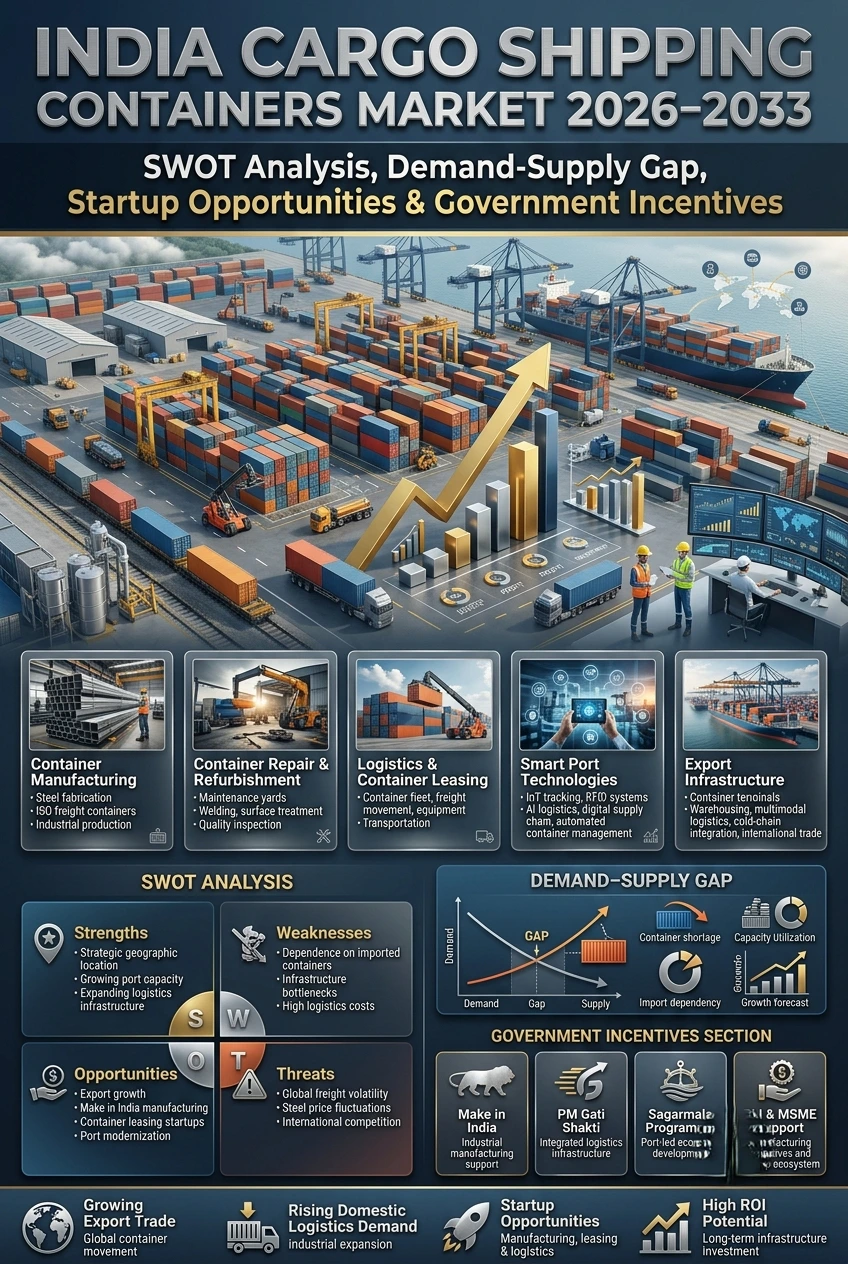
SWOT Analysis: India Cargo Shipping Containers Market
Any entrepreneur or investor considering entering this industry will need a good SWOT analysis. The advantages are structural in nature and continuously gaining ground, the disadvantages are largely fixable with capital and policy intervention, the opportunities are among the most alluring found in Indian manufacturing and the threats are real but can be managed through strategic positioning.
Strengths
As one of the top-ten trading countries in the world, India has an in-built and continuous demand base for containers. The Sagarmala Programme is the country’s port infrastructure modernization initiative which is being implemented at a scale of lakhs of crores. Now, transit time has considerably been reduced through Dedicated Freight Corridors (DFCs) — Eastern and Western corridors — and intermodal container movement is much more economical. Moreover, India boasts a significant steel manufacturing ecosystem with steel producers such as SAIL, Tata Steel and JSW Steel that can provide raw materials at internationally competitive prices for the production of containers.
Weaknesses
The biggest drawback is the lack of domestic capacity to produce domestic containers. The number of containers that India makes is an insignificant percentage of the containers that it consumes, and more than 96% of the world’s container production is controlled by China. It is a vulnerability of the supply chain that became painfully apparent during the COVID-19 pandemic and subsequent global freight disruption, when Indian exporters paid a freight rate three to five times greater than normal rates and were forced to wait for weeks for shipments because containers were scarce. The industry also does not have a skilled fabrication labor force to assemble high volume of steel containers for marine applications.
Opportunities
Changing opportunities. In the Union Budget 2026–27, the Government announced a ₹10,000 crore Container Manufacturing Assistance Scheme (CMAS) for five years with a clear aim of achieving 1 million TEUs of domestic manufacturing capacity in 10 years. The Bharat Container Shipping Line (BCSL), backed by the SCI and CONCOR, as well as the major port authorities has inked an MoU to invest a total of ₹59,000 crore in BCSL and allied domestic container manufacturing.
The BCLS alone is expected to need some one million TEUs for its fleet operations, thus providing a natural customer base for domestic manufacturers. The demand for smaller 20-foot containers for regular SME shipments is also being fuelled by India’s e-commerce industry. The demand for reefer containers is growing rapidly along with the agricultural export growth and expansion of cold chain logistics.
Get Detailed Insights from This Book: Our Books
Threats
Chinese dominance in the manufacture of containers is a fact of life, and has been supported by decades of large-scale production, the training of a skilled labor force and the vertically linked supply chains that keep Chinese production costs low relative to a fledgling Indian industry. Vietnam, too, is becoming a viable alternative production site, with the potential of stealing some of the market share from Indian producers.
The fluctuation in freight rates is a common occurrence in the shipping industry and has an indirect impact on India’s cargo pricing economics due to the difficulty in deciding between leasing containers or owning them. Besides, India continues to move around around 75% of its trade through foreign ports – Colombo, Singapore and Jebel Ali – that not only increases the cost of the trade but also curtails the country’s control over its own trade logistics.
Demand–Supply Gap: India’s Most Significant Container Sector Vulnerability
The demand-supply analysis in this sector is quite unique and stark. In all markets there is a gap, a deficiency between the level of supply of domestic producers and the level of demand of consumers. The gap in the Indian container manufacturing industry is not a step-wise or a partial one. It is near-total.
The handling capacity for containers in India is around 14 MT per year with a rate of growth of 8–10%. Contrast this with a virtually non-existent manufacturing capacity prior to the announcement of CMAS. In fact, with every standard dry freight container exported by a textile exporter from Ludhiana, a knitwear shop in Tirupur, and a diamond processing factory in Surat, the odds are high that the container had been assembled in China.
The Container Corporation of India (CONCOR) is the largest operator of container rail freight services in India, a Navratna PSU under the Ministry of Railway and has been spending around USD-28 million annually on Chinese imports. This one-size-fits-all procurement budget is just the institutional buyers’ version. If this import dependency is extrapolated across the entire EXIM logistics ecosystem of India, it becomes clear that it is a structural loss of foreign exchange and a loss of resilience in the supply chain.
The government’s reply — Rs 10,000 crore for five years and 1 million TEUs for domestic capacity each year — is on the right path but is a smaller size than the demands. The demand for 14 million TEUs is the current demand, and 1 million TEUs is the target; this means that in the coming decade, the commercial white space that private manufacturers and MSME-scale fabricators will have in their hands is the difference between the two. The Directorate General of Foreign Trade (DGFT) (www.dgft.gov.in) has set a target of USD 2 trillion for the value of merchandise exports by India in 2030, which means a significantly larger growth rate in demand for containerized cargo.
A secondary distortion is created due to domestic shortfall as India has no stock of containers and is forced to divert cargo through foreign transshipment ports. Vizhinjam International Seaport has been purpose built to start attracting this transshipment traffic, and gains in port efficiency will only serve to further increase the demand for containers.
Regional Analysis: Where Cargo Flows and Where Manufacturing Will Cluster
The geography of the Indian trade in containers is typically linked to the manufacturing and export areas in the country. JNPT (Mumbai), Mundra (Gujarat) and Pipavav serve as the hubs of the western region, which has the highest volumes of national containerised trade, with Gujarat’s chemical, pharmaceutical and textile industries being the most significant exporters, and Maharashtra’s engineering and auto-component industries. The State of Gujarat has also been developed as the main hub for the manufacturing of containers and currently Bhavnagar is recognized as a new production centre.
The Southern region dominated by the port city of Chennai, the port of Tuticorin (V.O Chidambaranar Port) and the new port of Vizhinjam in Kerala receives a large amount of goods from the auto export clusters of Tamil Nadu and the pharmaceutical manufacturers of Andhra Pradesh. The tripartite MoU finalised for the Outer Harbour project at Tuticorin, which has a finance provision of up to ₹15,000 crore, will help augment capacity for handling containers in Southern India.
The Eastern region, with its focal point Kolkata/Haldia and Paradip, is the hub of trade from West Bengal, Odisha, Jharkhand and the Northeast. The development of the inland waterways is being taken up by the Northeastern states in the framework of the National Waterways programme, with the National Waterway-1 (Ganga) the most commercially vibrant.
The strategic thinking of the startup manufacturers is quite clear that plant location near port-proximate industrial areas or SEZs, especially near JNPT SEZ, Mundra SEZ and the emerging areas near Tuticorin would have two-fold benefits, i.e., in terms of availability of raw material and the presence of anchor institutional buyers.
Government Incentives, Subsidies & Policy Framework
The policy framework for India’s ambition to become a key player in the container manufacturing industry is now robust and multi-layered. For entrepreneurs and investors, it is important to “draw” each scheme in the stage of the project.
Container Manufacturing Assistance Scheme (CMAS) — Budget 2026–27: ₹10,000 crore outlay for five years to promote container manufacturing units in the country. The scheme is to offer output-based incentives and input cost support to offset the price disadvantage for the Chinese manufacturers. The Ministry of Ports, Shipping and Waterways has integrated CMAS under PM Gati Shakti, thus ensuring ease of approval, access to infrastructure, and funding.
PM Gati Shakti National Master Plan: India’s multi-modal infrastructure planning platform coordinates investments in infrastructure in the roads, railways, ports and logistics parks. Integrated last mile connectivity, power and water infrastructure can be used to support the manufacturing of containers in PM Gati Shakti identified nodes.
The government of India’s Ministry of Ports, Shipping and Waterways has dedicated significant funds to modernize ports, develop the coastal economic zones, and establish port-proximate industrial clusters. Subsidised infrastructure and approvals for MSMEs producing containers in and around the Sagarmala project sites.
New Definition for MSMEs under MSME Schemes by Ministry of MSME: Industry using Container Manufacturing Units with investment ranging between ₹10-50 crore are considered as a medium enterprise. The units can be given credit facilities without any collateral security arrangement with the Credit Guarantee Fund Trust for Micro and Small Enterprises (CGTMSE), facilities for technology upgradation through Credit Linked Computer Scheme (CLCSS) and marketing support from National Small Industries Corporation (NSIC).
Production Linked Incentive (PLI) Considerations: As it stands, production threshold incentive is not applicable to the steel and fabrication industry but the CMAS can be applied as a PLI with output linked disbursal expected to incentivize steel manufacturers who meet the production thresholds.
Maritime manufacturing has been identified as a priority vertical of Make in India by the Department for Promotion of Industry and Internal Trade (DPIIT) . Some of DPIIT’s Industrial Corridor Development programme areas are also located in manufacturing corridors that are adjacent to ports and offer favourable conditions for establishing container plants.
State-Level Incentives: Gujarat, Tamil Nadu and Maharashtra have released state-level industrial policies that provide a range of incentives for manufacturing projects located in port-proximate zones, such as capital subsidy (of typically 15-25% of the project cost for MSME units), power tariff subsidies, stamp duty exemptions, and fast-track single window clearance.
Related Article: India’s ₹10,000 Crore Shipping Container Manufacturing Scheme: What It Means for Entrepreneurs
Major Indian Players in the Container Sector
Powered by the Ministry of Railways, Container Corporation of India (CONCOR) is the leading container logistics company in India. CONCOR operates a huge network of Inland Container Depots (ICD) and Container Freight Stations (CFS) throughout the country. It is the major institutional buyer of containers in India and a potential anchor customer for domestic manufacturers as per CMAS. As part of the import substitution initiative, CONCOR has already ordered container manufacturing companies from the country.
Shipping Corporation of India (SCI): The leading Government of India shipping company and a co-signer of Bharat Container Shipping Line MoU. As BCSL expands its 51-ship fleet, SCI’s operational mandate puts it in the driver’s seat as a primary user of locally produced container products.
APPL Containers Ltd: One of the more prominent private players in the domestic container fabrication industry, APPL invested in the industry with an estimated capital of about ₹133 crore and is proving that Indian private players can to make containers at institutional level to supply to such buyers as CONCOR and DP World. The well-capitalized MSME-to-institutional-supplier pathway, known as APPL, is now being viewed as replicable under the CMAS framework.
Adani Group: Adani Ports and Special Economic Zone (APSEZ) have shown keen interest in the container manufacturing and shipping sector in Budget 2026. APSEZ’s current port infrastructure and logistics system makes it a perfect manufacturer and end user of containers.
The Tata Group (Artsons): Tata Group companies in industrial infrastructure have expressed interest in the manufacturing of containers, building on the advantage of procurement of steel from the Tata Steel group and fabrication skills of the group.
International firms such as Maersk, MSC and DP World, although not manufacturers themselves, play a significant role in India’s container logistics market via their terminal operations, leasing, and fleet management activities, and are potential off-take partners for local manufacturers.
Import–Export Dynamics: India’s Container Trade Dependency
By all counts, India is a net importer of shipping containers. The nation’s container import bill is almost entirely due to its importations from Chinese manufacturers, who account for about 96% of world production of dry containers. It’s not a sector where India was marginally dependent on imports, it’s a sector where for all the time until very recently India had virtually no manufacturing at all.
The impact of this dependence was starkly highlighted during the Covid-19 crisis and the global supply chain disruptions that followed. As Chinese factories closed, shipping lines became extremely congested and container numbers decreased sharply. This created a scenario of a shortage of containers, which raised freight rates by 3 to 5 times the normal rates and resulted in a delay of weeks in shipping from different factories of Gujarat, Hyderabad and Pune, which were mainly exporters of textiles, pharmaceuticals and engineering goods.
In terms of exports, India’s merchandise trade is witnessing significant growth. Currently the country’s goods exports have reached USD 450 billion in the recent years and the government has set a target of USD 2 trillion for goods exports by 2030 under the Foreign Trade Policy. This export aspiration is directly linked to the availability of containers, and in the present-day scenario, for each new TEU of export growth, they need to purchase new containers from China.
The Federation of Indian Export Organisations (FIEO) (www.fieo.org) data has revealed that one of the foremost concerns of Indian MSME exporters is freight cost and availability of containers. The organisation has always been a strong proponent of the recognition of the importance of government assistance to the domestic containers industry as an effective competitiveness strategy for export.
India has a considerable imbalance in containers at port level as well. India is a net importer of containerised goods (consumer electronics, machinery, raw materials etc.) and this causes huge accumulation of empty containers at its ports, which is costing exporters a fortune for repatriating empty containers. This imbalance can be better managed by the Indian shipping companies in a mature domestic industry of container manufacturing.
Choose the right startup backed by real market demand
Startup & MSME Opportunity: Entering the Container Manufacturing Ecosystem
Startup Opportunity Insight:
The container manufacturing industry is not just a business opportunity but a government-backed structurally unfulfilled market where there is a well-established ecosystem of buyers (CONCOR, SCI, BCSL, DP World, Maersk India) and a ₹10,000 crore scheme that is especially meant to start the process of putting the cost of entry down. The market is open to well-capitalized MSMEs and first-generation entrepreneurs with a background in industrial fabrication, as APPL Containers Ltd. has shown that it’s possible to make a business out of this with an investment of just ₹133 crore.
The MSME opportunity chain in container manufacturing exists in three phases. Tier 1 is a direct container box manufacture, which consists of assembling the standard 20FT and 40FT dry freight boxes by using steel panels, corner castings and special fittings. This is the most capital-intensive enterprise (₹10 – 50 crore) and mostly gets benefitted through the subsidy support provided by CMAS and institutional procurement. The monthly operating charges of a medium scale plant of 10000 standard 20’ft. Dry freight containers per annum are ₹2.8 – 3.2 crore and the Investment cost is ₹10-12 crore. The revenue of ₹7.2–9 crore per year can be achieved at 60% capacity utilization and scales significantly with the full capacity.
Tier 2 encompasses component manufacturing — corner castings, lashing rings, container flooring (bamboo or hardwood), door gaskets, and marine-grade steel panels. These components currently have no significant domestic supply base and are imported alongside finished containers. An MSME manufacturer of corner castings or bamboo flooring panels for containers faces minimal direct competition and enjoys the same demand growth tailwind as finished container manufacturers.
Tier 3 is the rapidly growing container modification and repurposing market — converting standard containers into modular offices, site cabins, cold storage units, data centre housings, and portable retail spaces. This segment requires lower capital, shorter production cycles, and benefits from the large stock of retired or surplus containers in Indian ports. The Confederation of Indian Industry (CII) has flagged modular and prefabricated construction as a high-growth segment with strong government infrastructure project demand.
Non-manufacturing background entrepreneurs can start relatively low-cap ventures in container logistics services which are the container tracking technology, digital freight forwarding services platforms, container leasing services, and container inland depot services. These asset-light models ride the same growth wave without the fabrication investment.
Location selection is critical. Plants located in proximity to GIDC allocations in Bhavnagar or along the TIDCO zone in the Chennai-Tuticorin corridor gain the advantages of both raw material logistics and port proximity, while also usually availing themselves of the substantial state-level capital subsidies that can meaningfully reduce the overall project cost.
How Niir Project Consultancy Services (NPCS) Supports Container Sector Entrepreneurs
Niir Project Consultancy Services (NPCS) (www.niir.org) offers expertise in professional consultancy services targeted towards entrepreneurs looking to venture into various manufacturing industries, such as fabrication of containers along with container-related logistics infrastructure.
NPCS carries out Market Survey & Detailed Techno-Economic Feasibility Reports (DPRs), which provides entrepreneurs and investors with a reliable, concrete base for their investment decisions. For a container manufacturing project, an NPCS DPR would typically include:
- Detailed manufacturing process design for standard 20-foot and 40-foot dry freight, high-cube, and reefer containers
- Market research and demand analysis using primary and secondary data on Indian container throughput, EXIM trends, and institutional buyer procurement cycles
- Process Flow Diagrams (PFD/BFD) for container assembly lines
- Product mix planning (20-ft vs. 40-ft vs. reefer vs. flat rack) and annual capacity sizing recommendations
- Machinery specifications for CNC steel cutting, panel bending, welding, and surface treatment equipment, including sourcing guidance for both domestic and imported capital equipment
- Import–export dependency analysis covering the current Chinese supply dominance and projections for domestic market capture
- Project financials including capital expenditure modelling, operating cost structure, revenue projections at multiple capacity utilization levels, profitability timelines, and IRR/NPV evaluation
- CMAS eligibility assessment and guidance on accessing government subsidies and institutional procurement contracts
NPCS’s objective is to help entrepreneurs evaluate the technical feasibility, financial viability, and scalability potential of container manufacturing projects before committing capital. The consultancy reports are consumed by MSMEs, institutional investors, banks to facilitate their lending decision for project finance, and by the State Industrial Development Corporations to frame their industrial policies.
Frequently Asked Questions (FAQ)
Q1. What is the current size of India’s cargo shipping containers market?
The broader India cargo containers market — encompassing all containerized logistics, leasing, and transportation — is valued at approximately USD 20.5 billion, with forecasts projecting growth to over USD 31 billion by 2033 at a CAGR of 4.7%. The container manufacturing segment specifically is valued at approximately USD 389–403 million.
Q2. What is the Container Manufacturing Assistance Scheme (CMAS) and who can benefit?
CMAS is a ₹10,000 crore government scheme announced in Union Budget 2026–27 to build India’s domestic container manufacturing industry. It targets production of 1 million TEUs annually within a decade. Both large industrial groups and MSME-scale fabricators can benefit, with three tiers of opportunity: direct container assembly, component manufacturing, and container modification/repurposing.
Q3. Why does India import virtually all its shipping containers?
China controls approximately 96% of global dry shipping container production, backed by decades of industrial scale, specialized workforce development, and cost-competitive steel fabrication. India had no meaningful domestic container manufacturing base until the CMAS was announced. However, the strategic and commercial arguments for producing at home have been bolstered over the last few years after the supply chain upheavals.
Q4. What is the investment required to set up a container manufacturing unit?
It’s the same size with 100% container output; about 10 to 12 crore is required to setup a medium size 10,000 FEU/ year standard (20 ft dry) plant. Monthly operating costs range from ₹2.8–3.2 crore. At 60% capacity, annual revenues of ₹7.2–9 crore is achievable. Larger 40-foot high-cube container units carry higher margins. CMAS subsidies are expected to reduce the effective capital cost meaningfully.
Q5. Which Indian ports handle the largest container volumes?
The largest container port in India isJNPT (Mumbai), with the second largest in India beingMundra (Gujarat), Chennai, Tuticorin, Kolkata / Haldia,andKochi. It is predicted that theVizhinjam International Seaport which is opening up in Kerala would add considerably to southern India’s container handling ability, and cut India’s reliance on overseas hubs for transshipment.
Q6. What are the growth drivers for the India container market through 2033?
Major growth drivers for containers: Volume growth due to rise in global trade and trade through ports; Government’s port development with focus on Sagarmala Program; Dedicated Freight Corridor(s) will lower cost of land logistics; Expansion of e-commerce leading to increase in shipping containers and Frequent container movement. Increase in requirement for reefer container as exports grow of agriculture products and pharmaceuticals and ‘Bharat Container Shipping Line ‘will bring a large institutional domestic demand of Indian owned and made container to increase.
Q7. How can an MSME get started in container manufacturing in India?
The suggest course of action is that you would first need an in-depth technoeconomic feasibility analysis involving design of production process, identification of machinery, selection of suitable plant location to proximity to port- prox. Industrial areas, identification if the CMAS is eligible for it and financial modeling. Organizations like NPCS (www.niir.org) prepare such DPRs. Next, entrepreneurs should apply for MSME registration, explore GIDC or TIDCO land allotments, approach state-level single-window clearance systems, and initiate engagement with institutional buyers like CONCOR for potential offtake arrangements.
Conclusion: India’s Container Sector Is a Manufacturing Opportunity Unlike Any Other
Across India’s manufacturing landscape, it is rare to find a sector where the demand is established, the institutional buyers are identified, the government policy is fully operational, the domestic competition is near zero, and the strategic case for Indian production is both commercial and national security-driven. The cargo shipping container sector is precisely that sector.
India processes 14 million TEUs annually and is growing that number at 8–10% per year. The country imports essentially every box it uses from China. The government has committed ₹10,000 crore to change that. The Bharat Container Shipping Line has committed to 51 vessels that will need containers. CONCOR is already sourcing domestically. Bhavnagar and Chennai are being developed as manufacturing hubs.
For entrepreneurs with industrial fabrication capabilities, steel processing experience, or logistics sector networks, this is a generational entry window. For investors, the combination of government subsidy support, anchor institutional buyers, and a structurally underserved market creates a risk-return profile that is genuinely compelling.
The Ministry of MSME (www.msme.gov.in) and the Ministry of Ports, Shipping and Waterways have both signalled strong support for MSME participation in this sector. The window is open. The question for India’s entrepreneurs is not whether this market will grow — it is who will build the factories that supply it.
References and Useful Government / Institutional Links
The following official government and institutional resources are recommended for further reading and for direct application to the schemes discussed in this article.
- Startup India – Official Portal – https://www.startupindia.gov.in/
- Ministry of Micro, Small & Medium Enterprises (MSME) – https://msme.gov.in/
- Udyam Registration Portal – https://udyamregistration.gov.in/
- Department for Promotion of Industry and Internal Trade (DPIIT) – https://dpiit.gov.in/
- Small Industries Development Bank of India (SIDBI) – https://www.sidbi.in/
- MUDRA / PMMY Official Portal – https://www.mudra.org.in/
- CGTMSE Official Portal – https://www.cgtmse.in/
- Ministry of Micro, Small & Medium Enterprises – https://msme.gov.in/
- JanSamarth Portal (Government Loan Schemes) – https://www.jansamarth.in/
- Niir Project Consultancy Services (NPCS) – https://www.niir.org/