

The IV Fluid Manufacturing Plant industry is witnessing rapid growth due to increasing demand for sterile injectable solutions across hospitals, emergency healthcare services, clinics, and pharmaceutical supply chains. Intravenous (IV) fluids are essential in hydration therapy, surgery, trauma care, electrolyte replacement, and drug administration, making this sector one of the most important segments in healthcare manufacturing.
With advancements in Blow-Fill-Seal (BFS) technology, modern IV fluid manufacturing plants now achieve higher sterility, automation, and production efficiency while meeting global pharmaceutical standards. India is emerging as a major hub for IV fluids manufacturing due to increasing healthcare infrastructure, government support, export opportunities, and rising domestic demand.
How are IV Fluids Made?
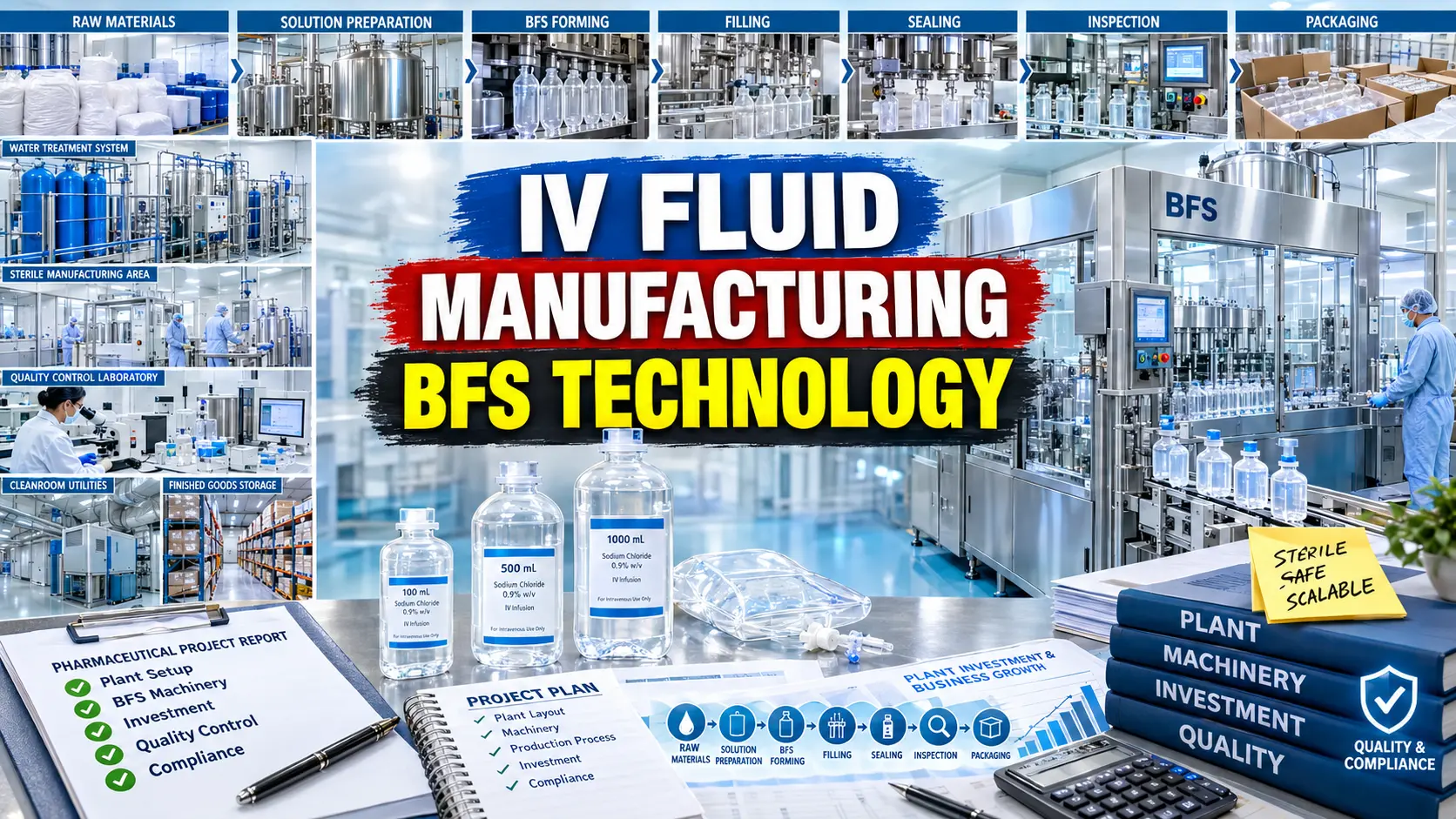
The IV fluid manufacturing process generally includes:
- Water purification (WFI generation)
- Solution preparation
- Sterile filtration
- Blow-Fill-Seal packaging
- Leak testing and inspection
- Labeling and packaging
- Sterility testing and quality control
This guide explains the complete IV fluid manufacturing plant setup process including BFS technology, plant investment, machinery, manufacturing process, licensing requirements, and profitability analysis.
What is an IV Fluid Manufacturing Plant?
An IV Fluid Manufacturing Plant is a pharmaceutical production facility that manufactures sterile intravenous fluids such as saline, dextrose, and electrolyte solutions using automated technologies like Blow-Fill-Seal (BFS) systems.
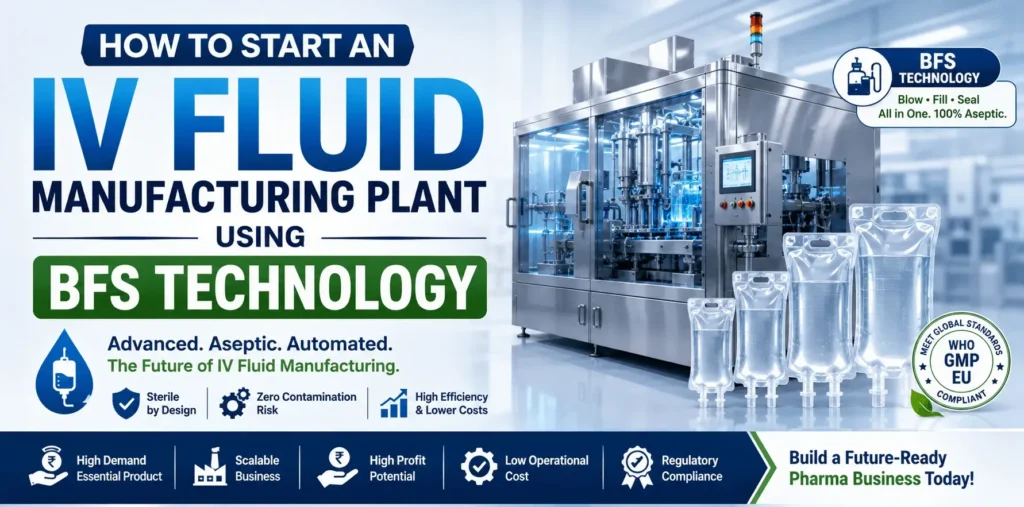
Modern manufacturing units use BFS (Blow-Fill-Seal) Technology, which is a highly automated process that forms the container, fills it with fluid, and seals it—all in one continuous operation. This minimizes human contact and ensures maximum sterility, a must in the pharmaceutical industry.
Applications of IV Fluids
IV fluids play a critical role in the healthcare and medical industry. Common applications include:
Hydration therapy for dehydration and fluid loss
Electrolyte replacement during surgery or trauma
Parenteral nutrition for patients who cannot eat
Drug dilution and delivery for antibiotics and anesthetics
Blood volume expansion in emergency care
The constant demand from hospitals, nursing homes, and healthcare centers makes this business highly sustainable.
Visit this Page for More Information: Start a Business in Intravenous Fluids Industry
Why Use BFS Technology in IV Fluid Manufacturing?
Blow-Fill-Seal technology revolutionized pharmaceutical packaging. Unlike traditional glass bottles or manually filled containers, BFS offers:
- Aseptic production with minimal human intervention
- Single-use packaging ideal for sterility and disposal
- Low contamination risk
- High-speed and cost-effective production
- Compact unit design with smaller footprints
- WHO-GMP compliance
Adopting BFS technology ensures compliance with international regulatory bodies like WHO, FDA, and GMP.
Read Similar Articles: PHARMACEUTICAL INDUSTRY
Types of IV Fluids You Can Manufacture
A well-planned IV Fluids Manufacturing unit can produce various types of fluids such as:
Normal Saline (0.9% Sodium Chloride Solution)
Dextrose Solutions (5%, 10%, 25%)
Ringer’s Lactate Solution
Dextrose-Saline Combination
Mannitol Injections
Sterile Water for Injection
Multivitamin and Electrolyte Fluids
Each product serves different clinical purposes and ensures a broad customer base.
Related Business Plan: IV Fluids, I.V. solutions
Raw Materials Required
Key raw materials for manufacturing IV fluids include:
Pharmaceutical-grade water (WFI – Water for Injection)
Sodium chloride, dextrose, potassium chloride, calcium chloride
Plastic granules (for BFS containers)
Sterile filters and cartridges
Labels, cartons, and secondary packaging
Quality sourcing and strict vendor controls are vital to ensure patient safety and compliance with drug regulations.
Related Feasibility Study Reports: I. V. Fluids
IV Fluids Manufacturing Process (Using BFS)
The IV Fluids Manufacturing process using Blow-Fill-Seal technology involves:
Water Purification – Raw water is purified using RO + UV + EDI systems and converted into WFI.
Solution Preparation – Precise quantities of solutes (like sodium chloride) are dissolved in WFI in a stainless-steel mixing tank.
Filtration – The solution is filtered to remove any microbial or particulate impurities.
BFS Operation – The plastic container is blow-molded, filled with fluid, and sealed—all in a sterile environment.
Leak Test & Inspection – Each unit is checked for leakage, particulate matter, and clarity.
Labeling and Packaging – The final product is labeled, packed, and stored in controlled conditions before distribution.
This process ensures high sterility and scalability for bulk orders.
Read our Books Here: Pharmaceutical, Drugs, Proteins Technology Handbooks
Equipment and Machinery Required
To set up a BFS-based IV Fluids manufacturing plant, the following machinery is essential:
BFS Machine (Blow-Fill-Seal Unit)
WFI Generation System
RO Water Treatment Plant
Mixing Vessels (SS316 grade)
Sterile Filtration Units
Online Leak Detection Machine
Visual Inspection Unit
Labeling and Packing Machines
HVAC and Clean Room Setup
A fully automated plant reduces labor requirements and enhances quality consistency.
Infrastructure and Layout
A medium-scale IV fluids plant will require around 10,000–20,000 sq. ft., divided into:
Raw material storage
Water treatment zone
Sterile manufacturing (Class 100 or Class 10,000 clean room)
BFS and packaging area
Quality control laboratory
Warehouse for finished goods
Office and utility space
Adherence to WHO-GMP, Schedule M, and ISO standards is mandatory for layout planning.
Regulatory Approvals and Compliance
The IV fluids business falls under the pharmaceutical sector, hence requires several licenses:
Drug Manufacturing License under the Drugs & Cosmetics Act
FSSAI license (if applicable)
GMP and WHO-GMP certification
Pollution Control Board NOC
Fire and Factory License
ISO 9001 and ISO 13485 (recommended for credibility)
CDSCO and FDA approval (for exports)
Proper documentation and audit readiness are essential to operate legally.
Cost of Setting Up IV Fluids Manufacturing Unit
The capital investment for setting up an IV fluids unit using BFS technology ranges from ?5 crores to ?15 crores, depending on:
Plant capacity (number of vials/bottles per day)
Degree of automation
Clean room setup and certifications
Location and utility costs
Regulatory compliance expenses
Working capital must also account for raw materials, utilities, staff salaries, and distribution.
Profitability and ROI
Despite high initial investment, IV Fluids Manufacturing promises strong returns:
Bulk demand from hospitals and healthcare distributors
High margin on sterile products (up to 30% per unit)
Scalability with export opportunities
Quick turnover and recurring orders
You can expect to reach break-even in 3 to 5 years, especially if you establish contracts with government or private hospitals.
Target Market and Sales Channels
Your customers include:
Government and private hospitals
Emergency medical services
Nursing homes and clinics
Medical distributors and wholesalers
Export agents and pharma chains
Distribution can be done through medical tenders, authorized dealers, or your own brand network.
Challenges and Risk Mitigation
Challenges:
High regulatory compliance
Initial cost burden
Technical know-how
Inventory wastage (if sterility is compromised)
Solutions:
Hire experienced pharma consultants
Outsource BFS machine operation to trained staff
Partner with raw material suppliers for timely sourcing
Establish robust QC systems and data logging
Risk management and quality assurance are the cornerstones of this business.
Future Scope and Market Trends
With increasing health infrastructure, pandemic preparedness, and demand for injectable therapies, the IV fluids sector is projected to grow at over 6–8% CAGR globally. India is becoming a hub for generic injectable manufacturing, making it an ideal time to enter this space.
You can also diversify into:
Antibiotic-filled IV fluids
Pediatric and veterinary IV solutions
Multivitamin or specialty IV nutrition blends
Contract manufacturing for global pharma giants
Conclusion
The IV Fluid Manufacturing Plant industry offers exceptional growth opportunities due to increasing healthcare demand, rising hospital infrastructure, and the expanding pharmaceutical sector in India. With advanced BFS technology, manufacturers can achieve high levels of sterility, automation, and production efficiency while meeting global regulatory standards.
Although the industry requires significant investment and strict compliance, the long-term profitability, recurring institutional demand, and export potential make IV fluids manufacturing a highly attractive pharmaceutical business opportunity.
Frequently Asked Questions
Q1. What is the cost of setting up an IV fluid manufacturing plant in India?
The investment for an IV fluid manufacturing plant using BFS technology generally ranges from ₹5 crore to ₹15 crore depending on capacity, automation, and compliance requirements.
Q2. How are IV fluids manufactured?
IV fluids are manufactured through water purification, solution preparation, sterile filtration, BFS filling, sealing, sterilization, and quality testing processes.
Q3. What is BFS technology in IV fluid manufacturing?
Blow-Fill-Seal (BFS) technology is an automated aseptic packaging process that forms, fills, and seals IV fluid containers in a single sterile operation.
Q4. Is IV fluid manufacturing profitable in India?
Yes, IV fluid manufacturing offers strong long-term profitability due to rising healthcare demand, recurring hospital requirements, and export opportunities.
Looking to Start an IV Fluid Manufacturing Plant?
If you are planning to establish an IV fluids manufacturing business, professional consultancy can help with:
- Detailed Project Reports (DPR)
- BFS technology consultation
- Plant layout planning
- Machinery selection
- CDSCO & GMP compliance guidance
- Manufacturing process support
- Financial feasibility analysis
- Pharma business strategy
Contact our expert team today to explore profitable IV fluid manufacturing plant opportunities in India.
Click here to send your queries/Contact Us
Reasons for Buying NIIR Report:
- Our research report helps you get a detailed picture of the industry by providing an overview of the industry along with the market structure and classification.
- Our report provides market analysis covering major growth driving factors for the industry, the latest market trends and the regulatory framework of the industry.
- Our Report provides an analysis and in-depth financial comparison of major Players / Competitors.
- Our Report provides indispensable buyers’ data with their company financials as well as the contact details, which can be an important tool in identifying the target customers.
- Our report provides forecasts of key parameters which help to anticipate the industry performance.
- We use reliable sources of information and databases. And information from such sources is processed by us and included in the report.
See More Links:
- Start a Business in Asia
- Start a Business in Potential Countries for Doing Business
- Best Industry for Doing Business
- Business Ideas with Low, Medium & High Investment
- Looking for Most Demandable Business Ideas for Startups
- Startup Consulting Services
- Start a Business in Africa
- Start a Business in India