
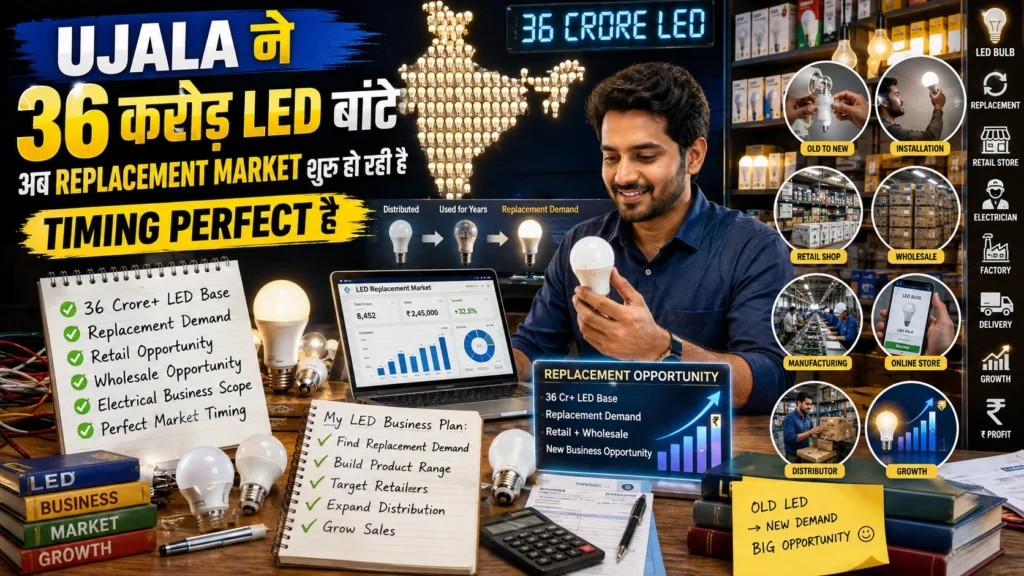
UJALA ने 36 करोड़ LED बांटे — और अब replacement market शुरू हो रही है। Timing perfect है
LED Bulb Manufacturing Business India में IBEF Electronics India के अनुसार, India का electronics market $150 billion+ का है। UJALA Official Portal की scheme ने LED penetration dramatically increase की है — India अब world का largest LED market है। PIB UJALA Scheme के अनुसार, UJALA ने 36 crore+ LED bulbs distribute किए हैं। DPIIT Electronics PLI scheme LED component manufacturing को incentivize कर रही है। Invest India Electronics में electronics manufacturing को Make in India का pillar बताया गया है। World Bank Energy India report में India की energy efficiency progress में LED transition का crucial role है। इस article में LED Bulb Manufacturing Business India में की complete guide दी जाएगी — setup process, financing, market strategy और government support के साथ। India में यह sector unprecedented growth पर है। Ministry of MSME Schemes के through MSME financing और World Bank India Industry report में India के industrial growth में इस sector का critical role documented है। Get Detailed Project Report (DPR): LED Light Bulbs, Tubes, Fittings, Spotlights and Wall Lights Projects Market Size और Growth Opportunity यह sector India के fastest growing manufacturing businesses में से एक है। Domestic demand strong है और export potential भी excellent है। Government support, growing consumer demand और import substitution push — तीनों factors मिलकर इस business को ideal बनाते हैं। Invest India MSME के अनुसार, इस sector में MSME units को priority financing मिलती है। Small और medium entrepreneurs के लिए market entry का यह सही समय है। सरकारी Support और Schemes Ministry of MSME Schemes के under इस sector के businesses को PMEGP (25-35% subsidy), MUDRA loan और CGTMSE guarantee scheme का लाभ मिलता है। Application process: Udyam registration → DPR preparation → bank application। State-specific incentives भी available हैं। Industrial policy के under land, power और infrastructure में concessions। Additional central schemes sector-specific हैं — APEDA, DPIIT, Ministry of Commerce के माध्यम से। Related Article: LED Bulb Manufacturing Plant in India: Investment, Machinery & Business Opportunities Business Ideas — Detailed Analysis 1. Residential LED Bulb Assembly 9W, 12W, 18W — standard residential bulbs India की highest volume segment है। Assembly cost ₹35-45/unit, retail ₹80-120/unit। BIS IS 16102 certification mandatory है। Component sourcing: LED chips, drivers, aluminum heat sinks — from Delhi और Shenzhen wholesale markets। यह business segment profitability के लिए proven है। Raw material sourcing, quality control और consistent delivery — ये तीन success factors हैं। 2. Street Light और Commercial LED Fixtures Municipal tenders और industrial clients के लिए high-power fixtures। B2B model with larger margins। GeM portal पर government procurement। Minimum unit investment ₹50-80K। Monthly output 200-500 fixtures। Revenue potential ₹3-8 लाख/month। यह business segment profitability के लिए proven है। Raw material sourcing, quality control और consistent delivery — ये तीन success factors हैं। Access Complete Business Plan: LED Street Light Assembling 3. Agricultural LED Grow Lights Indoor farming और greenhouse sector में growing demand। Premium product — ₹2,000-15,000 per unit। Specialty spectrum LEDs urban farming revolution को drive कर रहे हैं। यह business segment profitability के लिए proven है। Raw material sourcing, quality control और consistent delivery — ये तीन success factors हैं। 4. Solar LED Hybrid Products Solar panel + LED combination road lights, garden lights। Off-grid areas में massive demand। PIB UJALA Scheme और MNRE दोनों solar LED को support करते हैं। यह business segment profitability के लिए proven है। Raw material sourcing, quality control और consistent delivery — ये तीन success factors हैं। Check Out This Recommended Book: Solar PV Power and Solar Products Handbook Financial Planning Investment analysis: Basic unit ₹50,000-₹1 लाख से शुरुआत possible है। PMEGP से 25-35% subsidy effective investment reduce करती है। MUDRA loan working capital provide करती है। Revenue projections: Month 1-6: ₹30,000-₹1 लाख (client building phase). Month 7-12: ₹1-3 लाख (established phase). Year 2+: ₹3-8 लाख (scale-up phase). Break-even typically 8-12 months। Profitability drivers: Product mix optimization, bulk buying, quality consistency और repeat clients। Higher margin products पर gradually shift करें। Marketing और Client Acquisition B2B marketing में industry associations, trade directories और referral network most effective हैं। B2C में online platforms, social media और local retail important हैं। GeM portal पर registration government procurement access देता है। Consistent quality और reliable supply chain से repeat business और referrals generate होते हैं। Satisfied clients से testimonials collect करें। Explore proven business ideas with high success potential Import-Export Opportunity APEDA Export Data के through export channels available हैं। IEC code DGFT से, relevant Export Promotion Council registration, और quality certification से export ready हो सकते हैं। Per unit export realization domestic से 1.5-3x होती है। MSME Success Stories कई Indian entrepreneurs ने इस sector में शुरुआत ₹50,000-₹1 लाख से की और आज lakhs earn कर रहे हैं। Consistent quality, strong client relationships और strategic expansion इनकी success का formula है। Government schemes का सही उपयोग — PMEGP subsidy, MUDRA loan, MSME Technology Centre training — ने entrepreneurs को faster scale up में help किया है। Conclusion यह manufacturing business sector India की growth story का important chapter है। Government support, market demand और technology advancement तीनों favorable हैं। अभी शुरू करें — Udyam registration, market research और पहली manufacturing unit।
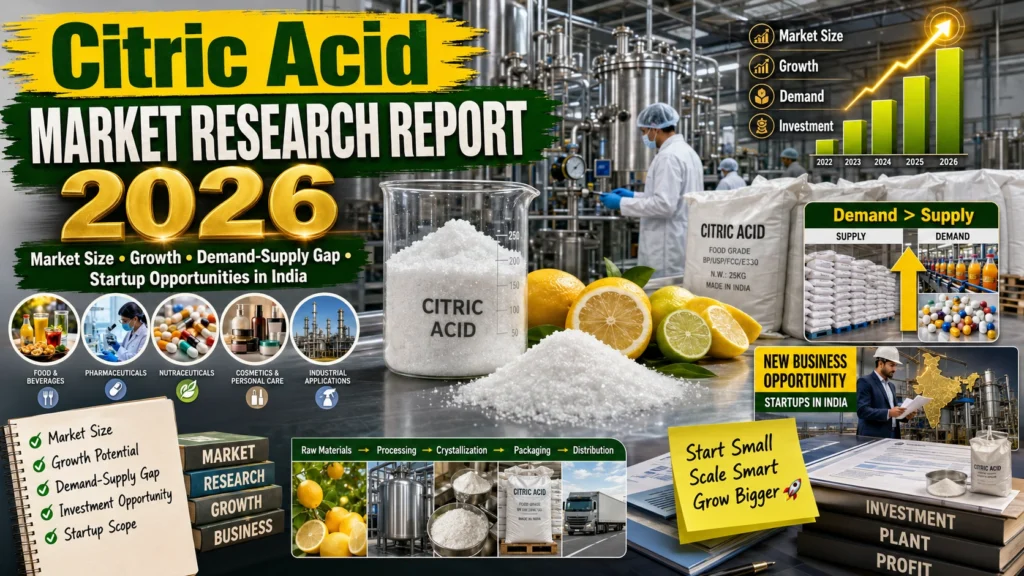
Citric Acid Market Research Report 2026: Size, Growth, Demand-Supply Gap and New Business Opportunity for Startups in India
Citric Acid Manufacturing in India India is the second highest consumer of citric acid and second highest producer of citric acid in the world but it still imports almost the entire quantity of citric acid required to meet the domestic demand by the Chinese industry which produces nine times more citric acid than India. China’s export market is tightening through 2026 and India’s food, beverage and pharmaceuticals industry is still booming, while the fermentation process is one that India is familiar with. View Full Project Details: Citric Acid Manufacturing Plant – Detailed Project Report & Business Plan What Is Citric Acid? Citric acid is a weak organic tricarboxylic acid, which is commercially produced almost exclusively by microbial fermentation; Aspergillus niger mould fermented on sucrose, molasses or corn-steep liquor that can yield over 90% (on substrate basis). The metabolic product of the mould is filtered out and citric acid is precipitated as calcium citrate with lime (calcium hydroxide) and re-dissolved in sulphuric acid (or can be separated by liquid-liquid extraction). Citric acid is available in two main forms: It is widely used in the following applications: Related Article: How to Start a Citric Acid Manufacturing Business from Lemon Global and India Citric Acid Market Size and Growth The global citric acid market in 2025-26 was valued at an estimated range of USD 3.77–4.21 billion, and is expected to reach between USD 4.81–5.54 billion by 2031-2033, with the average rate of growth being in the range of 3.7% to 4.12%. China leads the world in production by volume, with an estimated 65-70% of global capacity, fueled by an integrated fermentation facility and a large supply of corn-based feedstock. India has a truly noteworthy but structurally weak stake in this situation: It is the 2nd largest consumer of citric acid with an estimated consumption of 420,000 tonnes per year, behind only China (1.1 million tonnes), and the 2nd largest producer with domestic production of around 296,000 tonnes per year. China produces about 2.6 million tonnes, compared to India’s nine times less ability. Note on figures: Citric acid market studies can be different in considering the acid alone or including its salts or esters (sodium citrate, potassium citrate, etc.). NPCS can provide a customised techno-economic feasibility study, tailored to your target product form (anhydrous vs. monohydrate) and your target grade (food versus pharmaceutical), for numbers for the investor. India’s Quantified Supply-Demand Deficit The consumption of about 420,000 tonnes, and domestic production of about 296,000 tonnes annually indicate that India has a structural deficit of about 124,000 tonnes per annum, which is met almost entirely by imports, with China being the predominant supplier. This gap is there while at the same time India maintains a significant market presence through valuable exports including to the United States, indicating a market where domestic supply is lacking, in terms of both volume and quality/grade mix, compared to market demand. The dependence is real and near term: Chinese export monitoring has ratcheted up and freight risk has risen since 2026, with almost 70% of all citric acid imports from just one country, which is just the type of geopolitical and logistics risk that has spurred new domestic investment in import-dependent markets. Policy Tailwinds 1. Capacity protection and incentives for domestic capacity: Thailand used anti-dumping duties on imports from China to protect and incentivise domestic supply of citric acid, a policy that India can use, as capacity is documented and significant and import dependency is high in the country as of January 2025 (in 57.79%). 2. Growing domestic food processing and beverage industry: India’s ready to drink (RTD) beverage, processed food and packaged food industry is a direct growth driver for citric acid, further supporting citric acid backward integration in the domestic market. 3. Clean label, natural preservative demand: Citric acid is GRAS/FSSAI approved as a natural preservative and acidulant, which is correlated with the demand of natural preservatives/synthetic preservative substitutes by the Indian consumer and regulatory preference. 4. Incentives for circular economy and waste valorisation: Indian citric acid producers have increasingly been looking into waste valorisation as a strategy, e.g., use of spent fermentation biomass for animal feed, biogas or compost, and it is being integrated into the overall value-addition and sustainability agenda of the government. 5. Domestic sugar production base: India has a large domestic sugar and molasses base, which gives an authentic raw material advantage for new capacity as a molasses and sugar-based fermentation process. India Demand-Supply Gap: Citric Acid Parameter Current Position India’s annual demand ~420,000 tonnes — the world’s second-largest national consumption India’s annual production ~296,000 tonnes — the world’s second-largest national production base Annual supply deficit ~124,000 tonnes, met almost entirely through imports Comparison to China China’s production capacity (2.6 million tonnes) is roughly 9x India’s output, despite India being a similarly large consumer Import value (2024) India imported approximately USD 105.2 million worth of citric acid ingredient streams in 2024 Market structure A few large players dominate domestic capacity, while many small and mid-sized units rely on imports or toll production, leaving the supply chain exposed to input shocks and logistics delays Nature of the gap A clearly quantified, persistent import-substitution gap — roughly 30% of India’s total demand is currently unmet by domestic production, a structural rather than cyclical shortfall Opportunity for new entrants Strong — greenfield fermentation capacity investment is already being actively evaluated in India, with feasibility studies indicating attractive project economics at meaningful scale Reading the gap: With India already the world’s second-largest producer, this is not a technology or process-knowledge gap — India’s fermentation industry (used similarly for enzymes, antibiotics, amino acids, and other bio-based chemicals) already has the relevant expertise. The gap is one of installed capacity relative to a demand base that continues to grow with India’s expanding food, beverage, and pharmaceutical sectors — and one that a documented feasibility study for a 30,000-tonne-per-annum greenfield plant estimates could achieve a 47% rate of return with break-even at just 45% capacity utilisation, indicating genuinely attractive project economics