
How to Build Hospital in India with Up to 60% Government Funding
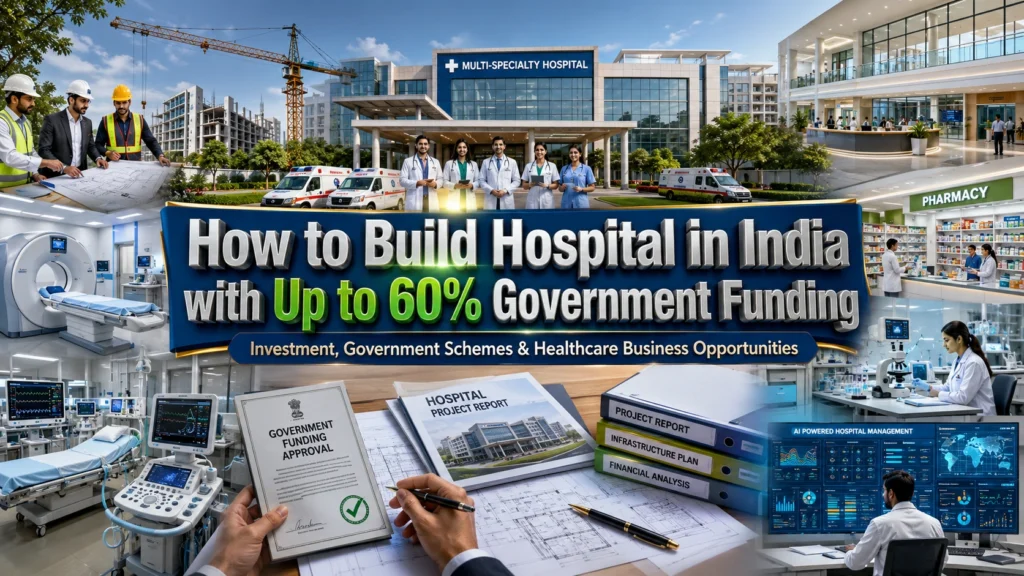
Hospital business in India India has a shortfall of more than 6 lakh hospital beds to meet the WHO recommended norms, and the government has put a number of financial instruments in place to address this shortfall — many of which the majority of entrepreneurs are unaware of. When the project is structured properly, the government can provide Rs.25–30 Crore to the hospital through the scheme of Viability Gap Fund (VGF) under the State Government, National Health Mission (NHM) capital funding, Ayushman Bharat Health Infrastructure Mission (AB-HIM) grants, and NABARD concessional long-term loan. These are ideas for businesses in healthcare that are both commercial and directly hit a public national health problem that’s being actively pursued by the government with allocated resources. Why India Urgently Needs Private Hospital Investment India has an average of 0.55 hospital beds per 1,000 individuals, which is significantly below the WHO recommendation of 3 beds/1,000 people. The gap is particularly acute in Tier-2 and Tier-3 cities where the capacity of the public health system is not being utilized optimally. More than 60% of healthcare expenditure is already on the private side in India, clearly showing that patients opt for private care when it’s available and affordable. The Ayushman Bharat PMJAY scheme has opened up insurance coverage for more than 55 crore beneficiaries, leading to assured inflows of patients into empanelled private hospitals provided the hospitals are available in the right places. Health entrepreneurs can use the district level health infrastructure gap data published by the Ministry of Health and Family Welfare to help them choose project locations. Get Detailed Insights from This Book: Investment Opportunities In Hospitality, Medical, Entertainment, Ware Housing & Real Estate Projects Government Schemes That Can Fund Up to 60% of Your Hospital A number of complementary Government schemes are available to be rolled up to finance a substantial part of a private hospital project. The National Health Mission (NHM) PPP component is in charge of funding the initiatives of private hospitals in low-density regions. Different states like Uttar Pradesh, Bihar, Rajasthan, Jharkhand and Odisha provide private hospitals with Viability Gap Funding (VGF), which is a grant of between 20-35% of the project cost that is provided for hospitals investing in district towns where healthcare facilities are inadequate. NABARD offers concessional long term loan facilities at lower interest rates in rural and semi urban areas for healthcare. Thousands of crores have been allocated under the Ayushman Bharat Health Infrastructure Mission (PM-ABHIM) for development of Healthcare Infrastructure with a provision for participation of the private sector. Having VGF grants and concessional NABARD loans along with operational revenue from PMJAY gives rise to a project financial model which makes the entrepreneur’s net capital requirement much less. Top Business Ideas Within the Hospital Development Model 100-Bed District Hospital with Surgical and Emergency Focus Most of the health needs of a population of 10 to 30 lakh people in a district is met by a 100-bed district hospital having a general surgery OT, orthopaedic surgery capability, obstetrics and gynaecology, ICU, NICU and 24×7 emergency services. After considering the state VGF, NABARD debt, the entrepreneur’s investment in equity comes to Rs.18-20 Crore. First Quality Milestone, get NABH Accreditation – mandatory for empanelment with PMJAY and CGHS and will ensure institutional revenue. Fill online application form on the National Health Authority website for empanelment under PMJAY. PPP Model Hospital Under NHM or State Government Concession The most capital efficient model is the Public-Private Partnership (PPP) model where a private operator constructs and operates a hospital in a public land, on the condition that the government will provide him a minimum patient volume or a subsidy for the operation of the hospital. The NHM has issued PPP guidelines that outline the mechanisms of engagement between the NHM and State health departments for district level hospital PPP arrangements. The State Governments in Tamil Nadu, Karnataka, Andhra Pradesh and Maharashtra have well established PPP hospital frameworks. In some state models, the government constructs the building and pays for the equipment and the private operator operates it and delivers clinical services — eliminating the need for a significant investment from the entrepreneur. Get Detailed Project Report (DPR): Healthcare Business Ideas in the Medical Sector Speciality Hospital Targeting One High-Volume Surgical Procedure Single specialty hospitals (cardiac, orthopaedics, ophthalmology or oncology) have better clinical outcomes and financial performance than generalist hospitals for the same size. A 50-bed cardiac care hospital in Tier-2 city can achieve the same revenue as 100 bed generalist hospital given the higher complexity of the procedures, which command premium rates of PMJAY packages. Specialisation decreases the diversity of equipment needed, leading to more efficient capital deployment. Talk to SECI equivalent at NABH for their advice on the speciality hospital accreditation pathways that lead to premium insurance rates. Import-Export Opportunities in Hospital Development There is a high level of import activity because of the development of hospitals — medical equipment’s from Siemens, GE, Philips and Fujifilm. CDSCO portal can be used to verify duty concession on medicals which are lifesaving medicines. The medical tourism industry is a foreign exchange generation sector in India which is growing day by day. A modern, NABH certified well equipped district hospital can be developed to attract medical tourists from Bangladesh, Nepal, Myanmar and the Gulf countries for its quality, affordable care. The Ministry of Tourism has a medical tourism policy that offers marketing assistance for the facilities approved. Indian MSME Success Stories in Hospital Development Narayana Health — Making Super-Speciality Care Affordable at Scale Located in Bengaluru, founded by Dr. Devi Prasad Shetty, Narayana Health challenged Indian healthcare by bringing to light the fact that cardiac surgery, when carried out in a high-volume, processes-driven fashion, can be a major cost-effective and yet world-class experience for every patient. Dr. Shetty’s shrewdness, that high volume would bring cost efficiency as well as improvement of quality, resulted in hospitals being constructed in areas where they were most needed. Narayana Health’s patient volume model was defined around the
India’s ₹5 Crore Food Processing Business: Gulf Export Opportunities for Manufacturers
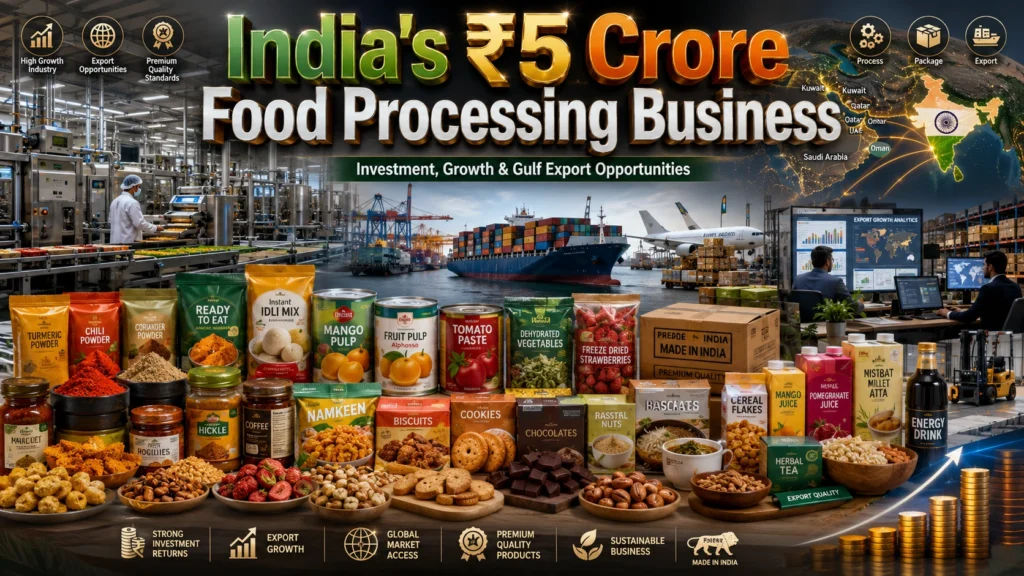
₹5 Crore Food Processing Business in India The food processing industry in India is at a turning point and for those who are thinking of entering into any serious business in manufacturing, the food processing unit with a capital investment of Rs.5 Crore for export to Gulf countries is one of the most commercially viable business ideas possible today. The Gulf Cooperation Council (GCC) countries – Saudi Arabia, UAE, Qatar, Kuwait, Oman and Bahrain – import billions of dollars in packaged and processed food each year. Geographic advantage of India along with huge population of NRIs in these countries leads to a natural demand pipeline. The Ministry of Food Processing Industries has always identified this as a priority for export and the availability of policy support in terms of capital subsidies and export promotion schemes is as easy as ever. Why the Food Processing Sector Is Booming in India India is the second largest producer of fruits and vegetables in the world but a large proportion of them is wasted because of lack of processing facility. The food processing industry is a significant contributor to manufacturing GDP of India and it is an industry which continues to attract investment from both the domestic and foreign sector. The food import needs of the Gulf countries, especially in Saudi Arabia and UAE, have increased substantially due to the huge rate of urbanization and development of the middle class. Indian processed food, including rice flour, spice blends, and ready to cook mixes, as well as frozen snacks, is always in demand in these markets. India’s agricultural exports have been continuously on the rise, with processed food playing a larger role, according to APEDA (Agricultural and Processed Food Products Export Development Authority). It’s an investment that’s also recession-proof — spending on food by consumers doesn’t slow down when the economy slows down, so consumer demand is always stable. Get Detailed Insights from This Book: Handbook on Fruits, Vegetables & Food Processing with Canning & Preservation Government Policies and Incentives for Food Processing Units Entrepreneurs are provided with several targeted schemes by the Ministry of Food Processing Industries (MoFPI). PMKSY offers capital subsidy to food processing units in clusters up to 35%. The innovative product category and organic product category are included in the Production Linked Incentive (PLI) scheme and are given incentives based on incremental sales. Further, the Credit Guarantee Trust Fund scheme of MSME Ministry has made it possible to avail collateral-free loan of Rs.2 Crore. APEDA is active in facilitating exports to the Gulf market in the following ways: Trade Fairs, Buyer-Seller Meetings, Export Certification. Food Safety and Standards Authority of India (FSSAI) has introduced fast-track licensing for export units, which can cut down the compliance timelines for the entrepreneurs. There are also electricity subsidy and provision of land in food parks by the State governments like Maharashtra, Gujarat, and Punjab. To get a detailed list of incentives available, please see the Startup India portal. Top Business Ideas in Food Processing for Gulf Exports Ready-to-Cook Indian Meal Kits and Spice Blends There are more than 8 million Indians living in the Gulf who are actively looking for real Indian flavours. Production of standardised spice mixtures, masala powder, ready to cook curry base, and meal kits can create a huge export brand with a simple investment. From Rs.5 Crore you can operate an automated blending, grinding and vacuum-packaging line, which complies with Gulf food safety certifications like GCC conformity marks and Halal certification. The two key factors in a supermarket’s success in retail shelf placement in the Gulf are consistency and packaging quality. Generally, gross margins for branded spice blends are between 35% and 50%, and hence this is one of the more profitable categories in the food processing industry. For direct buyer connect opportunities, APEDA’s export promotion programmes are for the benefit of entrepreneurs. Rice Flour, Semolina, and Milled Grain Products Domestic ag capacity is very low due to the arid conditions in the Gulf region which makes them very dependent on import of grains and milled products. This can be met by processing of rice and wheat in India which are available at competitive prices. A milling unit handling a capacity of Rs.5 Crore can mill the paddy or wheat to get refined flour, semolina, rice flour, beaten rice, and value-added grain products. Grain-based products are relatively easy to certify for the Halal markets in the Gulf (notably for the fact that this certification does not impose any extra compliance cost). Shelf life of 12 to 18 months can be obtained with good cold chain and moisture-controlled packaging, which meets the retail distribution cycles in the Gulf. Entrepreneurs should visit DGFT (Directorate General of Foreign Trade) for export documents and for IEC code registration. Your investment deserves the right opportunity Frozen Snacks and Traditional Indian Namkeen for the Gulf Retail Market One of the fastest-growing product line in the Gulf supermarkets is frozen food and packaged snacks. Indian namkeen, frozen samosa, frozen paratha and ethnic snack products have each a separate section in the Lulu Hypermarket, Carrefour and Spinneys in the Gulf. There is an investment requirement for the purchase of industrial fryers/ovens, individual quick-freezing equipment and cold storage packaging lines for setting up a frozen food processing unit at Rs.5 Crore. The unit should be HACCP standards and export-controlled temperatures. Many other Indian companies such as Haldirams, MTR Foods have proven this export model at large scale and enough opportunities are there for regional brands to establish niche positions. Import-Export Opportunity Analysis India has been steadily increasing its food and processed food exports to the Gulf region and bilateral agreements have ensured that most of the food categories have relatively low tariff. The APEDA data also reflects that rice, spices, processed vegetables and ready-to-eat products are the key commodities for India’s food export to the GCC. The UAE is also a re-exportation hub; if an Indian exporter sets up distribution in the UAE, then it is relatively easy to