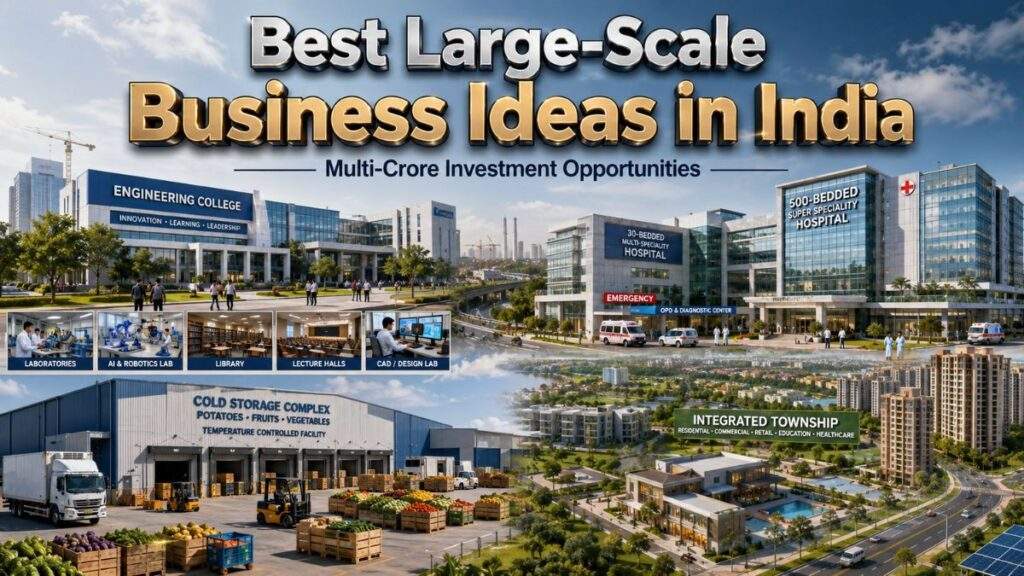

Best Large Scale Business Ideas in India
Why Infrastructure Is India’s Smartest Business Canvas
The story of India’s infrastructure has always revolved around steel tonnages, highway kilometres and power plant capacities. However, the more interesting narrative, one that matters to startup founders, institutional investors and first-generation entrepreneurs, is occurring at the intersection of services and built infrastructure. Engineering colleges, hospitals, cold storage places and integrated townships are not engineering play-rooms, but one of most durable businesses in today’s Indian market backed by demand, stickiness of essential services and has a scalable revenue architecture that is hard to beat in the manufacturing business.
Look at the structural background: India has an over 900 million working population, governments are aggressively striving to gain access to healthcare and increase access to higher education, agricultural sector is troubled with issues of post-harvest loss, and urbanisation is happening at an incredible pace, requiring planned urban housing. All of these trends are ideal investments on their own. As a whole, they create a time in which infrastructure businesses based on true demand, not speculative capital cycles are more appealing than ever. If the entrepreneurs and investors are ready to turn away from the traditional trade and manufacturing, the four sectors analysed here are some of the most bankable, policy supported and future-proof segments of the domestic economy.
Get Detailed Insights from This Book: Our Books
Why Infrastructure and Services: The Investment Logic
The demand visibility of infrastructure services is one of the few sectors in India that can show that kind of sustained demand visibility. Structural demand is the type of demand that does not go away during a recession, as it is with consumer products and manufacturing enterprises sensitive to input cost changes. For example, demand for healthcare in low-income countries is highly price inelastic. The demand for cold storage increases with food production and formalisation of food retailing. GDP and employment in engineering and technical education follow the curves of GDP and industrial employment with almost a perfect correlation.
In recent years, it’s the financial structure of these investments that has evolved. The Government of India through various ministries from the Ministry of Education to the Ministry of Health and Family Welfare, the Ministry of Food Processing Industries and the Ministry of Housing and Urban Affairs have gradually made it easier to offer subsidies, viability gap funding, and access to institutional lending facilities.
What you get is a risk adjusted return profile that performs well despite the volatility of commodity cycles and is competitive against the high growth manufacturing sector. These are some of the most defensible business architectures that exist, in the sense that they are suited to investors who have a 10-to-15-year time horizon and access to local institutional relationships and land.
Government Policies and Incentive Architecture
The policy context for infrastructure investments has come a long way. The Credit Guarantee Fund Trust for Micro and Small Enterprises (CGTMSE) under the Ministry of MSME offers collateral-free loans to enterprises for establishing cold storage and food processing support infrastructure facilities of up to ₹5 crore, thereby providing a strong de-risking facility to the first-generation entrepreneurs. Ayushman Bharat – Pradhan Mantri Jan Arogya Yojana (PM-JAY) et al creates a guaranteed payer base for empanelled hospitals, which would make even 30 bed secondary care hospitals in Tier-2 and Tier-3 towns have visibility of revenue!
The National Cold Chain Fund (NCCF) under the Ministry of Food Processing Industries (MoFPI) provides capital subsidy of up to 35% of project cost for integrated cold chain projects with an emphasis on potato, horticulture and perishable supply chains, catering for the identified gaps in post-harvest infrastructure. In the meanwhile, the Pradhan Mantri Kisan SAMPADA Yojana (PMKSY) offers infrastructure grants for agri-logistics nodes with a critical component of cold storage.
The Real Estate Regulatory Authority (RERA) framework on the whole is regulatory, but it has institutionalized the belief of the buyers, which in fact has furthered the speed at which the projects are completed and made them accessible for construction finance. The Smart Cities Mission and AMRUT schemes also provide urban local body co-financing for infrastructure in designated areas which lessen the burden on private developers. AICTE’s revised norms for approval of private engineering colleges and the National Education Policy (NEP) 2020 were also important in enhancing the commercial viability of private technical institutions, while there is a call for multidisciplinary education, which will benefit engineering education.
Startups in infrastructure that are linked to MSME get tax exemption, ease of compliance, and access to government infrastructure procurement process on par with other startups, under the Startup Recognition benefits provided by the Department for Promotion of Industry and Internal Trade (DPIIT). Together these schemes take the risk “floor” for first time infrastructure entrepreneurs down considerably.
Business Opportunities: Sector-by-Sector Analysis
1 Engineering College
The engineering and technical education space in India has one of the lowest investments to demand (I/D) ratios among all sectors in the country.
While the perception of a lack of seats exists in some of the metros, a ground level assessment of the country has revealed that there is a huge gap in the emerging corridors, especially in states such as Rajasthan, Odisha, Chhattisgarh, Uttar Pradesh and the Northeast region, where the ratio of engineering colleges to the population of 18-22 year old population is significantly lower than the national average. If a land owner with local stakeholder base wants to make an engineering college, the capital expenditure is high but it is also a business that can be banked easily due to the presence of AICTE.
The capital cost of a normal College with four departments (Computer Science, Mechanical, Civil, Electronics) of 300 seats is around 15-25 crores when taking into account the land cost and construction specification. Diversification of revenue streams: tuition fees, hostel, mess operations, consultancy and training, industry sponsored labs and more and more, skill development centres under PM Kaushal Vikas Yojana (PMKVY). A good and well-managed private engineering college evolves from a capital intensive start-up to a recurring revenue business with the assets appreciated in the value of the campus.
The success factors are promoter credibility with AICTE and the state technical education board, pre-commitment of good faculty (for NBA accreditation) and — crucially — industry connections to generate placement numbers, which leads to better admissions quality and fee premium. Those institutions with investments that have led to tie-ups with the large manufacturing plants, IT parks or industrial clusters located within 100 kilometres region always do better than those that do nothing more than campus-to-employer outreach. As part of the NEP 2020 framework, the doors are opened to B.Both fee-schedule and number of applicants higher for Voc and integrated MBA-Engineering combinations.
2 Hospital (30-Bedded and 500-Bedded)
The business in the hospital sector in India can be scaled as per two different business models, each having their own entrepreneurial possibilities. With an investment of about ₹2.5 to ₹4 crore, a 30-bed secondary care hospital optimally located in a Tier-3 town, peri-urban cluster and State Health Department’s headquarters can generate EBITDA margins of 22-28% within three to five years of the commissioning, especially when empanelled under PM-JAY and State Health Schemes. The 30-bed model isn’t a compromise — it’s, if you ask us, the right institutional answer to gaps in local healthcare infrastructure in many markets.
General surgery, gynaecology and obstetrics, orthopaedics, diagnostics and other services have relatively steady footfalls and revenue curves. Working capital cycle is very tight and the operating costs are manageable with six to eight resident doctors and 15-20 paramedics, if government insurance reimbursements is the backbone of the revenue.
The 500-bed tertiary hospital is a different kettle of fish altogether – it is a very capital intensive, long gestation project taking anywhere between ₹80 cr to ₹150 cr, including land, construction, medical equipment and a management team capable of operating at an institutional level in all clinical specialties. But it is commercially attractive in mid-sized cities (5 to 20 lakh population) where there is no tertiary referral centre within 100 kilometres.
Revenue includes outpatient consultations, inpatient admissions, diagnostics and imaging, surgery packages, margins in the pharmacy, medical education (when the medical college is collocated), and medical tourism referrals. Typically this breakeven time is 7-10 years and then the revenue defensibility of a well-branded tertiary centre in a captive catchment area is virtually impregnable. Both the hospital formats are greatly assisted by the benefit of both.
Existing NHM infrastructure grants and several state government hospital establishment subsidy schemes to bring private healthcare investment to unserved areas.
Related Article: Start a Profitable Hospitality Business in India
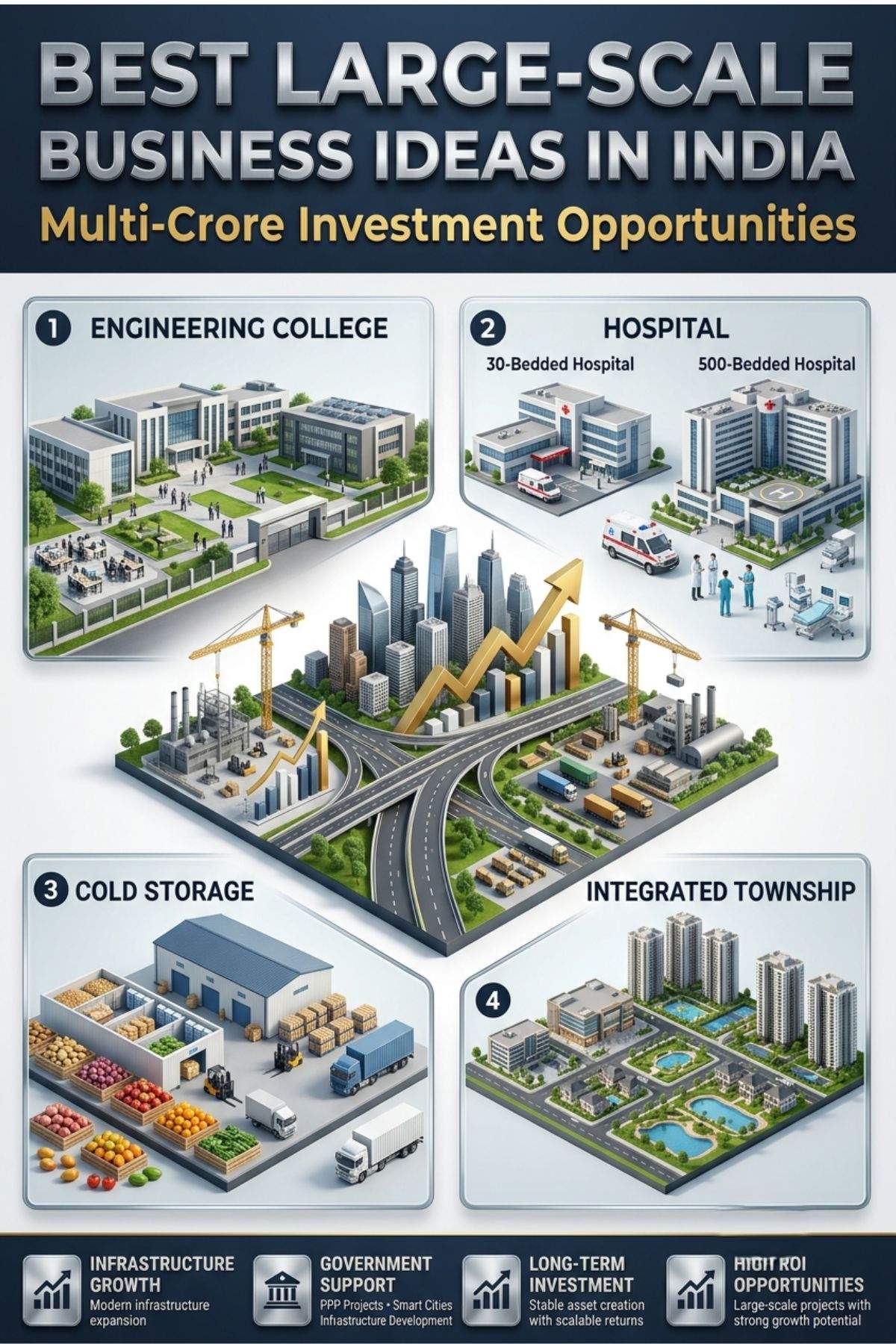
3 Cold Storage (Potato, Fruits, and Vegetables)
An estimated loss of 15-18% of India’s total food production to post-harvest spoilage is as much a failure of the policy as it is an opportunity for huge business. Cold storage for potato, fruits and vegetables are some of the more assured profitable agri-infrastructure investment opportunities available today with assured demand from traders, exporters and modern retail. The investment of an approximate amount of ₹ 3 to ₹ 5 crore is required for establishing a single commodity potato cold store of 5,000 metric tonne capacity, considering the land, civil construction, refrigeration equipment, insulation panels, and electrical infrastructure.
The operational economics are very positive: Using the stored produce, they can generally expect an annual rental income ranging from ₹60 to ₹90 lakh, and they can expect an EBITDA margin of 45 to 55% as fixed costs become more or less stable in the third year. Multi-commodity establishments that store vegetables and fruit enjoy a storage premium, and are also able to utilise the storage space throughout the year, which brings an additional advantage to single commodity stores when compared to single commodity facilities.
The cold storage capital subsidy structure is one of the most favourable in the agri-infrastructure sector. The registered warehouses and cold stores will have access to the negotiable warehouse receipt financing under the MoFPI’s PMKSY scheme and framework of WDRA, which will enable the cold stores to use the physical assets held in the cold stores as collateral for working capital loans. This alters the business equation for the owner or lessees of cold storage facilities.
The key strategic decision is the location – near the production areas (UP, Punjab – potato, Maharashtra, Andhra Pradesh – fruits, HP, J&K – apples) or near the consumption and export markets – careful analysis of trade routes is required. Those who site their facilities in a way that makes them suitable for the export supply chain and that cater to Middle East, South East Asian and European exporters receive premium rental fees and longer bookings.
4 Integrated Township
The integrated township is the most capital-intensive and strategically complex of the four opportunity clusters discussed in this report but also may be the most value creating in terms of change. The urbanisation process in India, with more than 40 million new urban residents added every 10 years requires a more planned and serviced mixed-use development which is far beyond what the municipal management or individual housing developers are able to provide at that scale.
These are townships that are integrated and are often built in clusters around road junctions, industrial estates or satellite urban centres, with residential plots, group housing, commercial developments, retail, schools, healthcare facilities and public amenities all planned within a single development, which provides multiple revenue streams through multiple years of project life.
Township development follows a business model of land aggregation, master planning, infrastructure development (roads, utilities, water, sewage) and a phased approach to selling plots or units. Revenue is sequential with the initial money coming in from the sale of plots and this usually covers 60-70% of the cost of land and infrastructure in the initial phase (Phase 1). Later phases provide greater realisations per square foot as infrastructure and amenities continue to develop, resulting in a cumulative appreciation that works for the developer and early purchasers.
The creation of an industrial park or Special Economic Zone (SEZ) provides a need for worker housing, commercial buildings and institutional needs. The affordable housing components in townships are eligible for ‘Housing for All’ under the PMAY scheme for subsidy and interest subsidy which makes the project more viable in Tier-2 cities where land cost is relatively low, while providing the infrastructure is the main development challenge.
Get Detailed Project Report (DPR): Project Reports & Profiles
Import–Export Opportunity Analysis
The trade dimension of infrastructure and services investment is not always recognized as an important one but is becoming more so. Cold storage and agri-logistics centers are enablers of India’s agricultural export vision. India’s existing strengths in exporting onions, rice, spices and processed food are reflected in its status as one of the world’s largest producers of such commodities and the government’s Agricultural Export Policy aims for a near doubling of the value of agricultural exports in the medium term.
Entrepreneurs can provide refrigeration and ripening services to processors and trading companies for export products by setting up cold storage and ripening centres in a location close to the corridor of exports, including towards the Mumbai, Chennai, Mundra and Nhava Sheva ports, with much better margins than providing storage on domestic commodities. The Agricultural and Processed Food Products Export Development Authority (APEDA) provides financial assistance for primary processing centres, pre-cooling facilities, etc. specifically for the development of export supply chain for cold chain infrastructure.
On the medical side, India’s hospital sector has emerged as a significant medical tourism destination, with patients from Africa, the Middle East, South Asia, and Central Asia travelling to Indian hospitals for cardiac, orthopaedic, cancer, and transplant procedures at 20-30% of comparable costs in their home countries or in Western markets. Hospitals that invest in international patient services — multilingual care coordinators, visa assistance, NABH accreditation for international patients — can access a premium revenue stream that is structurally protected from domestic pricing pressures.
The engineering education sector similarly has an export dimension: Indian engineering colleges that achieve international accreditation (NBA, NAAC with A+ grade, or affiliations with foreign universities) are beginning to attract fee-paying international students from Africa and Southeast Asia, creating a new revenue vertical that diversifies the domestic fee dependency.
Indian MSME and Entrepreneurial Success Stories
Manipal Hospitals – Dr. Ranjan Pai / Manipal Group
The Manipal Group’s healthcare journey, shepherded by the Pai family from a single medical college in coastal Karnataka, is one of India’s most instructive case studies in scaling healthcare infrastructure from regional to national stature. What distinguishes the Manipal model is not just capital deployment but deliberate institutional quality investment — NABL-accredited labs, internationally trained faculty, and consistent clinical outcome tracking — that built a referral network and brand equity no advertising budget could have purchased. The lesson for entrepreneurs entering healthcare today is that clinical reputation is the single most durable competitive moat in the hospital business. Cost-cutting at the quality level is the surest route to revenue stagnation.
Snowman Logistics – Sunil Nair / Gateway Distriparks
Snowman Logistics, which began as a cold chain joint venture within the Gateway Distriparks ecosystem, grew to become India’s largest temperature-controlled logistics company precisely because its founders understood the link between infrastructure scale and pricing power. By building a national network of cold storage facilities rather than isolated single-location stores, Snowman could offer large FMCG companies and pharmaceutical manufacturers a single-vendor, pan-India solution — a proposition no regional operator could match. The entrepreneurial insight is clear: in cold chain infrastructure, density of network creates disproportionate commercial advantage. Entrepreneurs entering the space today should plan with network ambitions from day one, even if execution is necessarily phased.
Amrapali Group – Lessons in Township Risk Management
The Amrapali Group’s trajectory — from one of North India’s most ambitious township developers to regulatory and financial collapse — is the cautionary counterweight that every township entrepreneur should study with equal rigour. The core failure was the divergence between sales collection and construction delivery, compounded by over-leveraging and misallocation of buyer funds. The post-Amrapali regulatory landscape, shaped by RERA’s buyer protection mandates and escrow requirements, has structurally reduced the systemic risk of similar failures for future buyers.
For promoters, the lesson is unambiguous: township development demands conservative capital structuring, disciplined fund segregation, and phased delivery schedules that match construction progress to revenue recognition. The developers who have emerged credibly from the post-RERA transition — DLF, Prestige, Mahindra Lifespace — share a common characteristic: balance sheet discipline and delivery credibility that allows access to cheaper institutional capital.
Professional Project Consulting: Where NPCS Fits In
For entrepreneurs evaluating any of the four business opportunities discussed here — whether a 30-bed hospital in a district headquarters, a 5,000 MT cold store in an agricultural belt, an engineering college in an emerging industrial corridor, or a 100-acre integrated township — the single most consequential early-stage decision is the quality of feasibility analysis applied before capital is committed. At Niir Project Consultancy Services (NPCS), we provide professional consulting for the preparation of Market Survey cum Detailed Techno-Economic Feasibility Reports (DPRs) for setting up new industries and businesses across precisely these infrastructure and services categories.
Our reports cover the complete pre-investment intelligence spectrum: detailed project economics with sensitivity analysis, market demand assessment and competitive landscape mapping, process flow diagrams and capacity planning, machinery and equipment selection with vendor benchmarking, raw material and input cost analysis, and full project financials including P&L projections, cash flow modelling, and IRR and NPV computation. With over 8,000 DPRs delivered across 50+ countries over 45 years of operations, NPCS brings an institutional depth of sector intelligence that genuinely differentiates a bankable project from an aspirational one. For entrepreneurs approaching banks, NBFCs, or government scheme offices for project financing, a well-structured NPCS DPR significantly improves both approval probability and loan terms.
Your investment deserves the right opportunity
Project Economics at a Glance
| Sector | Est. Project Cost | Key Revenue Streams | Approx. EBITDA Margin | Payback Period | Key Policy Support |
| Engineering College (300 seats) | ₹15 – ₹25 Cr | Tuition, Hostel, Training, Industry Labs | 20 – 30% | 8 – 12 years | NEP 2020, PMKVY |
| 30-Bed Hospital | ₹2.5 – ₹4 Cr | IPD/OPD, Diagnostics, Surgery, Pharmacy | 22 – 28% | 5 – 7 years | PM-JAY, NHM Grants |
| 500-Bed Hospital | ₹80 – ₹150 Cr | All specialties, Medical Tourism, Education | 25 – 35% | 10 – 15 years | PM-JAY, State Health Schemes |
| Cold Storage (5,000 MT) | ₹3 – ₹5 Cr | Storage Rental, Ripening, WDRA Finance | 45 – 55% | 4 – 6 years | PMKSY, NCCF, MoFPI Subsidy |
| Integrated Township (100 acres) | ₹50 – ₹200 Cr | Plot Sales, Group Housing, Commercial, Amenities | 30 – 45% | 7 – 12 years | PMAY, RERA Framework |
Frequently Asked Questions
Q1. What is the minimum land requirement to establish a private engineering college in India?
While AICTE norms state a minimum of 2.5 acres in metropolitan cities and 5 acres elsewhere, 5-10 acres on ground enables putting up adequate academic blocks, hostels, sports facilities and a provision for future growth-all major components of the NAAC score and admissions allure. A site in an emerging industrial corridor, not a land starved metro, can also bring down the cost, which the land, generally, is a biggest component of the total project cost.
Q2. How does a small hospital qualify for PM-JAY empanelment, and what does it mean for revenue?
Empanelment under PM-JAY (Ayushman Bharat) mandates minimum infrastructure requirements (number of beds, operation theatre, ICU, diagnostic equipment), trained manpower and state-level empanelment processes run by SHAs. After empanelment, hospitals can be reimbursed for over 1,900 treatment packages, thereby securing a minimum revenue level that is particularly useful in markets with low private insurance coverage. In a district with high PM-JAY beneficiary density, it is not uncommon for a 30-bed hospital to get 40-60% of inpatient revenue from government schemes.
Q3. What are the most common mistakes first-time cold storage entrepreneurs make?
The three most frequent and costly errors are: first, choosing location based on land price rather than cargo flow logic, resulting in a facility that sits at the wrong point in the supply chain and incurs high trucking costs; second, under-investing in refrigeration and insulation quality to save upfront capital, which leads to higher electricity consumption and produce spoilage claims that destroy reputation; and third, failing to register under the WDRA framework, which forecloses access to warehouse receipt financing — arguably the most attractive working capital mechanism available to cold store operators.
Q4. How long does it take to develop and fully occupy a Phase 1 integrated township?
A 25-30 acre typical Phase I township development (which includes master-planning, RERA registration, basic infrastructure and sales of the first lot of units/plots) can take between 24 to 36 months from land acquisition to handing over Phase 1 of the township to customers. Total Township completion, in phased manner, will vary anywhere between 8-15 years. The top-performing township developers build in reverse from the actual demand analysis in the catchments and phased development planning that match with the absorptive capacities rather than stocking up units for speculative demand.
Q5. Can a cold storage project qualify for both PMKSY capital subsidy and bank financing simultaneously?
Yes. The PMKSY and MoFPI cold chain subsidy schemes are designed to be stacked with institutional bank financing. Typically, the capital subsidy covers 25-35% of project cost, the promoter contributes 25-30% as equity, and the balance is funded through term loans from NABARD, SIDBI, or scheduled commercial banks. The subsidy is disbursed after project commissioning and is adjusted against the loan principal in most bank arrangements. NPCS DPRs prepared for cold storage projects specifically structure the financial model to reflect this tripartite funding architecture, which improves both bank appraisal outcomes and subsidy approval timelines.
Q6. What role does NPCS play for entrepreneurs entering any of these infrastructure sectors?
NPCS offers end to end pre investment feasibility consultancy, ranging from market study, site location consultancy to comprehensive financial modeling and DPR creation. For any infrastructure project needing bank loan funding, government scheme sanctions or approval of institutional investors, a NPCS Detailed Project Report is the main due diligence document. Our team has experience in all four sector areas discussed above (engineering colleges, hospital, cold storage & township) and the feasibility study can be customized as per the regulatory environment, financial and market situation of the intended place.