
Manufacturing Business Ideas in Jharkhand
Why Jharkhand Deserves More Investor Attention
If investors are interested in finding big business opportunities in developing states in India, Jharkhand is not one of them. That’s a big mistake. With a young and growing labour force, and an ambitious state industrial policy, Jharkhand is one of the underutilized industrial opportunities in India today, with a rich mineral belt in Asia. The state has rich coal, iron ore, copper, mica deposits which form a significant percentage of the country’s total resources of these minerals. However, it has a very small share of manufactured goods and processed exports. Smart capital should be flowing in the opposite direction, to that gap.
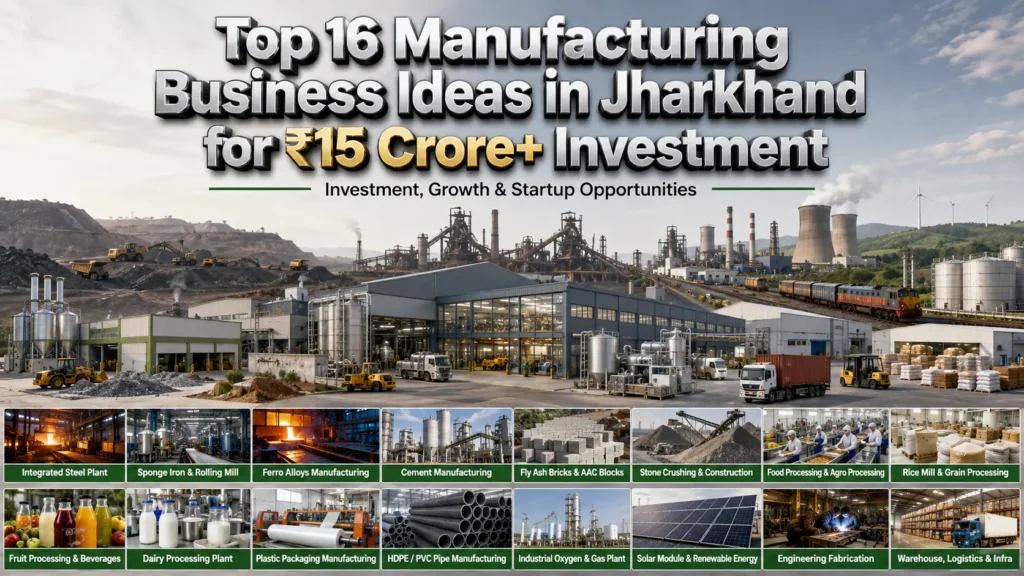
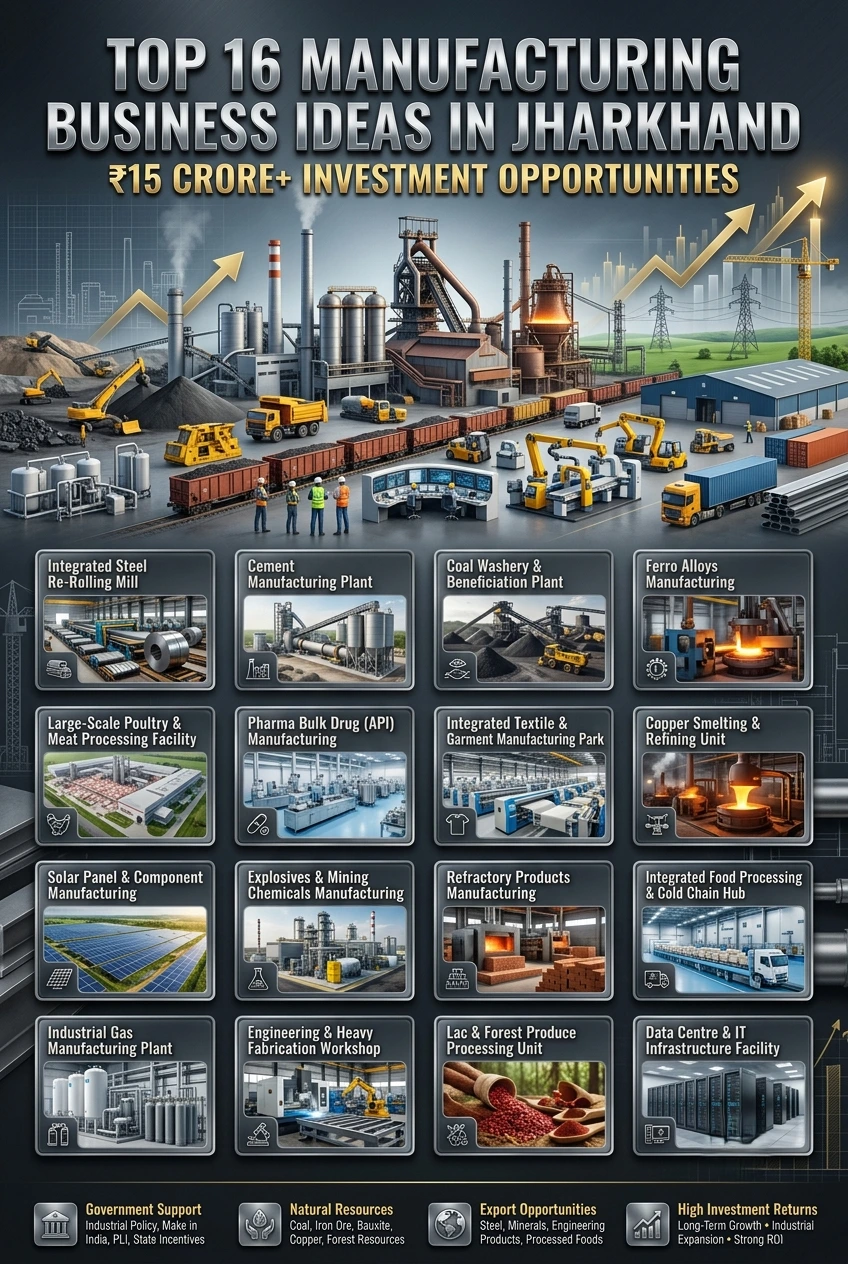
Investors with Rs.15 crore or more can buy the shares at an entry point that is exceptionally good. The Jharkhand Industrial and Investment Promotion Policy provides competitive land allocation, power tariff concession, tax benefits, especially for large scale manufacturing. Further, the country-level schemes initiated by the Ministry of MSME, DPIIT and Make in India further enhance the investment proposition. This article presents 16 judicious and economically viable business initiatives that meet the requirement of the availability of raw materials, have high domestic demand and also have a good export demand.
Why Jharkhand Is the Right State for Large-Scale Industry
The industrial appeal of Jharkhand is more than just its mineral resources. The state possesses over 40% of forest area, has good water resources in the shape of river systems like Damodar, Subarnarekha and Barakar and a developing network of national highways and railway lines linking it to the major port cities. This geographical advantage allows logistics costs to be kept to a minimum, which is a factor that is often a limiting factor for inland manufacturing companies.
Moreover, the state of Jharkhand has a well-educated technical staff, primarily due to the presence of institutions such as the Indian Institute of Technology, Dhanbad (ISM), NIT Jamshedpur and Birsa Institute of Technology. Labour cost is much less than it is in Gujarat or Maharashtra and this directly helps to make the unit economic of capital-intensive projects. The state government has also simplified the single window system for clearance by introducing e-Nivesh portal, which was not as cumbersome as in previous years.
Get Detailed Project Report (DPR): Jharkhand Investment & Entrepreneurship Guide
Key Sectors Driving Industrial Growth
Sectors that have seen the most promising growth patterns in Jharkhand are steel and metal fabrication, cement and construction materials, agro-processing, pharmaceuticals, power generation and electronics manufacturing. Besides this, State is becoming a potential place to establish food parks, textile industries and chemical industries. The Invest Jharkhand Portal is the official platform for new industrial project facilitation in Jharkhand and investors can keep track of the active investment opportunities and sector-wise data.
Government Policies and Incentives Supporting New Businesses
Multiple layers of policy support benefit investors in Jharkhand who intend to undertake large projects. Industrial area development authority (JIADA) gives industrial plots at subsidised rates in the industrial zone, capital investment subsidy, electricity duty exemption for 5–10 years, stamp duty refund and employment generation subsidy. JIADA is the first window for allocation of industrial land in the state.
The Chief Minister’s Office, Jharkhand has actively promoted investor summits and fast-track clearance process of projects involving investment of Rs.50 crore and above. This political commitment at the highest level helps to minimise ground delays to the project than what would occur if industrial facilation is a bureaucratic formality in states.
Central Government Schemes Worth Leveraging
The national level includes the Production Linked Incentive (PLI) Scheme, which is applicable to industries such as specialty steel, food processing, pharmaceuticals, electronics, etc., which are considered viable in Jharkhand. CGTMSE is a scheme that provides project finance for MSMEs. The Ministry of MSME promotes cluster manufacturing through SFURTI scheme. A ready infrastructure plug is provided to the textile investors by the PM MITRA park scheme. Investors should proactively seek assistance from DPIIT (Department for Promotion of Industry and Internal Trade) on matters relating to central incentives and new policies.
16 Large-Scale Business Ideas in Jharkhand (Rs.15 Crore+ Investment)
1. Integrated Steel Re-Rolling Mill
Steel re-rolling is perhaps the most natural business idea which can be implemented on a large scale in Jharkhand. The State is flanked by some of the richest iron ore and coking coal belts of India. An integrated re-rolling mill processing billet into TMT bars, sections and wire rods can cater to the demand of construction industry which uses explosions throughout the eastern and central parts of India. The investments of the project, which fall in the range of Rs.20 – Rs.50 crore, provide strong returns as the raw material procurement cost is structurally lower in this range as compared to any other state in India.
Domestic demand for TMT bars has been steadily increasing, fuelled by infrastructure investment within the National Infrastructure Pipeline (NIP). Besides, there is also additional market access owing to its proximity to Odisha and West Bengal. Backward integration into sponge iron should be considered by investors to improve their margin profile even further. Improvements in power sector were a challenge in Jharkhand for industrial areas, but now it’s better.
2. CemenManufacturing t Plant
Cement is one of the most feasible business ideas in Jharkhand as it has a good availability of limestone in Palamu district, of Hazaribagh and Latehar districts. The margin profile of a mid-scale cement plant is very strong in eastern India where supply has always been weak and the investment requirements are Rs.30–Rs.80 crores per day. Eastern corridor continues to be one of the most cement-starved ones in India. This deficit is expanding, not contracting, in light of the central government’s infrastructure push, which ranges from roads, housing, to bridges.
Moreover, the housing schemes of the state government, the Mukhyamantri Awas Yojana, also provide a captive consumption channel. Investors setting up regional cement companies in Jharkhand are likely to create substantial pricing power against the national cement companies, which have to deal with higher logistics costs.
3. Coal Washery and Beneficiation Plant
India is one of the biggest coal producing nations of the world and Jharkhand accounts for a significant share, especially the coking coal from the Jharia and Bokaro Coalfields. But a large amount of raw coal from the state is being sold at unprofitable prices, due to the lack of washing and beneficiation. A coal washery plant with a capacity of 25–60 crore tons per year of raw coal can transform the raw coal into high quality washed coal which fetches 25–40% price premium in the market. Washed Coal is in high demand from steel companies, power plants, and cement kilns.
The transportation and handling advantage of the location at the source of supply greatly minimizes transport and handling expenses. Further, Jharkhand is a region where the Coal India Limited (CIL) subsidiaries have long term needs in the field of third-party beneficiation, which is in a sense B2B demand.
4. Ferro Alloys Manufacturing
Ferro alloys producers are already established in Jharkhand and there is a lot of scope for capacity augmentation in the sector. The use of Ferro silicon, Ferro manganese and Ferro chrome is essential to the Steel sector – and India Steel is structurally expanding so the need for Ferro alloys is only going to grow as time goes. The investment range for establishing a ferro alloys manufacturing unit is Rs.30–Rs.70 crore. The availability of manganese ore in the state from Odisha and the availability of chrome ore deposits in the state of Jharkhand minimises raw material uncertainty.
There is also significant export potential as ferro alloys from India are competitive in the international market, especially in Europe and South Korea. It would be preferable if the investor had some knowledge of metallurgy or a good relationship with the steel producers.
Related Article: Top Ferro Alloys Industry Consultants in India: A Complete Guide for Entrepreneurs
5. Large-Scale Poultry and Meat Processing Facility
The agroclimatic conditions in Jharkhand and the traditional rearing system which has been followed by the tribal population of the tribal belt provides a unique opportunity in the processing of protein food. A big poultry processing and cold chain unit (Rs.20-40 crore) can process broiler chicken for retail and institutional supply in the State of Jharkhand, Bihar, West Bengal, Odisha. The story of protein demand in the east of India is interesting, right from the shift from unorganised to organised food supply chains, the significant rise in middle-class income, and the growth of urban population.
In addition to poultry farming, the Jharkhand government has been actively encouraging the establishment of goat farming clusters by tribal people. A meat processing entrepreneur can develop a secure base for sourcing the raw material from these clusters, and have enhanced livelihood impact at the same time, which enhances the goodwill of the regulator and the possibility of bank financing.
6. Pharma Bulk Drug (API) Manufacturing
The government’s PLI drug manufacturing for bulk drug manufacturing is creating a structural window which Jharkhand investors should seriously think of. API Manufacturing is a high barrier, high margin business. State has land available at competitive prices and industrial corridors for chemical manufacturing in Odisha and Bengal give flexibility in raw material logistics. The investment in a mid-scale API unit range from around Rs.40 crore and increases with the selection of the API choice. Demand for essential medicines, especially APIs for anti-infective, cardiovascular and diabetes drugs, are on the rise in the domestic market.
Moreover, India is in the process of phasing out Chinese API imports and moving towards local production, which makes this one of the most apt business ideas for the manufacturing sector. There is a scope for the investors to invest in the Bulk Drug Parks initiative for the co-location of infrastructure benefits.
Explore This Book: Drugs & Pharmaceutical Technology Handbook
7. Integrated Textile and Garment Manufacturing Park
The handloom weaving crafts have a rich tradition in Jharkhand, especially in Seraikela-Kharsawan and East Singhbhum districts. This cultural foundation can be used through the integrated textile park which integrates spinning, weaving, dyeing and garmenting in one place, and the PM MITRA (Mega Integrated Textile Region and Apparel) policy framework. The investment cost starts from Rs.50 crore and goes up a lot when it comes to such a park. The labour cost differential between Jharkhand and the other well-known hubs such as Surat or Tirupur is significant — it could be as much as 20-30% on a per-unit basis.
Overall, the market for Indian garments continues to be strong, and importers in Europe and the USA are increasingly looking to alternative suppliers, including India. A vertically integrated unit located in the right place for exports can create a sustainable cost edge in the medium term in Jharkhand.
8. Copper Smelting and Refining Unit
The copper ore deposits in India are the largest in Jharkhand, which is located around the Singhbhum Copper Belt. However, the state has little copper processing capacity, downstream. A smelting and refining plant exist in the region under the name of Hindustan Copper Limited (HCL) but private investment in smelting and refining has been low in the region. The market opportunity for a copper smelting and refinery project is huge while the investment is Rs.50–Rs.100 crore or more.
The factors driving India’s copper demand are the production of electric vehicles, power transmission infrastructure, solar energy, and electronics. Domestically, prices for processed copper products, such as rods and wires, sheets, are robust. The advantages for investors in this area are obvious: the supply of ores is much closer than that of copper concentrate imports from the coast, thus input logistics costs are significantly lower than those in coastal based smelters.
9. Solar Panel and Component Manufacturing
The transition of India towards renewable energy is a good opportunity for manufacturing. Solar PV Modules are eligible under PLI scheme for Solar PV Panel Assembly and Solar PV Module Manufacturing – mainly Solar PV Cell Manufacturing, Encapsulant Films and Back Sheets. With the power infrastructure and available industrial land, Jharkhand is a potential site for such a plant. The investment begins at Rs.30–Rs.60 crore for a proper level of operation. The domestic market is growing at a remarkable rate with the availability of solar parks of various sizes and rooftop installations.
Domestic manufacturers can secure an assured offtake from Government procurement programmes under SECI (Solar Energy Corporation of India). This concept is ideal for investors with background in precision manufacturing or electronics because of the quality standards.
10. Explosives and Mining Chemicals Manufacturing
The sustained demand from mining in Jharkhand is an ANFO, slurry explosives, detonator and safety fuse dependent. A great if very niche but defensible business idea: with proximity to the largest mining cluster in India and a Rs 25-50 crore investment, it is imperative to adhere to the Explosives Act and obtain PESO (Petroleum and Explosives Safety Organisation) licence for a explosives unit. Post this licence the customer- mining and government entities – is locked in since purchasing from locals is essential to mitigate risks, and gives pricing power. A firm with chemical background and regulatory expertise should consider this option.
11. Refractory Products Manufacturing
High temperature resistant linings, refractory bricks, and castables are critical inputs in steel, glass and cement kilns and non-ferrous smelters. Jharkhands proximity to the primary refractory inputs- fire clay, silica, and dolomite- makes it the logical place to establish a refractory manufacturing unit. A mid-scale refractory plant requires Rs.20-Rs.40 crore. The industry is also fortunate that its largest market-Steel and Mineral processing units- is located inJharkhand, providing the industry with a captive market base.
Further, Indian manufacturers of refractories enjoy a good reputation as exporters, especially in the Middle East and Southeast Asia. It’s a tough business from a technical standpoint, but potentially a highly rewarding one that ties in neatly with existing ties to the steel and cement industry.
12. Integrated Food Processing and Cold Chain Hub
Jharkhand produces rice, maize, pulses, vegetables, and forest-based products across a wide agricultural landscape. However, post-harvest losses remain exceptionally high because of inadequate processing and cold storage infrastructure. This can address both domestic retail and export segments of Indian markets, with a unit comprising sorting, grading, processing, packaging, and cold chain logistics facilities, situated in a fruit/vegetable-surplus region of Bihar and Jharkhand like Hazaribagh, Giridih or Khunti.
The initial investment requirement is between Rs 30 crore to Rs 60 crore and the project qualifies for PMKSY subsidies of the Ministry of Food Processing Industries. Additionally, tribal forest produces in the state such as mahua, tamarind and tendu also has an expanding export potential in international health foods and speciality products markets.
13. Industrial Gas Manufacturing Plant
Industrial gases, which include oxygen, nitrogen, argon, acetylene, CO2, form a foundation for industrial activities in steel, metal cutting, medical and chemical applications. The concentration of the steel belt in Jharkhand is a huge opportunity, as it is a natural captive market. The investment for an ASU plant, large acetylene plant comes to aboutRs 20-Rs 50 crore.
The business model involves a combination of bulk delivery of industrial gases by tanker and selling them in cylinders to individual customers, which offers dual revenue streams.
With steady growth in steel capacities in Jharkhand (in both the Jamshedpur belt and new industrial belts), industrial gas demand continues to grow structurally. The growing medical sector in Ranchi and other town centres adds to the demand for industrial grade gases like oxygen, medical nitrogen. The business does involve technical competence, but once it is operational, the returns come as steady cash flows.
14. Engineering and Heavy Fabrication Workshop
The Jharkhand industrial ecosystem – mining equipment, conveyor systems, heavy structural steel and plant equipment – generates huge opportunities in the areas of precision engineering and heavy fabrication. Every year mining houses; power utilities and steel companies spend hundreds of crores on outsourcing these fabrication and machining services. A well-equipped engineering workshop can cater to the market through its CNC machining, heavy fabrication and structural steel facilities including heat treatment processes. Investment typically starts at Rs.20–Rs.35 crore for a well-equipped facility.
The business enjoys strong B2B contract potential because established players like SAIL, HCL, Tata Steel, and NTPC have supplier empanelment programmes. A well-run engineering workshop in Jharkhand can also build an export portfolio for mining components to African and Southeast Asian markets where Indian engineering quality has a growing reputation.
15. Lac and Forest Produce Processing Unit
India produces over 50% of the world’s lac — a natural resin with applications in pharmaceuticals, food coatings, cosmetics, and industrial varnishes. A substantial amount of this national output is in Jharkhand, particularly from lac farming, by tribals on forest lands in districts such as Khunti, West Singhbhum and Latehar. Jharkhand State Forest Corporation Limited (JSFCL) facilitates lac farming and procurement of raw lac in tribal areas, though, most lac continues to leave the state raw.
Establishing a large unit to produce lac-based products such as shellac, dewaxed shellac and refined lac-based goods will require about Rs. 15 to 30 crores in investment and will produce significant export revenues. Lac produced from Jharkhand is highly sought after by European food and pharmaceutical sectors, commanding a high price. The concept also complements CSR and tribal development activities which can help access more concessional finance.
16. Data Centre and IT Infrastructure Facility
This might surprise investors who associate Jharkhand only with mining and manufacturing. However, the state offers meaningful advantages for data centre investment: relatively low land costs, growing power infrastructure, and a state government actively courting IT and digital investment. The Department of IT & e-Governance, Jharkhand has announced dedicated IT parks and fiscal incentives for technology companies setting up in Ranchi and other urban centres. A mid-scale data centre facility — requiring investment of Rs.50–Rs.100 crore — can serve state government digital initiatives, growing e-commerce logistics networks, and corporate IT requirements in eastern India.
The government’s Digital India framework creates a policy tailwind. Moreover, data centre business in tier-2 cities offers structurally lower operating costs than metro locations — an advantage that improves long-term returns for investors willing to pioneer the space.
Find the most profitable startup for your investment range
Import-Export Opportunity Analysis for Jharkhand Investors
The export case for Jharkhand-based manufacturers is often underestimated. Several of the business ideas listed above carry strong export potential — ferro alloys to South Korea and Europe, shellac and lac derivatives to Germany and the US, processed copper to Southeast Asia, and engineering components to Africa. Jharkhand is connected by rail to Kolkata port and Haldia port, which handle significant export cargo. Distance from port is manageable for high-value, low-bulk exports.
Import Substitution as a Business Strategy
On the import side, India currently imports significant volumes of processed copper, pharmaceutical APIs, solar components, and specialty chemicals — all of which can be produced in Jharkhand with competitive economics. The Production Linked Incentive schemes of government are precisely designed around the idea of this logic of import substitution. Any producer can use its capacity built at an export quality level to cater to both the domestic as well as foreign market, making the revenue model relatively risk-free.
Relevant export data and market intelligence is available from the Directorate General of Foreign Trade (DGFT) and the Federation of Indian Chambers of Commerce & Industry (FICCI). State-level export promotion support is also available through the Department of Industries, Mines & Geology, Jharkhand.
Indian MSME Success Stories to Learn From
Understanding how Indian industrial entrepreneurs scaled from early-stage investment to dominant market positions offers the most relevant strategic lessons for new investors in Jharkhand.
Case 1: Tata Steel (Jamshedpur, Jharkhand)
Jamsetji Nusserwanji Tata’s decision to establish India’s first modern steel plant in Jamshedpur — then a remote forested area — was considered commercially reckless by British colonial administrators. He anchored the decision on one fundamental logic: proximity to raw material (iron ore and coal) would always overcome the disadvantage of distance from markets. That logic has compounded over generations. Today, Tata Steel Jamshedpur remains one of the most competitive steel plants in the world on a cost-per-tonne basis. The lesson for new entrepreneurs: in capital-intensive businesses, raw material proximity is often more valuable than market proximity.
Case 2: Usha Martin (Ranchi, Jharkhand)
Brij Kishore Jhawar founded Usha Martin in Ranchi and built it into one of India’s leading wire rope and specialty steel producers. The company’s success demonstrates how a focused product strategy — wire ropes for mining, oil & gas, and construction — combined with consistent quality investment can create a globally competitive MSME-origin business. Usha Martin today exports to over 60 countries. The lesson: specialisation within a large commodity sector builds pricing power that pure commodity producers rarely achieve.
Case 3: Aarti Industries (Specialty Chemicals)
The Gogri family’s Aarti Industries has transformed itself from a small chemical trading entity into India’s leading respected specialty chemical manufacturers with substantial export footprint. Their success story-buy at a cheap cost via import substitution and invest consistently in process technologies-can be applied to Jharkhand’s chemical & explosives manufacturing business sector. The lesson: gain a competitive advantage through in-depth process know-how in forgotten chemical and industrial areas. For investors in chemical, explosives, refractory businesses in Jharkhand, Aarti’s growth story presents a useful blueprint.
How NPCS Can Help You Evaluate These Opportunities
Identifying a promising business idea is only the first step. Before committing Rs.15 crore or more to any project, thorough feasibility analysis is non-negotiable. At Niir Project Consultancy Services (NPCS), we provide professional consulting for the preparation of Market Survey cum Detailed Techno-Economic Feasibility Reports (DPRs) — the kind of structured analysis that separates well-informed investment decisions from expensive guesses.
Our reports cover the complete investment picture: detailed manufacturing processes, demand and market research, process flow diagrams, capacity planning and product mix strategy, machinery and equipment sourcing details, raw material procurement analysis, and comprehensive project financials including profitability projections, breakeven timelines, and ROI modelling. Our goal is simple – let an entrepreneur test if a business idea makes any commercial sense before the first rupee gets spent on it. In Jharkhand specifically, such in-depth pre-investment analysis can mean the difference between an active industrial plant and a large write-off.
Large-Scale Business Ideas in Jharkhand: Investment and Opportunity Snapshot
| Business Idea | Min. Investment (Rs. Cr) | Key Raw Material | Primary Market | Export Potential |
| Steel Re-Rolling Mill | 20–50 | Iron Ore, Coal | Eastern India | Medium |
| Cement Plant | 30–80 | Limestone | East & Central India | Low |
| Coal Washery | 25–60 | Raw Coal | Steel & Power Cos. | Low |
| Ferro Alloys Unit | 30–70 | Manganese, Chrome | Steel Industry | High |
| Poultry & Meat Processing | 20–40 | Live Poultry/Livestock | East India Retail | Low |
| Pharma API Manufacturing | 40–90 | Chemicals | Domestic Pharma | High |
| Integrated Textile Park | 50–120 | Cotton, Yarn | Domestic & Export | High |
| Copper Smelting & Refining | 50–100 | Copper Ore | EV, Power Sector | High |
| Solar Panel Manufacturing | 30–60 | Silicon Wafers | Govt. & Commercial | Medium |
| Explosives Manufacturing | 25–50 | Ammonium Nitrate | Mining Cos. | Low |
| Refractory Products | 20–40 | Fireclay, Silica | Steel, Cement Plants | Medium |
| Food Processing Hub | 30–60 | Agri Produce | Retail & Export | Medium |
| Industrial Gas Plant | 20–50 | Air, Carbide | Steel, Medical | Low |
| Heavy Fabrication Workshop | 20–35 | Steel, Alloys | Mining & Industry | Medium |
| Lac Processing Unit | 15–30 | Raw Lac | Pharma, Food, Export | High |
| Data Centre Facility | 50–100 | Power, Land | Govt. & Corporates | Low |
Frequently Asked Questions (FAQ)
Q1. Which districts in Jharkhand are best for large-scale manufacturing investment?
East Singhbhum (Jamshedpur), Dhanbad, Bokaro, and Hazaribagh are the major industrial districts. However, Giridih, Ramgarh, and Khunti have promising potential for new industries with attractive prices for land and government incentives for early movers. Detailed information on district industrial areas are available in the JIADA website. The chosen district must cater to raw material availability and logistics.
Q2. What government incentives are available for large-scale businesses in Jharkhand?
The Jharkhand Industrial and Investment Promotion Policy offers capital subsidies, electricity duty exemptions, stamp duty refunds, and employment-linked incentives. Full details of the incentive framework are published on the Department of Industries, Mines & Geology, Jharkhand. At the central level, PLI schemes, CGTMSE guarantees, and cluster development schemes are also accessible. Investors should engage JIADA for land allocation and the state industries department for clearance facilitation.
Q3. Is Jharkhand a good location for export-oriented manufacturing?
Yes, in select product segments. In Jharkhand, railway links to ports of Kolkata and Haldia make exports feasible for categories like ferro alloys, shellac, copper products, refractory materials and engineering components. For export-oriented units located in the state, extra travel of 2-4 days in transit as compared to port-based sites is an acceptable time, for non-perishable industrial items.
Q4. How does Jharkhand compare to Odisha or Chhattisgarh as an industrial destination?
All states do have advantages of their own. Odisha, on the other hand has a more developed coastline & port infrastructure advantage. Chhattisgarh has similar mineral resources with a variation in mix. Jharkhand has coking coal deposits, some industrial cluster around Jamshedpur & Bokaro & better base of technical people, the competitive advantage.
Q5. What kind of feasibility report should an investor prepare before entering Jharkhand?
Detailed Project Report (DPR): Any investment >Rs 15 crore will require a thorough Detailed Project Report that examines aspects like market demand, assessment of location, sources of raw materials, technology choices, estimated machinery & civil costs, approvals required, projected profitability (NPV, IRR & payback period) and sensitivity analysis. Banks, private equity and venture capital firms routinely ask for it before funding any project.
Q6. Are tribal land acquisition regulations a concern for industrial projects in Jharkhand?
This, indeed, is a crucial regulatory aspect. Large landmasses in Jharkhand are tribal protected zones, including those falling under the purview of the Chota Nagpur Tenancy (CNT) Act and the Santhal Pargana Tenancy (SPT) Act. Industrial investors must focus on acquiring lands located within JIADA notified areas or those government owned land parcels. The Invest Jharkhand Portal provides guidance on pre-cleared land parcels. Engaging local legal counsel with CNT/SPT expertise is strongly advisable.
Conclusion: The Time to Act in Jharkhand Is Now
Jharkhand is not the easiest industrial destination in India. It’s a lumpy infrastructure, a messy regulatory landscape, and a legacy of industrial under-performance. Yet for investors who are prepared to roll up their sleeves and put in the work, those very issues offer competitive moats. In Jharkhand’s industrial scene, first-movers tend to do significantly better than those who are waiting for things to be just right.
The 16 business ideas discussed in this article cover the full spectrum — from resource-intensive heavy industry to technology-driven sectors — all of which are economically viable in Jharkhand’s current operating environment. The common thread is that each idea leverages something Jharkhand genuinely has: natural resources, labour, location, or policy incentives.
For serious investors planning projects above Rs.15 crore, the next step is disciplined feasibility analysis. Explore the state’s investment framework through Invest Jharkhand and JIADA. Leverage central government resources through Ministry of MSME and Make in India. Engage professional consultants to build a credible DPR. Then move decisively — because the window of first-mover advantage in Jharkhand’s emerging industrial corridors is still wide open, but it will not stay that way indefinitely.