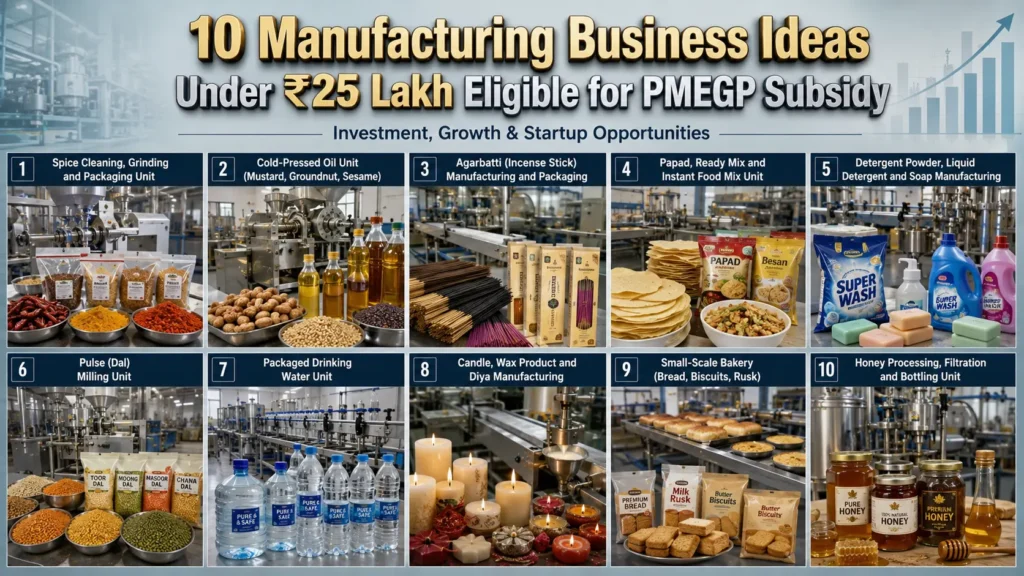

Ten manufacturing units that fit comfortably within PMEGP’s project cost framework, with realistic cost ranges and the subsidy math worked through
PMEGP Manufacturing Business Ideas Under 25 Lakh
A supportive middle ground for planning PMEGP is ₹25 lakh. It is not too large to be able to establish a medium sized a medium scale unit with the proper machinery, but sufficiently small that the entrepreneur’s contribution of 5 to 10 percent (depending on type) is easily manageable for most first-time applications.
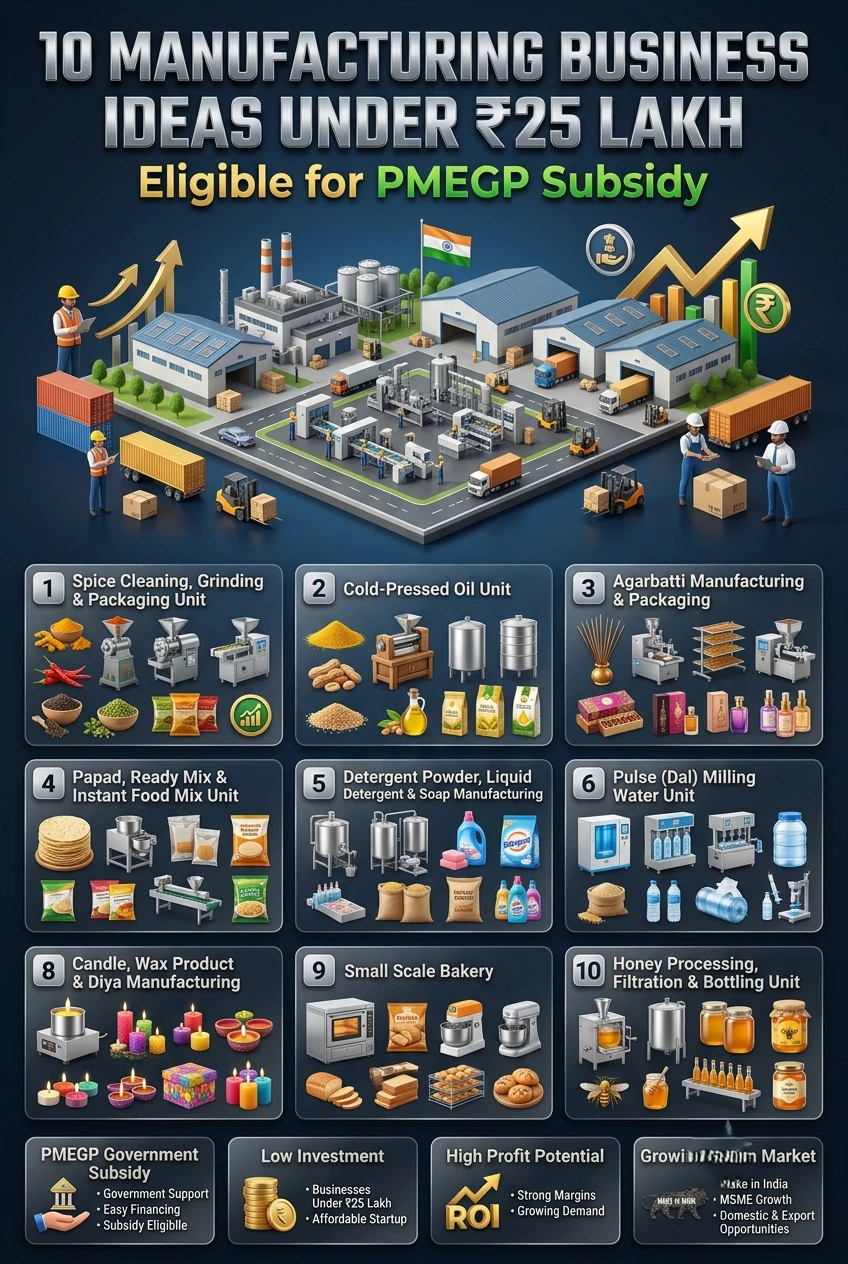
The ten ideas below have been selected because they have three common features: The machinery and set-up cost is within or less than ₹25 lakh; The raw material is not limited to a specific geographical area but is available in most parts of India; They are categories that are seen by PMEGP-implementing banks and KVIC offices frequently, and not in an unusual way.
Production using a spice processing unit, which involves cleaning, drying, grinding, blending and packaging, requires around ₹15 to 25 lakh investment — one of the lowest capital-intensive avenues into food manufacturing, with India being the world’s leading producer of spices, ensuring a consistent raw-materials supply.
1. Spice Cleaning, Grinding and Packaging Unit
The spice processing industry is one of the most viable small-scale manufacturing sectors in India due of its status as the largest producer and exporter of spices in the world. A unit which purchases raw turmeric, chilli, coriander or blends of spices from various regions, cleans and dries the raw spices, grinds the raw spices to the desired fineness and packs them in a packaging line with simple machinery, can be established for Rs. 15 lakhs to 25 lakhs.
Value addition makes the economics much better, a packaged, branded masala blend is worth a much higher price than lose ground spice sold to a wholesaler, and the extra cost of packaging is low compared to the price increase. The manufacturing cost ceiling is well within the boundary of this trade category and the profile of the trade is well known with respect to PMEGP because this is one of the more commonly approved trades.
View Full Project Details: Spices and condiments, Indian Kitchen Spices, Masala Powder
2. Cold-Pressed Oil Unit (Mustard, Groundnut, Sesame)
A small cold pressed or expeller-based oil unit, processing mustard, groundnut, sesame or coconut, depending on availability, usually involves the use of an expeller machine, filtration machine and storage and packing plant, the total investment for a small unit (might be ₹10-22 lakh) being a daily capacity of around 10 tons. Today, with the shift to oils that are cold pressed and free from chemicals, there is a retail premium for these oils that didn’t exist ten years ago, especially in the urban markets.
This can be made around a producing cluster for the selected oilseed, reducing raw material cost in a significant manner and often, the higher subsidy rates of PMEGP coincide with such type of siting.
3. Agarbatti (Incense Stick) Manufacturing and Packaging
Although Agarbatti manufacturing is one of the simplest industries on this list, the basic rolling machines, drying racks and perfuming and packaging set-up can be acquired for ₹5-15 lakh, depending on the level of automation and the technology used. Demand is steady and is not quite cyclic, as the product is consumed every day for religious and ritualistic purposes all over India.
This is also a category that can see a significant boost in output for a small unit without a commensurate proportionate increase in the number of staff working on the machine, especially in the unit economics part of the equation after the initial setup period.
4. Papad, Ready Mix and Instant Food Mix Unit
Instant food mixes (dhokla, gulab jamun, pakora mixes and others), papad and idli/dosa batter mixes are a category that has significant retail demand in the urban markets and is growing in sales. These can be manufactured in a unit which can be setup in ₹10-20 lakh with mixing, rolling/extrusion and packaging equipment, FSSAI registration is the primary regulatory requirement.
This category is attractive to a PMEGP applicant because the production cycle is relatively short and the recognition of the market is possible without having to invest in significant new machines each time a new product is added to the production line.
5. Detergent Powder, Liquid Detergent and Soap Manufacturing
Units involved in detergents production, dishwashing liquid and bathing / laundry soap etc remained very common among the categories approved by PMEGP due to the proven technology for making detergents, established chemical supply chain for raw materials and year-round demand for these products during the recession. The basic unit with mixing vessels, simple soap-cutting/detergent-mixing line with packaging can be set up at ₹8-20 lakh.
This is a field that the author has explored in great depth in the Soaps, Detergents and Disinfectants Technology Handbook published by NPCS, which explains how to formulate the product, how to test the product quality and how to choose the machinery needed to produce the soap that performs as well as the established product. These are the areas where a first-time entrepreneur in this field is most likely to need guidance to make the product that performs as well as the established product.
Find the most profitable startup for your investment range
6. Pulse (Dal) Milling Unit
For the small-scale daily capacity, a small dal milling unit which consists of dehusking, splitting, polishing and grading of pulses fits in between the price of ₹20 to ₹25 lakh and the core of the equipment comprise of dehusking machine, polishing drum and grading equipment. India is a vast consumer of pulses, with much of its production being ground in the country, near its consumption areas, a structural advantage which export dependent categories have not.
The unit is best suited close to a pulse producing belt, both for the raw material cost and the fact that the by-products (husk, broken grain) are also sold; one such outlet is to poultry feed manufacturers, which increases the unit economics.
Related Article: Startup Opportunities in Processing Fruits, Pulses, Spices, and Dairy
7. Packaged Drinking Water Unit
The small-capacity packaged drinking water units, which involve an initial investment of ₹20-25 lakh per set (which is higher as compared to a number of other types on this list) in terms of equipment — and the purified water plant and filling and packaging equipment — have consistent demand in both retail and institutional (events, offices, construction sites) segments and the latter can offer more consistent bulk orders for the new unit in the initial months.
For this category, BIS certification is a mandate and must be taken into account at the initiation of the project as it would influence the marketability of the unit after installation.
8. Candle, Wax Product and Diya Manufacturing
Mould sets, Wax Melting Equipment and a finishing/packaging area will cost you a total of ₹5-15 lakh which is one of the more viable entry points in this list for the candle and decorative wax product manufacturing, including festival diyas, scented candles and gift-segment wax products. Working capital planning must also consider seasonal fluctuations of demand, for example when stockpiling with regard to festivals; a steady monthly demand is not always to be expected.
The decorative/gifting market is a reasonable export option in this category, which could be grown as the unit grows beyond the initial domestic-market phase.
9. Small-Scale Bakery (Bread, Biscuits, Rusk)
A small bakery can be started up for bread, biscuits, rusk, etc. for local retail and institutional supply (schools, hostels, small hotels) with an oven of 1000 to 2000 kg capacity, mixing and proofing plant and packing plant at ₹15-25 lakh based on the capacity and automation level of the oven. This is a category that has a short shelf-to-sale cycle and a local market that is easy to identify in the market analysis phase of the DPR.
This is where institutional supply contracts to schools or local catering companies can prove most useful as early validation as this gives a predictable volume of use which does not exist in the first year of use at the retail level.
10. Honey Processing, Filtration and Bottling Unit
A processing unit for honey processing (filtration, moisture reduction and bottling) using raw honey collected from local beekeepers or apiaries will be a cost of Rs.10-20 lakhs for a small-scale processing unit which can be particularly suited in the forest fringe or in the agricultural fields where the beekeeping is undertaken informally. This also overlaps with the support provided by the SFURTI cluster in areas where the honey-based clusters have been approved and can help the unit to bear lesser equipment if there is a common facility centre in that area.
Get Detailed Insights from This Book: The Complete Book on Beekeeping and Honey Processing
NPCS Insight
All the above ten categories have one simple benefit, the project cost, if structured properly in the DPR, is easily able to accommodate the entrepreneur’s contribution (which is 5-10% of the project cost, depending on the category) and PMEGP margin money (which is 15-35% of the project cost, depending on category and location), and the remaining amount is the bank term loan. NPCS prepares DPRs in PMEGP format for all these categories including detailed specifications of machinery required and financial projections for specific product and location.
Cost Range and Subsidy Fit
| Business Idea | Typical Project Cost | Key Machinery | PMEGP Fit |
| Spice processing & packaging | ₹15-25 lakh | Cleaner, grinder, packaging line | Manufacturing, well within ceiling |
| Cold-pressed oil unit | ₹10-22 lakh | Expeller, filtration, storage tanks | Manufacturing, rural rate often applies |
| Agarbatti manufacturing | ₹5-15 lakh | Rolling machine, dryer, packaging | Manufacturing, low entry cost |
| Papad / instant mix unit | ₹10-20 lakh | Mixer, roller/extruder, packaging | Manufacturing, short production cycle |
| Detergent / soap manufacturing | ₹8-20 lakh | Mixing vessels, cutting/mixing line | Manufacturing, frequently approved |
| Dal (pulse) milling | ₹20-25 lakh | Dehusker, polisher, grader | Manufacturing, near ceiling for category |
Remaining Ideas: Cost and Notes
| Business Idea | Typical Project Cost | Notes |
| Packaged drinking water | ₹20-25 lakh | BIS certification required before commercial sale |
| Candle / wax / diya manufacturing | ₹5-15 lakh | Seasonal demand; plan working capital for festival peaks |
| Small bakery (bread, biscuit, rusk) | ₹15-25 lakh | Institutional supply contracts aid early validation |
| Honey processing & bottling | ₹10-20 lakh | Can intersect with SFURTI cluster support |
PMEGP Subsidy Recap for a ₹25 Lakh Project
| Category | Area | Own Contribution | Margin Money Subsidy | Bank Loan |
| General | Urban | ₹2.5 lakh (10%) | ₹3.75 lakh (15%) | ₹18.75 lakh (75%) |
| General | Rural | ₹2.5 lakh (10%) | ₹6.25 lakh (25%) | ₹16.25 lakh (65%) |
| Special category | Rural | ₹1.25 lakh (5%) | ₹8.75 lakh (35%) | ₹15 lakh (60%) |
Turning a Shortlist into a Bankable Project
All of these ten ideas are good on paper, but the key points of what makes a category look viable versus the project actually being approved are the same points discussed elsewhere on this platform: Project costs that are realistic with specific machine quotes, a market analysis based on data of what is being demanded in the local market, and a financial projection that reflects industry standards for the product in question and the project’s margins.
Niir Project Consultancy Services prepares detailed project report for each of these categories, which are structured to the PMEGP format and have machinery specifications, raw material sourcing guidelines, and financial projections based on the actual location and scale on which the entrepreneur proposes to implement the project (not generic numbers that just need to be put in the equation once the bank starts asking questions).
Choosing Between These Ten
For an entrepreneur evaluating this list, the most useful filter is usually local raw material and market access rather than which category has the highest theoretical margin. A spice processing unit in a spice-growing belt, a dal mill near a pulse-producing district, or a honey processing unit in an area with existing apiaries each has a structural advantage over the same business set up somewhere without that local context — and that advantage shows up in both the project cost (lower transport costs) and the market analysis section of the DPR (genuine local demand evidence).
Once the category and location are chosen with this in mind, the PMEGP subsidy calculation — covered in detail in our companion guide on calculating project cost and margin money — determines the exact financing structure for the specific project.
Frequently Asked Questions
Are any of these concepts able to be integrated into a single unit?
While it is possible (e.g. a spice processing unit and a papad/instant mix unit share some packaging infrastructure), combining categories adds to the complexity of the DPR and the market analysis. A first PMEGP application tends to be more easily approved as a single, well-defined product line, than as a multi-product application.
Which of these is the quickest to get from set up to first sale?
Typically, the setup to sale time for Agarbatti manufacturing and Candle / Wax products is the lowest as the machinery is simpler and the regulatory requirements, apart from the requirement for FSSAI, are lighter.
Are all these FSSAI Registered?
The food related categories, such as processing of spices, cold pressed oil, papad/instant mix, dal milling, packaged drinking water, bakery and honey processing, need to be registered by FSSAI or be licensed. Other licenses may be applicable to the units for manufacturing products like Agarbatti, detergent/soap and candle/wax for which FSSAI is not applicable.
Is the maximum project cost of PMEGP manufacturing ₹25 lakh?
NO, the ceiling for manufacturing overall is ₹50 lakh and this is used here as a mid-range figure which can be comfortably accommodated within the ceiling and also be adequate enough to have a functional unit having adequate machinery.
Which place is there for an entrepreneur to obtain a DPR for one of these classifications?
Niir Project Consultancy Services prepares a detailed project report for each of these categories of manufacturing in a manner suited to the requirements of PMEGP appraisal format with specifications of the required machinery and financial projections based on the selected product and location.
Sources and References: Ministry of MSME | DPIIT | Make in India | CGTMSE | Exim Bank India | FIEO | CII | NSIC | Udyam Registration