
Chemical Manufacturing Business Ideas India
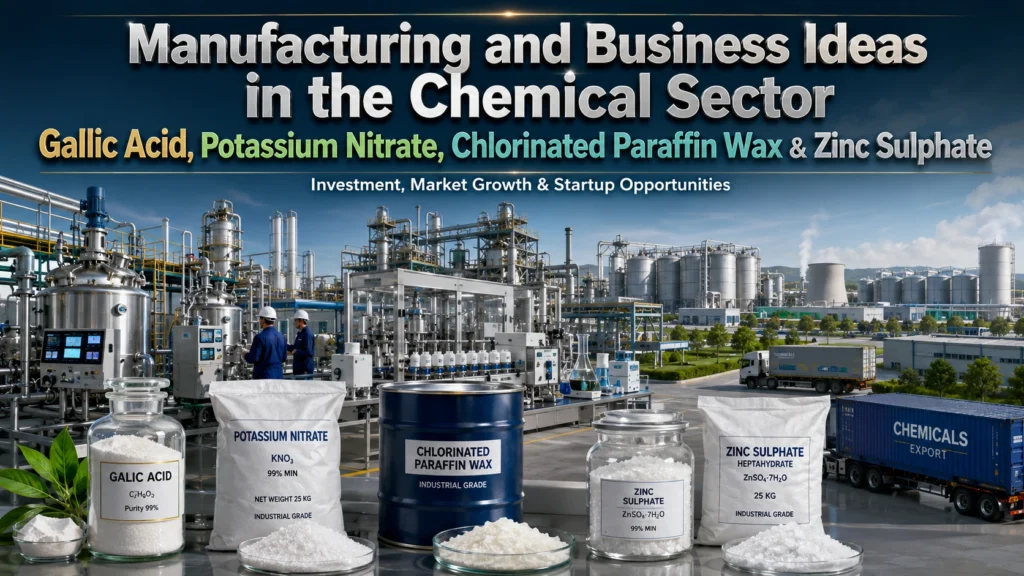
The Indian chemical economy has morphed itself into one of the most promising business incubators for 1st generation entrepreneurs to execute without resorting to a multinational balance sheet. Over the years, I have seen hundreds of feasibility reports on small and mid-sized chemical companies and am always coming back to a few products that meet the criteria of reasonable capital investment, reasonable demand and a true import substitution rationale. There are four such opportunities that include gallic acid, potassium nitrate from tobacco waste, chlorinated paraffin wax, and a combined zinc sulphate heptahydrate–monohydrate unit.
There is no glamour about them as there is about a battery gigafactory, and each are part of a supply chain that Indian industry relies on every day, be it from pharmaceuticals to leather, fertilisers to plastics to textiles.
Why This Sector, Why Now
Speciality and fine chemicals are in a strange situation in the Indian manufacturing industry because, although the local market is large and expanding, there has never been a significant expansion of the local production of meaningful intermediates, and so they have remained imports from China and Europe. It is here that the right kind of an MSME can fill that void. Process chemistry rewards consistency and quality control and reliable sourcing more than R&D expenditure, and that’s what the tannin derivatives, nitrate salts, chlorinated wax and zinc-based micronutrients are.
The rationale for profitability is further complicated by export potential: buyers in SE Asia, the Middle East and Africa are actively seeking to de-risk their China-dependent supply chain and Indian producers offering consistent purity specifications are taking their business. The margins in this space are decent, not brilliant, and typically in the 15-25% operating range, when a plant operates at reasonable capacity utilisation, but the demand base is sticky because these are input chemicals that are used continuously by the downstream industries as opposed to discretionary purchases.
Explore This Book: Handbook On Chemical Industries (Alcohol Based)
Government Policies and Incentives Supporting New Entrants
Business owners who move into this area do not need to give money their own way. The Ministry of MSME’s Credit Guarantee Fund Scheme and the Prime Minister’s Employment Generation Programme are loan support schemes which provide collateral-free loans for new manufacturing units, especially for chemical projects which also involve high investments in machinery. The PLI scheme for specialty chemicals, which is now being administered by the Department of Chemicals and Petrochemicals, has also created space for downstream players even if the main beneficiary of the PLI scheme is a larger integrated producer, because the demand pull from the PLI generates for ancillary/in-between suppliers.
Gujarat, Rajasthan and Tamil Nadu have established industrial policies, especially for industrial clusters in these states to provide power tariff concessions and stamp duty exemption along with capital subsidy to new small-scale chemical / MSME units. Besides, time for environmental and factory licences, the biggest bottleneck for chemical start-ups, has been reduced significantly thanks to the Stand-Up India scheme and a number of state-level single-window clearance portals. A business man can check out the existing scheme information straight on the.
The entrepreneurs can check the details of the schemes available at the portal of the Ministry of MSME.
Multiple Business Ideas Within This Chemical Cluster
1. Gallic Acid Production from Tannic Acid
Gallic acid is at an interesting crossroads of pharmaceuticals, ink making and the leather and dyeing industries and is the kind of product that demands a consultant’s eye rather than just an academic one. The major consumers of gallic acid are pharmaceutical intermediate manufacturers for trimethoprim and propyl gallate and the food industry for its use as an antioxidant preservative, which is synthesized by the acid or enzymatic hydrolysis of tannic acid (which is derived from natural material, such as tara pods, myrobalan or gallnuts).
The key to the attractiveness to a new entrust for this business concept is that the basic hydrolysis work does not require any special equipment – a reasonably sized hydrolysis reactor, crystallisation and drying plant can be set up with moderate investment; the raw material – tannic acid – can be obtained locally from a number of well-established suppliers, and therefore the risk of dependence on imported raw materials is low.
The realistic challenge is quality consistency: pharma-grade buyers are not only looking for production capacity but also for capability in analytical testing, for which the initial investment is the key to success for a new unit. Indian pharma intermediate manufacturers have been increasingly acquiring the necessary intermediate gamma in order to shift away from a dependence on Chinese imports and that opportunity is enough to keep a well-run plant busy.
Discover business ideas that actually make money
2. Potassium Nitrate from Tobacco Waste
This one’s a business concept that seems like a crazy idea until you plow through the economic math and realize that it only makes sense for there to be several well-established businesses out there making money around this concept.
Tobacco waste, which is made up of stems, dust and rejected tobacco leaves from bulk tobaccos processors, contains high concentrations of potassium and nitrate, which can be extracted using a leaching/crystallisation process to create potassium nitrate, a high-value nitrate compound employed in a variety of industrial applications including fertilizer formulations, fireworks production, glass and ceramics manufacturing, and food preservation. The investment thesis here is that the raw material cost advantage: tobacco waste is usually at low or even negative cost, as the processor has to pay someone to dispose of it.
The processing itself includes aqueous extraction, purification and controlled crystallisation, which is readily handled by a medium scale MSME chemical plant. For this business, location is a critical factor – the nearer they are to tobacco processing centres in Andhra Pradesh, Karnataka, Gujarat, the lower will be the cost of feedstock logistics, and so any entrepreneur looking at this opportunity should establish the location of the plant based on the availability of waste first and market access second.
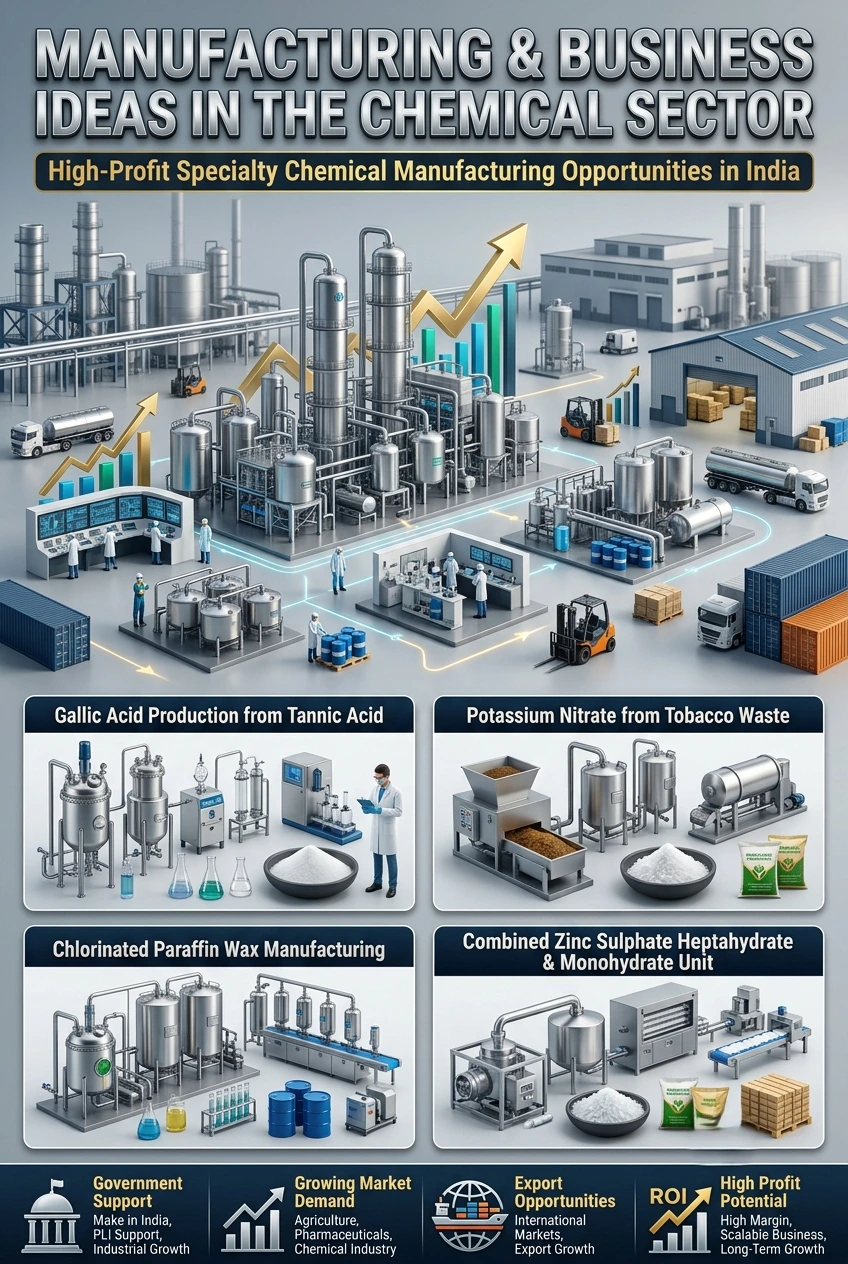
3. Chlorinated Paraffin Wax Manufacturing
Chlorinated paraffin wax comes in a significantly larger category than the first two products, and it is indeed a very versatile chemical for use in PVC, rubber, paint and lubricant industries as a plasticiser, flame retardant and extender in India.
The manufacturing process requires chlorine gas to chlorinate paraffin wax, which does need more serious safety infrastructure – chlorine handling systems, effluent treatment, and scrubbers – but the payoff is a much larger addressable market, since the consumption of CPW is directly proportional to the growth of construction, cable and automotive components in India. What I have seen looking at feasibility studies in this category is that where producers have some control on getting paraffin wax competitively from a refinery as opposed to through trading, they can make a meaningful difference to their margins.
There is also a clear difference between short- and medium-chain products, against which new players should act with prudence before investing capital, as regulatory attention is focussing on the short-chain products, and Indian manufacturers producing medium-chain products for domestic PVC and rubber compounding are less exposed to future regulations affecting short-chain products. Here demand growth is more about novelty rather than expansion of India’s underlying industrial base; each new cable manufacturing line or PVC compounding plant is a potential CPW buyer.
Related Article: How to Start a Manufacturing Business of Chlorinated Paraffin Wax (CPW)
4. Combined Zinc Sulphate Heptahydrate and Monohydrate Unit
On this list, zinc sulphate is definitely one of the most demand-proof products, since it directly enters agriculture and the demand for agricultural inputs don’t boom and bust as industrial chemicals do. The heptahydrate crystalline form is the most common form used in fertiliser blending and supplementation of animals; the more concentrated and stable form monohydrate is increasingly preferred for formulations of granular fertiliser and industrial applications such as rayon manufacturing and electroplating.
A combined unit capable of operating at the two grades depending on the order mix makes good capital allocation since it enables the same reactor and crystallisation train to service two different customer bases—with the additional capital investment for a dehydration step for the monohydrate line. The sourcing of raw materials is also easy, it can be sourced as zinc ash or zinc dross or zinc oxide reacted with sulphuric acid, which is fairly easy in India’s non-ferrous metal recycling market and makes this business easy to present as widely sustainable as possible, as more and more institutional customers of fertiliser consider sustainability as an important part of their operations.
The Indian demand for zinc sulphate is not cyclical in nature as soils are widely found to be zinc deficient, which has been repeatedly brought to the farmers’ attention by agricultural extension programmes; hence, this is one of the more defensible business ideas discussed in the entire chemical cluster.
Import–Export Opportunity Analysis
These are four unique trade angles that each of these products has and should be considered before finalizing a business plan. In both of these categories, India imports substantial quantities, mostly from China, and therefore doesn’t face a competitor from a new Indian manufacturer but a competitor from a market already served by another manufacturer, namely, a commercial proposition that is materially easier. Potassium nitrate, however, does have a real export dimension as Indian nitrate is being sold to the fertiliser blenders in Bangladesh, Nepal and other parts of Africa and when the cost of the product is kept low by the domestic production of tobacco-waste nitrate as compared to nitrate production in the Middle East and Europe.
In between are zinc sulphate: India imported zinc sulphate from those countries where zinc ash is less expensive, and exported finished agricultural grade product to its neighboring countries in South Asia, and therefore a new producer’s competitiveness will rely mainly on getting contracts on zinc ash or dross supply. Entrepreneurs seriously interested in the export market should register with the Directorate General of Foreign Trade and avail themselves of export finance schemes of the Reserve Bank of India, which can positively alleviate working capital pressure in the initial stages of order building.
Indian MSME Success Stories Worth Studying
The stark example of Vinati Organics built by its promoter Vinod Saraf is that speciality and fine chemical manufacturing in India can scale into a business with high margins and global competitiveness if a promoter chooses to narrow down its portfolio to a set of products where he can achieve global market leadership and not diversify broadly when taking the first shot. But a different, but equally telling route was taken by Aarti Industries, established by the Chinai family, which has slowly integrated backward into a diversified specialty chemicals major with a focus on long-term supply deals with the world’s pharmaceutical and agrochemical giants – the backward-integration discipline discussed above in the CPW context.
Some zinc sulphate and micronutrient fertilisers producers in a few regions in Gujarat and Rajasthan, including family-run businesses that began their operations as single shift businesses, have become multi-crore businesses largely based on their ability to keep their quality certification standards high and their direct relationships with the fertiliser blending companies, without depending on any trading intermediaries in between — and this proves that it does not take a huge initial scale to become a viable business.
How NPCS Can Support Your Chemical Manufacturing Venture
Niir Project Consultancy Services (NPCS) are professionals in preparing Market Survey cum Detailed Techno-Economic Feasibility Reports (DPRs) for new industries and/or enterprises including all the products discussed in this article. The manufacturing processes are explained in detail in our reports, which cover market research, demand analysis, process flow diagrams, product mix and capacity planning, machinery details, raw material details and complete project financials with profitability analysis.
This is the kind of structured feasibility work that can make or break a plan that’s passed the scrutiny of lenders and regulators, or a plan that is realistic with respect to regional demand, and a plan that is not. Our mission is to empower entrepreneurs to think about feasibility, profitability and long-term scale before investing, ensuring that the capital is invested in the right product, scale and from the outset.
Get Detailed Project Report (DPR): Chemicals, Biotechnology & Bio Fertilizer Projects
Indicative Market and Investment Snapshot
| Product | Approx. Plant Investment | Key End-Use Sectors | Demand Outlook |
| Gallic Acid from Tannic Acid | ₹60 Lakh – ₹1.2 Crore | Pharma intermediates, food antioxidants, dyeing | Steady, import-substitution driven |
| Potassium Nitrate from Tobacco Waste | ₹50 Lakh – ₹1 Crore | Fertiliser blends, fireworks, glass/ceramics | Strong regional and export demand |
| Chlorinated Paraffin Wax | ₹1.5 Crore – ₹3 Crore | PVC, rubber, paints, lubricants, cables | High volume, construction-linked growth |
| Zinc Sulphate (Combined Unit) | ₹1.2 Crore – ₹2 Crore | Fertiliser, animal feed, electroplating, rayon | Structurally resilient, agriculture-linked |
References and Data Sources
Department for Promotion of Industry and Internal Trade (DPIIT)
Federation of Indian Chambers of Commerce and Industry (FICCI)
Confederation of Indian Industry (CII)
Directorate General of Foreign Trade (DGFT)
Frequently Asked Questions
Q1. Which of these four business ideas needs the lowest starting capital?
With relatively lower input cost, the input cost of the other materials like chlorinated paraffin wax has some requirements on chlorine handling, which greatly increases the investment of such projects.
Q2. Is chlorine handling for chlorinated paraffin wax manufacturing a serious regulatory hurdle?
Granted it involves the usual Factory and Environmental clearances and compliance for handling of Hazardous chemicals but it’s already a well-established procedure in India with several already licensed producers therefore there are no major unknowns in the regulatory pathway, with right consultancy it’s achievable.
Q3. Where is the best location for a potassium nitrate from tobacco waste unit?
By far the most important location factor is proximity to tobacco processing centres in Andhra Pradesh, Karnataka and Gujarat, so that cost of transportation of feedstock is kept to the minimum and steady supply of waste is assured.
Q4. Does zinc sulphate demand fluctuate seasonally?
The product is linked to fertilizer cycles, but since zinc sulphate is also used in feed, plating, and other industries, a blended heptahydrate-monohydrate facility is able to achieve greater throughput year-round compared to a single grade plant.
Q5. Can a first-time entrepreneur access government funding for these projects?
Yes, schemes of Ministry of MSME, Credit Guarantee Fund Scheme and various state governments’ industrial subsidy schemes are applicable for new units if they are backed by a well-prepared feasibility report and financial projection for loan or subsidy support.
Q6. How do I decide which of these four business ideas suits me best?
The decision, which is best depends on your accessibility of raw materials, capital you possess and appetite for risk – but a thorough Techno Economic Feasibility Study in terms of your location, your availability of funds and your market target vs each product needs is probably the best deciding factor.