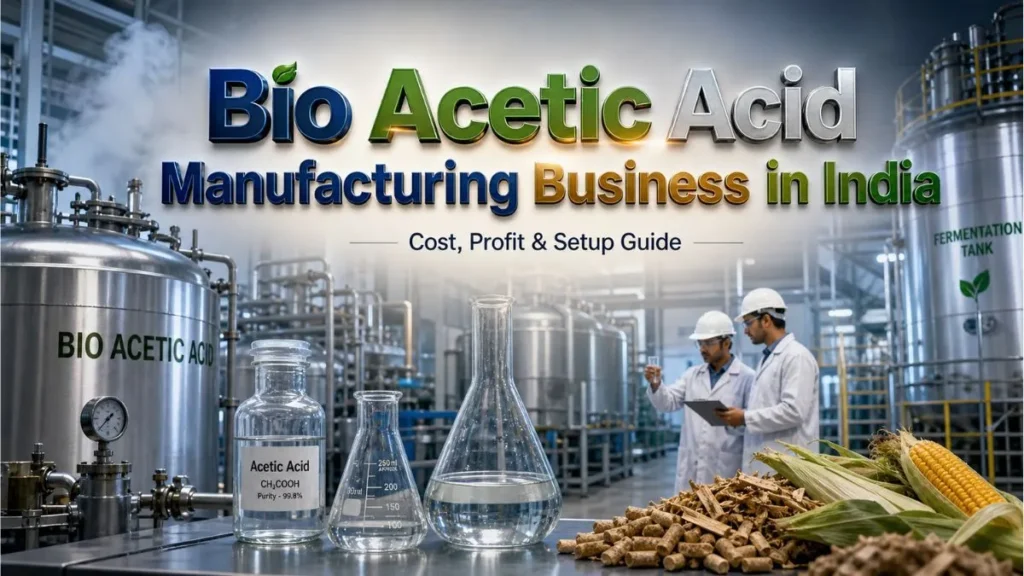

Bio Acetic Acid Manufacturing Business in India
While bio-acetic acid may not be a widely recognized name it plays an important role in Indian industry. It is utilized in pharmaceuticals, preservatives, textiles, dyes and plastics. Despite its important role India still imports large quantities of acetic acid on an annual basis.
This gives small businesses a fantastic market. As business trends move toward environmentally sound and region-sourced chemicals, bio-acetic acid production is becoming one of the most profitable small-scale chemical manufacturing business possibilities in India.
Download the Full Guide: Handbook On Chemical Industries (Alcohol Based)
Why Bio-Acetic Acid Manufacturing Is Growing Rapidly
India is a major user of acetic acid (over 600,000 tonnes are consumed annually, a majority imported). Meanwhile there is high demand from many industries for bio-based chemicals due to environmental and export restrictions.
This opens up opportunities for the domestic manufacturers. Local manufacturing helps keep transportation costs lower and enables quicker delivery to customers.
A few of the factors for this growth are:
- Growth in demand from pharmaceutical and textiles
- Growing demand for green chemicals
- High level of import substitution potential
- Government encouragement for MSME manufacturing
Investment and Profit Potential
The investment required to set up a bio-acetic acid plant is not very high compared to the big chemical plants. A small-scale plant can be easily established with a limited budget and gradually expanded.
Typical financial overview:
- Capital requirement: ₹46 lakh-72 lakh
- Annual production: 150-200 MT
- Annual revenue: ₹80 lakh to ₹120 lakh
- Net profit margin: 18% to 24%
- Return on Investment: approx. 2-3 years
The figures make it an attractive business opportunity for MSMEs and new entrepreneurs.
Get Detailed Project Report (DPR): Glacial Acetic Acid Project Report & Business Plan
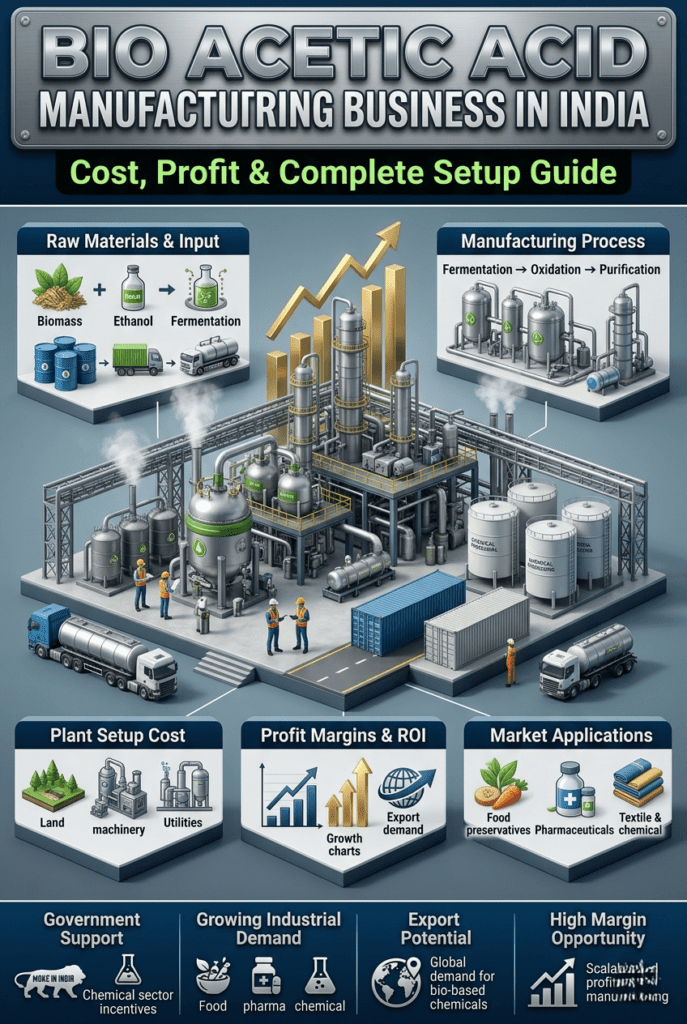
Step-by-Step Process to Set Up the Plant
Setting up of a bio-acetic acid producing plant can be achieved with proper planning but the procedures involved are quite simple.
First, register the business. The two most popular choices for entrepreneurs are Private Limited Company or LLP. And, Udyam Registration is necessary to avail government benefits. GST is also essential for the sale of chemicals.
Once the legal procedures are done, the next step is to establish infrastructure. For a plant, 2,000-3,000 sq ft space of covered area and some storage is required. It is recommended that the plant should be set up at industrial locations in states such as Gujarat, Maharashtra and Tamil Nadu because of the better infrastructure and ease of operation.
After this, machinery installation takes place. The manufacturing process involves fermentation and purification.
Equipment needed includes:
- Fermentation vessel (SS 316L)
- Aeration and agitation system
- Distillation column
- Cooling tower and heat exchanger
- Storage tanks and testing equipment
These are the core of your production equipment.
Raw Material Availability in India
The great advantage of this business is the availability of raw materials in India. Bio-acetic acid is made from renewable feedstocks that are readily available.
Common raw materials include:
- Sugarcane molasses (cheap and readily available)
- Mahua flowers
- Crop waste such as rice straw and cassava peel
Maharashtra, Uttar Pradesh, Karnataka and Tamil Nadu are good sources. Direct sourcing from suppliers ensures smooth production and higher margins.
Build a profitable business with the right idea
Licences and Approvals Required
A number of licences are required to start the business. Although it is time consuming, it is not difficult like in heavy chemicals.
You will need:
- Factory Licence (from the state)
- Pollution Control Board approval (CTE & CTO)
- FSSAI licence (if for food-grade)
- BIS certificate (for industrial clients)
- Fire safety clearance
Typically, approvals can be done in 3 to 5 months, depending upon documentation
Government Schemes and Financial Support
The Indian government has various schemes to promote small manufacturing enterprises, particularly those committed to sustainability.
Some important schemes include:
- PMEGP: Offers 25% – 35% subsidy on project cost
- CGTMSE: Provides collateral-free loans up to ₹2 crore
- MUDRA Loans: Good for smaller loans
- State subsidies: Power tariff and tax subsidies
Such scheme schemes considerably reduce the capital costs and bring projects within affordable means.
Why Proper Planning Is Important (NPCS Role)
Not all entrepreneurs fail due to demand, but due to planning. For example, starting a chemical manufacturing business without technical know-how may result in wrong decisions.
Here, NIIR Project Consultancy Services come in handy. They offer project reports containing:
- Complete manufacturing process
- Machinery and cost estimation
- Financial projections
- Market analysis
- Bank loan documentation
Their reports are well accepted by banks and can help get funding for schemes such as PMEGP and CGTMSE. This advice can help minimise the risk for new entrepreneurs.
Related Article: India Imports 85% Acetic Acid: The ₹10,000 Crore Chemical Manufacturing Opportunity (2026–2031)
Marketing and Sales Strategy
Bio-acetic acid is easier to market than other products because there is a market. The trick is to start small and establish a relationship with customers.
Rather than going after a large market, go after:
- Local pharmaceutical companies
- Food processing units
- Textile and dye manufacturers
Delivering quality and quantity will help you build repeat business. You can scale up your plant once it is in steady production.
Challenges to Consider
The business has great prospects but it’s essential to know the risks.
It is necessary to produce high quality product, particularly if the customer is an industrial firm. Fermentation must be carefully supervised as a single error can reduce yields.
The availability of raw materials needs to be effectively managed. Multiple vendors minimise the risk of shortages and production stops.
These tasks can be managed by planning and employing a good team.
Conclusion: A Feasible and Scalable Venture
The production of bio-acetic acid is one of the rare business opportunities in India with high demand, low investment and government incentives. It’s not a pie-in-the-sky concept, but a reality in many states.
This business is not only lucrative in the long run, but also stable, if the entrepreneur is willing to take some risks and work hard. The key to success is to start small, keep quality high and develop a network of buyers.
Frequently Asked Questions (FAQs)
Q1. What is the cost of setting up?
A small-scale plant can be established with an investment of ₹46-72 lakh.
Q2. How long will it take to start production?
The overall project time frame required to set up is from 10-14 months.
Q3. Do you need technical know-how?
Some knowledge is beneficial, but it is recommended to appoint a trained supervisor.
Q4. What are the expected profits?
Net profits are around 18%-24%.
Q5. Is collateral free loan available?
Yes, MSMEs can get a loan without collateral under the CGTMSE.
Q6. How can I get assistance from NPCS in starting this business?
NIIR Project Consultancy Services offers project reports, financial and technical assistance to entrepreneurs for smooth plant setting up.