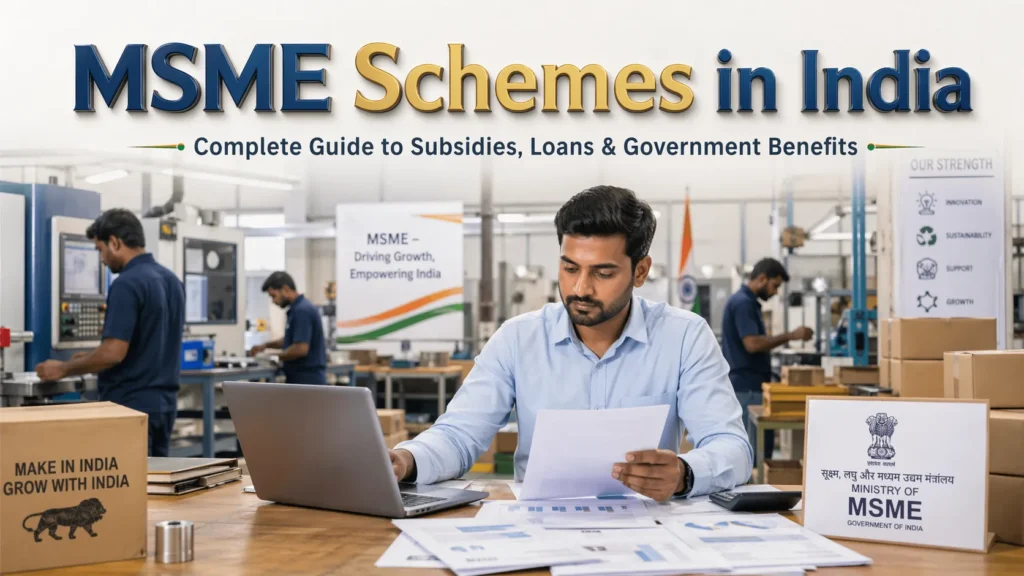

Introduction: MSME schemes in India
One of the well-built sectors of the Indian economy is the Micro, Small and Medium Enterprises (MSME) sector. It supports almost one-third of GDP and employs millions of individuals both in the rural and urban India.
Nevertheless, many entrepreneurs have one big problem namely, insufficient funds and knowledge of government programs. Interestingly, India is already well-established with a complete subsidy and credit system, but it is not used to its full potential because of the complicated procedures and absence of proper guidance.
Nowadays, subsidies, loans are provided without collaterals, and state incentives allow MSME entrepreneurs to start up and grow their business at a considerably low cost. The difficult thing is to understand what scheme suits your business, and utilize it properly.
Related Article: JanSamarth Loan Apply Online 2026: Complete Government Business Loan Guide for MSME
MSME Classification in India
It is necessary to know about MSME classification before delving into schemes. The classification of businesses is according to investment in plant and machinery as well as turnover annually.
- Micro enterprises: Investment up to 1 crore and turnover up to 5 crores.
- Small businesses: Investment less than 10 crore and turnover less than 50 crore.
- Medium enterprises: Investment increase of up to 50 crore and turnover increase up to 250 crore.
This categorization is significant since subsidies and loans are determined by it. The majority of schemes demand Udyam Registration, the official MSME registration in India.
Major MSME Schemes in India
India has a number of governmental programs which assist the business owners in various phases of the business development.
Read the Complete Book Here: Our Books
PMEGP – Prime Minister Employment Generation Programme
PMEGP is the most popular scheme among new entrepreneurs. It assists people to initiate micro enterprises by availing them with financial aid as a subsidy of margin money.
In this scheme, a subsidy of 15 to 35% of the project cost would be given to eligible applicants based on location and category.
It is particularly applicable to first time business people who wish to establish manufacturing or service-based businesses.
MUDRA Loan Scheme
MUDRA scheme is a collateral free loan scheme to the micro and small businesses. It is among the simplest financing means in India.
The scheme is categorized into three:
- Shishu: Less than ₹50,000 to very small startups.
- Kishore: 50,000-5 lakh to expand businesses.
- Tarun: 5 to 10 lakh to existing micro units.
Such loans are extended by banks, NBFCs and microfinance institutions.
CGTMSE Scheme
Credit Guarantee Scheme of Micro and Small Enterprises (CGTMSE) enable the enterprises to borrow money without collateral.
Key benefits include:
- Loan up to 2 crores.
- Government-backed credit guarantee
- Less difficult bank approvals.
- Less risk to the lenders.
The scheme is very vital to businesses which lack assets to pledge.
Get Detailed Project Report (DPR): Project Reports & Profiles
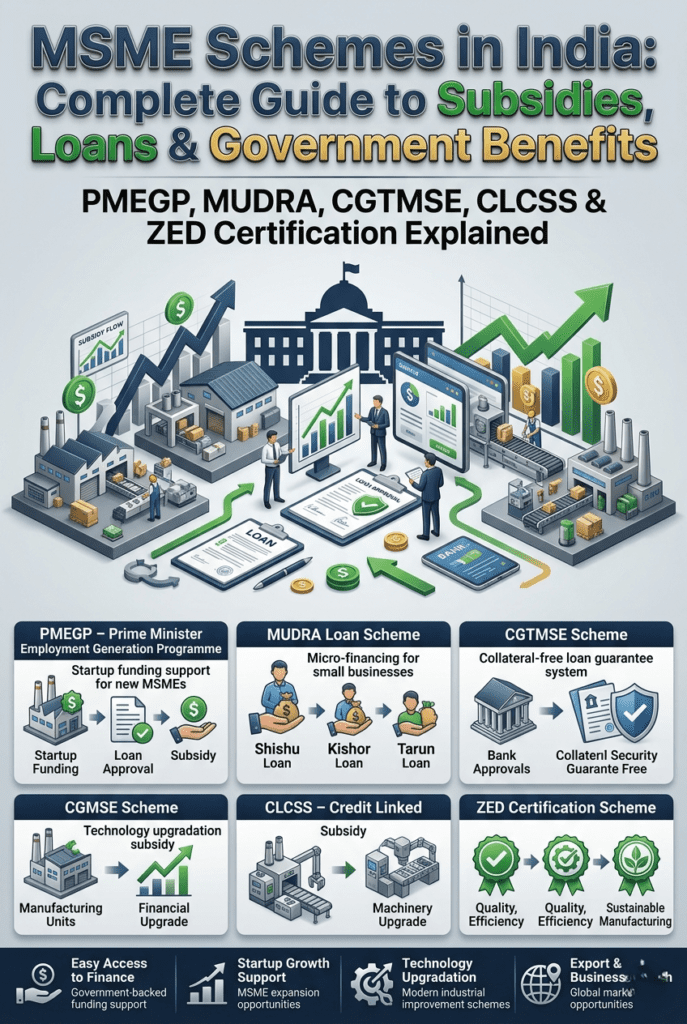
CLCSS – Technology Upgradation Subsidy
This plan encourages companies that desire to modernize the equipment and embrace new technology. It assists in enhancing productivity and competitiveness within manufacturing industries.
- Gives as much as 15% capital subsidy.
- Maximum benefit of up to 15 lakhs.
- Usable on approved equipment.
ZED Certification Scheme
Zero Effect Zero Defect (ZED) scheme encourages quality production and sustainability.
Benefits include:
- Reimbursement of certification cost.
- Export preparedness support.
- Promotion of environmentally friendly manufacturing.
Such a plan is particularly applicable to manufacturers who have a global target.
State Government MSME Schemes
In addition to central government schemes, state governments provide some other incentives to MSMEs as well.
There are some large-scale ones, such as:
- Gujarat: Subsidy of interest and lower cost of industrial land.
- Maharashtra: Capital subsidy on micro enterprises.
- Tamil Nadu: Power tariff and wage support benefits.
- Karnataka: MSME interest subvention.
- Capital subsidy on manufacturing units in Rajasthan:
- Uttar Pradesh: ODOP scheme in Favor of local products.
Such plans are usually combined with central subsidies, with the net effect of boosting the overall benefits of entrepreneurs.
How to Apply for MSME Schemes
The application is easy and should be well planned and documented.
The first one is that all businesses need to undergo Udyam Registration, which is free of charge and online. Most MSME schemes are obliged to register.
Once registered, the next thing to do is to decide the appropriate scheme according to your business stage. As an illustration, new entrepreneurs tend to use under PMEGP and existing businesses use MUDRA or CGTMSE.
Preparation of a Detailed Project Report (DPR) is one of the most crucial steps. This document includes:
- Business model and product information.
- Set up and machinery cost.
- Financial projections
- Market demand analysis
- Break-even estimation and profit.
It is hard to get loan or subsidy approval without a powerful DPR.
Lastly, applications are done via banks, DIC offices or government portals depending on the scheme. Upon verification and inspection, subsidies or funds are granted.
Stop guessing—choose the right business with confidence
Challenges Faced by MSME Entrepreneurs
Although the government is very supportive, most of the entrepreneurs continue to encounter problems like:
- Inadequate knowledge regarding schemes.
- Poor or unsuccessful project reports.
- Bank delays.
- Lack of comprehension of eligibility requirements.
- Poor documentation management
Such difficulties tend to lead to rejection or postponement of applications.
Role of NPCS (Niir Project Consultancy Services)
Professional guidance is of great importance in such a complex eco system. NPCS (Niir Project Consultancy Services) is a reputable consultancy that assists businesspeople with the planning and paperwork.
NPCS offers services including:
- Detailed Project Reports (DPRs)
- Market research and feasibility studies.
- Cost analysis and machinery.
- MSME scheme guidance
- Investment planning support
The reports will be tailored to meet bank and government standards, which further enhances the success of loan and subsidy approval.
In the case of first-time entrepreneurs, NPCS serves as an intermediary between the schemes of the government and their practical application to minimize risks of rejection and save time.
Conclusion
The government support provided by MSME schemes in India creates a strong business development opportunity for entrepreneurs who want to establish and expand their companies. The system provides financial relief to small businesses through its various funding options which include PMEGP subsidies and CGTMSE collateral-free loans.
The process requires proper understanding together with appropriate documentation and execution to achieve success. The ecosystem gives entrepreneurs significant advantages when they select appropriate funding programs and develop their project documentation.
The current period of Indian MSME growth represents an optimal time because digitalization is increasing while government funding for MSMEs is becoming more accessible. The business development process which starts with an idea and ends with a successful company launch becomes simpler through expert assistance from organizations like NPCS.
Frequently Asked Questions (FAQ)
Q1. Which MSME scheme is best for new entrepreneurs?
The PMEGP program serves as the most appropriate option for entrepreneurs who plan to launch their first business.
Q2. Is Udyam Registration compulsory?
The registration process is required because it serves as the primary requirement needed to obtain most Micro, Small, and Medium Enterprise(MSME)programs and their associated benefits.
Q3. Can MSME loans be taken without collateral?
The CGTMSE and MUDRA programs offer borrowers the option to obtain loans without requiring any physical assets as security.
Q4. How much subsidy can MSMEs get?
The subsidy amount which MSMEs can receive ranges between 15 percent and 35 percent based on their particular program and eligibility requirements.
Q5. What is NPCS?
The Organization NPCS (Niir Project Consultancy Services) provides entrepreneurs with assistance through project reports and feasibility studies along with MSME planning support.