
Manufacturing Business in Afghanistan
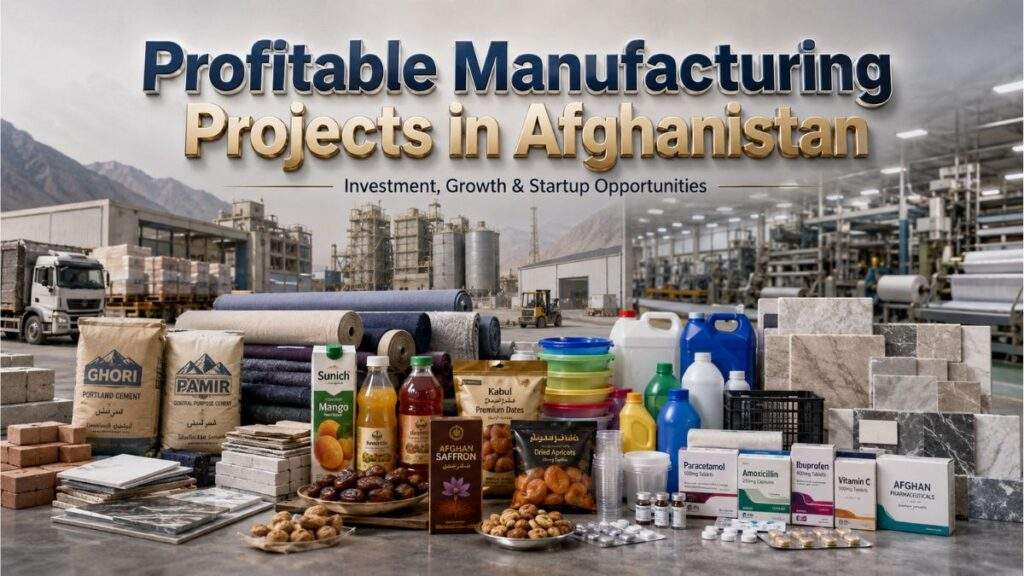
Although Afghanistan is not often cited as a manufacturing hub, it provides one of the best industrial opportunities in Asia. There are significant gaps in local manufacturing in Afghanistan and many developing markets are already saturated with competition. It is a country with high level of agricultural and mineral resources; however, its processing facilities are less. This imbalance means the export of raw materials is done at a more affordable price than the import of finished goods.
This is a huge opportunity for those who are entrepreneurs who are willing to be among the early entrants.
Afghanistan has a wide export of raisins, almonds, pistachios, saffron and dried fruits each year. But, most of these products are not cleaned, graded, branded and packaged within the country. International companies process the articles in UAE, Europe and India and take the biggest benefits.
It is the same in the case of construction materials and pharmaceuticals. Though there are high demand in Afghanistan, but Afghanistan is importing most of the building materials and medicines from neighboring countries.
This is a golden opportunity for Indian entrepreneurs and MSME investors to play a first-mover advantage.
Why Afghanistan Has Strong Manufacturing Potential
Business opportunities can be the largest when the supply chain is incomplete. This is evident from the economy of Afghanistan. The country is still relying on imports for products which can be produced locally.
There are some major market gaps such as:
- Limited facilities for food processing.
- Higher dependency on imports for medicines
- Low local production of construction materials
- Agricultural production that is big but not adequately processed.
- The increased demand in the cities of Kabul, Kandahar and Herat.
This means that manufacturers have good profit margins available due to the combination of raw material availability and low competition.
One of the other key benefits is that of exports. Afghan saffron, raisins, almonds and apricots already enjoy a good reputation in the international markets. The lack of an industrial processing and branded packaging layer.
It is here that manufacturing companies can really make healthy margins.
Related Article: Best Import Substitution Industries in Afghanistan
Dry Fruit Processing: The Best Low-Risk Manufacturing Opportunity
Dry fruit processing is the most feasible business opportunity for the entrepreneurs in all the manufacturing sectors in Afghanistan.
Afghanistan already has high-quality:
- Raisins
- Pistachios
- Almonds
- Dried apricots
- Saffron
But the major products are exported in their raw state. These products can have their market value enhanced significantly when the businesses involved in their cleaning, sorting, grading, packaging and branding do so.
Why This Business Works
The raw material supply is already available and there is a steady demand for exports in the following markets:
- UAE
- Germany
- Saudi Arabia
- India
- United Kingdom
The investment in the medium scale processing unit is in the range of ₹64 lakh to ₹1.10 crore depending upon the level of automation and production capacity.
Basic Machinery Required
A machine used to clean and de-stone.
- Colour sorting machine
- Grade and size equipment
- Packaging line
- Cold storage unit
- Moisture testing devices
The majority of the machinery can be obtained from industrial cities in India like Ahmedabad, Ludhiana and Pune.
One of the most significant benefits of this sector is that it is non-violent. It is easier to meet the regulatory requirements than for pharmaceuticals. The margins on exports are much greater than in heavy construction manufacturing.
Dry fruit processing is probably the best and most secure venture for the first time industrial entrepreneurs.
Get Detailed Insights from This Book: Drying & Milling of Cereal Foods
Construction Material Manufacturing: A Growing Domestic Market
The cities of Afghanistan are growing at a high rate, however the capacity to produce building materials is low. Hence contractors heavily depend upon import from Pakistan, Iran and China.
It provides good prospects in the following industries:
- Hollow concrete blocks
- Marble processing
- Tiles and stone finishing
- Cement-based products
Another attractive manufacturing option for hollow concrete blocks is that the setup cost is relatively low and a demand exists.
Why Demand Is Rising
Across Kabul and other cities urban development projects are still on the rise. Construction materials are needed for residential buildings, commercial buildings, warehouses, and roads.
A medium sized block manufacturing unit can manufacture thousands of blocks in a day and deliver to local contractors.
Key Advantages
- Lower setup cost
- Simple machinery requirements
- Immediate domestic demand
- Stable recurring orders
Another sector that has potential is the marble processing sector since Afghanistan has great reserves of marble, but lacks modern finishing facilities. The majority of the marbles produced are not cut or polished and the value added is left for foreign processors.
Pharmaceutical Manufacturing: High Investment, High Margins
Pharmaceuticals are the greatest opportunity in Afghanistan with a high barrier to entry and some great long-term returns.
Medicines, including basic generic medicines, are mostly imported in Afghanistan. Most of the products used, such as painkillers, antibiotics, vitamin tablets and so on are imported.
This gives a huge opportunity to local pharmaceutical formulation plants.
The selection of products with strong demand.
- Tablets
- Capsules
- Antibiotics
- Vitamin supplements
- Pain relief medicines
The cost of a pharmaceutical manufacturing project is typically between ₹1.5 crore and ₹4 crore, depending on the scale of production and the standards for compliance.
Major Requirements
- WHO-GMP compliance
- Regulatory approvals
- Skilled technical workforce
- Clean-room infrastructure
Set-up is more complex but operation margins can be very high after approvals are given, due to limited competition.
It is the best place for experienced industrial investors who can deal with the regulatory and operational complexity.
Access Complete Business Plan: India Pharmaceutical API Market Report
Why Indian Entrepreneurs Have an Advantage
Indian companies currently are well established at using:
- Food processing
- Pharmaceutical manufacturing
- Industrial machinery
- Packaging solutions
- Export management
Geographical proximity and ready access to machinery are other advantages for Indian entrepreneurs. Technical support and the availability of spare parts are relatively easy in the case of Industrial equipment import from India.
Indian MSMEs have a good strategic edge in the rapidly growing manufacturing sector of Afghanistan.
Importance of Proper Feasibility Planning
It is always advisable to start manufacturing projects in frontier markets with detailed feasibility analysis. Entrepreneurs must evaluate:
- Raw material availability
- Market demand
- Machinery costs
- Logistics
- Regulatory approvals
- Profitability projections
NPCS (NIIR Project Consultancy Services) is one of the leading Industrial consultancy firms of India which provides:
- Detailed Project Reports (DPRs)
- Techno-economic feasibility studies
- Financial projections
- Machinery guidance reports
- Market research analysis
- Plant setup planning
The reports are much used by entrepreneurs for bank loans, investor presentations, and industrial planning.
Entrepreneur India Magazine also offers more manufacturing opportunities and business insights in the industrial world.
Discover business ideas that actually make money
Conclusion
Despite the growing competition in other industrial markets, Afghanistan is still one of the markets in which this low competition can be found along with high raw material availability and increase in domestic demand. There are significant opportunities for entrepreneurs to build domestic manufacturing capability, as the country relies heavily on finished goods imports.
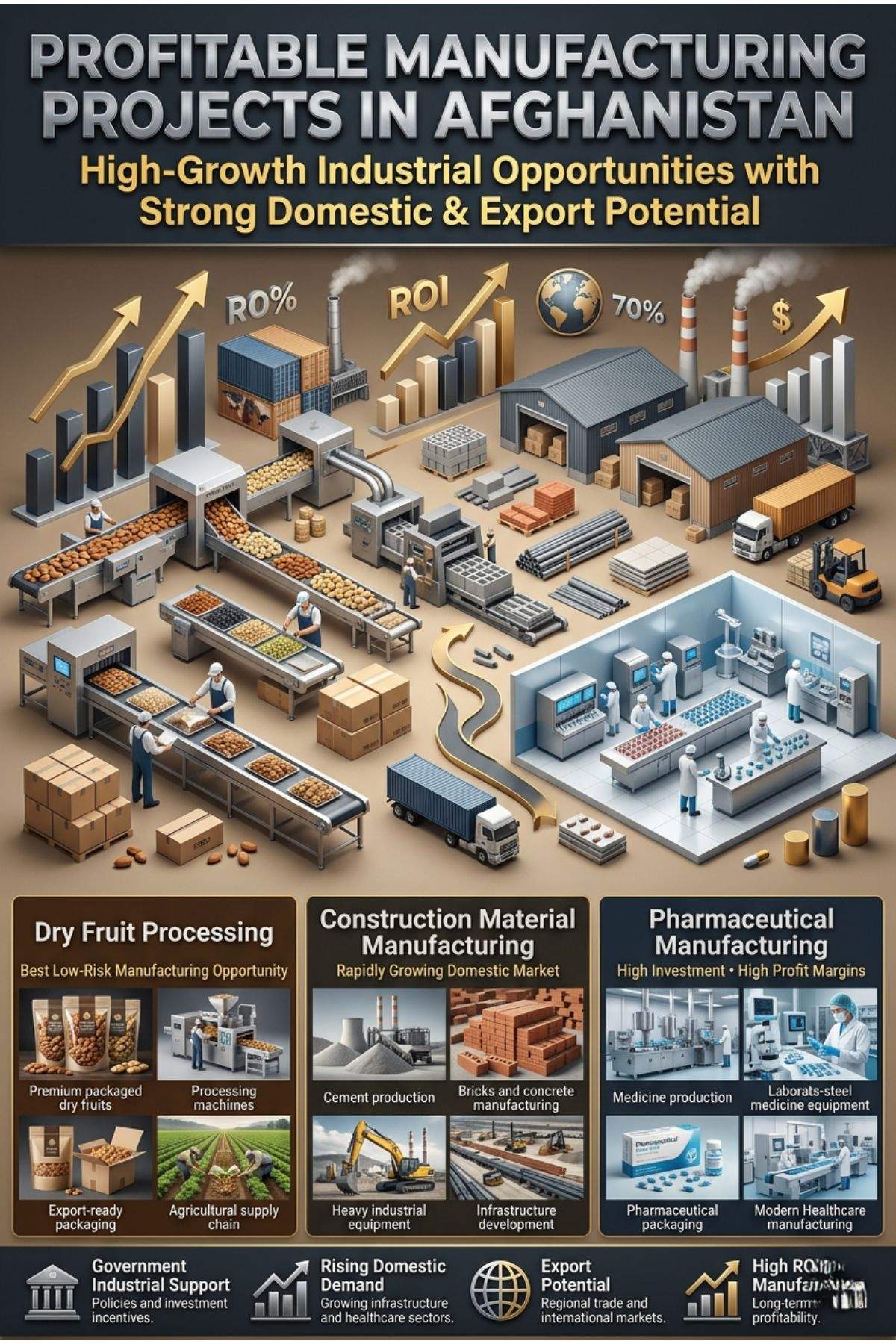
Currently, the best long-term prospects in every sector are seen in the dry fruit processing, construction materials and pharmaceutical manufacturing industries.
Early movers and those who establish good supplier networks, export channels, and systems will have a significant edge in the market before the larger regional players go on the attack.
A business is successful when it’s planned, executed and analyzed well in terms of feasibility. A few of those who take a strategic plunge today could reap huge rewards in future years.
Frequently Asked Questions (FAQ)
Q1. What is the best business to do in Afghanistan?
The dry fruit processing is, at present, seen as one of the most lucrative and viable opportunities in Afghanistan as the country has already recognized agricultural products which have high export demand.
Q2. What is the price needed for building a factory in Afghanistan?
The sector is a determinant of investment:
- Produce hollow blocks: ₹55–70 lakh
- Preservation of dry fruit: ₹8 lakh–₹1.50 crore
- Pharmaceutical formulation: ₹1.5–4 crore
Q3. Are there export opportunities for manufacturing in Afghanistan?
Yes. Saffron, raisins, almonds, pistachios, and dried fruits already have established demand in international markets in GCC countries, Europe and South Asia.
Q4. What are the key risks to be considered in Afghanistan manufacturing projects?
The primary challenges are:
- Political uncertainty
- Problems with logistics and transportation.
- Currency fluctuations
- Infrastructure limitations
The downside is of course that there is little competition and significant market gaps, but the upside is that they also have high growth potential.
Q5. Is it legal to invest in Afghanistan by Indian entrepreneurs?
Yes. Indian businessman can invest with compliance of FEMA and export-import regulations and local approval by Afghanistan.
Q6. What are NPCS’s services to an entrepreneur who is planning factory work?
Project reports, feasibility reports, machinery suggestions, cash estimates and consultancy services are given in detail on the NPCS Official Website for industrial projects for manufacture.