
Profitable Manufacturing Projects in Afghanistan
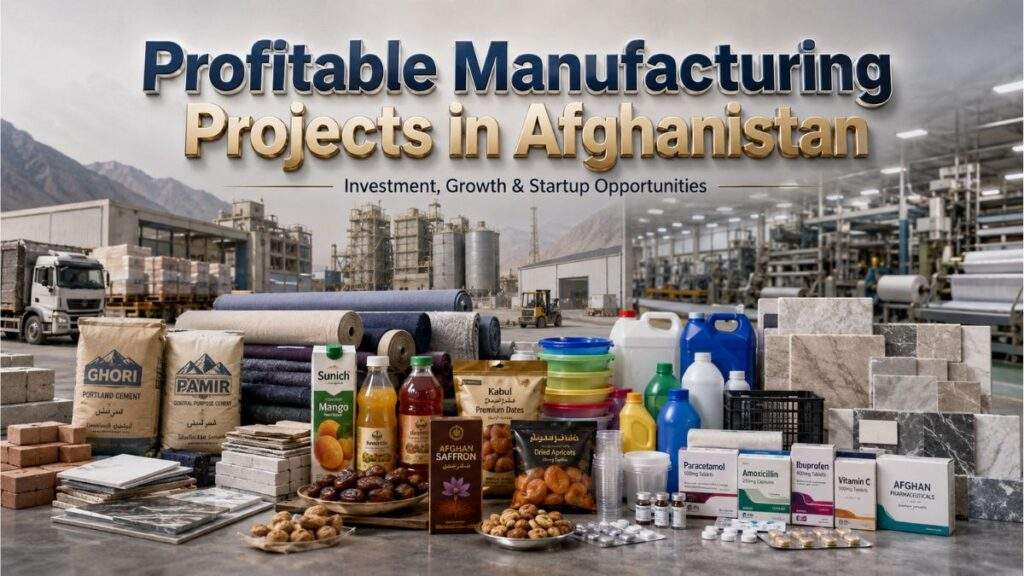
Manufacturing Business in Afghanistan Although Afghanistan is not often cited as a manufacturing hub, it provides one of the best industrial opportunities in Asia. There are significant gaps in local manufacturing in Afghanistan and many developing markets are already saturated with competition. It is a country with high level of agricultural and mineral resources; however, its processing facilities are less. This imbalance means the export of raw materials is done at a more affordable price than the import of finished goods. This is a huge opportunity for those who are entrepreneurs who are willing to be among the early entrants. Afghanistan has a wide export of raisins, almonds, pistachios, saffron and dried fruits each year. But, most of these products are not cleaned, graded, branded and packaged within the country. International companies process the articles in UAE, Europe and India and take the biggest benefits. It is the same in the case of construction materials and pharmaceuticals. Though there are high demand in Afghanistan, but Afghanistan is importing most of the building materials and medicines from neighboring countries. This is a golden opportunity for Indian entrepreneurs and MSME investors to play a first-mover advantage. Why Afghanistan Has Strong Manufacturing Potential Business opportunities can be the largest when the supply chain is incomplete. This is evident from the economy of Afghanistan. The country is still relying on imports for products which can be produced locally. There are some major market gaps such as: Limited facilities for food processing. Higher dependency on imports for medicines Low local production of construction materials Agricultural production that is big but not adequately processed. The increased demand in the cities of Kabul, Kandahar and Herat. This means that manufacturers have good profit margins available due to the combination of raw material availability and low competition. One of the other key benefits is that of exports. Afghan saffron, raisins, almonds and apricots already enjoy a good reputation in the international markets. The lack of an industrial processing and branded packaging layer. It is here that manufacturing companies can really make healthy margins. Related Article: Best Import Substitution Industries in Afghanistan Dry Fruit Processing: The Best Low-Risk Manufacturing Opportunity Dry fruit processing is the most feasible business opportunity for the entrepreneurs in all the manufacturing sectors in Afghanistan. Afghanistan already has high-quality: Raisins Pistachios Almonds Dried apricots Saffron But the major products are exported in their raw state. These products can have their market value enhanced significantly when the businesses involved in their cleaning, sorting, grading, packaging and branding do so. Why This Business Works The raw material supply is already available and there is a steady demand for exports in the following markets: UAE Germany Saudi Arabia India United Kingdom The investment in the medium scale processing unit is in the range of ₹64 lakh to ₹1.10 crore depending upon the level of automation and production capacity. Basic Machinery Required A machine used to clean and de-stone. Colour sorting machine Grade and size equipment Packaging line Cold storage unit Moisture testing devices The majority of the machinery can be obtained from industrial cities in India like Ahmedabad, Ludhiana and Pune. One of the most significant benefits of this sector is that it is non-violent. It is easier to meet the regulatory requirements than for pharmaceuticals. The margins on exports are much greater than in heavy construction manufacturing. Dry fruit processing is probably the best and most secure venture for the first time industrial entrepreneurs. Get Detailed Insights from This Book: Drying & Milling of Cereal Foods Construction Material Manufacturing: A Growing Domestic Market The cities of Afghanistan are growing at a high rate, however the capacity to produce building materials is low. Hence contractors heavily depend upon import from Pakistan, Iran and China. It provides good prospects in the following industries: Hollow concrete blocks Marble processing Tiles and stone finishing Cement-based products Another attractive manufacturing option for hollow concrete blocks is that the setup cost is relatively low and a demand exists. Why Demand Is Rising Across Kabul and other cities urban development projects are still on the rise. Construction materials are needed for residential buildings, commercial buildings, warehouses, and roads. A medium sized block manufacturing unit can manufacture thousands of blocks in a day and deliver to local contractors. Key Advantages Lower setup cost Simple machinery requirements Immediate domestic demand Stable recurring orders Another sector that has potential is the marble processing sector since Afghanistan has great reserves of marble, but lacks modern finishing facilities. The majority of the marbles produced are not cut or polished and the value added is left for foreign processors. Pharmaceutical Manufacturing: High Investment, High Margins Pharmaceuticals are the greatest opportunity in Afghanistan with a high barrier to entry and some great long-term returns. Medicines, including basic generic medicines, are mostly imported in Afghanistan. Most of the products used, such as painkillers, antibiotics, vitamin tablets and so on are imported. This gives a huge opportunity to local pharmaceutical formulation plants. The selection of products with strong demand. Tablets Capsules Antibiotics Vitamin supplements Pain relief medicines The cost of a pharmaceutical manufacturing project is typically between ₹1.5 crore and ₹4 crore, depending on the scale of production and the standards for compliance. Major Requirements WHO-GMP compliance Regulatory approvals Skilled technical workforce Clean-room infrastructure Set-up is more complex but operation margins can be very high after approvals are given, due to limited competition. It is the best place for experienced industrial investors who can deal with the regulatory and operational complexity. Access Complete Business Plan: India Pharmaceutical API Market Report Why Indian Entrepreneurs Have an Advantage Indian companies currently are well established at using: Food processing Pharmaceutical manufacturing Industrial machinery Packaging solutions Export management Geographical proximity and ready access to machinery are other advantages for Indian entrepreneurs. Technical support and the availability of spare parts are relatively easy in the case of Industrial equipment import from India. Indian MSMEs have a good strategic edge in the rapidly growing manufacturing sector of Afghanistan.
Entrepreneur India April 2026: India’s Industrial Transformation Is Creating Business Opportunities Worth Billions

Entrepreneur India April 2026 India is now in a new phase of growth in the field of industries. The country is experiencing one of the biggest manufacturing growths in decades with the introduction of electric vehicles, use of advanced materials, green packaging solutions, and agro-processing as a few examples. Businesses that can be developed today in the right industries will be very lucrative over the next decade. NIIR Project Consultancy Services (NPCS), April 2026 issue of Entrepreneur India Magazine, features some of the most promising industrial opportunities that are now available in India. Entrepreneur India is different from the regular magazines which bring to light start-up stories or corporate news, it is all about real business opportunities supported by industrial research and project feasibility analysis. At a time when India is witnessing the growth of manufacturing sector due to various factors such as strong government support, escalating domestic demand, infrastructure development, and the global China+1 strategy, this edition comes at a perfect time. International companies are seeking manufacturing alternatives other than China, and India is among the most significant beneficiaries of this trend. Related Article: Entrepreneur India April 2026 Is Here — And It Could Change the Way You Look at Indian Manufacturing Why India’s Manufacturing Sector Is Growing So Fast Indian industry is on the rise due to a number of strong influences. The government is promoting domestic investment in manufacturing through various schemes such as Make in India and Production Linked Incentive (PLI) scheme in several industries. Concurrently, the growing urban demand and the surge in the demand of sustainable products are generating new business opportunities. The following are key factors in this growth: Expansion of EV and battery manufacturing Increasing demand for green products The development of infrastructure and logistics. Import substitution opportunities Growing demand for specialty chemicals. To give more attention to the use of renewable energy resources The April 2026 edition of Entrepreneur India delves into the sectors that are directly benefiting from these long-term economic shifts. High-Growth Business Opportunities Featured in Entrepreneur India April 2026 One of the best features of this issue is that it concentrates on industries that are scalable for the long-term and have a high future demand. Lithium-Ion Battery Assembly The Indian electric vehicle industry is rapidly expanding, leading to a significant demand for lithium-ion batteries and energy storage solutions. It is expected that Battery Manufacturing will be one of the largest industrial sectors in the near future in the country. There are opportunities in this sector for work in the following occupations: EV battery packs Solar energy storage Industrial battery systems Consumer electronics batteries Indian Government is also giving a push to electric mobility and entrepreneurs interested in this business might reap huge benefits in the coming years. Get Detailed Insights from This Book: Lithium-Ion & Lead-Acid Battery Production Get Detailed Insights from This Book: Just For Starters: How To Start Your Own Export Business Rice Husk Biodegradable Cutlery As regulations start to take effect and plastic bags are enforced for all consumers, there is a growing need for biodegradable options. Rice husk biodegradable cutlery is an ongoing business that emerges as profitable since it helps the conversion of agricultural waste to eco-friendly products. The following are some of the key benefits of this enterprise: Low-cost raw materials Growing export demand Eco-friendly market positioning The support for sustainable manufacturing is provided by government. It’s a good example of the conversion of waste materials to commercially useful materials. Carbon Fiber Reinforced Polymer (CFRP) The applications of carbon fiber reinforced polymer are in the fields of aerospace, automotive, railways, renewable energy and construction. India currently has significant import dependence on CFRP products, thus presenting a high level of import substitution potential for domestic CFRP manufacturers. The sector has potential due to: High industrial demand Strong profit margins Advanced manufacturing growth Long-term infrastructure expansion View Full Project Details: Carbon Composite Fiber Manufacturing Plant Report Hesperidin and Pectin Extraction The magazine also makes an in-depth focus on opportunities for citrus peel processing. Citrus waste has been used to extract hesperidin and pectin, which are relevant for the food processing, cosmetic, pharmaceutical, and nutraceutical industry. This business model is desirable because: Raw materials will cost less. The finished products are of high value. Demand is increasing globally Increased profitability due to waste utilization. Circular Economy Manufacturing Is Becoming a Major Trend One of the key topics in the April 2026 issue is circular economy manufacturing. Agricultural waste, food waste, or industrial waste are increasingly being used for profit by businesses. Entrepreneurs are now converting waste into: Biodegradable packaging Nutraceutical ingredients Industrial chemicals Eco-friendly consumer products These businesses can usually enjoy high profitability as the raw material costs are low, and there is a demand from the consumer for “green” products, which entitle them to premium prices. The push towards sustainability in the environment is likely to bring even more opportunities from this segment in India in the coming decade. Why Import Substitution Businesses Have Huge Potential India still has a high dependence level on imports for many industrial products and specialty materials. This opens up huge possibilities for Indian entrepreneurs to set up indigenous manufacturing units. The following industries have high import substitution potential: Specialty chemicals Battery materials Advanced engineering products Industrial minerals High-performance materials The government actively encourages domestic production by providing incentives, subsidies and infrastructure support. There is potential for policy-driven growth as well as strong demand for entrepreneurs to enter these sectors. How NPCS Helps Entrepreneurs Start Manufacturing Businesses NIIR Project Consultancy Services (NPCS) is one of the most experienced project consultancy and industrial research firms in India having over 45 years of experience. NPCS provides support for entrepreneurs through: Detailed Project Reports (DPRs) Techno-economic feasibility studies Market research reports Plant setup guidance Financial projections Bank loan documentation Selecting suitable machinery and processes Thousands of entrepreneurs, MSMEs, investors, financial institutions use the NPCS reports to assess the manufacturing opportunities and industrial projects. The main strength of NPCS is its specialization