
Electrical & Electronics Manufacturing Business
For those who are looking around for business ideas with a long-term horizon, it is a good idea to take a second look at India’s electrical and electronics manufacturing base, because it is one of the most significant changes that the industry is currently undergoing. The reasons are not philosophical. Wiring and protection devices are required on every new residential tower; batteries packs are required for every electric two-wheeler, control panels are required for every industrial shed and every motor rewinding shop requires enamelled copper wire.
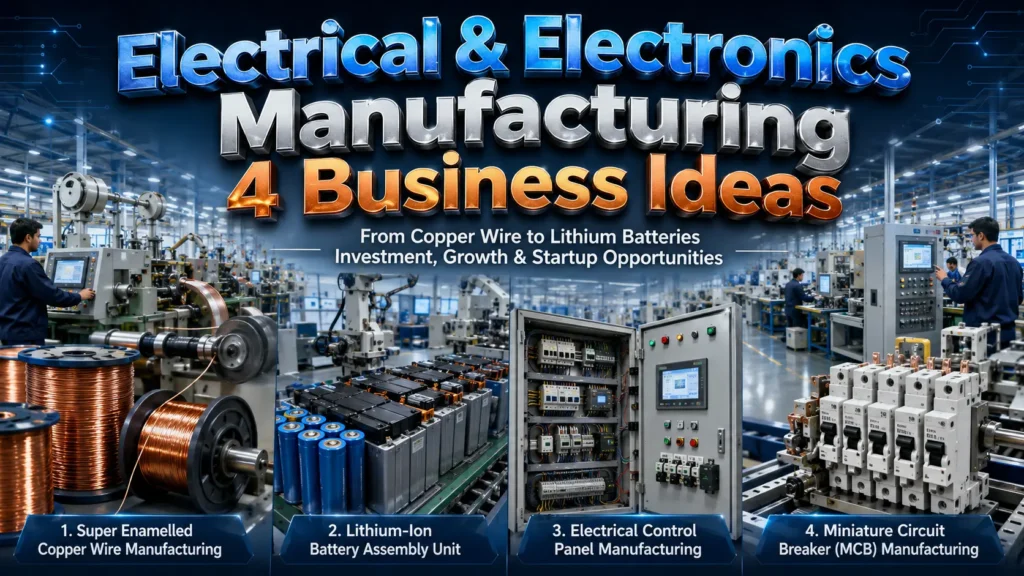
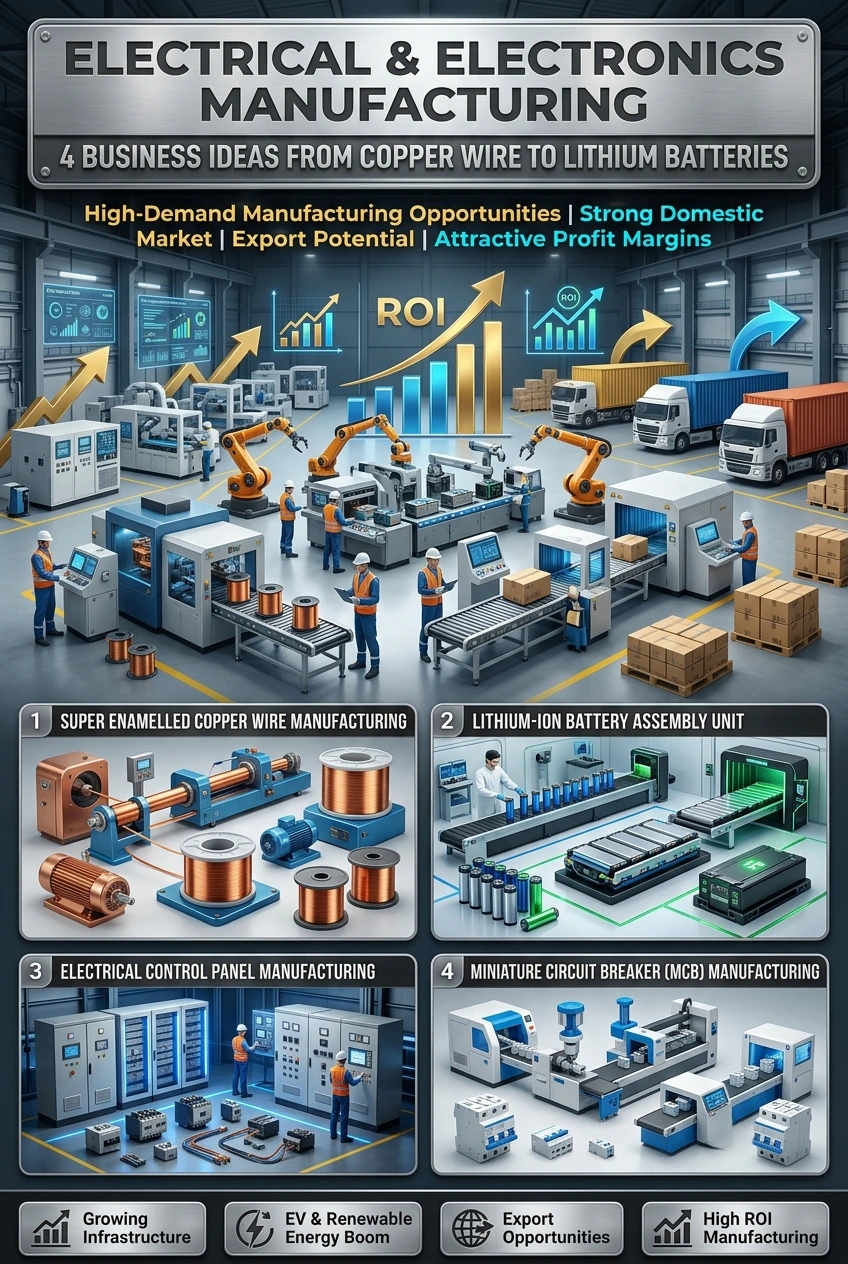
This article outlines four real manufacturing opportunities – Super Enamelled Copper Wire, Lithium-Ion Battery Assembly, Electrical Control Panels, and Miniature Circuit Breakers (MCBs) – in a way that a consultant would approach when considering a project for a first-generation entrepreneur with practical, feasibility-oriented logic.
Why This Sector Deserves Attention Right Now
It is unusual and noteworthy that three separate demand curves are converging at the same time. Construction and real estate activities are driving up the demand for control panels and MCBs as distribution boards and protective switchgear are essential for any commercial or residential project prior to its use. At the same time, the electric mobility transition is generating a completely new supply chain for components: lithium-ion cells and battery packs—an industry that existed only in small quantities a decade ago.
But there is an undercurrent to these, the simple enamelled copper wire, which is used in almost every motor, transformer and generator the country produces and whose consumption goes hand-in-hand with industrial growth and investment in infrastructure, rather than any one trend.
The mix is appealing from a profitability perspective on a few reasons: It covers both established, cash-generating businesses (copper wire and MCBs) and growth businesses that offer more opportunity for new entrants (battery assembly and control panels for niche applications). A consultant who reviews this area will consider raw material cost pass-through, as well as the trust of the brand in products where safety is a critical issue, and the ability to service the OEM client on a recurring basis — and all three points would find electrical manufacturing to be reasonably defensible once a unit has proven themselves.
There is another export aspect: Indian products such as wiring, panels and battery packs are increasingly selling in the African, Middle East and South Asian markets, where Indian products that are price competitive and reasonably certified are well-positioned against higher-priced options.
Related Article: How to Start an Electrical Manufacturing Business in India – Profitable Ideas & Complete Guide
Government Policies and Incentives Supporting New Entrants
Entrepreneurs may not be aware but policy support for this sector is more widespread than they imagine and can substantially alter the economics of a project if used correctly. The Production Linked Incentive (PLI) for Advanced Chemistry Cell (ACC) battery storage has secured significant investments in large-scale Lithium-Ion Batteries (LIB) manufacturing in India, while the smaller battery pack assembly units indirectly benefit from the cell ecosystem being nurtured by the PLI scheme. The PLI scheme for White Goods and the overall PLI for electronics manufacturing similarly provide benefits for component suppliers that supply to the larger assembly business, such as control panel and switchgear component suppliers.
On the borrower’s side, there is a credit guarantee scheme and the assistance of the Ministry of MSME for collateral-free loans provided to a first-time entrepreneur, which makes it a lot easier to avail the working capital without pledging family property and availability of interest subvention schemes that reduce the cost of the term loans for plant and machinery.
The FAME and then the EV linked incentive program by the government of the country known as Ministry of Heavy Industries has benefited indirectly the demand for Lithium-ion battery assembly by providing subsidy to end-vehicles, which trickles down to the supplier of components. State-level industrial policies, especially in the states that actively promote the electronics and EV component industries, often add on power tariff concessions, stamp duty exemption, and capital subsidy. Eligibility details are updated periodically; therefore, readers can check scheme details directly on the Ministry of MSME portal for authentic and updated scheme details.
Multiple Business Ideas for Startups in This Sector
1. Super Enamelled Copper Wire Manufacturing
Super enamelled copper wire is the “plain vanilla” of the electrical motor and transformer industry, and this is why it’s a viable business venture for a serious entrepreneur and not a hobby. The product consists of copper conductor covered with a number of layers of enamel (polyester, polyesterimide or polyamide-imide) which are applied to the conductor by a continuous line of wire-drawing and enamelling, and then baked in ovens to the dielectric strength and thermal class desired by applying the end-user. The range of real-world applications is vast, including domestic and industrial motors, transformers, generators, relays, solenoids and household appliances, and is far from seasonal like some customer types.
An important manufacturing tip is that most quality complaints come at the enamelling oven stage of the process and not at the wire drawing stage, so it’s important to budget enough for a sure-fire multiple pass enamelling machine, not the wire drawing. One of the key raw materials, which is subject to price volatility, is Copper wire (rod) used in electrolytic production and Enamel varnish used for coating the wires, which are sold to customers on a formula basis.
Motor rewinding industry, OEM transformer manufacturers, fan and pump industry, the motor rewinding industry is a major consumer of copper wire and the fan and pump industry is a major user of copper wire, and the motor rewinding industry is a major demand driver for copper wire, and because copper wire is an actual input and not discretionary, the revenue can be tracked fairly closely with the industrial production data.
Processing efficiency and working capital discipline are most important factors affecting profitability in this category, as copper content is significant in determining the overall cost, and a well-run processing unit with a consistent quality certification can benefit from long-term copper supply contracts with transformer and motor manufacturers which will greatly level the demand cycle.
Explore This Book: Manufacture of Electrical Cables, Wire and Wire Products Handbook
2. Lithium-Ion Battery Assembly Unit
Lithium-ion battery assembly is arguably the most dynamic of the four areas addressed here, and it is important not to lump the task of assembling imported or domestically produced cells with battery management systems, casing and thermal design into the cell manufacturing process: Assembly is a much more approachable entry point for a new manufacturer than cell chemistry. They’re used in electric two-wheelers and three-wheelers, home and commercial inverters, telecom backups, solar storage, and, more and more, forklift and material handling equipment in industry.
From the manufacturing end, the essential capabilities a new assembly unit requires are cell sorting and matching, spot welding / laser welding of tabs, BMS integration / calibration, and pack-level safety testing, which do not require extensive fabrication facilities. There is a significant amount of currency movement in the raw material sourcing, including a high proportion of lithium-ion cells (mainly Asian-based, established cell-makers, until the local ACC industry matures and can expand its footprint), BMS board and casing materials, so a feasibility study must include import logistics as a relevant part of the cost model.
Demand drivers are unusual, with multiple strong and varied ones all driving in the same direction at the same time – electric vehicle transition, rooftop solar storage adoption, and the replacement of older lead-acid systems in the telecom tower are just a few examples. A more profitable perspective on margins would be the one of the new unit buyers who are OEMs and especially EV manufacturers, all of whom would be more interested in the cycle life and safety consistency provided by the margins, than in the last few rupees off the unit price, which would reward the new entrants who have built their margins around quality, as opposed to those who have just competed on price.
3. Electrical Control Panel Manufacturing
An entrepreneur who has an electrical engineering background or can hire one early is the person who can better understand electrical control panels, making this business idea ideal for his or her needs. Switchgear, relays, meters, PLCs, wiring, and controls that control and protect industrial machinery, HVAC systems, water treatment plants and building electrical distribution needs are found in control panels and every factory, commercial building, and infrastructure project has some type of control panel. Manufacturing here is more assembly and engineering focused than heavy processing: Sheet metal fabrication or bought-out enclosures, busbar work, component mounting, wiring per approved drawings and factory acceptance testing prior to dispatch.
The key inputs are mild steel or powder-coated housing, copper bus bars, circuit breakers and contactors from well-known brands and control wiring – a considerable amount of the value-added work is in the engineering and assembly labour and testing, which is generally easier on working capital than a pure fabricating business. Order pipeline is somewhat lumpy, but high value – due to demand that is highly project linked, from real estate developers, industrial capex, water and wastewater infrastructure, and renewable energy installations.
In this category, it is advantageous to specialise: an inverter panel or a water treatment control panel specialist with a stable base of repeat business gets better margins and more regular order flow than a panel manufacturer that bases its business solely on tendering for a wide range of panels.
Discover business ideas that actually make money
4. Miniature Circuit Breaker (MCB) Manufacturing
There’s a difference between the MCBs and the other three in that the former is a more mature, brand consolidated category, which means that an entrepreneur should look at it differently, but not eliminate it — differentiation and quality certification become more important from the get-go. The MCB is designed to protect electrical circuits in a residence or light commercial building from overload and a short circuit, and its key elements must be fabricated to tight tolerances as it is safety-critical and must be certified to meet the relevant standards.
The plastics injection moulding of housings, precision assembly of the trip mechanism and the exhaustive testing for short circuit and endurance requirements require investment up-front and quality systems cannot be an afterthought. Raw materials include engineering grade plastics, bimetal strips, silver alloy contacts and copper components; and, frequently, it is the quality of the contact material that distinguishes between budget and premium products.
Demand drivers are very closely associated with residential and commercial building activity, rewiring of older buildings and with the required compliance in new electrical installations, resulting in a fairly predictable, infrastructure-driven growth path for the category. It is helpful to manufacturers who have been able to obtain certification from BIS and establish working relationships with electrical contracting firms and retailers, as trust and certification outweigh what the price tag is.
Import–Export Opportunity Analysis
The trade situation in this area is two-sided; a new business person should take this into account when completing a business plan. On the export side, India continues to export a significant percentage of battery cells and some grades of enamel varnish as well as precision electronic components for use inside in control panels and MCBs; a domestic assembly or manufacturing unit with a cost and lead-time advantage over pure importers is quite real.
On the export side, India’s copper winding wire, control panels designed to suit specific industrial applications have been selling well in Africa, the Middle East, Bangladesh and Nepal, where Indian manufacturers are able to outcompete Chinese or European products on price, quality and culture and logistics. If you’re looking to production for export markets, you should keep BIS in mind right away, and if applicable, international certification costs, as certification lead time may be the limiting factor in the export market, not production capacity.
Indian MSME Success Stories Worth Studying
A handful of Indian entrepreneurs offer genuinely instructive templates here. Havells India, built by Qimat Rai Gupta from a modest trading operation into one of India’s most recognised electrical brands, shows how consistent quality and aggressive brand-building in categories like MCBs and switchgear can out-compete larger unbranded players over time — the lesson for a new entrant is that trust, once earned in a safety-critical category, becomes the real moat.
Polycab India, founded by the Jaisinghani family starting from a small wires and cables trading business in Mumbai, demonstrates how deep specialisation in wire and cable manufacturing, paired with wide distribution reach, can scale a commodity-adjacent product into a market-leading enterprise — a directly relevant lesson for anyone considering the copper wire opportunity described above.
Exide Industries, one of India’s oldest battery manufacturers, illustrates a different but equally useful lesson for the lithium-ion battery assembly opportunity: incumbents with decades of lead-acid battery distribution and service networks are now pivoting into lithium chemistries, and a new entrant’s real competitive question is not just technology but how to build or partner into that kind of service and distribution depth over time.
How NPCS Can Support Your Project
We at Niir Project Consultancy Services (NPCS) provide professional consulting for the preparation of Market Survey cum Detailed Techno-Economic Feasibility Reports (DPRs) for setting up new industries or businesses, including each of the four opportunities discussed in this article. Our reports include detailed manufacturing processes, market research and demand analysis, process flow diagrams, product mix and capacity planning, machinery and raw material details, and complete project financials with profitability analysis.
Be it an entrepreneur looking into a small enamel-coated copper wire unit or a project into large lithium-ion battery assembly, we partner with the entrepreneur to assess feasibility, profitability, and sustainability of their business concept before they invest capital. This is based on our years of domain-specific data and field consulting experience in India’s diverse manufacturing ecosystem.
Get Detailed Project Report (DPR): E-waste Recycling (Electronic Waste, E-waste, E-scrap, Waste Electrical and Electronic Equipment (weee)) Disposal and Management Projects
Snapshot: Market Size, Growth and Entry Investment
| Product Segment | Approx. Market Size | Growth Outlook | Typical Entry Investment |
| Super Enamelled Copper Wire | Large, multi-thousand crore industry | Steady, driven by motors & transformers | ₹50 lakh – ₹2 crore (small unit) |
| Lithium-Ion Battery Assembly | Fastest-growing electrical segment | High double-digit growth, EV-led | ₹75 lakh – ₹5 crore (assembly line) |
| Electrical Control Panel | Sizable, fragmented, project-driven | Moderate-to-high, industrial capex linked | ₹25 lakh – ₹1.5 crore |
| Miniature Circuit Breaker (MCB) | Established, brand-consolidated | Steady, real estate & infra linked | ₹1 crore – ₹4 crore |
Figures are indicative, consultant-estimated ranges intended for preliminary planning; actual project cost depends on scale, location, and technology selected.
Frequently Asked Questions
Which of these four businesses needs the lowest starting capital?
Electrical control panel manufacturing and small-scale enamelled copper wire units generally have the lowest entry thresholds, since both can start on a modest scale with bought-out components and scale up as order volumes and client trust grow.
Is BIS certification mandatory for MCB manufacturing?
Yes, MCB’s requires mandatory quality certification because they perform critical functions related to safety, hence obtaining this early in product development should be a milestone of the project, as it impacts your access to the market and the credibility of the buyers.
Can a lithium-ion battery assembly unit start without manufacturing cells in-house?
Yes, and in fact most new entrants should start this way, source certified cells and focusing manufacturing effort on pack design, BMS integration, and testing, which is a more accessible and less capital-intensive entry point than cell production.
How important is location for a control panel manufacturing unit?
Proximity to industrial clusters, ports, or major infrastructure project corridors matters considerably, since control panels are often bulky, project-specific, and benefit from shorter logistics chains and faster site-support turnaround.
What is the typical gestation period before these businesses turn profitable?
Copper wire and MCB units, being closer to established supply chains, often reach steady operations within twelve to eighteen months, while control panel and battery assembly businesses can take somewhat longer to build the client relationships and certifications needed for consistent order flow.
Do these businesses require import of machinery?
Some specialised equipment, such as enamelling ovens or precision moulding machines for MCB housings, is often imported or sourced from specialised domestic suppliers, so a realistic project report should budget for both machinery cost and installation lead time.