
Manufacturing business ideas in Tamil Nadu
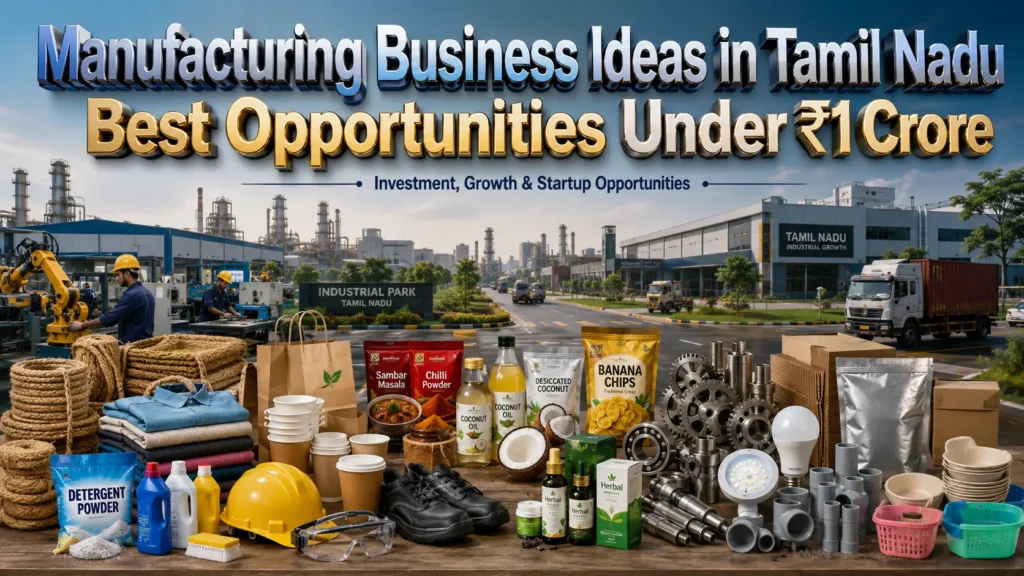
Tamil Nadu is now one of India’s most powerful manufacturing states and entrepreneurs with ₹1 crore in their pocket have more business ideas that are real than in any other part of the country. The state has a mix of port facilities, skilled workers, and a rich network of suppliers that most first-timers fail to recognise until they begin to survey land. To build a new unit in Chennai, Coimbatore, Tiruppur or Hosur does not require a strong demand base to be created.
As Chennai, Coimbatore, Tiruppur and Hosur already have established the demand base for the global supply chain, a new unit can be set up at these locations without facing any difficulty in creating demand. It just needs to connect to the existing.
This article dissects where the real scope lies, which government schemes are effective at cutting down your capital expenditure, and which particular manufacturing lines make sense at an investment of ₹1 crore. The objective is not a wish list, but a practical decision making.
Get Detailed Project Report (DPR): Tamil Nadu Business Opportunities Guide
Why Tamil Nadu Is the Right Base for This Investment
The production share of Tamil Nadu in India is one of the highest in the manufacturing sector, which isn’t a coincidence. For decades, the state has been spending money on developing industrial corridors and power plants and on vocational training colleges that churn out skilled manpower for the factories. Thus, a founder who establishes here can save time in training employees and more time in production stabilisation.
Access to exports is also important. A significant proportion of India’s exports are carried by Chennai and Tuticorin ports, reducing the cost of logistics for those who produce components, textiles or processed foods for export to international markets. Further, the cluster system in Tamil Nadu reduces working capital cycle as raw material suppliers, job-work vendors and testing labs are within a 50-kilometre radius.
Government Policies and Incentives Supporting New Units
There are a handful of schemes that directly decrease the effective amount of money that a founder has to invest. For those who have only ₹1 crore in their bank account, the credit guarantee fund trust for micro and small enterprises (CGTMSE) with collateral-free loans up to a defined limit is significant, and the Prime Minister’s Employment Generation Programme (PMEGP) is crucial for financing new manufacturing units by the ministry of MSME.
The Production Linked Incentive (PLI) scheme, under the Department for Promotion of Industry and Internal Trade (DPIIT), incentivises certain industries such as textiles and electronics for increasing their production and Tamil Nadu’s own state industrial policy also includes capital subsidy, stamp duty concession and power tariff relief. They should also visit Tamil Nadu Industrial Guidance Bureau to obtain single window clearance which takes away a significant portion of the delay in approvals that regularly drains the first year.
The Ministry of MSME website provides the scheme details with eligibility and caps on subsidy for each of these schemes.
Multiple Business Ideas Worth Evaluating
Textile Weaving and Processing Unit
Tamil Nadu also has a significant production of cotton yarn and knitwear – especially in Tiruppur and Coimbatore – and so a weaving or processing unit here exists within a pre-existing ecosystem rather than on the fringes. A mid-scale weaving unit, with dyeing and finishing capacity, and with a businessman with a capital of ₹1 crore, can start it with a selling price of direct transaction with export houses who are already procuring from the local market. Margins are far more related to the type of fabric and generally with processed cotton fabric, the realisation is higher than that of raw yarn trading, which makes it a better option for the new entrants than actually spinning.
Read the Complete Book Here: The Complete Technology Book on Textile Spinning, Weaving, Finishing and Printing
Auto Components and Precision Machining
Hosur and Chennai have a high concentration of auto and auto-ancillary manufacturing facilities, resulting in consistent and recurring demand for precision-machined parts. A job-work unit based on CNC can have two or three machines that can be expanded as quality certificates are received and order volumes increase with the budget of ₹1 crore. Geography is also a competitive advantage for the founders outside Tamil Nadu as OEMs like to use vendors in the vicinity of their assembly lines.
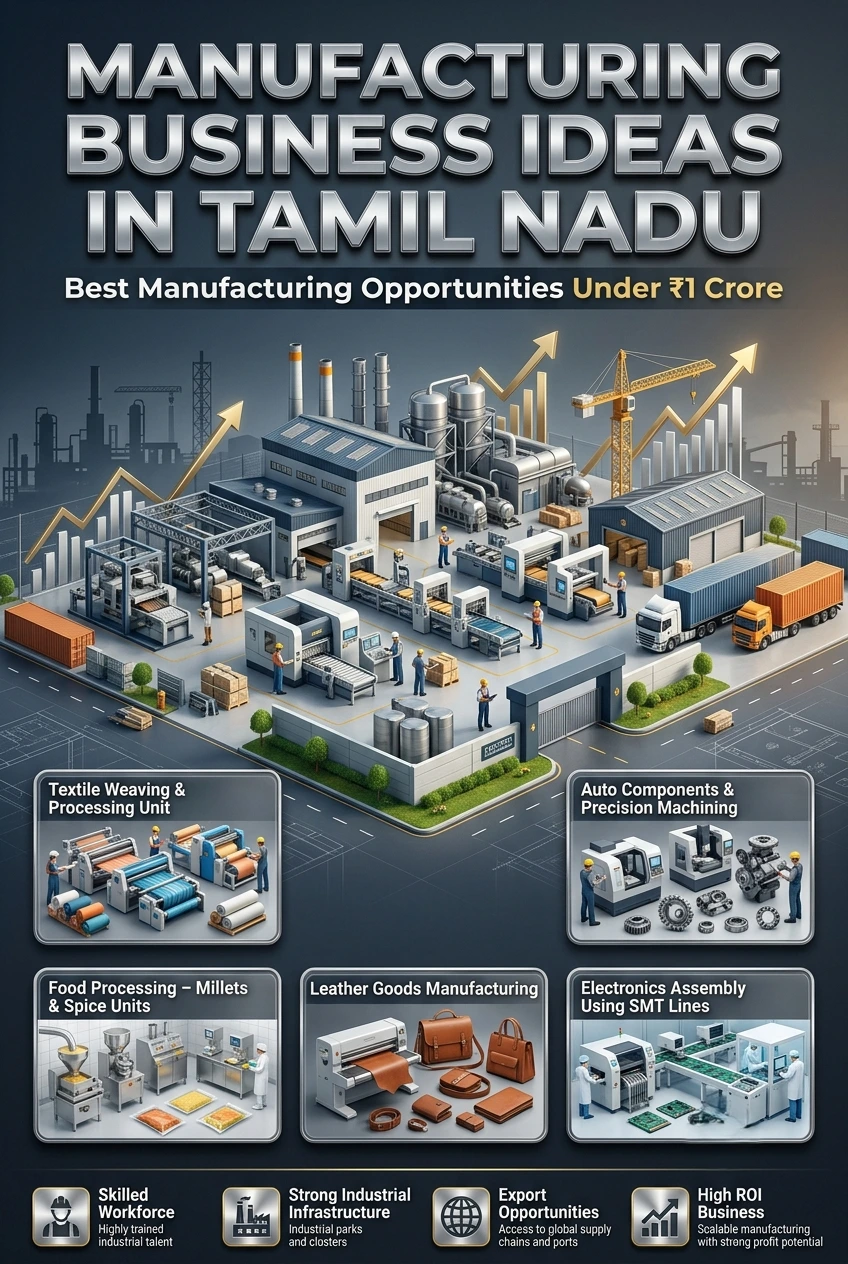
Food Processing: Millets and Spice Units
There has been a significant increase in the demand for processed millets, as they are being sold to the health-conscious consumers, and agricultural belt of Tamil Nadu is providing raw material at competitive rate. Modest machine investment is required to set up a cleaning, milling and packaging plant for millets or regional spices, which can be utilized by the retail markets as well as the institutional markets. Founders need to invest in good moisture control and packaging equipment, since shelf-life and packaging quality are important factors for repeat orders.
Related Article: Semiconductor & Electronics Manufacturing in India: MSME Entry Points, Realistic Costs, and Where the Real Money Is
Leather Goods Manufacturing
The leather industry is one of the oldest clusters in India and the area of Vellore and its surrounding areas has developed its tanning facilities and artisans. Having a ₹1 crore unit manufacturing finished leather goods, instead of raw leather tanning, greatly reduces the costs of environmental compliance and still provides lucrative margins for export products such as leather bags, leather belts and leather components for shoes.
Explore This Book: Leather Processing & Tanning Technology Handbook
Electronics Assembly Using SMT Lines
Under the PLI push, electronics manufacturing is gaining momentum with Tamil Nadu already having several electronics parks. This budget is suitable for a smaller assembly, using SMT, unit that specializes in sub-components or contract assembly with larger OEMs and can make a profit if that stable anchor client is found prior to investing in the entire line of SMT machinery.
Import-Export Opportunity for New Manufacturing Startups
The ports of Tamil Nadu receive significant volumes of shipping containers and therefore new manufacturing units in the state are able to receive imported machinery and exports quickly, unlike manufacturers in other landlocked states. The movement of textiles, leather goods, and auto parts, in particular, already follows well-established export channels and a new unit can leverage existing buyer relationships rather than creating new demand in the export market. From the import side, the raw material and machine prices from the Southeast Asian and Chinese markets also fall significantly because of the shorter shipping distances.
Indian MSME Success Stories Worth Studying
Kirloskar Brothers grew from a small engineering workshop into one of India’s leading pump and engineering manufacturers, largely because the founders reinvested early profits into precision manufacturing capability instead of diversifying too early. Karsanbhai Patel, who built Nirma from a small detergent-mixing operation into a listed FMCG giant, is often cited for proving that low-cost, high-volume manufacturing can outcompete larger players when distribution is handled smartly. Closer to Tamil Nadu, TVS Motor’s growth from a transport business into a full manufacturing group shows how deep supplier relationships and consistent quality control compound over decades. The lesson across all three is similar: focus on one manufacturing line, get the process right, and scale only after margins are proven.
How NPCS Helps You Validate the Right Business Before You Invest
We at Niir Project Consultancy Services (NPCS) provide professional consulting for the preparation of Market Survey cum Detailed Techno-Economic Feasibility Reports (DPRs) for setting up new industries or businesses. Our reports include detailed manufacturing processes, market research and demand analysis, process flow diagrams, product mix and capacity planning, machinery and raw material details, and complete project financials with profitability analysis. Before committing ₹1 crore to any of the ideas above, founders should evaluate feasibility, profitability, and long-term scalability with a proper DPR, since assumptions on paper rarely survive contact with real supplier pricing.
Find the most profitable startup for your investment range
Investment and Capacity Snapshot
| Business Idea | Approx. Investment (₹) | Plant Capacity (Indicative) | Payback Period |
| Textile Weaving & Processing Unit | ₹60–75 lakh | 500–800 MT/annum fabric | 3–4 years |
| Auto Components (Precision Machining) | ₹85 lakh–1 crore | 2–3 lakh components/annum | 3.5–4.5 years |
| Food Processing (Millets & Spices) | ₹50–70 lakh | 10–15 MT/day | 2.5–3.5 years |
| Leather Goods Manufacturing | ₹65–90 lakh | 500 pieces/day | 3–4 years |
| Electronics Assembly (SMT-based) | ₹95 lakh–1 crore | 50,000 units/month | 4–5 years |
Frequently Asked Questions
Which manufacturing business needs the lowest machinery investment at ₹1 crore?
In general food processing units (especially related to millet or spice processing) require less investment in machinery as compared to the investment in assembly for auto components or electronics, thereby freeing up more working capital to meet raw materials and marketing requirements.
Can I get collateral-free funding for these businesses?
Yes, loans with the support of CGTMSE also do permit lending for amounts without security till a particular limit, and a good many of your unit sizes fall into that category, your DPR and profile permitting you to qualify.
Is Tamil Nadu better than neighbouring states for auto component manufacturing?
The closeness of Tamil Nadu to Hosur and OEM hub in Chennai offers it unique logistics advantage as shorter delivery distance translate to low freight cost as well as low lead time for the vendors.
How long does it take to break even on a ₹1 crore manufacturing unit?
Most of the businesses discussed here break even within three to five years, depending on capacity utilisation and how quickly the founder secures anchor buyers.
Do I need an export licence to sell leather goods or textiles abroad?
Yes, you will need to get an Importer Exporter Code from DGFT and the Founders will also have to register with the relevant EPC for the products category.
Should I start with job-work or my own branded product line?
Job-work typically offers faster, steadier cash flow for a first-time manufacturer, while a branded product line takes longer to profit but builds higher long-term equity in the business.
Conclusion
Tamil Nadu offers a rare combination of skilled labour, port access, and cluster-based supply chains that make ₹1 crore go further than it would in most other states. The right choice among these business ideas depends less on which sector sounds attractive and more on which one matches your existing network, machinery access, and appetite for compliance. A proper feasibility study before signing any lease or machinery order remains the single best way to protect that capital.