
Udyam Registration 2026: Step-by-Step Guide, Business Ideas and Common Rejection Reasons
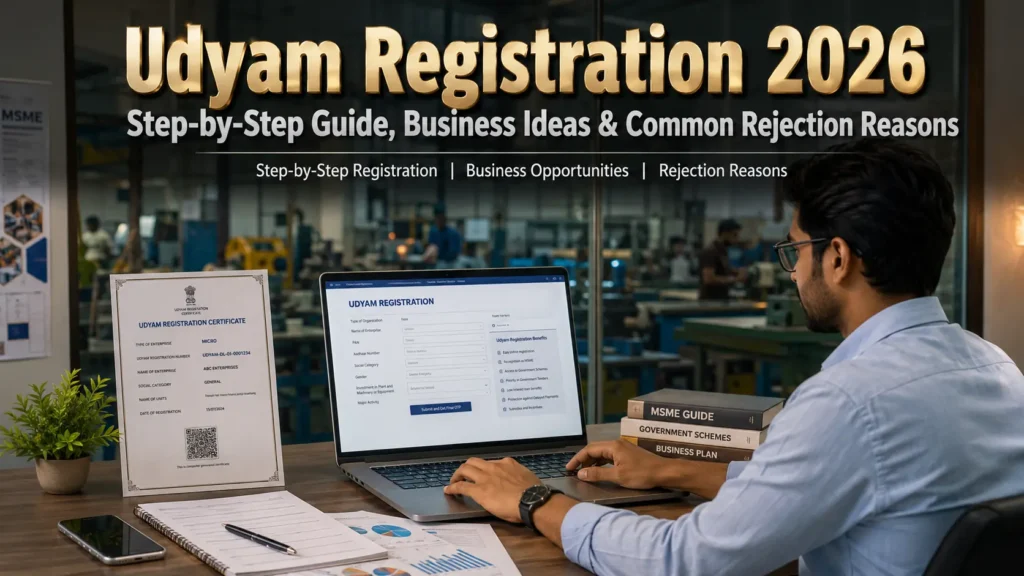
Guide for Udyam Registration 2026 in India, Government Incentive, and Business ideas it unlocks Thousands of good business opportunities in India languish at the paper stage every year. It is not because of the weakness of the product or the absence of the market, but because the founder didn’t get to Udyam registration or the application was rejected on a technicality. It is a real waste as Udyam registration takes less than 30 minutes for most of the applicants, is free of cost and is the only document required to avail priority-sector loans, government tenders, tax benefits and a host of other subsidies. This guide explains the steps to be taken, why applications are rejected and how concrete business ideas that make sense from a business perspective and are supported by current government policies, incentives and market demand can be registered immediately. Why Udyam Registration Deserves Your Attention Right Now Small and medium enterprises are the backbone of the manufacturing and services base in India. However, a considerable proportion of them still remain unregistered, thus losing the benefits of collateral-free loan facilities, access to GeM tenders and protection from delayed payments. The Ministry of MSME has been trying its best to narrow this gap, most recently through an increase of investment and turnover limits for MSME classification. This one action catapulted a number of growing businesses back into the MSME category and all the associated advantages. If you’re a first-generation entrepreneur or a business owner who wants to formalise your business, the time is right. Priority lending norms, credit guarantee cover and interest rate support are all linked to Udyam status. In the meantime, buyers have become more inclined to go for the registered MSME vendors as the statutory obligation of paying the tax within 45 days of the bill becomes a liability for the large companies to pay the MSME dues sooner or lose the tax deduction. That’s just one of the best incentives to enroll early—and it has gone unpublicized. Understanding MSME Classification Before You Apply Before you approach the registration form, have an awareness of your category. The classification of the business is based on two factors: investment in plant and machines or equipment and annual turnover. They both need to be met and if either exceeds a limit then your enterprise is upgraded to the next category. Investment is calculated as the original cost and not depreciated cost and export turnover is not included in the turnover calculation, in reality an incentive for export-oriented units. MSME Category Investment Limit (Plant & Machinery/Equipment) Annual Turnover Limit Typical Business Examples Micro Enterprise Up to ₹2.5 crore Up to ₹10 crore Home-based food units, small job-work workshops, boutique manufacturing Small Enterprise Up to ₹25 crore Up to ₹100 crore Auto-component units, packaged food plants, plastic processing units Medium Enterprise Up to ₹125 crore Up to ₹500 crore Mid-sized chemical plants, engineering goods exporters, textile mills Table 1: Revised MSME classification thresholds as per MSMED Act Government Policies and Incentives Supporting Udyam-Registered Businesses The Udyam registration is not just a single scheme; it’s a package of schemes. Upon registration, an enterprise can avail of credit from banks with priority sector credit norms and collateral free loans as well as avail of government procurement opportunities from GeM. The base registration is followed by several schemes. Credit Guarantee Cover Through CGTMSE The Credit Guarantee Fund Trust for Micro and Small Enterprises provides collateral free credit guarantee cover for eligible unit up to ₹10 crore. This is a good thing for founders with a viable project, but without property to offer as security, as banks lend based on the guarantee instead of on personal collateral. Production Linked Incentive and Sector Schemes The PLI scheme for electronics, pharmaceuticals, textiles, food processing, specialty steel, and other sectors is still in operation. Eligibility is different across sectors but it is mostly targeted at higher production volumes and the opportunity for the MSMEs is actually in filling in the PLI-anchor supply chains as ancillary and component suppliers. Prompt Payment Protection Under Section 43B(h) This is one incentive that the founder overestimates. If the buyer fails to pay the registered Micro or Small enterprise after 45 days, he/she is not entitled to claim the expense as a tax deduction. In reality, this has led to a much more careful approach by large corporates in clearing MSME invoices as the tax liability of a delayed invoice is real money that is on their books. State-Level Subsidies and Single-Window Clearances Apart from the central benefits, most of the State Industrial policies impose their own subsidy, exemption from stamp duty and power charge on the unit which has a valid Udyam certificate. You should definitely check your industry department portal in your respective state and also the Invest India national portal as the eligibility criteria and percentage of subsidy and the application period vary from state to state. Udyam Registration: Step-by-Step Process The process runs entirely online through the official Udyam Registration portal, and there is no government fee at any stage. Anyone asking you to pay for registration is not the official channel. Step 1: Keep Your Documents Ready Aadhaar number of proprietors, managing partner or authorised signatory, PAN of the business and GST information (if applicable) are required. There’s no need to upload any physical documents – most of the data is pulled straight from linked government databases. Step 2: Visit the Udyam Portal and Choose Your Applicant Type For the new entrepreneurs not registered on the portal or those who are new to the previous EM-II system or UAM system, the option will be available on the portal. People who already have a Udyog Aadhaar are advised to avail of the option for its migration, rather than fresh filing. Step 3: Verify Aadhaar and Enter PAN Fill the Aadhaar and the complete name as mentioned on the Aadhaar card and verify with OTP. This is one of the most frequent mistakes and even a spelling error could
How to Start Electrical Transformer Manufacturing Business in India (Up to 20,000 kVA, 36 kV)
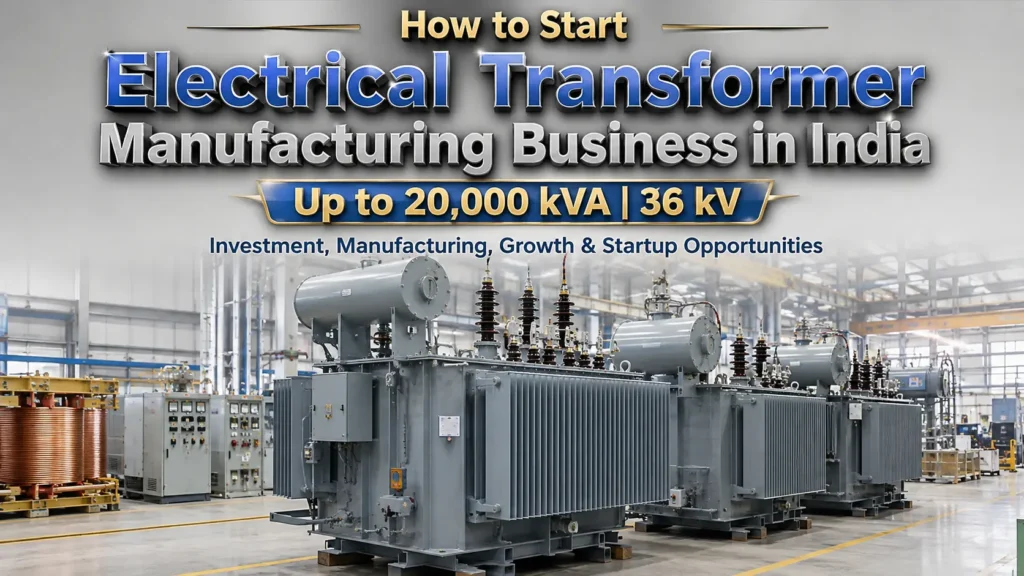
Electrical Transformer Manufacturing Business Simple as this is, India requires more power each and every year and this is where one of the most stable manufacturing business ideas of today is booming in the industrial sector; the manufacturing of electrical transformers. Transformers rated up to 20,000 kVA at 36 kV are needed by all distribution utilities, industrial plants, and renewable energy developers, and demand continues to grow, even in the wake of other sectors experiencing a slowdown. This is a unique combination of consistent orders, policy support, and long product life cycles for entrepreneurs looking into business ideas that have the active support of the government. This article provides insight into why time is crucial, the schemes that truly benefit new manufacturer, and the specific business ideas that fit a first-time promoter. Why This Sector Is Growing Fast The demand for power in India continues to grow. Peak electricity demand is already at 240 GW and will soon exceed 400 GW within this decade. This means that state utilities and private developers must purchase thousands of new transformers annually, simply to provide new connections, as well as to replace old transformers that are no longer efficient. This demand is being propelled in greater and greater numbers by three forces. First, the government’s distribution reform programme is upgrading old feeders and substations in various states, thereby generating new orders for transformers on an ongoing basis. Second, the number of inverter-duty and solar step-up transformer demand is huge for renewable energy projects, and this market was barely present 10 years ago. Third, the blooming growth in pharma, data centre, steel and cement industries is creating direct demand for dedicated power and distribution transformer. In the meantime, the fact of dependence on imports is an issue to consider. In the past, Chinese manufacturers have been known to secure a number of big tenders from utilities at cheaper rates, which has prompted the authorities to actively promote domestic capacity development. This means that new players that are interested in quality, test facilities, and on time delivery are able to secure contracts more easily than many other capital goods businesses. What’s rare about manufacturing business ideas is that the demand for transformer manufacturing is predictable and backed by the government instead of consumer sentiment. The demographic aspect can be a point of interest also. A number of well-known transformer producers were founded in a single generation and a few are now facing succession or capacity issues. This leaves space for new, efficient operators to be able to secure tender bids for units that can’t service them on time. That is, it’s not a market in need of consolidation, it’s an expanding pie that can be carved up by new entrants who deliver and are properly certified. Get Detailed Project Report (DPR): Electrical Transformer & Power Equipment Guide Government Policies Supporting New Businesses A capital-intensive manufacturing plan can make or break on the basis of good or bad policy support. Fortunately, transformer manufacturing is a field that falls into the crosshairs of multiple government programmes, and most first-generation business owners can connect two or three of them together at least. PLI Scheme for Electrical Equipment The Production Linked Incentive scheme for white goods and capital goods manufacturing directly helps the manufacturers of the components of transformers. The primary aim of the PLI scheme is the big manufacturer, but MSMEs can still benefit by being approved component or material suppliers to PLI linked companies. This is an indirect route suitable for a new winding or assembly unit, especially for a new one supplying to another larger original equipment manufacturer (OEM) under an approved PLI project. PMEGP for First-Generation Entrepreneurs New manufacturing units have been provided with margin money subsidy under the Prime Minister’s Employment Generation Programme (PMEGP) of Khadi and Village Industries Commission, Ministry of MSME. The 15 to 25 percent subsidy for General category applicants and 25 to 35 percent for women and special category applicants (SC, ST, OBC, etc.) will depend on the location of the unit. The costs for the manufacture of the units are up to fifty lakh rupees, at present, under this scheme, therefore it is a genuine option for a small distribution transformer plant. It is always advisable for the entrepreneurs to check the updated subsidy slabs on the official site before applying. Credit Guarantee Cover Without Collateral The Credit Guarantee Fund Trust for Micro and Small Enterprises wave offs the one most important obstacle in the way of most new entrepreneurs – collateral. In this scheme, these are loans of working capital or term loans that are disbursed without any property being pledged and this is of much importance in a business where the capital equipment is a significant portion of the total investment, especially in the case of machinery. State-Level Incentives In addition to central schemes, states like Gujarat, Maharashtra, Uttar Pradesh and Rajasthan have their own industrial policies for electrical equipment manufacturers. Usually, this involves capital subsidies, power tariff concessions and stamp duty exemption for land acquisition of new manufacturing units. In a few instances, state incentives, in addition to central schemes, can reduce the effective project cost by as much as fifteen to thirty percent for a qualified project. Make in India and Import Substitution Transformers have been identified as a component of high value addition required in India under the Make in India initiative by the Department for Promotion of Industry and Internal Trade. In the same way, the Revamped Distribution Sector Scheme is also compelling the state discoms to upgrade the infrastructure and this will directly mean new transformer procurement during the coming couple of years. Multiple Business Ideas for Startups Transformer making is not a monolithic industry. Rather, it is broken up into a number of distinct product lines and service niches, each with a different level of investment and buying profile. Here are some business ideas that you can consider before you finalize your project report. Small Distribution Transformer Unit (up to
पैकेजिंग इंडस्ट्री में बिजनेस — कम निवेश, हर सेक्टर में डिमांड
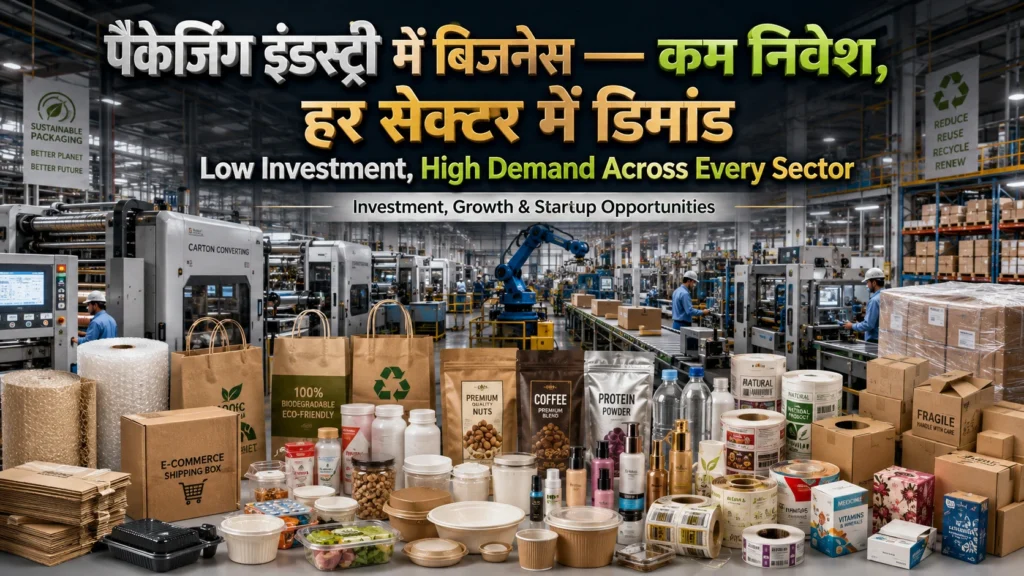
पैकेजिंग इंडस्ट्री में बिजनेस Packaging एक ऐसी industry है जो किसी एक sector पर निर्भर नहीं है। Food, pharma, FMCG, e-commerce, cosmetics, agriculture — हर जगह packaging चाहिए। यही कारण है कि packaging manufacturing को ‘recession-proof’ industry भी कहा जाता है। और अगर आप कम investment में एक ऐसा business idea ढूंढ रहे हैं जिसमें demand कभी कम न हो, तो packaging sector सबसे suitable जवाब है। भारत की पैकेजिंग इंडस्ट्री — मौजूदा स्थिति भारत दुनिया के top packaging markets में से एक है। Indian Institute of Packaging (IIP) के अनुसार, भारत का packaging sector तेज़ी से विस्तार कर रहा है। E-commerce boom, FMCG growth, और food processing expansion — तीनों ने इस growth को fuel किया है। Get Detailed Insights from This Book: Handbook on Modern Packaging Industries पैकेजिंग के मुख्य सेगमेंट 1. Corrugated Box Manufacturing यह packaging industry का सबसे large segment है। E-commerce ने corrugated boxes की demand में massive jump लाया है। Amazon, Flipkart के sellers को हमेशा boxes चाहिए। Investment ₹15-40 लाख से शुरू होता है। Monthly revenue एक medium unit से ₹20-50 लाख तक हो सकती है। 2. Flexible Packaging Laminated pouches, standup pouches, और multilayer films food और pharma packaging का सबसे popular format बन चुका है। यह traditional rigid packaging से lighter, cheaper, और more attractive है। Related Article: Sustainable Packaging Business in India – Future, Investment & Profit Guide 3. Rigid Plastic Containers Bottles, jars, और containers की demand personal care, pharma, और food sectors में बहुत ज़्यादा है। Injection molding machines से ये बनते हैं — एक machine से multiple products बना सकते हैं। 4. Paper और Paperboard Packaging Paper bags, paper cups, paper plates, और folding cartons की demand plastic ban के बाद और बढ़ गई है। यह एक environmentally friendly segment है जिसमें premium market भी है। Get Detailed Project Report (DPR): Biodegradable Packaging & Bio-based Polymers 5. Industrial Packaging Drums, IBCs (Intermediate Bulk Containers), और pallet wraps — ये industrial buyers के लिए हैं। Chemical, paint, और lubricant companies इनके बड़े buyers हैं। सबसे Profitable Packaging Products — Comparison Product Investment (₹) Target Market Profit Margin Scalability Corrugated Boxes 15–40 लाख E-commerce, FMCG 15–25% बहुत ज़्यादा Flexible Pouches 30–80 लाख Food, Pharma 20–35% ज़्यादा Plastic Containers 20–60 लाख Personal care, Food 25–40% ज़्यादा Paper Bags/Cups 5–20 लाख Retail, Cafes 25–40% मध्यम Industrial Drums 25–70 लाख Chemical, Paint 20–30% मध्यम E-Commerce Packaging — सबसे तेज़ Growing Segment E-commerce packaging सबसे fast-growing packaging segment है। Confederation of Indian Industry (CII) के अनुसार, India का e-commerce market तेज़ी से बढ़ रहा है, जिससे packaging demand में proportional growth आ रही है। Customized boxes, protective packaging (bubble wrap, foam inserts), और branded mailer bags की demand हर महीने बढ़ रही है। Packaging Business के लिए ज़रूरी Machines Corrugated Box Unit: Die-cutting machine, Flexo printing machine, Stitching machine Paper Bag Unit: Paper bag making machine, Handle fitting machine Plastic Container: Injection molding machine, Blow molding machine Flexible Pouch: Lamination machine, Pouch making machine सरकारी Support और Schemes Packaging industry को MSME schemes का पूरा benefit मिलता है। Udyam registration के बाद MUDRA loan, CGTMSE credit guarantee, और Credit Linked Capital Subsidy Scheme (CLCSS) — सब available हैं। Export के लिए DPIIT (Department for Promotion of Industry and Internal Trade) की startup और MSME schemes का लाभ उठाएं। Choose the right startup backed by real market demand Packaging Business में सफलता के Tips Quality consistency सबसे ज़रूरी है। एक bad batch पूरा contract खो सकती है। इसलिए raw material quality पर कभी compromise नहीं करें। Delivery reliability भी उतनी ही ज़रूरी है। Packaging buyers को just-in-time delivery चाहिए। इसलिए production planning और inventory management strong होना चाहिए। Customization offer करना competitive advantage देता है। Branded packaging, custom colors, और special printing — इससे आप commodity supplier से value-added supplier बन जाते हैं। अक्सर पूछे जाने वाले सवाल (FAQ) Q1. Packaging business के लिए minimum investment कितना चाहिए? Paper bag manufacturing जैसे simple segment में ₹5-10 लाख से शुरुआत हो सकती है। Corrugated boxes या flexible packaging के लिए ₹20 लाख से ज़्यादा चाहिए। Q2. Packaging में export का scope है? हां, pharmaceutical packaging और specialty packaging में India के export opportunities बड़े हैं। FDA-compliant packaging units को US और European clients मिलते हैं। Q3. क्या घर से packaging business शुरू हो सकता है? बहुत छोटे scale पर — जैसे handmade paper bags या gift packaging — घर से शुरू हो सकता है। लेकिन industrial scale के लिए dedicated space ज़रूरी है। Q4. Packaging में BIS या किसी certification की ज़रूरत है? Pharma packaging के लिए FDA approval ज़रूरी है। Food contact packaging के लिए food-grade material certification चाहिए। General packaging के लिए कोई mandatory certification नहीं है। निष्कर्ष Packaging industry एक ऐसी manufacturing business है जिसमें demand कभी नहीं रुकती। E-commerce, food processing, pharma — ये सभी sectors growing हैं, और सबको packaging चाहिए। कम investment में high demand वाला यह business idea उन उद्यमियों के लिए perfect है जो stable और scalable business चाहते हैं। अधिक जानकारी और Detailed Project Report के लिए niir.org पर जाएं।
The Government Will Pay 35% of Your Factory Setup Cost. Most People Don’t Know.
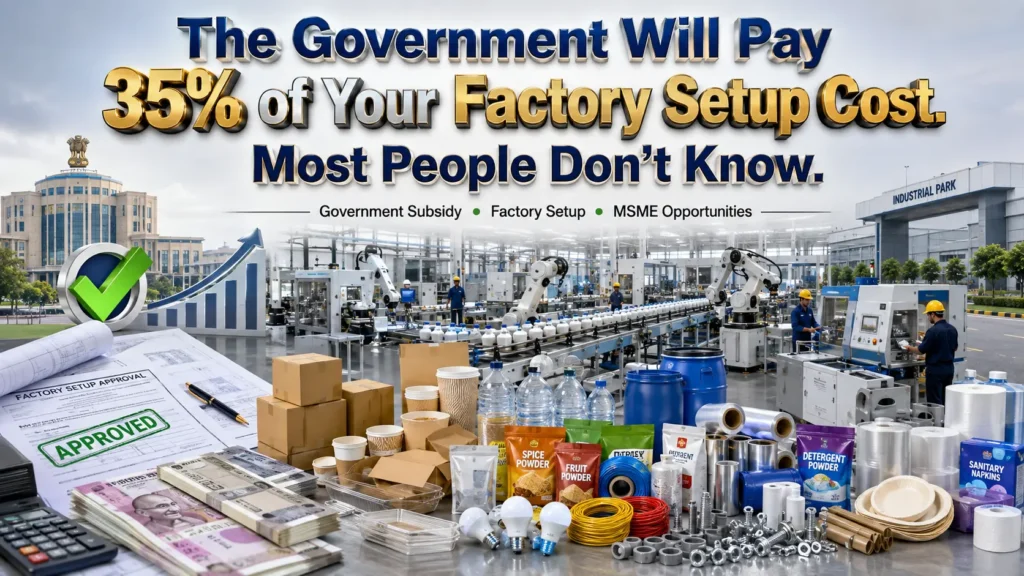
Government Pays 35% Factory Cost India has one of the world’s most untapped pool of manufacturing business ideas and startup capital, and a significant portion of it is from the Government. Thousands of entrepreneurs are investing their savings, borrowing from relatives or borrowing money on high interest rates to establish a factory and do not know that the Prime Minister’s Employment Generation Programme (PMEGP) provides up to 35% of the project costs as a direct capital subsidy. This works out to be a sum of ₹17.5 lakh of free government money for a manufacturing unit, valued at ₹50 lakh. However, many of the first-generation entrepreneurs have either never heard of it, or think they can’t be part of it. This article explains how the scheme works, who’s eligible to use it and which manufacturing business ideas have the greatest potential for success — with the government lining up on your side. Why Manufacturing Remains the Smartest Business Entry Point in India India is on the verge of witnessing the biggest change in decades for the manufacturing sector. The government has bitten off more than it can chew: it has set itself the ambitious target of increasing the contribution of manufacturing to GDP from 17% to 25%. All its policies, from tax breaks to investments in infrastructure, are geared toward this goal. This is an unusual confluence of circumstances: high demand, government support, export opportunity, and lower competition for the entrepreneur and investor. Additionally, the Make in India initiative has been successful in not only securing investments in Indian supply chains but also in creating and expanding premium procurement chains involving domestic component manufacturers. This means that the window of opportunity for a first-generation manufacturer has been greater than ever before. The initial cost of setup in the factory is still competitive. Availability of raw material is good. The domestic middle class keeps on consuming manufactured goods faster than any other economy in the world. Furthermore, with import substitution becoming a national priority, the government is actively encouraging local production under various overlapping schemes. If an entrepreneur really grasps this policy stack, he can significantly reduce his actual capital requirement by 35% to 50% prior to manufacturing even the first unit. Government Policies That Can Fund 35% of Your Manufacturing Business Setup PMEGP – The 35% Capital Subsidy You Are Missing The Prime Minister’s Employment Generation Programme (PMEGP) is the flagship programme for manufacturing start-ups in India. It is the direct capital subsidy offered by Khadi and Village Industries Commission (KVIC), Ministry of MSME, for 15% to 35% of the project cost. The general category entrepreneurs in urban areas get 15% and the special category entrepreneurs (women, SC/ST, minorities, ex-servicemen, differently abled) in rural areas get 35% of the subsidy. Manufacturing Businesses – The maximum eligible project cost is ₹50 lakh. Importantly, the funding from the applicant represents a small percentage (5-10%) of the total project cost. The remaining amount is financed by the bank. This translates to a capable businessman can establish a manufacturing business with ₹50 lakh with a mere investment of ₹2.5 lakh of his own funds. The bank finances ₹30 lakh and the government finances ₹17.5 lakh. That’s a capital efficiency ratio that hardly any private investment structure can beat. Production Linked Incentive (PLI) Scheme for Scale Businesses The Production Linked Incentive (PLI) Scheme provides performance-based financial incentives of up to 14 key sectors with 4% to 6% of incremental sales over a fixed base year for the entrepreneurs who are willing to scale up. PLI covers sectors like electronics, pharmaceuticals, food processing, textiles, automobiles and specialty steel. As of November, of the previous reported year, invested amount in committed PLI projects was ₹1.61 lakh crore which resulted in production and sales of around ₹14 lakh crore, and generated direct and indirect employment creation of 11.5 lakh. CLCSS and CGTMSE – Technology and Credit Support The Credit Linked Capital Subsidy Scheme (CLCSS) offers a capital subsidy of 15% on institutional finance received for technology upgradation in 51 specified sub-sectors with a maximum limit of ₹1 crore. At the same time, the Credit Guarantee Fund Trust for Micro and Small Enterprises (CGTMSE) has been introduced to provide collateral-free loans of up to ₹5 crore to MSMEs, which is a significant benefit for first-generation entrepreneurs who may not have an asset base. Manufacturing Business Ideas for Startups: High-Profit Units You Can Start With PMEGP 1. Food Processing and Packaging Unit Among all the business ideas in India, food processing is still one of the most resilient and least volatile businesses. The food processing industry has continued to grow in India, and the Ministry of Food Processing Industries is keen to encourage new food processing units by offering several capital and grant schemes. A start-up unit for grinding spices, milling pulses or manufacturing packaged snacks can be set-up in a project cost of Rs 30 lakh – Rs 50 lakh which falls within the project manufacturing limit of PMEGP. The operational economics are also favourable for the entrepreneur as there is a ready availability of raw materials, a developed distribution system and increasing demand for Indian food products in foreign markets. This is one of the financially most approachable avenues in manufacturing for the women entrepreneurs who start rural food processing units receiving the full subsidy of 35% under PMEGP. Get Detailed Project Report (DPR): Food & Beverage Packaging 2. Agarbatti (Incense Stick) and Dhoop Manufacturing The manufacture of agarbatti is one of those few business ideas, where the demand is huge in the country, export market is good and the government is encouraging production in the country. India is the world’s major importer as well as exporter of incense products. The SFURTI Scheme (Scheme of Fund for Regeneration of Traditional Industries) is particularly supporting the agarbatti clusters with infrastructure and technology support. The cost of setting up a basic mechanised agarbatti unit is in between ₹10 lakh to ₹20 lakh, which is perfect for first-time entrepreneurs to avail
Stop Waiting for the Perfect Business Idea. Start With This One
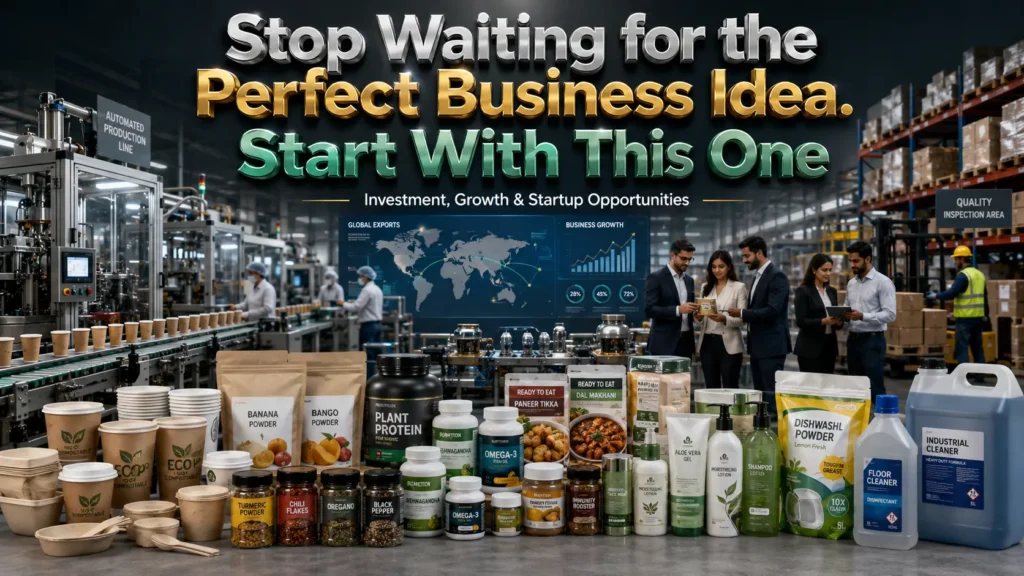
The first-time entrepreneurs start their own business, they wait years for the one “perfect” idea that’s risk-free, endlessly scalable and completely original. Meanwhile, thousands of smart manufacturing ideas quietly generate steady income, create jobs and build generational wealth for those who paused, and just took action. But the reality is, the Indian market does not honor the creative idea finder. It can pay off the one who can implement a successful concept with discipline and proper planning. The manufacturing industry is at a tipping point in India. The opportunity is not merely theoretical; it is structural and has an impact on nearly 30% of GDP and 45% of total exports through more than 7.5 crore MSMEs. The government policy, credit access and trade infrastructure is aligned to actually favour new manufacturers. The issue isn’t this time around whether to establish a manufacturing venture. The challenge now is to choose the idea and to do it smartly. Stop guessing—choose the right business with confidence Why Manufacturing Business Ideas Are Winning Right Now India’s expansion to become a viable option to the Chinese led supply chains has generated real demand deficits in a wide range of product categories. The MNCs are on the lookout for suppliers from India. The growth of domestic consumption is picking up pace in Tier 2 and Tier 3 cities. But e-commerce has created distribution channels that would have needed a lot of capital to reach before. In addition, India’s local manufacturing production is steadily increasing. Government data shows that the contribution of the MSME industry to overall manufacturing is 36%. In a recent reporting period, the credit growth in MSME sector has expanded by 19.6% YoY, which signifies the growing demand for new businesses as well as the rise of lender confidence. Today, 2/3rd of Indian MSMEs is digitally prepared and can manage procurement, sales and export documentation without having to hire a large support team for the new founder. The fact that it is a combination of rising domestic demand, export pull, government-backed credit, and robust digital infrastructure, makes manufacturing business ideas truly accessible for first-generation entrepreneurs rather than well capitalised conglomerates. Government Policies That Are Actually Helping New Manufacturers Manufacturing policy in India is now more pro-startup than ever. There are now multiple schemes layered on top of each other, thereby providing an actual capital advantage to new entrants. Production Linked Incentive (PLI) Scheme Under PLI Scheme, there are 14 priority sectors and cash incentive from 4% to 20% on increment sales over the base year. The actual investment made under PLI has surpassed ₹2.40 lakh crore, which has created more than 14 lakh direct and indirect employment. The secret to the PLI opportunity, for an MSME founder, is to be not only eligible to enter the fray but also be able to cater to the need of large manufacturers who are registered with PLI, a B2B play that most new entrepreneurs are not focusing on. PMEGP — The First-Generation Entrepreneur’s Launchpad The Ministry of MSME runs the Prime Minister’s Employment Generation Programme to provide credit linked subsidy for establishing micro manufacturing units. The subsidy for the general category applicants is 15% in urban areas and 25% in rural areas. For SC/ST and women entrepreneurs it is up to 35%. This will lead to a reduction in the breakeven risk for a new founder and the maximum government subsidy that could be availed will be between ₹6.25 lakh and ₹8.75 lakh for the manufacturing unit costing ₹25 lakh. CGTMSE and Collateral-Free Lending Credit Guarantee Fund Trust for Micro and Small Enterprises (CGTMSE) is a scheme between Ministry of MSME and SIDBI to provide banks with loans for micro and small manufacturers without requiring collateral. That’s very important for people who are first-generation entrepreneurs without property assets to put up as collateral. Having access to MUDRA loans for working capital, an MSME founder can easily start their business without needing to provide a single rupee of traditional collateral. Startup India and DPIIT Recognition Registered Startups under Startup India are offered with income tax exemption for three consecutive years, patent fee concessions and simplified exit norms. The Department for Promotion of Industry and Internal Trade (DPIIT) also eases the way for manufacturing startups by providing for fast-track regulatory clearances, thereby eliminating the typical delays that manufacturing entrepreneurs might face. Manufacturing Business Ideas for Startups: Where to Actually Begin The following business ideas are not dream concepts. They are current government policy priorities and categories of products that have proven to have market demand, viable startup economics, and documented. These are concepts that the market is talking about you, you just have to respond. 1. Food Processing and Value-Added Agricultural Products India is one of the world’s biggest producers of fruits, vegetables, dairy and spices; however, a considerable amount of the agricultural produce is wasted because of lack of processing infrastructure in the country. This vacuum is one of the lucrative and scalable manufacturing business ideas that aspiring entrepreneurs have these days. A food processing unit can commence with a specific product, such as dehydrated vegetables, spice blends, ready to eat snacks or packaged pulses and generate sales both from domestic retail markets and export markets. The investment cost starts from ₹10 lakh for micro processing unit to ₹40 lakh for mid-scale units. The Food Safety and Standards Authority of India (FSSAI) offers a clear regulatory roadmap and there are PLI incentives for several processed food categories. The average margin is 18-35% depending on the product and its value added. In addition, the Ministry of Food Processing Industries provides incentive for cold chain development to the sector. Explore This Book: Handbook on Fruits, Vegetables & Food Processing with Canning & Preservation 2. Herbal and Ayurvedic Product Manufacturing The Indian herbal and wellness product market is booming with increasing health awareness among Indians and people around the world. The cost of setting up a small-scale herbal manufacturing unit, where one produces hair oils, immunity supplement, skin care products,
India-Oman CEPA: New Export Opportunities for MSMEs in Manufacturing & Business
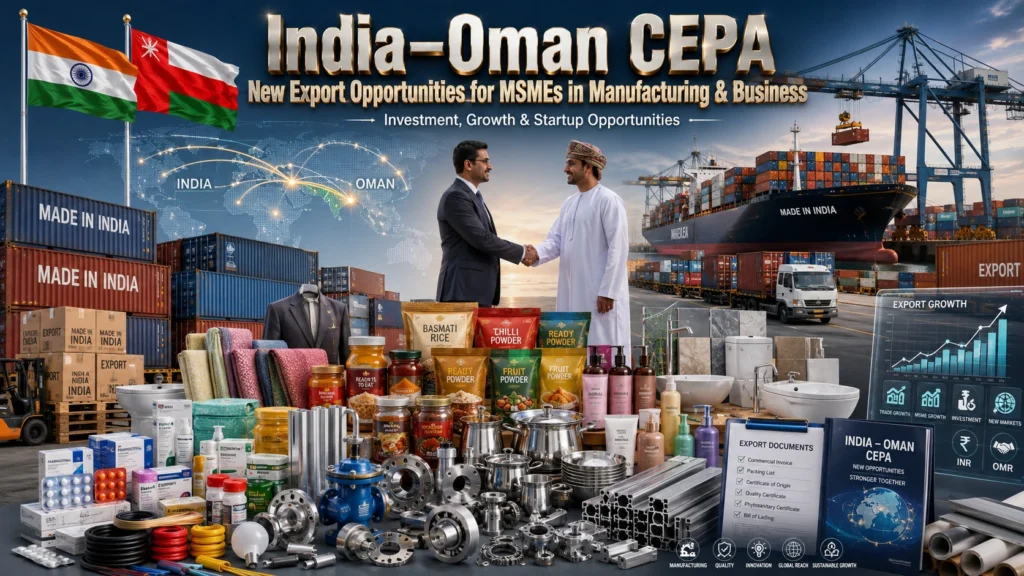
India Oman CEPA Export Opportunities A Trade Agreement That Changes the Manufacturing Math Trade pacts do not generally evoke excitement in the minds of MSMEs. Most of them are framed in bilateral diplomacy and not in terms of any practical business ideas for manufacturers/exporters on the ground. The India-Oman Comprehensive Economic Partnership Agreement (CEPA), however, is unique — and the difference is significant to anyone who operates or is considering a manufacturing unit in India. The CEPA was signed by India and Oman in a strategic setting. Oman is located at the mouth of the Arabian Sea, part of the Gulf Cooperation Council (GCC) trade corridor and is actively diversifying its economy from hydrocarbons. This deal is a boon to Indian manufacturers and exporters, especially MSMEs as they gain access to a high-income and import-dependent market on preferential tariffs. The timing coincides with India’s own desire to expand its exports of goods massively. This treaty is beneficial to several business sectors — processed foods, Pharma, Engineering Goods, Chemicals, Textiles and Handicrafts. In this article, we examine which sectors have the best export prospects for the MSMEs and what government initiatives can help magnify those benefits, and how Indian MSMEs can capitalise on the Oman corridor for long-term export success. Why the India-Oman Trade Corridor Is Gaining Strategic Importance Oman is not a big economy in the world. It is a strategic one, though. The country imports almost 80% of its food, most of its industrial raw materials and increasing amounts of its manufactured products. Such reliance leads to a permanent market for foreign suppliers. Traditionally, India has been a main source of imports for Oman, especially in the areas of Food Products, Textiles, Engineering Goods, and Construction Materials. The CEPA is an agreement that formalises and strengthens this relationship. The CEPA between India and Oman encompasses thousands of product lines as per the Ministry of Commerce and Industry, Government of India. The biggest advantage for India’s exporting companies is the gradual removal of customs duties on a host of manufactured products. This directly helps the price competitiveness, the main problem of Indian SME exporters in the Gulf countries where Chinese and SE Asian competition is dominating the market. Oman is also a re-export point to the wider GCC region outside of tariffs. A manufacturing company which develops a distribution chain up into Oman effectively places itself to distribute into Saudi Arabia, United Arab Emirates, Kuwait, Bahrain and Qatar. The corridor’s multiplier effect is the reason why the area is seriously considered by people monitoring business growth through exports. Related Article: India-Oman CEPA: The Trade Gateway Every Indian Exporter Has Been Waiting For Government Policies and Incentives Supporting MSME Exporters India has put together an effective package to facilitate Indian manufacturers from entering the export markets. These schemes work better under the CEPA framework as the pricing difference at the destination is decreased through preferential tariffs. Below are the most relevant policies for MSME exporters for Oman: MSME Export Promotion Schemes Small manufacturers directly get financial relief from Interest Subvention Scheme, Credit Guarantee Fund Trust for Micro and Small Enterprises (CGTMSE) and the Ministry of MSME’s ZED (Zero Defect Zero Effect) Certification Programme. Export-oriented units (EOU) are supported in a way that is very advantageous for an MSME with collateral-free credit of ₹2 crore provided by the CGTMSE. RoDTEP: Duty Refund for Exporters The Remission of Duties and Taxes on Exported Products (RoDTEP) scheme is implemented by Directorate General of Foreign Trade (DGFT) that will refund embedded taxes that exporters are unable to claim elsewhere. RoDTEP provides a 1–4% extra margin on FOB value for manufacturing industries such as processed foods, pharma, engineering goods, etc. which are some of the best beneficiaries of RoDTEP. That is a minimal amount but on an annual export order worth of ₹5 crore it’s ₹ 5 – 20 lakh of direct savings. ECGC and Export Credit The Export Credit Guarantee Corporation of India (ECGC) offers a risk cover to exporters who have dealings with foreign buyers. ECGC coverage is highly beneficial for new MSME exporters, who are entering into the market of Oman, as it reduces the risk of non-payment. It is coupled with post-shipment credit lines by the partner banks, which makes it possible even for an exporter with a turnover of ₹1-5 crore. Learn more at ECGC. PLI and Sector-Specific Incentives The PLI Scheme applies to 14 sectors such as food processing, pharmaceuticals, textiles, advanced chemistry cells, specialty chemicals, etc. for larger manufacturing plays. The PLI offers incentives of up to 20% on incremental production to MSMEs. When PLI is combined with preferential access to CEPA, a strong cost competitiveness can be gained. State-Level Export Incentives There are a few incentives available for export-oriented manufacturers in several states of India. Both Invest Rajasthan and Gujarat Industrial Development Corporation (GIDC) provide subsidy on land, power and infrastructure for MSMEs establishing export units. There are also MSME export promotion policies for Tamil Nadu, Karnataka and Maharashtra. Entrepreneurs should check with various state industrial development corporations to determine the best mix of central and state incentives. Manufacturing Business Ideas for MSMEs Under the India-Oman CEPA The CEPA brings concrete benefits to a number of manufacturing and export sectors. Specific business ideas are presented below that can be taken as action points by MSME entrepreneurs who wish to either start or expand their manufacturing businesses with the main export markets in Oman. 1. Processed and Packaged Food Products Oman is a net importer of food. The tariff concession in CEPA can have substantial benefits for Indian processed food manufacturers, especially in the spices, ready-to-eat foods, cereal-based foods, pickles and packaged snacks sector. Lowering or removing import taxes on complete food products makes Indian food more competitive than those from Thailand, Malaysia and Turkey, which have traditionally held a commanding position on the shelves of the Gulf countries. With an initial investment of about ₹50 lakh to ₹2 crore, an MSME entrepreneur setting up a food processing
How to Start Power Cable and Winding Wire Manufacturing Business: High-Demand Business Ideas in India’s Electrical Conductors Sector
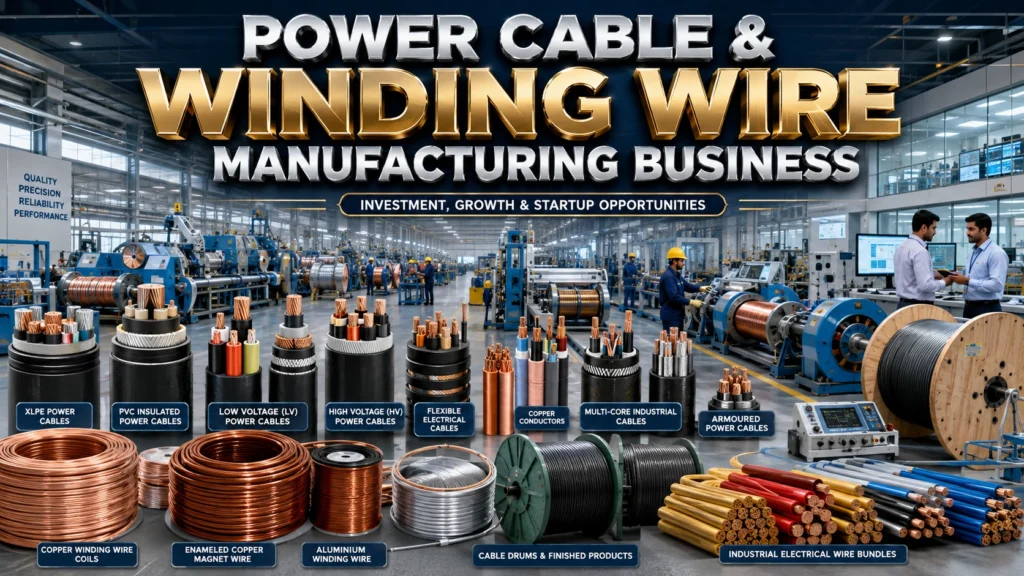
Power Cable Manufacturing Business Business ideas do come in cycles. There are also companies that are part of the cycle. Power cable and winding wire factories are in second category. Conductors are used every kilometre of transmission line, every substation commissioned, every transformer wound, every motor assembled and every industrial building electrified. The power cable, control cable, winding wire, and specialty conductor segments of the Indian electrical conductor market together account for tens of thousands of crores per year and have seen compounded growth across a number of fronts. Cables and winding wires combine a large and dynamic market, government initiatives to boost domestic manufacturing, a well-defined opportunity for import substitution at the specialty end, multiple product entry points at varying investment scales, and significant future opportunities for entrepreneurs to assess, making them an attractive manufacturing business idea for an MSME. However, there are some challenges inherent in the sector, particularly the prices of copper and aluminium which are benchmarked and volatile throughout the world; but experienced manufacturers overcome this by using commodity hedging, by timing purchases and by passing through material cost fluctuations to customers. Get Detailed Insights from This Book: Manufacture of Electrical Cables, Wire and Wire Products Handbook Why This Manufacturing Business Is Growing at an Exceptional Pace The power transmission and distribution in India is experiencing the most forward-thinking investment cycle in its history. The National Electricity Plan calls for installing more than 50,000 circuit kilometres of transmission lines within 10 years’ time. Particularly in urban areas, the underground cabling of distribution networks is creating a persistent demand for underground LT and HT cables in all key metropolises under the Revamped Distribution Sector Scheme (RDSS). The amount of conductor needed on cabling for each kilometre of length of underground cable is significantly greater than that of lines of a similar capacity on the top of the tower. There is an alternative demand engine from the renewable energy industry. Solar parks need DC cables from panel strings to the inverter and AC cables from the inverter to the point of connection to the grid. Several thousand kilometres of cable might be used in a 100MW solar installation. The wind farm network needs flexible wind farm cables buried and armoured cables in the turbine towers. The Indian target of 500 GW of renewable capacity equates to a demand for the industry to meet at home, which it is actively working on. Enamelled copper and aluminium wires for transformers, motors and generators are also experiencing a surge in demand. Winding wire is used for every new transformer made. Each EV motor needs a certain type of enamelled copper wire. Winding wire is utilized with all types of industrial motors, home appliances compressors and generators. Winding wire demand is directly linked to the growth of the domestic transformer, motor and EV component manufacturing. The demand for winding wire goes hand-in-hand with the growth of the domestic transformer, motor and EV component manufacturing. This is an actual inflection point in the sector. Export Opportunity: Indian Cable Manufacturers Are Winning Global Orders Indian power cable manufacturers are adept at exports and have established a strong presence in the power cable market in Africa, Middle East, and Southeast Asia. The data obtained from EEPC India reveals that engineering exports, such as cables and conductors, have been growing steadily. The UAE, Bangladesh, Kenya and Tanzania are some of the countries that import large quantities of Indian cables. A well certified MSME manufacturer can generate some good export revenues which when added up can give a good cushion against the price fluctuations of the domestic market, especially with regard to exporting IEC certified cables from India as compared to the Chinese and the European options in many of the export markets. Government Policies and Incentives for Cable and Wire Manufacturers BIS Certification: Mandatory and a Market Advantage All power cables delivered to Indian utilities, government projects and big power plants have to be BIS certified. PVC Insulated power cables are covered by IS 1554. XLPE-insulated cables are covered in IS 7098. IS 8783 is applicable to flexible cables. IS 13730 is the standard for winding wires. Although it involves some upfront cost for type testing and factory evaluation, BIS certification can bring benefits such as preferential bidding in Government tenders and deliver credibility in terms of quality to the private sector buyers. BIS certification provides the domestic cables with a score advantage when public tenders are evaluated in accordance with Make in India approach. MSME Support Schemes The Ministry of MSME’s CGTMSE scheme has been introduced to provide working capital and term loan assistance without any collateral up to Rs 5 crores, which is very crucial for the cable manufacturing industry as copper and aluminium are the major expenditure items and the working capital. Upgrading the existing equipment with modern extrusion and wire-drawing machines is supported by the Technology Upgradation Fund Scheme (TUFS). There are two other state level subsidy schemes for electrical conductor manufacturing units under the name of capital subsidy in Rajasthan, Gujarat, Uttar Pradesh and Telangana. PLI and Domestic Content Policy Ministry of Heavy Industries has been actively encouraging the production of electrical componentry at home with PLI-adjacent support schemes. Remarkably, some of the state electricity boards have adopted local content clauses in cable procurement tender that mandates a percentage of locally made cable, which directly benefits Indian MSMEs manufacturers. Duty drawback benefits are also available for exported cable products by Directorate General of Foreign Trade (DGFT), which makes export-oriented manufacturing models more economical. Business Ideas in Power Cable and Winding Wire Manufacturing Business Idea 1: LT Power Cable Manufacturing (Up to 1.1 kV, PVC and XLPE) The low-tension power cable market segment is the widest and most accessible cable manufacturing market, and includes 1.1 kV power cables with PVC insulation (widely used, lower cost) and 1.1 kV power cables with XLPE insulation (higher capacity, longer service life, preferred by utilities). The uses of LT cables are vast in the field
LED Bulb Manufacturing Plant in India: Investment, Machinery & Business Opportunities
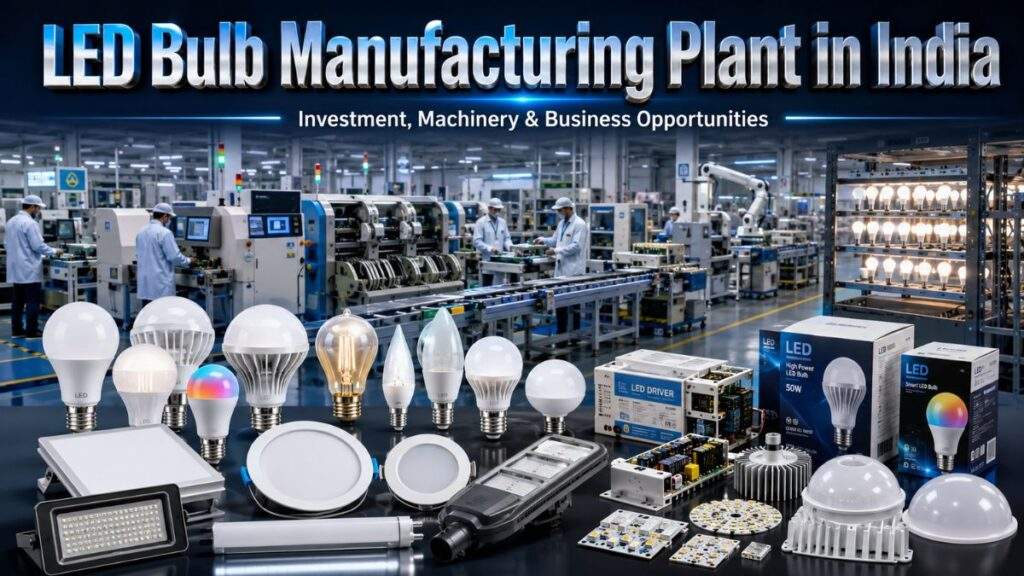
LED Bulb Manufacturing Plant The LED light revolution in India is one of the most successful government initiatives in the field of transitioning from traditional lighting to LED technology, and it offers entrepreneurs an exciting opportunity in the electronics manufacturing business with a Rs.5 Crore LED light manufacturing unit at a sweet spot of high domestic demand, institutional procurement by the government and the emerging export possibilities. Mass LED adoption has been achieved through the UJALA programme and the energy efficiency regulations that have ensured that LED is the standard light for the household, commercial and industrial sectors in the country under the leadership of the Bureau of Energy Efficiency (BEE), Ministry of Power. Beyond just replacing bulbs, India’s LED market is still expanding with the introduction of smart lighting, horticulture LED, and solar powered LED systems. Why LED Manufacturing Is a Strategic Opportunity in India The LED lighting market in India has witnessed tremendous growth over the years, driven by the increasing push for energy conservation, declining LED lighting chip prices, and government regulations. Institutional demand alone saw the UJALA scheme roll out over 36 crores of LED bulbs at subsidised rates in India. Commercial and Industrial LED use – factories, office buildings, hospitals, and street lighting – is also expanding with energy cost savings being measurable and payback periods generally ranging from 12-24 months. The Ministry of New and Renewable Energy also supports solar LED systems for rural electrification, thus establishing a renewable energy market for LED. Based on the BIS certification, an LED manufacturer from India will be able to sell LED products to the private sector and institutions across India. Get Detailed Project Report (DPR): LED Light Bulbs, Tubes, Fittings, Spotlights and Wall Lights Projects Government Policies Supporting LED Manufacturing LED products are certified under the star rating programme by BEE under the Ministry of Power and procurement preference is given to LED products that are BEE rated in government procurement. The Government e-Marketplace (GeM) portal provides access to Government as one of the biggest institutional buyers to MSME manufacturers registered on GeM. The technology upgradation funds under MSME Ministry are used to acquire the modern LED assembly and testing machine. LED Lamps sold in India must have BIS (Bureau of Indian Standards) certification as per IS 16102 and can be checked from BIS portal. There is a PLI scheme for electronics manufacturing that offers production subsidy to LED manufacturing companies that meet its criteria. Top Business Ideas in LED Manufacturing at Rs.5 Crore Scale LED Bulb and Tube Light Assembly for Domestic Market and GeM A semi-automated LED assembly machine with an investment of Rs.5 Crore can produce 10,000 to 30,000 LED bulbs as well as tube lights per day for imports of LED chips and drivers and domestically manufactured LED housing and heat sink. The main quality marks for the domestic market sale are IS 16102 certified by BIS. The GeM portal enables MSME manufacturers to directly sell to Government departments, Municipal corporations and public sector units, making it one of the biggest LED buyers in India. The municipal street lighting, government building lighting and school and hospital LED projects are big tender categories for institutions in which MSME manufacturers having GeM registration and BIS certification compete directly with each other. Agricultural and Horticulture LED Grow Lights The use of plant growth LEDs is a niche segment of LED manufacturing that is growing rapidly, and is tailored for greenhouse horticulture, vertical farming, and controlled environment agriculture. The growing protected agriculture in India, poly-house and vertical farming by urban farms place demand on the light spectrum specific grow lights, which stimulate plant growth and electricity usage compared to conventional horticulture lighting. The cost of grow lights per watt is 3–5 times as much as normal LED bulbs, which results in a better revenue per unit and margin profile. There is also good export potential to horticulture markets in South East Asia and Europe for this product category. Solar-Integrated LED Street Lighting and Garden Lighting The use of solar powered LED street lights, including solar panel, battery storage, LED luminaire and intelligent controller, is required in rural electrification projects, border area lighting and off-grid community lighting. There is a significant budget for solar LED street-lighting procurement in the MNRE and the state electricity boards. One manufacturing unit with the capacity of Rs.5 Crore per set of solar LED integrated systems can apply for state/central government tenders for rural street lighting. The average unit price is also much higher than the price of a retail LED bulb, which ranges from Rs.50 to Rs.200, to the cost of a solar LED street light system ranging from Rs.8,000 to Rs.25,000 per system, which greatly enhances the revenue per order. Get Detailed Insights from This Book: Solar PV Power and Solar Products Handbook Import-Export Opportunity Analysis India presently imports a substantial quantity of LED chips (epitaxial wafers) and LED drivers mainly from China, Taiwan and South Korea. The PLI scheme by the government for electronics manufacturing and global buyers’ China Plus One policy are providing opportunities for Indian LED manufacturers to increase the supply of chips and drivers from domestic manufacturers. Indian LED manufacturers are price competitive and quality as compared with the markets of Africa, South Asian and Middle East region of the world. The DGFT registers LED product exporters for RoDTEP benefits. Other LED export market development is through export promotion of electronics through APEDA equivalent, in the form of Electronics and Computer Software Export Promotion Council (ESC). Indian MSME Success Stories in LED Manufacturing Syska LED: Building India’s Largest LED Brand The Rajesh and Govind Uttam Chandani of the Syska Group developed the India’s most recognised LED lighting brand, choosing to specialise entirely in LED as India began its energy transition from a small electronics company. Its aggressive distribution strategy – that is, introducing Syska LED products in all segments of the Indian retail from modern trade to kirana stores – gave the company national visibility,
गांव में शुरू होने वाले 50 सबसे फायदेमंद बिजनेस आइडियाज़
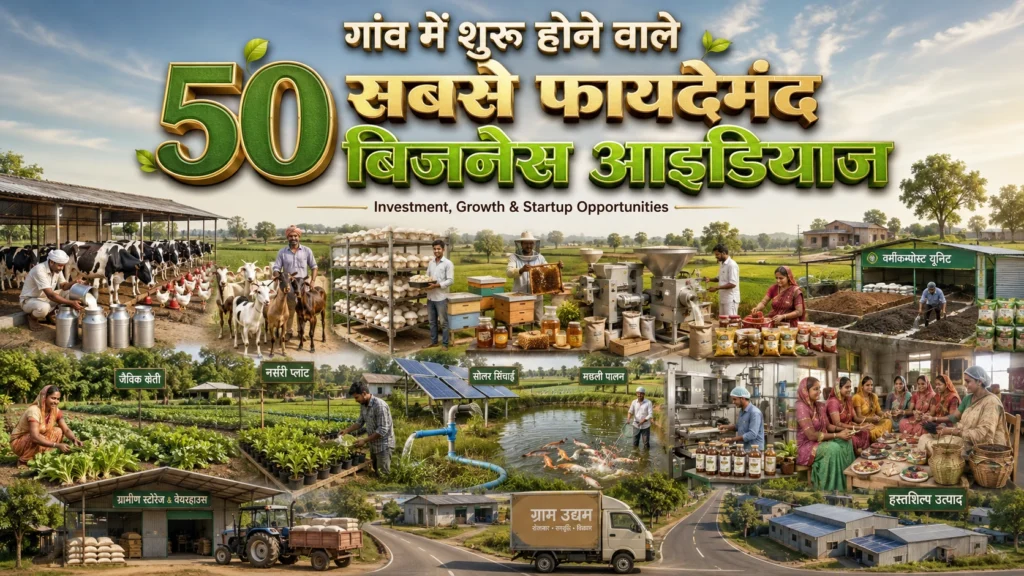
गांव में बिजनेस आइडिया भारत के गांवों में एक बड़ा आर्थिक बदलाव चल रहा है। जमीन सस्ती है। मजदूरी कम है। कच्चा माल करीब है। और सरकारी योजनाएं पहले से कभी इतनी अनुकूल नहीं थीं। एमएसएमई मंत्रालय के आंकड़ों के अनुसार देश के कुल सूक्ष्म, लघु और मध्यम उद्यमों का करीब 51 प्रतिशत ग्रामीण और अर्ध-शहरी क्षेत्रों में काम करता है। नाबार्ड की वित्तीय समावेशन रिपोर्ट बताती है कि ग्रामीण परिवारों की औसत मासिक आय पिछले एक दशक में दोगुनी से ज्यादा हो चुकी है। यह रिपोर्ट उन 50 बिजनेस की बात करती है जो असल में चलते हैं — और जिनकी व्यवहार्यता जमीनी स्तर पर साबित हो चुकी है। यह क्षेत्र मजबूत स्टार्टअप अवसर क्यों है बाजार की मांग और विकास ग्रामीण खपत लगातार बढ़ रही है। खाद्य प्रसंस्करण, कृषि सामग्री, हस्तशिल्प और हल्के विनिर्माण — सभी में मांग बढ़ी है। हर बड़ी सरकारी योजना एक नई स्थानीय आपूर्ति श्रृंखला बनाती है। सरकारी सहयोग और नीतियां पीएमईजीपी योजना के तहत ग्रामीण उद्यमियों को 25 लाख रुपये तक की विनिर्माण इकाई के लिए 35 प्रतिशत पूंजी अनुदान मिलता है। अनुसूचित जाति, जनजाति और महिला उद्यमियों को यह और अधिक मिलता है। पीएमएफएमई योजना खाद्य प्रसंस्करण इकाइयों को दस लाख रुपये तक का ऋण सहायता अनुदान देती है। नाबार्ड ग्रामीण उद्योगों को कार्यशील पूंजी ऋण और तकनीकी सहायता देता है। जोखिम जागरूकता ग्रामीण बिजनेस में तीन मुख्य जोखिम हैं — कच्चे माल की मौसमी उपलब्धता, परिवहन की सीमाएं और कुशल कार्यबल की कमी। बिजनेस चुनते समय पहले स्थानीय कच्चे माल और खरीदार की पुष्टि करें — फिर पूंजी लगाएं। बिजनेस चयन का तर्क गांव में बिजनेस चुनते समय ‘क्या चल सकता है’ नहीं, ‘यहां क्या टिकेगा’ यह पूछें। मुनाफे की संरचना तीन स्तरों पर काम करती है: पहला — कृषि आधारित प्रसंस्करण: सकल मुनाफा 18 से 30 प्रतिशत, पूंजी कम, बाजार करीब। दूसरा — हस्तशिल्प और वस्त्र: सकल मुनाफा 35 से 55 प्रतिशत, बाजार जोड़ जरूरी। तीसरा — हल्का विनिर्माण (साबुन, मोमबत्ती, कागज थैली): मुनाफा 35 से 60 प्रतिशत, विस्तार संभव। विस्तार का रोडमैप सरल रखें। छोटी इकाई से शुरू करें, स्थानीय मांग सिद्ध करें, फिर बढ़ें। Find the most profitable startup for your investment range 50 फायदेमंद गांव के बिजनेस — विस्तृत विवरण 1. आटा चक्की गांव में हर घर रोज आटा पिसवाता है — यह मांग कभी नहीं रुकती। पांच से दस घोड़े-शक्ति की मोटर वाली छोटी चक्की में डेढ़ से तीन लाख रुपये की शुरुआती लागत है। रोजाना 200 से 500 किलो पिसाई पर सकल मुनाफा 15 से 22 प्रतिशत बनता है। पीएमईजीपी में 35 प्रतिशत पूंजी अनुदान मिलता है। विपणन की जरूरत लगभग शून्य है — ग्राहक खुद आते हैं। 2. दाल मिल अरहर, मूंग, उड़द — ये सभी दालें ग्रामीण इलाकों में बड़े पैमाने पर उगाई जाती हैं। छोटी दाल मिल में तीन से सात लाख रुपये की लागत है। प्रसंस्कृत दाल कच्चे अनाज से 30 से 40 प्रतिशत महंगी बिकती है। मध्यप्रदेश और महाराष्ट्र में ऐसी इकाइयां सालाना पांच से दस लाख रुपये कमाती हैं। उद्यम पंजीकरण के बाद नाबार्ड से कार्यशील पूंजी ऋण आसानी से मिलता है। 3. अगरबत्ती निर्माण घर से शुरू होने वाला जाना-पहचाना सूक्ष्म उद्योग। मशीन और कच्चे माल पर 50 हजार से डेढ़ लाख रुपये। महिला उद्यमियों में यह सबसे लोकप्रिय विनिर्माण बिजनेस है। तमिलनाडु और कर्नाटक में घरेलू इकाइयां सालाना तीन से पांच लाख रुपये कमाती हैं। खादी एवं ग्रामोद्योग आयोग प्रशिक्षण और बाजार सहयोग देता है। सकल मुनाफा 30 से 45 प्रतिशत। 4. मोमबत्ती निर्माण पैराफिन मोम, धागा और सांचों से शुरुआत होती है। 30 हजार से 70 हजार रुपये में इकाई लग जाती है। सजावटी मोमबत्तियां ऑनलाइन बाजार में 150 से 800 रुपये प्रति नग बिकती हैं। त्योहारी मौसम में मांग तीन गुना हो जाती है। देशभर के ऑनलाइन बाजार तक पहुंच सरल है। सकल मुनाफा 40 से 55 प्रतिशत। 5. साबुन निर्माण हर्बल और हाथ से बने साबुन की मांग शहरी बाजार में बढ़ रही है। 40 हजार से 80 हजार रुपये में घरेलू उत्पादन शुरू होता है। नीम, हल्दी, चारकोल — ये सामग्री गांव में आसानी से मिलती हैं। ठंडी विधि से बने साबुन में सकल मुनाफा 35 से 50 प्रतिशत है। सूक्ष्म खाद्य उद्यम योजना में पैकेजिंग के लिए अलग अनुदान उपलब्ध है। 6. वर्मी खाद उत्पादन जैविक खेती की मांग साल-दर-साल बढ़ रही है। 100 वर्ग फुट इकाई से शुरुआत — लागत 15 हजार से 30 हजार रुपये। तीन महीने में पहली खेप तैयार। आठ से 12 रुपये प्रति किलो के भाव पर महीने में 500 किलो बेचना संभव है। कच्चा माल लगभग मुफ्त मिलता है। सकल मुनाफा 40 से 55 प्रतिशत। 7. मुर्गी पालन एवं चारा प्रसंस्करण 500 ब्रॉयलर मुर्गियों से शुरुआत — लागत डेढ़ से ढाई लाख रुपये। प्रति खेप 45 दिन में शुद्ध आमदनी 20 हजार से 35 हजार रुपये। साल में छह खेप संभव हैं। नाबार्ड के कुक्कुट उद्यम पूंजी कोष से वित्त उपलब्ध है। चारा प्रसंस्करण जोड़ने पर मुनाफा और बढ़ता है। Read the Complete Book Here: Preservation of Meat and Poultry Products 8. मधुमक्खी पालन एवं शहद प्रसंस्करण दस बक्सों से शुरुआत पर 25 हजार से 40 हजार रुपये की लागत। प्रति वर्ष 200 से 300 किलो शहद उत्पादन। जैविक शहद 300 से 500 रुपये प्रति किलो बिकता है। प्रसंस्करण और पैकेजिंग जोड़ने पर 600 से 900 रुपये प्रति किलो तक मिलता है। कौशल विकास मिशन और खादी आयोग दोनों प्रशिक्षण देते हैं। 9. पशु चारा निर्माण डेयरी पशुपालन की वृद्धि के साथ गुणवत्तापूर्ण चारे की कमी है। छोटी चारा मिल में दो से पांच लाख रुपये की लागत है। कृषि उपउत्पादों को मूल्यवर्धित चारे में बदला जाता है। स्थानीय डेयरी सहकारी से सीधा आपूर्ति अनुबंध मिलता है। सकल मुनाफा 20 से 30 प्रतिशत। मध्यम आकार की इकाई सालाना 15 से 25 लाख रुपये का राजस्व बनाती है। 10. गुड़ निर्माण गन्ना उत्पादक गांवों में यह सबसे स्पष्ट अवसर है। पारंपरिक क्रशर और उबालने की इकाई में एक से तीन लाख रुपये लगते हैं। जैविक गुड़ शहरी बाजार में 80 से 150 रुपये प्रति किलो बिकता है जबकि उत्पादन लागत 25 से 35 रुपये है। सूक्ष्म खाद्य उद्यम योजना में पैकेजिंग के लिए अनुदान मिलता है।
BHAVYA-Rasayan Scheme: 3 Chemical Parks, 10 chemical manufacturing Business Ideas for MSMEs
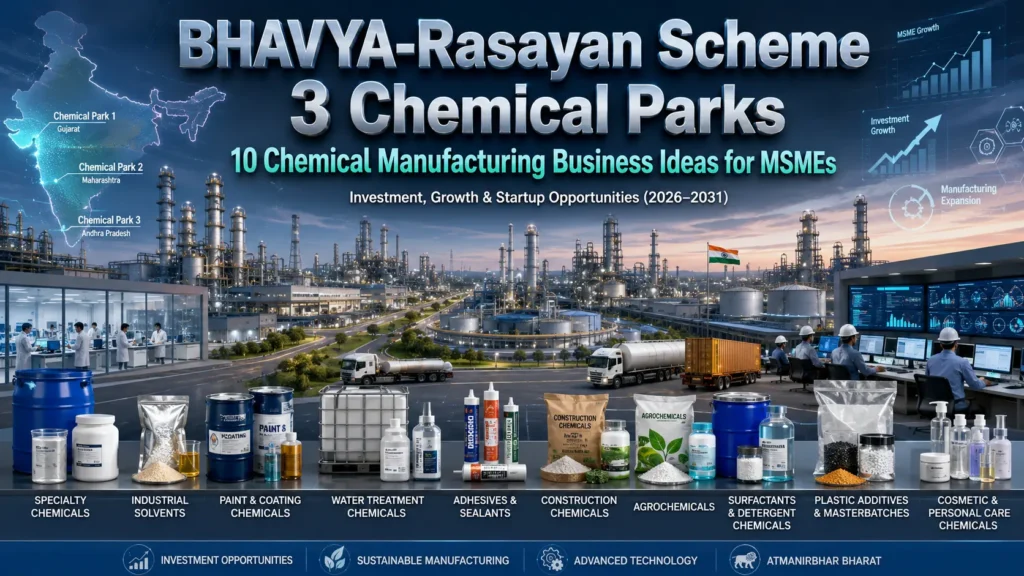
BHAVYA Rasayan Scheme Ten first-time promoters will say: What does it take to manufacture chemicals? Nine will say: What does it take to manufacture chemicals? How many dollars does it cost? That’s a good question, but it’s masking a better one. The question is what is the interest earned on each rupee and what is the time period. This article has both answers. It classifies practical business ideas based on the amount you can invest; so that you will not waste your time on the projects that you can’t afford. The timing is also a factor. Three dedicated chemical parks are a part of the BHAVYA-Rasayan scheme and the Union Cabinet has approved funding of ₹3030 crore for the same. Concentrated utilities within those parks will reduce the capital cost for all units within those parks. As a result, a number of projects that were considered to be too expensive just a year ago are now at the reach of a mid-size promoter. Why Founders Ask the Wrong Question First Capital Is Rarely the Real Constraint Good chemical projects are bank financed. They have been doing so for decades. The money is the least thing that prevents most promoters from succeeding. Far more projects fail due to weak product selection, missing approvals, and unrealistic demand estimates than due to tight budgets. Thus, capital is a result of good planning and not the beginning. What Actually Decides Your Return The profitability of this sector is determined by three factors. The first is the level of narrowness and defensibility of your product. Second, the efficiency with which you are using utilities like steam, power, water etc. Thirdly, your rate of filling capacity. The plant is not the same at 40 per cent as it is at 80 per cent. In most years, in fact, utilisation is more than the price. Margins Rise as Products Get Harder to Copy Simple blending businesses have regular, but modest margins. Product with the need of process know-how, catalysts or tight product purity fetches much more. They also require improved chemists and extended customer approval processes, though. So it does not actually make any sense to say it is a choice of ladders anymore. Select the rung that suits your team, not your bank account. How to Read a Chemical Project Cost Sheet The Five Blocks Every Project Contains When you’re judging a project, divide it up into 5 parts: Land and site development, which is eliminated by a park location. This is typically 15 to 20 per cent of the building or civil work cost. Plant, machinery and instrumentation (usually the largest block). Utilities and pollution control, typically 20 – 30 per cent, in standalone units. Working capital in the form of preliminary expenses, contingency and margin money. Be aware of the significant contribution of utilities and pollution control to the total. This one sentence is the answer as to why shared park infrastructure is such an important issue to smaller promoters. Related Article: 15 Profitable Chemical Business Ideas in India (Low Investment Manufacturing Guide) The Working Capital Trap This is where new founders are most likely to get hurt. Raw material must be paid for within a short period of time, and customer payment takes 60 to 90 days. Export buyers pull it even more. In the meantime, there is never an idle hour for salaries or power bills. Thus, even if a profitable plant is developed, it may still be cash-flowed in the first year. For at least 3-4 months operating cost, budget the operating cost as working capital; arrange the limit before commissioning; don’t wait after commissioning to arrange the operating cost limit. Business Ideas Under ₹2 Crore Don’t let small capital fool you, this is a big opportunity. The ideas below require small investments since they do not demand a lot of synthesis and pollution load. Chemical Testing and Calibration Laboratory All chemical units are required to test raw materials, finished products, effluent and emissions. Small units don’t have the resources for their own full analytical lab; therefore, they outsource. Thus, there is a demand for a NABL accredited third party laboratory from its first year. Services smoothly widen into instrument calibration, safety data sheet preparation and export support. Investment is in the instruments and qualified analysts, not land and reactors. Margins remain high because the key factor is skill. Fortunately, tougher environmental standards continue to grow the market without needing to be pushed. This still stands as one of the best opportunities for a technically savvy entrepreneur with little money to invest, anywhere in the industry. Drum Reconditioning and Chemical Packaging Chemicals are transported in drums, carboys, IBCs and each and every one of these requires cleaning, testing and certification before reusing. A reconditioning unit removes the used containers, conditions them to be standard and puts them back into circulation. The demand gradually increases with the increasing capacity of chemicals, which is close to the demand. Discipline in the areas of safety and traceability is more important for the business than extensive knowledge of deep chemistry. Therefore, it is appropriate for promoters coming from an engineering or logistics background looking for a presence in the sector without taking on process risk. The cash cycles are short, as buyers are not distant distributors but some industrial units. Subsequent operators go on to expand into bulk liquid transport, using the same customers. Institutional Cleaning and Sanitation Chemicals Consumables such as floor cleaners, disinfectants, degreasers and hand hygiene products are purchased on a regular basis by hospitals, hotels, food plants, and large offices. These are blending operations, not synthesis, which means that capital remains low and approvals remain easy. The real business is in the quality of the formulations and institutional selling. The majority of volume is generated by tenders and annual rate contracts which means income is predictable after empanellation. Another thing that you should know about contract manufacturing for bigger brands is that you will get your cash flow early and