
7 Industrial Business Ideas Near HPCL Pachpadra Refinery That Can Earn ₹1 Crore/Year
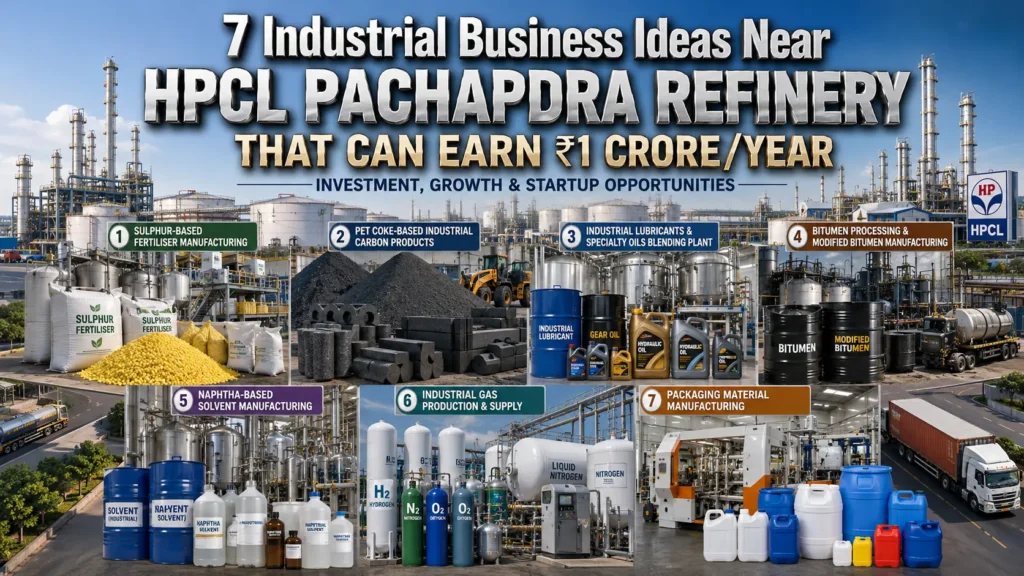
Business Ideas Near Pachpadra Refinery A Refinery That Changes the Map One of the biggest industrial events in the remote memory of western India is the commissioning of HPCL (Rajasthan) Refinery at Pachpadra, Balotra-Barmer belt. A greenfield crude oil refinery of this magnitude isn’t just a manufacturing plant for fuel; it’s a whole new environment of entrepreneurial concepts that savvy business people can exploit today. The supply chains, workforce and infrastructure that a mega-refinery attracts benefits all of the above. The Pachpadra corridor is undoubtedly the most enticing industrial opportunity in the country right now if you are a startup founder, MSME investor or first-generation entrepreneur seeking an opportune industrial entry into the nation. This article takes a detailed look at this opportunity – the sector logic, where the government support is available, some ideas for projects, trade dynamics and models of success to learn from. Understanding the HPCL Pachpadra Refinery and Its Industrial Significance The project for the HPCL Refinery Limited (HRRL) is a joint venture between Hindustan Petroleum Corporation Limited (HPCL) and the Government of Rajasthan at Pachpadra. It is meant to process locally available crude oil from Rajasthan, which is mainly from Barmer oil fields, with a capacity of 9 million metric tonnes per annum (MMTPA). Thus, it is one of the bigger greenfield refinery projects being undertaken during India’s recent industrial history. But it is not just the refinery that is significant for entrepreneurs. It’s the industry that develops around the refinery, and what it makes. Modern crude oil refinery produces more than petrol and diesel. They include naptha, liquefied petroleum gas (LPG), aviation turbine fuel (ATF), sulphur, petroleum coke (pet coke), bitumen, propylene, and other hydrocarbon streams, which are generated as by-products or co-products. These are each a separate “downstream” manufacturing value chain. Plus, because it’s such a large refinery, it requires massive amounts of support infrastructure: industrial gases and packaging materials, logistics, maintenance services, chemical intermediates, and so on. Thus, the business opportunity is direct (in the processing of the refinery outputs) and indirect (in provision of services and materials required by the refinery and its employees). Information about the refinery project can be obtained from HPCL official corporate website. Why the Petrochemical and Ancillary Manufacturing Sector Is a Strong Bet Right Now The Indian Petrochemical industry is in structural growth mode. Demand of polymers, plastics, synthetic fibres and specialty chemicals have been on the ascent in the domestic market. This demand is sustained by rising activity in the construction, food and drinks packaging, automotive and agriculture industries. India is currently importing considerable quantity of petrochemical intermediates which presents an opportunity for domestic manufacturers to meet the demand through import substitution. In addition, the state of Rajasthan is relatively underpenetrated industrially in terms of its resource base and size. The state government has made a conscious effort to make it an attractive industrial location through the Rajasthan Investment Promotion Scheme (RIPS) and dedicated industrial areas. The process of the Pachpadra refinery coming to life is also an anchor investment, which normally leads to an ancillary unit, workforce settlement and service industries coming into the area. One of the biggest costs benefits a manufacturer can have is its proximity to the raw material source, from a profitability perspective. Companies set up near Pachpadra refinery will benefit from reduced logistics costs for feedstocks, quicker response of supply chain and possible preferential access to by-product streams. The benefits directly impact on operating margins. The Ministry of Chemicals and Petrochemicals, Government of India is an authoritative source for industry level data and statistics for the petrochemical industry. Export Potential from the Pachpadra Industrial Belt The Indian petrochemical exports have been on the rise, and major markets in Southeast Asia, Africa and Middle East are actively looking for competitively priced petrochemical intermediates as well as finished products from India. The geo-location factor also proves to be advantageous for Rajasthan. The manufacturing sector has easy access to the sea through proximity of Mundra and Kandla ports located in Gujarat, which is essential for export-oriented industries. It is possible for an entrepreneur to start a petrochemical/ specialty chemical unit which can be export oriented from day one near Pachpadra, provided the product is in line with the global demand patterns such as agrochemicals, packaging polymers, industrial lubricants etc. Government Policies and Incentives Supporting New Manufacturing Businesses The policy landscape for new manufacturing enterprises that are located in the vicinity of an anchor industrial project, such as HRRL Pachpadra, is truly conducive at the moment. There are a few schemes at both central and state levels that offer capital subsidy, tax exemption, institutional support and thereby mitigate the financial risk for the first time investors. Central Government Schemes Production Linked Incentive (PLI) Scheme has been introduced by the Ministry of Chemicals and Petrochemicals for certain chemicals and petrochemicals. It provides incentives based on incremental production, which is especially appealing for manufacturers expanding production. The MSME Credit Guarantee Fund Trust (CGTMSE) scheme provides credit support of up to ₹2 crore to eligible MSMEs without the need for collateral.The MSME Credit Guarantee Fund Trust (CGTMSE) scheme is an important facilitator for the small manufacturing setups for providing credit support without collaterals to MSMEs. Besides, the Ministry of MSME also operates PMEGP (Prime Minister’s Employment Generation Programme) that offers capital subsidy of up to 35% for manufacturing industries in rural and semi-urban areas. Pachpadra is considered as semi-urban area, which is very relevant for small manufacturing entrepreneurs for the implementation of PMEGP. Likewise, the Technology Upgradation Fund Scheme (TUFS) is applicable in the case of investment by business in modern and efficient manufacturing equipment. Rajasthan State Incentives Rajasthan Investment Promotion Scheme (RIPS) is the state’s key industrial incentive scheme. Provides subsidies on investments, exemption from electricity duty, rebate on conversion of land charges, and waiver of stamp duty for qualified industries. Typically, the sectors including units for Petrochemicals and Chemicals are considered as priority sectors for RIPS incentives. Further, the Rajasthan MSME Act provides
How to Start a Power Transformer & Distribution Transformer Manufacturing Business: A Complete Guide
Power Transformer Manufacturing Business and distribution transformer manufacturing is among the most robust and sought-after manufacturing business ideas in India’s industrial landscape and that is one of the reasons why electricity is never in demand. Transformers are used in every new factory, solar farm, residential township, railway line, data centre or irrigation pump. This reality can make transformer manufacturing a viable business idea and structurally sound long duration opportunity for first generation entrepreneur and MSME investors. India is undergoing a large-scale electricity infrastructure build-out. The government’s thrust on 24×7 power supply, modernization of the grid and integration of renewable energy sources are driving transformer demand to a new high. The government’s thrust on 24×7 power supply, modernization of the grid, and integration of renewable energy sources are driving transformer demand to new heights. At the same time, the changes in the global value chain are opening export opportunities that India manufacturers could not have envisioned 10 years ago. Covering investment structure, raw materials, government incentives, project models, and real-world success stories, this article delves into all facets of this manufacturing enterprise. Why the Transformer Manufacturing Sector Is a Smart Business Entry Demand Fundamentals Are Unusually Strong The market for transformers in India (both distribution transformer and power transformer) is more than Rs.30,000 crore and is increasing at a compound annual growth rate of approximately 8 to 10 percent. State electricity distribution companies (DISCOMs) buy hundreds of thousands of distribution transformers annually for electrification in rural areas, feeder separation and for replacing old transformers. Other demand drivers include private industrial estates, commercial real estate developers and renewable energy project developers. Finally, the transition to renewables is a key layer. Step up transformers are used for connecting the generation to the grid in every solar and wind energy park. As India aims to install 500 GW of renewable energy upcoming, transformer demand is likely to be huge from this stream. The market offers volume (distribution transformers) and margin (power and specialty transformers) to a new manufacturing company entering the market. Get Detailed Insights from This Book: Solar PV Power and Solar Products Handbook Export Opportunity and Import Substitution India is currently importing some of its power transformer requirement especially of the High Voltage transformers of the greater than 220 KV range. This presents a clear opportunity for import substitution: to have locally produced manufacturers ready to invest in advanced capabilities. Besides, India’s ability to become a rightful and cost-competing electrical equipment exporter is improving. African DISCOMs, grid companies in Southeast Asia, and Middle Eastern EPC companies are actively seeking transformers from Indian manufacturers, especially those that are IEC and IS certified. The Make in India initiative (https://www.makeinindia.com/sector/electrical-machinery) also helped to build trust among global buyers and Indian manufacturers that India is not only an opportunistic vendor but can also become a long-term supply partner. It’s a paradigm change which a well-positioned new manufacturing company can benefit from early. Government Policies and Incentives Supporting This Manufacturing Business Production Linked Incentive (PLI) and Capital Goods Schemes The ministry of heavy industries (https://heavyindustries.gov.in/) has been managing the following schemes that are of interest to the transformer manufacturers. The PLI scheme for white goods and electrical equipment is based on incentives for sales growth, thus incentivizing incremental investments in manufacturing. The schemes for capital goods can provide financial assistance for upgradation of technology and establishment of new plants — both of which can be directly applied for the business of making transformers. MSME Schemes: Credit, Cluster, and Subsidy Benefits There are a number of schemes run by the Ministry of MSME (https://msme.gov.in/) which directly impact the new transformer manufacturers. Credit Guarantee Fund Trust for Micro and Small Enterprises (CGTMSE) offers collateral free loans of Rs.2 crore, especially helpful in the case of small distribution transformer units. For small manufacturers, there are two schemes, namely Technology Upgradation Fund Scheme (TUPS) and Credit-Linked Capital Subsidy Scheme (CLCSS), which provide support for machinery investment. In addition, MSME Clusters have been developed in various states such as Gujarat, Maharashtra, Rajasthan, Uttar Pradesh, etc. for electrical equipment. Establishing within a cluster provides a new business with shared test infrastructure, shared facility centres and quicker clearances. Manufacturing startups can also avail of other tax exemptions and self-certification benefits provided by the DPIIT Start Up Recognition (https://www.startupindia.gov.in/), portal. BIS and Standards Compliance as a Business Moat BIS certification of the product under IS 1180 (distribution transformer) and IS 2026 (power transformer) is not just a regulatory requirement but also an edge. The one biggest buyer group is the State DISCOMs which procure only BIS certified transformers. A new manufacturer which gets BIS certified in a relatively short period of time is given a channel of procurement of thousands of crores of rupees for the year. The Bureau of Indian Standards (BIS) (https://www.bis.gov.in/) offers transparent certification processes for new applicants. Get Detailed Project Report (DPR): Transformer Manufacturing Handbook State-Level Incentives Gujarat, Telengana, Tamil Nadu, Rajasthan and Madhya Pradesh have active industrial policies that provide additional incentives for electrical equipment manufacturing. This includes stamp duty exemptions, electricity tariff concession, defrayal of GST for a specified term and employment subsidies. State-level industrial policies need to be considered prior to site selection by an entrepreneur. Specific Business Ideas in Power and Distribution Transformer Manufacturing Business Idea 1: Small Distribution Transformer Manufacturing Unit (Up to 200 KVA) It is the easiest and the most convenient start point for the first-generation entrepreneurs and MSME investors. The distribution transformer having a rating of 25 KVA to 200 KVA is the workhorse of the rural / semi-urban electricity distribution system. State DISCOMs procure these in bulk — often through annual rate contracts. The capital investment for a small unit having capacity of 500 to 1000 transformers per year is around Rs.2 to Rs.4 crore, which includes a fabrication shed, core cutting and winding machine, tank fabrication set up, oil impregnation machine and a testing station. The margin profile is good, usually between 18-24% at the operating level, with a well-defined
India Cargo Shipping Containers Market 2026–2033: SWOT Analysis, Demand-Supply Gap, Startup Opportunities & Government Incentives
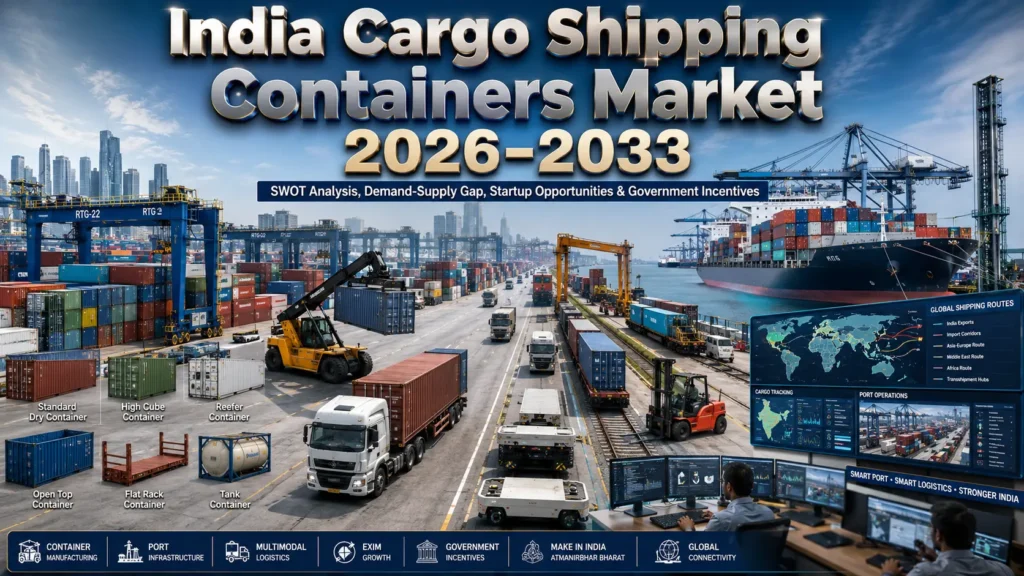
India Cargo Shipping Containers Market The India cargo shipping containers market is estimated to be valued at USD 20.5 billion and is projected to reach USD 31 billion by 2033 at a CAGR of 4.7%. The current annual handling capacity of India’s major ports is more than 14 million TEUs which is growing at 8–10% annually. Even with this demand scale, Indian exporters have critically low dependence on external sources if the amount of over 95% dry shipping containers used by Indian exporters has to be considered. If the amount of dry shipping containers used by Indian exporters is taken into consideration, then Indian exporters are critically dependent on external sources with an over 95% dependence rate. Domestic container production in India is close to zero and annually, there is a throughput demand of 14 million TEUs. Almost all dry freight containers are imported from China. Indian exporters faced freight rates up to 3-5 times higher, and even waited for weeks for containers in recent times of freight disruptions around the world. This structural deficiency has been reflected in Budget 2026 via the ₹10,000 crore Container Manufacturing Assistance Scheme (CMAS) – a meagre amount of domestic manufacturing capacity compared to actual demand – in 1 million TEU per year over 10 years. Why Shipping Containers Are the Backbone of India’s Trade Ambitions Talking about India becoming a global manufacturing hub is always accompanied by the words like port, freight corridors and logistics efficiency in New Delhi where the policymakers talk about becoming a manufacturing powerhouse. However, there is one infrastructure that does not get the attention it deserves despite its critical role in India’s trade with the world: The simple steel shipping container. Almost 90 percent of the world’s trade in merchandise goods is conducted by sea, and containers are the standard units of steel that enable this transportation. Availability, cost and origin of shipping containers are not logistics foot-notes in a country like India, where the ports process over 95% of the international trade by volume according to the Ministry of Ports, Shipping and Waterways (MoPSW). It is a national priority issue. This is the paradox of the India cargo shipping containers market: very high demand in a one of the fastest growing trading economies, with virtually all shipping containers coming from China. The market opportunity being analyzed is a paradox: high throughput and no domestic production. Get Detailed Project Report (DPR): Business Ideas for Steel Shipping Container Manufacturing India Cargo Shipping Containers Market: Size, Growth & Forecast 2026–2033 India cargo containers market is estimated to hit USD 20.5 billion by 2021 and is expected to grow at CAGR of 4.7% till 2033. If one focuses only on the shipping container manufacturing and leasing business alone, the market is estimated to be in the range of USD 389 – 403 million and will increase to approximately USD 546 – 563 million during the same period. These numbers, however, only tell part of the story. The far more significant measure is ‘containerized throughput’ – an estimated 14 million TEUs (Twenty-foot Equivalent Units) are handled through Indian ports each year, an increase of 8–10% year-on-year. The highest share is accounted for by JNPT, Mumbai near port and the port at Chennai, Mundra and Kolkata. The growth of deep-water terminals, particularly the Vizhinjam International Seaport in Kerala, reflects India’s plans for much greater volume of containers being processed in the coming decade. The India Brand Equity Foundation (IBEF) (www.ibef.org) has been emphasizing over and over that India’s port and logistics infrastructure is undergoing the most transformational shift since liberalisation, and that the port-led development policy is being given a top priority in the midst of this shift – the Sagarmala Programme. Market Segmentation at a Glance Segment Category Key Observation Market Share By Size 40 Feet Containers Dominant for bulk/industrial goods 57.7% By Size 20 Feet Containers Preferred by SMEs for frequent shipments ~35% By Application Consumer Goods Largest revenue share; urbanization-led Dominant By Application Food & Beverages Fastest growing; reefer container demand Fastest CAGR By Application Industrial Goods / Pharma / Healthcare Growing with export clusters Significant By Region Western India (Mumbai/JNPT/Mundra) Highest container throughput nationally Largest SWOT Analysis: India Cargo Shipping Containers Market Any entrepreneur or investor considering entering this industry will need a good SWOT analysis. The advantages are structural in nature and continuously gaining ground, the disadvantages are largely fixable with capital and policy intervention, the opportunities are among the most alluring found in Indian manufacturing and the threats are real but can be managed through strategic positioning. Strengths As one of the top-ten trading countries in the world, India has an in-built and continuous demand base for containers. The Sagarmala Programme is the country’s port infrastructure modernization initiative which is being implemented at a scale of lakhs of crores. Now, transit time has considerably been reduced through Dedicated Freight Corridors (DFCs) — Eastern and Western corridors — and intermodal container movement is much more economical. Moreover, India boasts a significant steel manufacturing ecosystem with steel producers such as SAIL, Tata Steel and JSW Steel that can provide raw materials at internationally competitive prices for the production of containers. Weaknesses The biggest drawback is the lack of domestic capacity to produce domestic containers. The number of containers that India makes is an insignificant percentage of the containers that it consumes, and more than 96% of the world’s container production is controlled by China. It is a vulnerability of the supply chain that became painfully apparent during the COVID-19 pandemic and subsequent global freight disruption, when Indian exporters paid a freight rate three to five times greater than normal rates and were forced to wait for weeks for shipments because containers were scarce. The industry also does not have a skilled fabrication labor force to assemble high volume of steel containers for marine applications. Opportunities Changing opportunities. In the Union Budget 2026–27, the Government announced a ₹10,000 crore Container Manufacturing Assistance Scheme (CMAS) for five years with a
India Paper-Based Products Market 2026–2033: SWOT, Demand-Supply Analysis, Regional Insights & Startup Opportunities
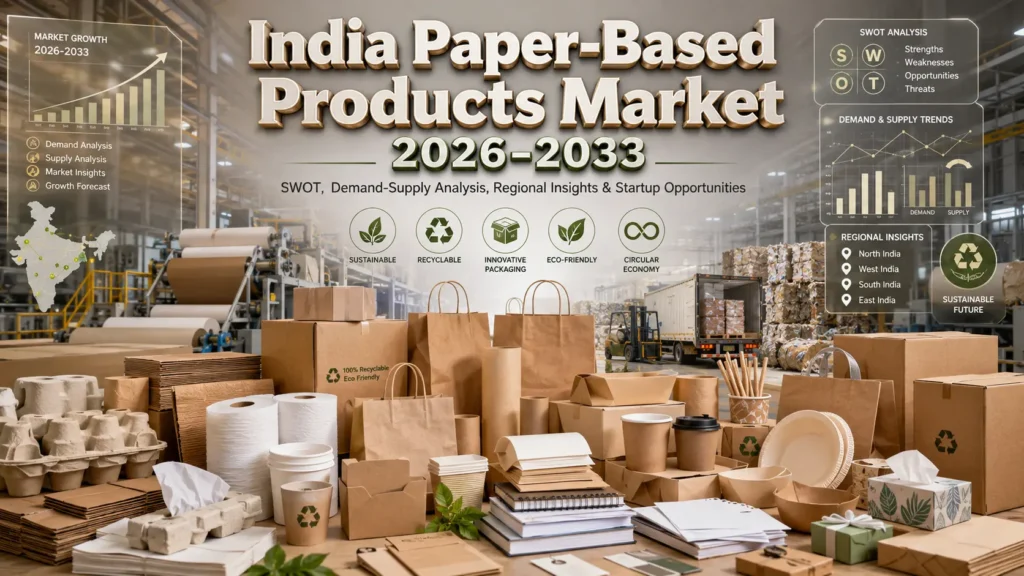
India Paper Based Products Market Market Insight The paper-based products sector in India is at a juncture – where policy support initiatives, increasing e-commerce volumes and a significant change in consumer mindset from single-use plastics are shaping the entire demand curve. Indian paper and paper products market is estimated at USD 9.25 billion and will reach a value of USD 11.91 billion by 2030 with steady growth of approximately 4.37% during the forecast period. The packaged paper market, meanwhile, is growing at much higher rates, and India’s paper packaging market alone was worth about USD 18.6 billion, which by 2033 should be worth USD 28.3 billion, according to data tracked by the India Brand Equity Foundation (IBEF). The headline growth rate is not the most compelling part of this opportunity. It is the increasing disconnect between the demand and supply of domestic consumption, which must be clearly analyzed by policy makers, investors and manufacturing entrepreneurs. India Paper-Based Products: Market Overview and Growth Trajectory India is now among the fastest growing paper markets of the world and the total paper and paperboard consumption have reached 23-24 million tonnes per annum. The production capacity of the operating mills is in the range of 22-24 million tonnes, whereas installed capacity of mills is in the range of 30-32 million tonnes, which is a contradiction and highlights under-usage of production capacity as well as structural deficiency of supply. According to the data given by the Central Pulp & Paper Research Institute (CPPRI), which is an autonomous body under Ministry of Commerce & Industry in the Government of India, the manufacturing of paper in the country is around 900 with only 550-560 being operational. This figure alone represents the level of investment and consolidation needed in the sector. Generally, there are four application segments of the paper market in India – packaging paper and paperboard, writing and printing paper, newsprint, and specialty papers. The packaging is the largest growth driver of these, representing almost 65% of paper usage, with an annual increase of more than 8%, and is fueled by growth from FMCG, organized retail, pharmaceutical packaging and the structural development of e-commerce logistics. India shipped more than 5.2 billion online shipments in one recent year alone, and that figure is still rising — all of these shipments need corrugated packaging, paper bags, labels, or protective paper inserts. Writing and printing paper is the second-largest segment and is expected to see a fairly consistent demand from education institutions, publishing houses, government documentation and stationery from the value chain, as they consume paper at the rate of about 35%. India, despite the digital disruption, has more than 105000 registered newspapers published in various languages of which more than 100000 are daily newspapers in India, according to the Registrar of Newspapers in India, which is the highest in the world in terms of newspaper and writing paper demand. The turnover of Indian paper industry is about Rs. It is estimated to be about Rs. 70,000 crores for the national exchequer. 8,000 crores. Not only is it an industry sector, but it directly and indirectly employs more than five lakh people and helps thousands of agro-forestry farmers all over the country, too. Get Detailed Insights from This Book: Modern Technology of Pulp, Paper and Paper Conversion Industries Per Capita Consumption Gap: The Single Biggest Market Opportunity The one figure that sums up the investment case of the paper-based products industry in India is this: India consumes about 15-17 kilograms of paper per capita annually. The average for the world is 57 kilograms. In developed countries such as the USA, it is over 200 kg per person/year. This is an abysmal consumption deficit and it is not just a number — it is an economic deficit. Increase in India’s per capita paper consumption by 1kg is approximately equivalent to one million additional tonnes of paper consumption per year. In India, the economy is rapidly formalizing, urbanization is increasing rapidly and literacy is on the rise, which will lead to a per capita consumption of 28 to 30 kilograms of paper in 2030. It does not take much imagination to realize that this alone would mean the need for adding up to 15–16 Mt of consumption capacity in this decade—an extraordinary manufacturing opportunity. The Indian Paper Manufacturers Association (IPMA) data shows domestic use of packaging paper is more than 8% a year now, and the total paper market is expanding at 6-7% a year. But a lot of this incremental demand growth is being satisfied right now not by domestic manufacturers but by imports, and especially from China, the ASEAN countries and South Korea. Demand–Supply Gap: Where the Real Opportunity Lies The Indian paper-products industry has a real, measurable and commercially important demand-supply gap. On the other, the domestic consumption is expected to increase to 23.5 million tonnes per annum while the domestic production capacity (with only the operational mills considered) is around 22 MT per annum. This is being addressed mainly by new imports, which have increased dramatically, of around 1.5 to 2 million tonnes per year. IPMA data shows that at certain junctures, imports of paper and paperboard have demanded over 15% of the total Paper Market in India — almost 2.8 to 3 million tonnes of paper per year. Imports from China have increased by more than 13% on an annual basis in value terms and imports from ASEAN have soared by more than 78% in certain quarterly periods. Most of the paper which India imports are coated papers, specialty papers, tissue, kraft paper and newsprint which can be produced locally in India, with the exception of coated papers, which are imported from the Far East. The import surge is structural, not cyclical, according to information from the Directorate General of Commercial Intelligence and Statistics (DGCI&S). Nearly Rs. 14 billion worth of paper and paperboard were imported. This amounts to 10,000 crores in a single nine-month period and is a straight-line impact on the viability of
Top 20 Manufacturing Business Ideas in Odisha with High Growth Potential
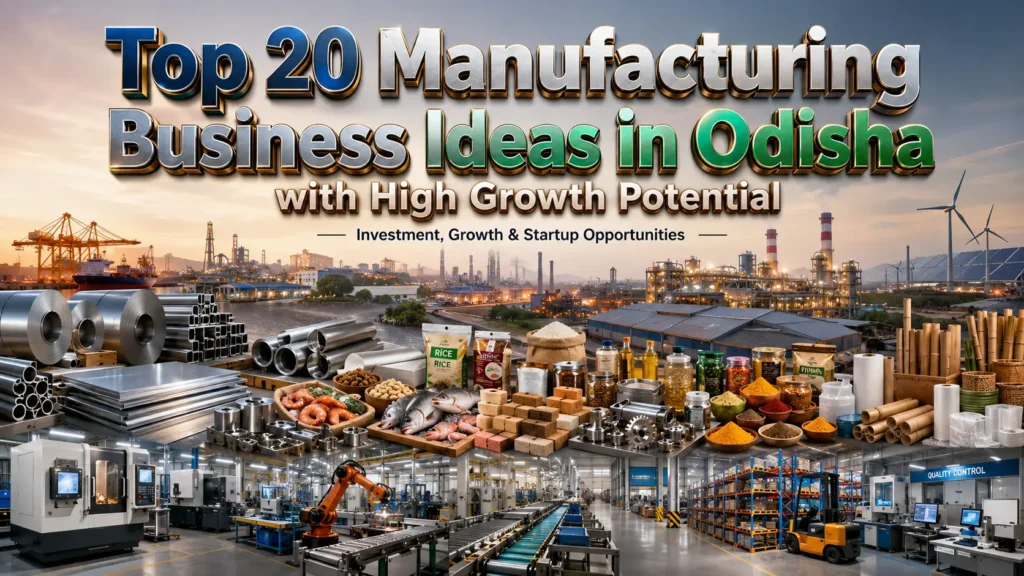
Manufacturing business ideas in Odisha Odisha has quietly emerged as one of the most attractive manufacturing locations in India. This state now provides a unique mix for those who are looking into their business ideas with a capital of ₹15 crore — abundant natural resources, fast-improving industrial infrastructure as well as a very aggressive government policy to encourage investment pulling in. From a first-generation entrepreneur to an MSME promoter seeking diversification, the manufacturing business scenario in Odisha is expanding across various industry sectors that may not have been taken seriously until now. Strategically located near the important mineral belts, Odisha has three major ports (Paradip, Dhamra, Gopalpur) and a coastal geography that allows for export logistics. The Odisha Industrial Development Corporation (IDCO) has been developing more than 50 industrial estates and parks in various important districts of the state which are equipped with plug and play infrastructure for new manufacturing units, according to the corporation. Combine these with the fact that the population is over 45 million, the consumer class is expanding, and the road and rail infrastructure is improving and you have the makings of a manufacturing company that has the potential to grow significantly over the next five to seven years after commission. This article discusses 20 potential manufacturing projects which are ideal for the investment range of ₹ 15 crores. These business ideas have been screened using a criterion of feasibility, namely access to raw materials, the demand for the business, policy support, and the logic of profitability. Why Odisha Is a Smart Location for Manufacturing Business Even the investors still prefer to go for Gujarat or Maharashtra for manufacturing business planning. It’s a natural instinct but one that is also becoming more expensive: land value has skyrocketed, labour costs have skyrocketed, and competitive density has skyrocketed in those states. The state of Odisha, on the other hand, has prospered in a quiet and effective manner. The State of Odisha, on the other hand, has been growing quietly and effectively. The Indian Bureau of Mines (IBM) shows that Odisha has almost 25% share of the country’s total iron ore reserves and has a significant advantage in the distribution of reserves of chromite, bauxite, coal and manganese – which is a mineral asset that is not found in any other states of India in the same quantity. These mineral reserves are not only for big steel and aluminium companies. They develop a whole downstream system – processed minerals to industrial chemicals, precision components, refractory products – which can be profitably entered by smaller manufacturers having ₹10-20 crore revenue. Moreover, the industrial policy of the Odisha government provides you with land at subsidised rate in the industrial parks, capital investment subsidy and power tariff concession which all directly reduces your operating cost. The Ministry of Commerce & Industry, Government of India data reveals an uninterrupted growth rate in the year-on-year trend of investments in industries in Odisha. Enhancement in ease of doing business and improved single window clearance has also driven growth in the state’s MSME sector. Government Policies and Incentives That Make Manufacturing Business Viable The Odisha Industrial Policy offers detailed incentives for both MSMEs and big manufacturing establishments. With just a few schemes available for a project that is worth ₹15 crore. Perhaps the greatest leverage is the state capital investment subsidy on fixed capital investment of 20-40%. This cuts your equity requirement and increases ROI. Further, you benefit from VAT/GST concession, electricity duty exemption for the first 5 years and stamp duty waiver on land purchase in Industrial Estates which further helps bring down your set-up cost. The Ministry of MSME has established Credit Guarantee Fund Trust for Micro and Small Enterprises (CGTMSE) at the national level, which provides for collateral-free loan facility of up to ₹5 crore. The Production Linked Incentive (PLI) scheme under DPIIT includes 14 industries, most of them with good presence in Odisha such as food processing, textile, specialty chemicals etc. The Make in India initiative has also simplified environmental/ factory clearance for manufacturing units located in the notified areas. The time and cost of commissioning is minimized with ready infrastructure from Industrial Development Corp of Odisha at its various clusters such as Kalinganagar, Jharsuguda and Parasdep SEZ. Also, the National Bank for Agriculture and Rural Development (NABARD) provide refinance schemes and direct credit to agro-processing and food manufacturing units in Odisha — which is a significant source of support for food-sector entrepreneurs. 20 Manufacturing Business Ideas in Odisha at ₹15 Crore Investment 1. Sponge Iron Manufacturing There are more sponge iron plants in Odisha than anywhere else in India. This is because Odisha is the largest concentration of sponge iron plant in India. Keonjhar and Sundargarh are the two districts which have rich deposits of iron ore. The Ministry of Steel, Government of India has published data on direct reduced iron (sponge iron) which portrays India is the largest producer of direct reduced iron (sponge iron) in the world, and Odisha contributes a major chunk of the total capacity of the country. The investment required for a small scale (50000 TPA) sponge iron plant is within the range of ₹12–15 crore. Sponge iron is still in demand as it is a raw material for small steel re-rollers and induction furnaces. Margins are closely related to iron ore procurement expenses, giving Odisha an edge. But any entrepreneur will have to properly invest in the pollution control system and waste heat recovery system to comply with the norms while minimizing the cost of fuel. 2. Ferro Alloys (Ferro Manganese / Silico Manganese) Ferro alloys are essential inputs for steelmaking and that Odisha is endowed with deposits of manganese ore which gives it a clear upstream advantage. The cost of establishing a Ferro Alloy Plant of medium size (10,000-15,000 TPA) will require around ₹13-15 crore. A steady demand exists for these products from Japan, South Korea and Europe, which are steelmakers. According to data collected by Ferro Alloys Producers’ Association of India (FAPA),
Manufacturing Business Ideas in Tamil Nadu: Best Opportunities Under ₹1 Crore
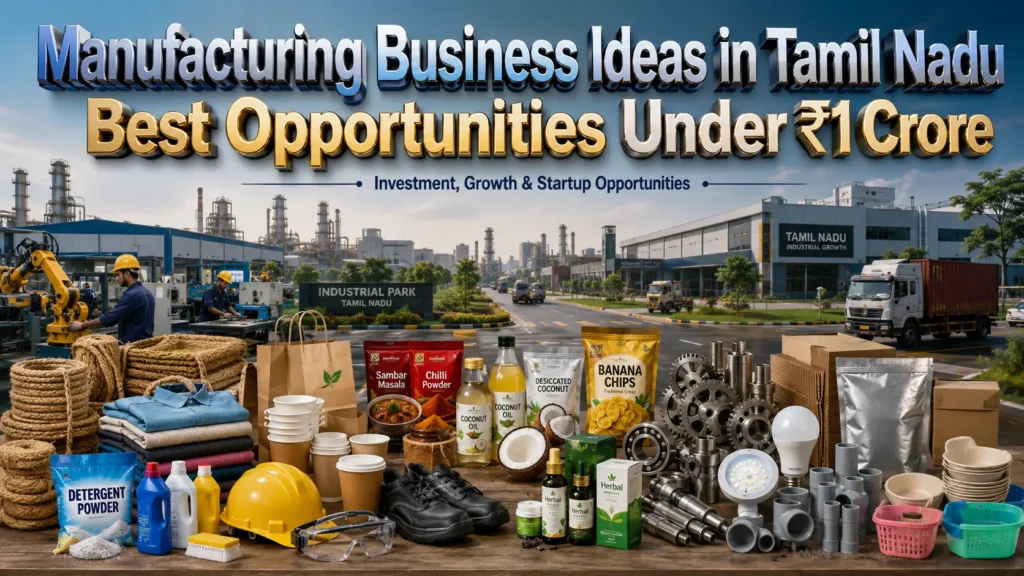
Manufacturing business ideas in Tamil Nadu Tamil Nadu is now one of India’s most powerful manufacturing states and entrepreneurs with ₹1 crore in their pocket have more business ideas that are real than in any other part of the country. The state has a mix of port facilities, skilled workers, and a rich network of suppliers that most first-timers fail to recognise until they begin to survey land. To build a new unit in Chennai, Coimbatore, Tiruppur or Hosur does not require a strong demand base to be created. As Chennai, Coimbatore, Tiruppur and Hosur already have established the demand base for the global supply chain, a new unit can be set up at these locations without facing any difficulty in creating demand. It just needs to connect to the existing. This article dissects where the real scope lies, which government schemes are effective at cutting down your capital expenditure, and which particular manufacturing lines make sense at an investment of ₹1 crore. The objective is not a wish list, but a practical decision making. Get Detailed Project Report (DPR): Tamil Nadu Business Opportunities Guide Why Tamil Nadu Is the Right Base for This Investment The production share of Tamil Nadu in India is one of the highest in the manufacturing sector, which isn’t a coincidence. For decades, the state has been spending money on developing industrial corridors and power plants and on vocational training colleges that churn out skilled manpower for the factories. Thus, a founder who establishes here can save time in training employees and more time in production stabilisation. Access to exports is also important. A significant proportion of India’s exports are carried by Chennai and Tuticorin ports, reducing the cost of logistics for those who produce components, textiles or processed foods for export to international markets. Further, the cluster system in Tamil Nadu reduces working capital cycle as raw material suppliers, job-work vendors and testing labs are within a 50-kilometre radius. Government Policies and Incentives Supporting New Units There are a handful of schemes that directly decrease the effective amount of money that a founder has to invest. For those who have only ₹1 crore in their bank account, the credit guarantee fund trust for micro and small enterprises (CGTMSE) with collateral-free loans up to a defined limit is significant, and the Prime Minister’s Employment Generation Programme (PMEGP) is crucial for financing new manufacturing units by the ministry of MSME. The Production Linked Incentive (PLI) scheme, under the Department for Promotion of Industry and Internal Trade (DPIIT), incentivises certain industries such as textiles and electronics for increasing their production and Tamil Nadu’s own state industrial policy also includes capital subsidy, stamp duty concession and power tariff relief. They should also visit Tamil Nadu Industrial Guidance Bureau to obtain single window clearance which takes away a significant portion of the delay in approvals that regularly drains the first year. The Ministry of MSME website provides the scheme details with eligibility and caps on subsidy for each of these schemes. Multiple Business Ideas Worth Evaluating Textile Weaving and Processing Unit Tamil Nadu also has a significant production of cotton yarn and knitwear – especially in Tiruppur and Coimbatore – and so a weaving or processing unit here exists within a pre-existing ecosystem rather than on the fringes. A mid-scale weaving unit, with dyeing and finishing capacity, and with a businessman with a capital of ₹1 crore, can start it with a selling price of direct transaction with export houses who are already procuring from the local market. Margins are far more related to the type of fabric and generally with processed cotton fabric, the realisation is higher than that of raw yarn trading, which makes it a better option for the new entrants than actually spinning. Read the Complete Book Here: The Complete Technology Book on Textile Spinning, Weaving, Finishing and Printing Auto Components and Precision Machining Hosur and Chennai have a high concentration of auto and auto-ancillary manufacturing facilities, resulting in consistent and recurring demand for precision-machined parts. A job-work unit based on CNC can have two or three machines that can be expanded as quality certificates are received and order volumes increase with the budget of ₹1 crore. Geography is also a competitive advantage for the founders outside Tamil Nadu as OEMs like to use vendors in the vicinity of their assembly lines. Food Processing: Millets and Spice Units There has been a significant increase in the demand for processed millets, as they are being sold to the health-conscious consumers, and agricultural belt of Tamil Nadu is providing raw material at competitive rate. Modest machine investment is required to set up a cleaning, milling and packaging plant for millets or regional spices, which can be utilized by the retail markets as well as the institutional markets. Founders need to invest in good moisture control and packaging equipment, since shelf-life and packaging quality are important factors for repeat orders. Related Article: Semiconductor & Electronics Manufacturing in India: MSME Entry Points, Realistic Costs, and Where the Real Money Is Leather Goods Manufacturing The leather industry is one of the oldest clusters in India and the area of Vellore and its surrounding areas has developed its tanning facilities and artisans. Having a ₹1 crore unit manufacturing finished leather goods, instead of raw leather tanning, greatly reduces the costs of environmental compliance and still provides lucrative margins for export products such as leather bags, leather belts and leather components for shoes. Explore This Book: Leather Processing & Tanning Technology Handbook Electronics Assembly Using SMT Lines Under the PLI push, electronics manufacturing is gaining momentum with Tamil Nadu already having several electronics parks. This budget is suitable for a smaller assembly, using SMT, unit that specializes in sub-components or contract assembly with larger OEMs and can make a profit if that stable anchor client is found prior to investing in the entire line of SMT machinery. Import-Export Opportunity for New Manufacturing Startups The ports of Tamil Nadu receive significant volumes
Top B2B Manufacturing Business Ideas for Indian MSMEs
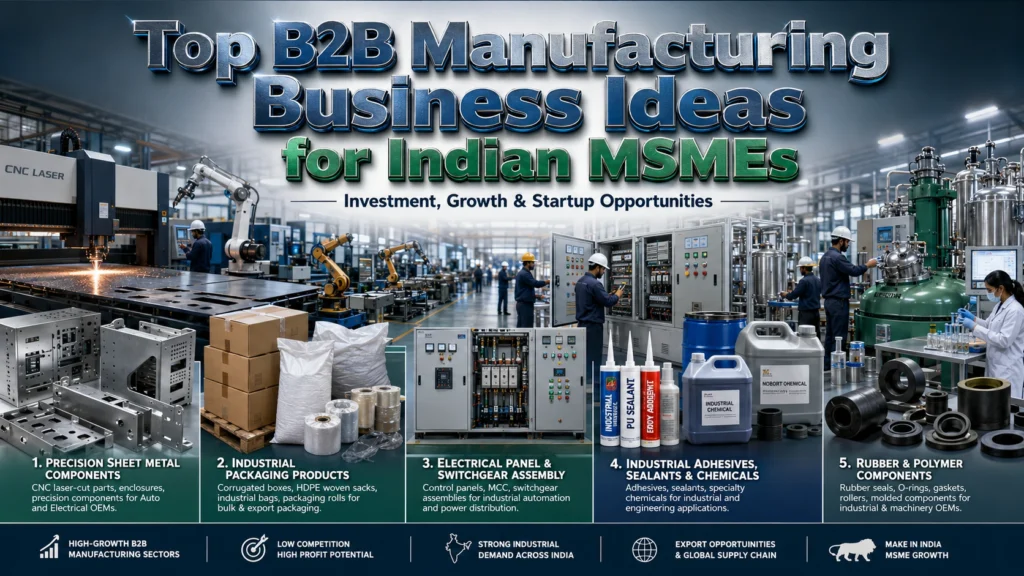
B2B Manufacturing Business Ideas for Indian MSMEs The factory floor of India is stealthily becoming the most potent engine of wealth creation and that is giving a huge opportunity to new B2B manufacturing business ideas. When compared to consumer startups that are looking to satisfy the short-lived desires of retail customers, B2B manufacturers are providing products and services to the demand side of the supply chain that has a deep appetite for reliable, quality consistent vendors. That makes this segment particularly good for the budding entrepreneur. Large OEMs in all automotive, electrical, construction and FMCG businesses are actively de-risking their suppliers. They would like to see more home vendors, rather than fewer. It is indeed one of the better windows to get into industrial production in India for a founder with a small capital and willing to get his hands dirty to master a manufacturing process. Why B2B Manufacturing Deserves Serious Attention Right Now Consumer manufacturing is on a growth trajectory and demand for components, packaging and industrial inputs is continuing to rise. Dozens of smaller vendors need to supply parts, packaging and sub-assemblies to every new appliance manufacturing plant, to every new EV assembly line, to every new FMCG manufacturing plant. Now, a new player can easily slot in into that vendor ecosystem. This is further complicated by export potential. There has been increasing trend in the global market towards diversification from one country-based purchase to a mix of countries, and India has emerged as a viable option. Therefore, a well-managed small manufacturing plant today can supply the local OEMs or convert into export orders as soon as the quality system is developed. It’s a similar scenario as B2B, where profitability means it’s better to sell to other businesses than to consumers. Business buyers can buy large quantities, pay over a well-defined credit cycle and are not in the business of spending as much as the consumer products spend on branding and marketing their products. When margins are steadier, it’s not because they’re slimmer, per se, but because volumes and repeat orders do the bulk of the work. Discover business ideas that actually make money Government Policies and Incentives Backing New Manufacturers The government’s involvement in manufacturing has come a long way beyond the subsidies. Credit Linked Capital Subsidy Scheme (CLSS) by the Ministry of Micro, Small and Medium Enterprises and the Credit Guarantee Fund Trust for Micro and Small Enterprises (CGTMSE) are initiatives that provide capital subsidy and remove the collateral barrier for many first-generation entrepreneurs from accessing credit. The PLI scheme will continue to offer financial incentives on the basis of scale and production to various manufacturing activities, and the MUDRA loan scheme is still the most convenient option for micro enterprises looking for working capital loans of less than a few lakh rupees. In addition, most state industrial policies include capital investment subsidies, waiver of stamp duty and power tariff concessions on the units established in designated industrial areas. In the meantime, the Make in India initiative is working on these new unit preferences by moving the public procurement agenda toward local manufacturers, albeit in a subtler fashion. Learn more via the DPIIT, and the Make in India portal. Multiple B2B Manufacturing Business Ideas Worth Exploring Precision Sheet Metal Components for Auto and Electrical OEMs Sheet metal fabrication is one of the most solid starts to B2B manufacturing because nearly every OEM, including automotive, electrical panel manufacturers, and more, outsources bracket, bezel, and enclosure work, rather than doing it in-house. A unit based on a CNC turret punch, press brake and simple powder coating line can begin to provide local OEMs in a matter of months—after commissioning. The investment in a small machine is usually in the range of ₹40 lakh to ₹80 lakh, depending on the tonnage of the machine, and the gross profit is in the range of 20 to 30 per cent after tooling cost is adjusted. Since OEMs are expecting the vendors to be consistent, a founder who succeeds in the first year in controlling tolerance and delivering on time is likely to secure repeat orders in no time. Explore This Book: Handbook on Steel Bars, Wires, Tubes, Pipes, S.S. Sheets Production with Ferrous Metal Casting & Processing Industrial Packaging: Corrugated Boxes and HDPE Woven Sacks One of the business ideas that is more recession-proof is corrugated board and HDPE woven sack manufacturing as every manufacturing plant, warehouse, and export unit requires a regular packaging supplier. Corrugation plants may begin with a semi-automatic flexo printer and slotter unit and expand to a fully automatic line. Woven sack units for HDPE (High Density Polyethylene), however, are used by cement, fertiliser and food-grain packers who require bulk and reliable capacity. Both segments are also supported by availability of raw material in most of the industrial clusters and the demand for packaging follows the overall demand of industries; demand for packaging is not cyclical and does not dry up easily. Electrical Panel and Switchgear Assembly Units The demand for low voltage distribution boards, motor control centres, switchgear panels has steadily increased with the proliferation of real estate, infrastructure and renewable energy projects. The critical components of assembling a panel are skilled wiring labour, a testing bay and good connections with the component suppliers such as circuit breaker and busbar manufacturers. In the case of panels, they are engineered products that pay off for design skill, not assembly speed, and margins here are better than pure fabrication work, at the 25 to 35 percent level. EPC contractors and builders also order more from the same vendor after they have a history of reliability with lead time. Related Article: India’s $235 Billion Electrical Equipment Boom: What Every Founder Must Know Industrial Adhesives, Sealants, and Specialty Chemicals Another type of opportunity exists in formulation-based manufacturing, including industrial adhesives, sealants, and specialty coatings, where an IP can be embedded into the product. A small batch manufacturing facility including reactors, mixers and quality testing equipment will provide construction, furniture,
Manufacturing Business Under ₹1 Crore in India: Best Business Ideas for 2026
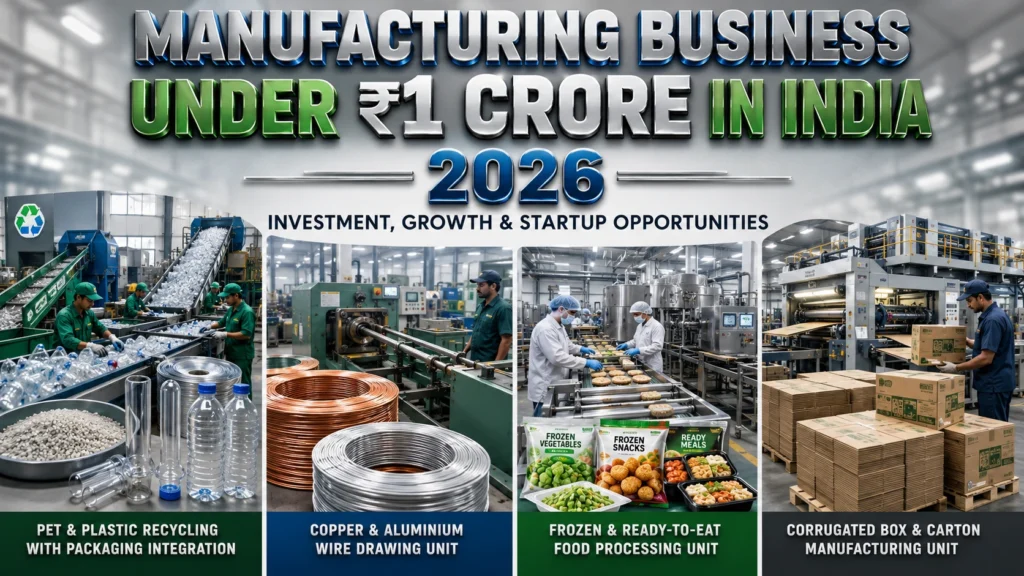
Manufacturing Business Under ₹1 Crore in India For each and every entrepreneur sitting with ₹1 crore, the question is: Where does this money work best? So, it’s no accident that manufacturing is the honest answer. It builds assets, it qualifies for government subsidy and it generates a business that a bank will re-lend on again next year. This article covers real project report, real client discussion, real factory floor, and real business ideas that are feasible and affordable with a ₹1 crore budget. Until the price of a compact manufacturing line, crore rupees seem like a lot of money. That’s quickly consumed by machinery, working capital, a small shed and statutory approvals. Fortunately, there are a number of manufacturing segments developed just for these ticket sizes and government assistance brings the price differential even closer, up to 30-40%. Why Manufacturing Deserves Your ₹1 Crore Right Now The supply of local food products, local packaged products, and locally manufactured components have lagged behind the demand and India is steadily rising in factory production. No longer a slogan, import substitution is manifested through actual orders from FMCG buyers seeking Indian suppliers, auto-ancillary buyers and export houses for their reliable vendors. The different nature of manufacturing adds complexity to the trading of manufactured goods. The trading business expands as you increase your investment. A manufacturing facility grows with your capacity utilisation; and capacity can be increased without raising additional equity on quarterly basis. The better the unit is run, the better the margin will be as the fixed cost becomes more spread over the higher turnover, and this is why a well-run unit at 40 lakh turnovers can look totally different at 4 crore turnovers three years later. Land and power costs are also lower in Tier-2 and Tier-3 industrial areas and state industrial policies often add soft industry support in the form of capital subsidy, stamp duty exemption, and lower power tariffs for new units. It’s not so easy to duplicate in services nor in trading. Related Article: Medium Investment Manufacturing Business Ideas in India for MSMEs Government Policies and Incentives That Change the Math Budget support is not an afterthought here; it can be a deciding factor between a viable project and an unviable one. The Prime Minister’s Employment Generation Programme (PMEGP) provides capital subsidy of 25% (35% in rural areas) for setting up new manufacturing units under funded by KVIC and its partner banks. The Credit Guarantee Fund Trust for Micro and Small Enterprises (CGTMSE) guarantees loans of up to ₹2 crore without collateral, which is very significant for an entrepreneur who has no collateral to offer for the first time. Many projects worth ₹1 crore are approved only on the basis of a solid Detailed Project Report as collateral is no longer required with CGTMSE. CLCSS, a scheme of the government provides capital subsidy of 15% for technology upgradation of new machine while PLI scheme provides incentive to the scale generated and exports done in selected sectors like food processing and specialty chemicals. In the meantime, the ZED Certification Scheme provides a financing up to 80% of the certification cost, thus giving a young unit credibility with the bigger buyers sooner than it would otherwise. Before applying anywhere, entrepreneurs should register in Udyam as nearly all the schemes like CGTMSE and PMEGP treat Udyam registration as the entry ticket. Manufacturing Business Ideas Worth Backing With ₹1 Crore Small-Scale PET and Plastic Recycling with Packaging Integration Plastic packaging waste continues to rise and the new Extended Producer Responsibility (EPR) legislation now requires that big brands in the FMCG sector buy recycled material. A unit that can gather, wash and reprocess PET flakes into granules, and take a portion of those granules to make packaging sheets or strapping, takes margin at two levels, rather than one. Washing and extrusion and pelletising machine is available in the range of ₹60-70 lakh which leaves scope for working capital and Pollution Control Board clearance as well. It is not difficult to find buyers; almost all plastics processors and many packaging exporters today are searching for recycled granule suppliers. Get Detailed Project Report (DPR): Plastic Waste Recycling Plant Copper and Aluminium Wire Drawing Unit Demand for electrical cables follows closely India’s housing and infrastructure cycle and both continue to be in strong growth phase. The setup cost of a wire drawing unit that can take copper or aluminium rod and draw into smaller gauge wire can be from ₹80 lakh to ₹1 crore depending on the capacity of the unit, which requires a wire drawing machine, a furnace for annealing the wire and a wire spooling machine. Even with the margins being thin on paper, this business works when the volume of the business reaches 3-4 tonne per day as it can easily cross ₹20 lakh monthly turnover once the regular buyer base is established by the cable makers and electrical contractors. Frozen and Ready-to-Eat Food Processing Unit Urban kitchens are getting smaller and working families are looking for quick food without compromising on quality. For a small capacity, a blast freezer, cold storage and packaging line is needed for a frozen paratha, as well as snacks or ready-to-eat curry unit, the cost of which is a maximum of ₹60-90 lakh. This section is also non-negotiable, with FSSAI licensing and clean HACCP aligned process, but with some of the healthiest margins on this list, especially for products with regional and ethnic identity that aren’t served by national brands. Explore This Book: Handbook on Fruits, Vegetables & Food Processing with Canning & Preservation Corrugated Box and Carton Manufacturing The demand for corrugated packaging is constant and exists in all ecommerce clusters, especially those. A single or double facer corrugation machine in conjunction with slotting and stitching machine is available between ₹70 lakh and ₹1 crore for a regional scale plant. This business is contract-driven, repeat orders rather than single orders, so it has higher cash flow predictability for a manufacturing business of this size. Import-Export
3 High-Demand Manufacturing Business Ideas – PET Preform, PET Bottle & Tile Adhesive – Each with ₹50 Lakh+ Annual Profit Potential
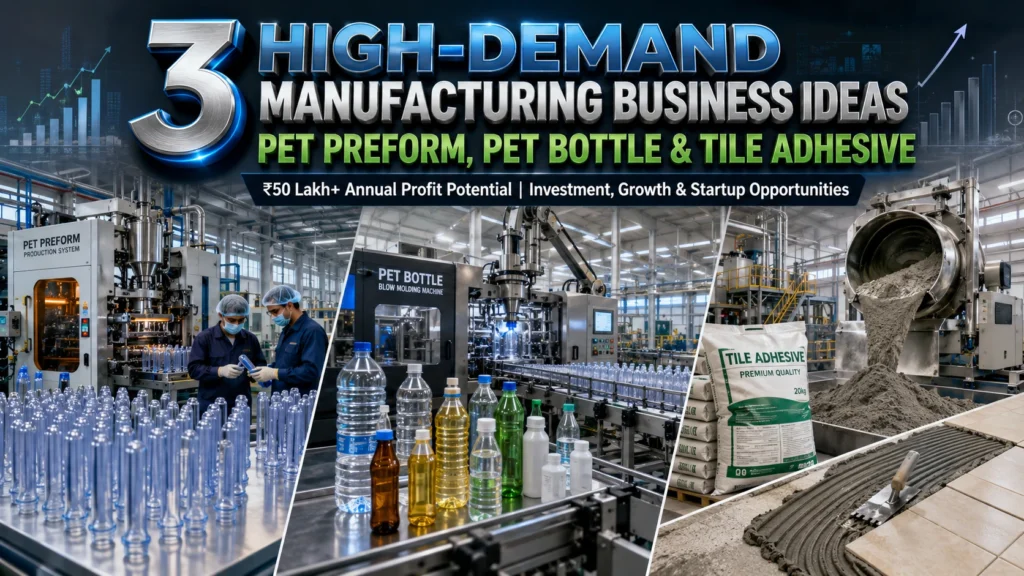
PET Preform Manufacturing Business Where Real Manufacturing Business Ideas Are Made As a nation on a fast track to a $5 trillion economy, the best business concepts often cannot be enjoyed in apps or fintech, but rather reside in the supply chain of everyday materials. PET preforms, PET bottles and tile adhesive might not be in the headlines, but they work behind the scenes to provide the backbone to India’s booming beverage sector, construction industry, and pharmaceutical supply chain. They’re not down-under plays. They are policy-mandated, demand-driven, capital efficient manufacturing avenues that are increasingly seen as one of the surest bets entry points for the manufacturing sector by first-generation entrepreneurs, MSME investors, and industrial consultants. These three segments are ones that should be closely monitored by anyone who is considering investing money on a project at the next investment cycle. Get Detailed Insights from This Book: Our Books Why This Sector — And Why Now Urbanization, organised retail and government infrastructure initiatives have put packaging and construction materials in a highly conducive situation. India’s per capita consumptions of packaged beverages are far below the global average and, for the PET packaging entrepreneur, this is nothing but structural space for growth. The disorganized construction material segment, on the other hand, is undergoing transformation in response to the rising demand for performance-based adhesives for tiles, as seen in the quality-driven approach of real estate developers and the mass housing goal of Pradhan Mantri Awas Yojana. India’s export prospects are good as the quality-price positioning is in their favour in the markets of Southeast Asia, Middle East, and parts of Africa. The domestic tile adhesives market is at a similar juncture—with the Indian flooring market shifting away from commodity tiles to higher value formats, the adhesive requirement per square metre has risen and so has the margin. These are not cyclical tailwinds; they are structural trends that are being fueled by regulatory adjustments, construction standardisation and urbanisation and income growth. Government Policies and Incentives Supporting Entry The government has made clear its intention to drive growth through manufacturing and it has given support for this in practice. The industrial infrastructure support, funding for technology upgradation, and single-window clearances are applicable to plastic packaging and construction material manufacturing units under the Make in India scheme. The Credit Guarantee Fund Trust for Micro and Small Enterprises (CGTMSE) scheme is a crucial support for first-generation entrepreneurs who do not have legacy assets to put up as collateral for loans for up to ₹2 crore, for MSME-registered units by the Ministry of Micro, Small & Medium Enterprises (MSME). The CLCSS (Credit Linked Capital Subsidy Scheme) of the DPIIT offers Capital subsidy of up to 15% for Technology Upgradation in Small Enterprises, applicable for Small PET Processing units who are investing in newer Injection Moulding or Blow Moulding technology. The Production Linked Incentive (PLI) framework is now focussed on the high investment sectors, but has generated momentum in the ecosystem, resulting in Tier-2 suppliers such as PET preform manufacturers, who serve large FMCG customers being benefitted. The National Housing Bank (NHB) and PM Awas Yojana are fueling the demand for tile adhesive in affordable housing market, which is providing regular off-take for new manufacturers. Other state governments have provided interest subventions, power tariff concessions and land package in the greenfield clusters of manufacturing units located in the industrial estates offered by various states, which significantly reduces capital deployment by the proponents of new projects. Manufacturing Business Ideas for Startups: Product-Wise Analysis 1. PET Preform Manufacturing from PET Resin A crucial entry point in the Indian packaging economy is PET preforms, intermediate mouldings in test tubes that are then stretch blow-moulded into PET bottles. The business model is simple in structure and requires utmost care in execution: raw PET resin (mostly obtained from Reliance Industries and IOCL and imported grades from Korea and China) is dried and then injection moulded with precise temperatures and pressures to get preforms of specific neck finish, weight and wall thickness as per client specifications. If a mid-size unit (4-6 injection moulding machines with a combined output of 8-12 million preforms per month) operates at prevailing market prices, it can generate a revenue of ₹4-6 crore/month, excluding other expenses such as resin cost, while the EBITDA margin is likely to range from 12-18% depending upon the efficiency of resin procurement and capacity utilisation. This is especially appealing to new investors thanks to the customer profile. PET preform buyers in the Indian market include some of the most credible players in the FMCG, beverage, and pharmaceuticals and personal care segments where the entire payment cycle is more or less standardised and there is a predictable offtake. Even having a committed supply contract with two or three local branded mineral or beverage water companies can give the base revenue predictability necessary to repay project debt. The following are important technical factors: 28mm, 38mm or custom finishes for the neck, IV (Intrinsic Viscosity) control in order to achieve the barrier properties, and optimisation of cycle time for the control of the per-unit conversion cost. The payback period is usually 3 – 4 years, for a commercially viable plant capital investment is in the range of ₹1.5 – 3 crore with 70%+ utilization of the machines. 2. PET Bottle Manufacturing The downstream part of the PET bottle value chain, after preform production, is the PET bottle segment, and it can be said that it is the more commercial part from the perspective of the public. These are either bought or produced in-house and are then stretched to the final bottle shape under air pressure in a mould (stretch blow moulding). PET bottles are used in beverages (carbonated soft drinks, juices, water), edible oil, pharmaceutical syrups, personal care (shampoo, hair oil, lotions) and home care products in India. Every segment is driven by specific specification demands – such as pressure ratings for CSD bottles and HDPE demands for pharma applications – and the small business person stepping into
Electrical & Electronics Manufacturing: 4 Business Ideas from Copper Wire to Lithium Batteries
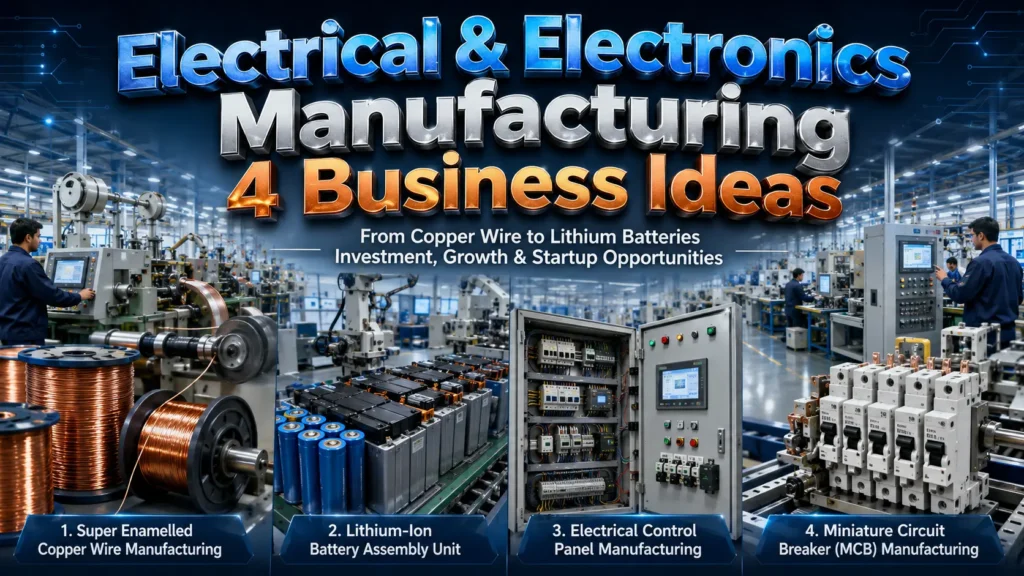
Electrical & Electronics Manufacturing Business For those who are looking around for business ideas with a long-term horizon, it is a good idea to take a second look at India’s electrical and electronics manufacturing base, because it is one of the most significant changes that the industry is currently undergoing. The reasons are not philosophical. Wiring and protection devices are required on every new residential tower; batteries packs are required for every electric two-wheeler, control panels are required for every industrial shed and every motor rewinding shop requires enamelled copper wire. This article outlines four real manufacturing opportunities – Super Enamelled Copper Wire, Lithium-Ion Battery Assembly, Electrical Control Panels, and Miniature Circuit Breakers (MCBs) – in a way that a consultant would approach when considering a project for a first-generation entrepreneur with practical, feasibility-oriented logic. Why This Sector Deserves Attention Right Now It is unusual and noteworthy that three separate demand curves are converging at the same time. Construction and real estate activities are driving up the demand for control panels and MCBs as distribution boards and protective switchgear are essential for any commercial or residential project prior to its use. At the same time, the electric mobility transition is generating a completely new supply chain for components: lithium-ion cells and battery packs—an industry that existed only in small quantities a decade ago. But there is an undercurrent to these, the simple enamelled copper wire, which is used in almost every motor, transformer and generator the country produces and whose consumption goes hand-in-hand with industrial growth and investment in infrastructure, rather than any one trend. The mix is appealing from a profitability perspective on a few reasons: It covers both established, cash-generating businesses (copper wire and MCBs) and growth businesses that offer more opportunity for new entrants (battery assembly and control panels for niche applications). A consultant who reviews this area will consider raw material cost pass-through, as well as the trust of the brand in products where safety is a critical issue, and the ability to service the OEM client on a recurring basis — and all three points would find electrical manufacturing to be reasonably defensible once a unit has proven themselves. There is another export aspect: Indian products such as wiring, panels and battery packs are increasingly selling in the African, Middle East and South Asian markets, where Indian products that are price competitive and reasonably certified are well-positioned against higher-priced options. Related Article: How to Start an Electrical Manufacturing Business in India – Profitable Ideas & Complete Guide Government Policies and Incentives Supporting New Entrants Entrepreneurs may not be aware but policy support for this sector is more widespread than they imagine and can substantially alter the economics of a project if used correctly. The Production Linked Incentive (PLI) for Advanced Chemistry Cell (ACC) battery storage has secured significant investments in large-scale Lithium-Ion Batteries (LIB) manufacturing in India, while the smaller battery pack assembly units indirectly benefit from the cell ecosystem being nurtured by the PLI scheme. The PLI scheme for White Goods and the overall PLI for electronics manufacturing similarly provide benefits for component suppliers that supply to the larger assembly business, such as control panel and switchgear component suppliers. On the borrower’s side, there is a credit guarantee scheme and the assistance of the Ministry of MSME for collateral-free loans provided to a first-time entrepreneur, which makes it a lot easier to avail the working capital without pledging family property and availability of interest subvention schemes that reduce the cost of the term loans for plant and machinery. The FAME and then the EV linked incentive program by the government of the country known as Ministry of Heavy Industries has benefited indirectly the demand for Lithium-ion battery assembly by providing subsidy to end-vehicles, which trickles down to the supplier of components. State-level industrial policies, especially in the states that actively promote the electronics and EV component industries, often add on power tariff concessions, stamp duty exemption, and capital subsidy. Eligibility details are updated periodically; therefore, readers can check scheme details directly on the Ministry of MSME portal for authentic and updated scheme details. Multiple Business Ideas for Startups in This Sector 1. Super Enamelled Copper Wire Manufacturing Super enamelled copper wire is the “plain vanilla” of the electrical motor and transformer industry, and this is why it’s a viable business venture for a serious entrepreneur and not a hobby. The product consists of copper conductor covered with a number of layers of enamel (polyester, polyesterimide or polyamide-imide) which are applied to the conductor by a continuous line of wire-drawing and enamelling, and then baked in ovens to the dielectric strength and thermal class desired by applying the end-user. The range of real-world applications is vast, including domestic and industrial motors, transformers, generators, relays, solenoids and household appliances, and is far from seasonal like some customer types. An important manufacturing tip is that most quality complaints come at the enamelling oven stage of the process and not at the wire drawing stage, so it’s important to budget enough for a sure-fire multiple pass enamelling machine, not the wire drawing. One of the key raw materials, which is subject to price volatility, is Copper wire (rod) used in electrolytic production and Enamel varnish used for coating the wires, which are sold to customers on a formula basis. Motor rewinding industry, OEM transformer manufacturers, fan and pump industry, the motor rewinding industry is a major consumer of copper wire and the fan and pump industry is a major user of copper wire, and the motor rewinding industry is a major demand driver for copper wire, and because copper wire is an actual input and not discretionary, the revenue can be tracked fairly closely with the industrial production data. Processing efficiency and working capital discipline are most important factors affecting profitability in this category, as copper content is significant in determining the overall cost, and a well-run processing unit with a consistent quality certification can benefit from