
Best Large-Scale Business Ideas in India: Multi-Crore Investment Opportunities
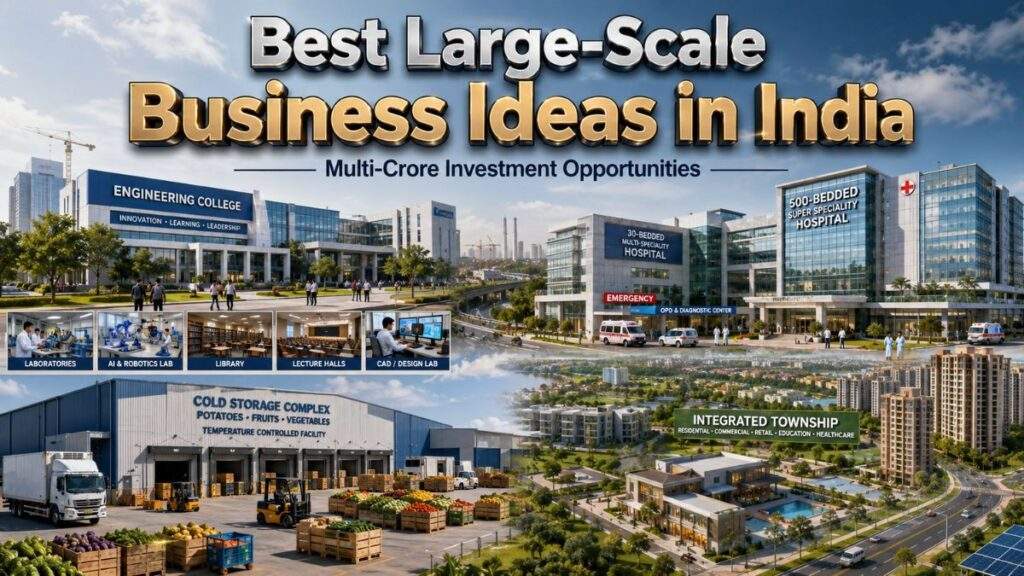
Best Large Scale Business Ideas in India Why Infrastructure Is India’s Smartest Business Canvas The story of India’s infrastructure has always revolved around steel tonnages, highway kilometres and power plant capacities. However, the more interesting narrative, one that matters to startup founders, institutional investors and first-generation entrepreneurs, is occurring at the intersection of services and built infrastructure. Engineering colleges, hospitals, cold storage places and integrated townships are not engineering play-rooms, but one of most durable businesses in today’s Indian market backed by demand, stickiness of essential services and has a scalable revenue architecture that is hard to beat in the manufacturing business. Look at the structural background: India has an over 900 million working population, governments are aggressively striving to gain access to healthcare and increase access to higher education, agricultural sector is troubled with issues of post-harvest loss, and urbanisation is happening at an incredible pace, requiring planned urban housing. All of these trends are ideal investments on their own. As a whole, they create a time in which infrastructure businesses based on true demand, not speculative capital cycles are more appealing than ever. If the entrepreneurs and investors are ready to turn away from the traditional trade and manufacturing, the four sectors analysed here are some of the most bankable, policy supported and future-proof segments of the domestic economy. Get Detailed Insights from This Book: Our Books Why Infrastructure and Services: The Investment Logic The demand visibility of infrastructure services is one of the few sectors in India that can show that kind of sustained demand visibility. Structural demand is the type of demand that does not go away during a recession, as it is with consumer products and manufacturing enterprises sensitive to input cost changes. For example, demand for healthcare in low-income countries is highly price inelastic. The demand for cold storage increases with food production and formalisation of food retailing. GDP and employment in engineering and technical education follow the curves of GDP and industrial employment with almost a perfect correlation. In recent years, it’s the financial structure of these investments that has evolved. The Government of India through various ministries from the Ministry of Education to the Ministry of Health and Family Welfare, the Ministry of Food Processing Industries and the Ministry of Housing and Urban Affairs have gradually made it easier to offer subsidies, viability gap funding, and access to institutional lending facilities. What you get is a risk adjusted return profile that performs well despite the volatility of commodity cycles and is competitive against the high growth manufacturing sector. These are some of the most defensible business architectures that exist, in the sense that they are suited to investors who have a 10-to-15-year time horizon and access to local institutional relationships and land. Government Policies and Incentive Architecture The policy context for infrastructure investments has come a long way. The Credit Guarantee Fund Trust for Micro and Small Enterprises (CGTMSE) under the Ministry of MSME offers collateral-free loans to enterprises for establishing cold storage and food processing support infrastructure facilities of up to ₹5 crore, thereby providing a strong de-risking facility to the first-generation entrepreneurs. Ayushman Bharat – Pradhan Mantri Jan Arogya Yojana (PM-JAY) et al creates a guaranteed payer base for empanelled hospitals, which would make even 30 bed secondary care hospitals in Tier-2 and Tier-3 towns have visibility of revenue! The National Cold Chain Fund (NCCF) under the Ministry of Food Processing Industries (MoFPI) provides capital subsidy of up to 35% of project cost for integrated cold chain projects with an emphasis on potato, horticulture and perishable supply chains, catering for the identified gaps in post-harvest infrastructure. In the meanwhile, the Pradhan Mantri Kisan SAMPADA Yojana (PMKSY) offers infrastructure grants for agri-logistics nodes with a critical component of cold storage. The Real Estate Regulatory Authority (RERA) framework on the whole is regulatory, but it has institutionalized the belief of the buyers, which in fact has furthered the speed at which the projects are completed and made them accessible for construction finance. The Smart Cities Mission and AMRUT schemes also provide urban local body co-financing for infrastructure in designated areas which lessen the burden on private developers. AICTE’s revised norms for approval of private engineering colleges and the National Education Policy (NEP) 2020 were also important in enhancing the commercial viability of private technical institutions, while there is a call for multidisciplinary education, which will benefit engineering education. Startups in infrastructure that are linked to MSME get tax exemption, ease of compliance, and access to government infrastructure procurement process on par with other startups, under the Startup Recognition benefits provided by the Department for Promotion of Industry and Internal Trade (DPIIT). Together these schemes take the risk “floor” for first time infrastructure entrepreneurs down considerably. Business Opportunities: Sector-by-Sector Analysis 1 Engineering College The engineering and technical education space in India has one of the lowest investments to demand (I/D) ratios among all sectors in the country. While the perception of a lack of seats exists in some of the metros, a ground level assessment of the country has revealed that there is a huge gap in the emerging corridors, especially in states such as Rajasthan, Odisha, Chhattisgarh, Uttar Pradesh and the Northeast region, where the ratio of engineering colleges to the population of 18-22 year old population is significantly lower than the national average. If a land owner with local stakeholder base wants to make an engineering college, the capital expenditure is high but it is also a business that can be banked easily due to the presence of AICTE. The capital cost of a normal College with four departments (Computer Science, Mechanical, Civil, Electronics) of 300 seats is around 15-25 crores when taking into account the land cost and construction specification. Diversification of revenue streams: tuition fees, hostel, mess operations, consultancy and training, industry sponsored labs and more and more, skill development centres under PM Kaushal Vikas Yojana (PMKVY). A good and well-managed private engineering college evolves from a capital
Manufacturing and Business Ideas in the Chemical Sector: Gallic Acid, Potassium Nitrate, Chlorinated Paraffin Wax and Zinc Sulphate
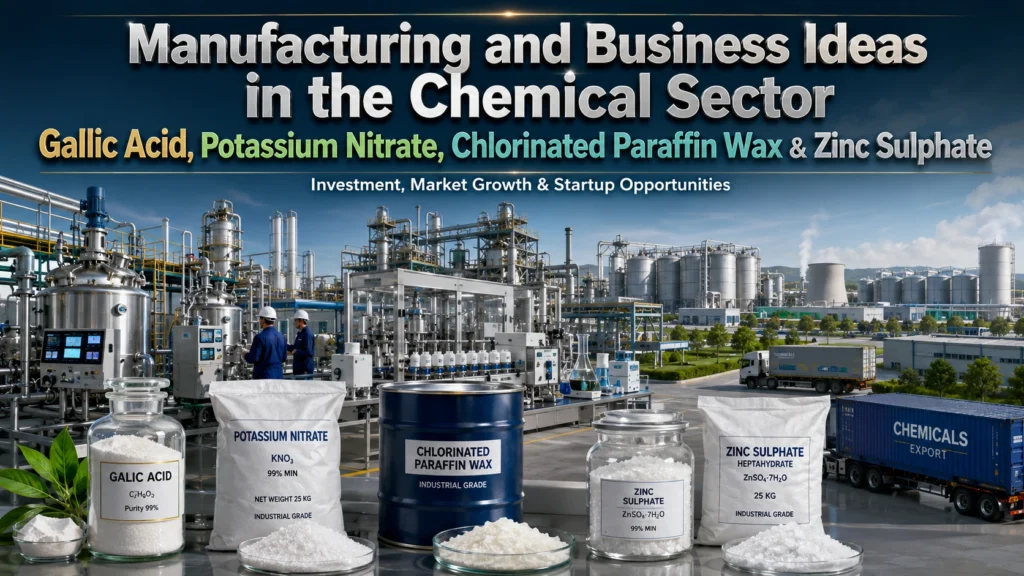
Chemical Manufacturing Business Ideas India The Indian chemical economy has morphed itself into one of the most promising business incubators for 1st generation entrepreneurs to execute without resorting to a multinational balance sheet. Over the years, I have seen hundreds of feasibility reports on small and mid-sized chemical companies and am always coming back to a few products that meet the criteria of reasonable capital investment, reasonable demand and a true import substitution rationale. There are four such opportunities that include gallic acid, potassium nitrate from tobacco waste, chlorinated paraffin wax, and a combined zinc sulphate heptahydrate–monohydrate unit. There is no glamour about them as there is about a battery gigafactory, and each are part of a supply chain that Indian industry relies on every day, be it from pharmaceuticals to leather, fertilisers to plastics to textiles. Why This Sector, Why Now Speciality and fine chemicals are in a strange situation in the Indian manufacturing industry because, although the local market is large and expanding, there has never been a significant expansion of the local production of meaningful intermediates, and so they have remained imports from China and Europe. It is here that the right kind of an MSME can fill that void. Process chemistry rewards consistency and quality control and reliable sourcing more than R&D expenditure, and that’s what the tannin derivatives, nitrate salts, chlorinated wax and zinc-based micronutrients are. The rationale for profitability is further complicated by export potential: buyers in SE Asia, the Middle East and Africa are actively seeking to de-risk their China-dependent supply chain and Indian producers offering consistent purity specifications are taking their business. The margins in this space are decent, not brilliant, and typically in the 15-25% operating range, when a plant operates at reasonable capacity utilisation, but the demand base is sticky because these are input chemicals that are used continuously by the downstream industries as opposed to discretionary purchases. Explore This Book: Handbook On Chemical Industries (Alcohol Based) Government Policies and Incentives Supporting New Entrants Business owners who move into this area do not need to give money their own way. The Ministry of MSME’s Credit Guarantee Fund Scheme and the Prime Minister’s Employment Generation Programme are loan support schemes which provide collateral-free loans for new manufacturing units, especially for chemical projects which also involve high investments in machinery. The PLI scheme for specialty chemicals, which is now being administered by the Department of Chemicals and Petrochemicals, has also created space for downstream players even if the main beneficiary of the PLI scheme is a larger integrated producer, because the demand pull from the PLI generates for ancillary/in-between suppliers. Gujarat, Rajasthan and Tamil Nadu have established industrial policies, especially for industrial clusters in these states to provide power tariff concessions and stamp duty exemption along with capital subsidy to new small-scale chemical / MSME units. Besides, time for environmental and factory licences, the biggest bottleneck for chemical start-ups, has been reduced significantly thanks to the Stand-Up India scheme and a number of state-level single-window clearance portals. A business man can check out the existing scheme information straight on the. The entrepreneurs can check the details of the schemes available at the portal of the Ministry of MSME. Multiple Business Ideas Within This Chemical Cluster 1. Gallic Acid Production from Tannic Acid Gallic acid is at an interesting crossroads of pharmaceuticals, ink making and the leather and dyeing industries and is the kind of product that demands a consultant’s eye rather than just an academic one. The major consumers of gallic acid are pharmaceutical intermediate manufacturers for trimethoprim and propyl gallate and the food industry for its use as an antioxidant preservative, which is synthesized by the acid or enzymatic hydrolysis of tannic acid (which is derived from natural material, such as tara pods, myrobalan or gallnuts). The key to the attractiveness to a new entrust for this business concept is that the basic hydrolysis work does not require any special equipment – a reasonably sized hydrolysis reactor, crystallisation and drying plant can be set up with moderate investment; the raw material – tannic acid – can be obtained locally from a number of well-established suppliers, and therefore the risk of dependence on imported raw materials is low. The realistic challenge is quality consistency: pharma-grade buyers are not only looking for production capacity but also for capability in analytical testing, for which the initial investment is the key to success for a new unit. Indian pharma intermediate manufacturers have been increasingly acquiring the necessary intermediate gamma in order to shift away from a dependence on Chinese imports and that opportunity is enough to keep a well-run plant busy. Discover business ideas that actually make money 2. Potassium Nitrate from Tobacco Waste This one’s a business concept that seems like a crazy idea until you plow through the economic math and realize that it only makes sense for there to be several well-established businesses out there making money around this concept. Tobacco waste, which is made up of stems, dust and rejected tobacco leaves from bulk tobaccos processors, contains high concentrations of potassium and nitrate, which can be extracted using a leaching/crystallisation process to create potassium nitrate, a high-value nitrate compound employed in a variety of industrial applications including fertilizer formulations, fireworks production, glass and ceramics manufacturing, and food preservation. The investment thesis here is that the raw material cost advantage: tobacco waste is usually at low or even negative cost, as the processor has to pay someone to dispose of it. The processing itself includes aqueous extraction, purification and controlled crystallisation, which is readily handled by a medium scale MSME chemical plant. For this business, location is a critical factor – the nearer they are to tobacco processing centres in Andhra Pradesh, Karnataka, Gujarat, the lower will be the cost of feedstock logistics, and so any entrepreneur looking at this opportunity should establish the location of the plant based on the availability of waste first and market access second. 3. Chlorinated
Madhuban Bapudham, Ghaziabad: NCR’s Next Industrial Powerhouse and 6 High-Potential Manufacturing Business Ideas for MSME Entrepreneurs
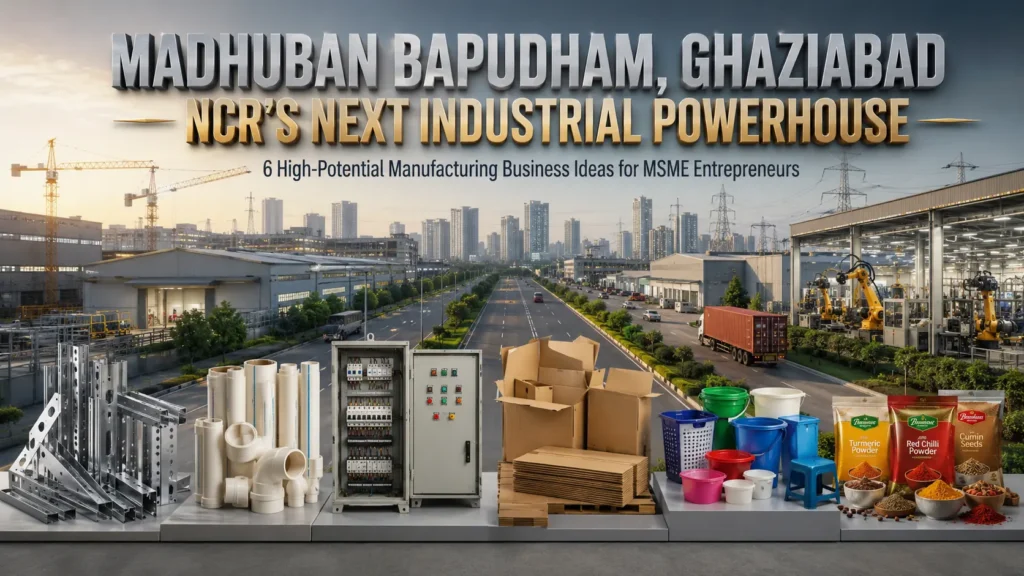
Madhuban Bapudham Industrial Hub One News Report That Could Reshape Your Business Direction Recently, the Navbharat Times published a report that has immense ramifications for not just entrepreneurs but MSMEs in the National Capital Region. As per this report in Navbharat Times, the Madhuban Bapudham area of Ghaziabad is slated to become a significant new industrial location with more than 200 factories in the area and the plan to provide jobs to over 5000 youths. It’s no ordinary real estate story. It’s a market shift signal, a signal that will create wide business opportunities for entrepreneurs, suppliers and service providers in coming 3-5 years. Ghaziabad has been one of the significant industrial centres of NCR for long. The key areas of the corridor has been manufacturing activity for decades at Sahibabad Industrial Area, Loni and Modinagar. Today, Madhuban Bapudham is becoming a new industrial pole and entrepreneurs who grasp this development early will be in key position to steer their sectors of the future. The development is particularly significant given the direct access via the Delhi-Meerut Express Highway, connection to the Duhai Namo Bharat RRTS station, and planned infrastructure growth by the Ghaziabad Development Authority. These combine to give conditions which are not usual for most emerging industrial zones. The question is not if this area will be growing, it is only if you will be part of that growth. What the Recent Navbharat Times Report Actually Signals Navbharat Times reports that Ghaziabad Development Authority (GDA) has formally given its approval to Madhuban Bapudham as an industrial area. The main facts of this development are: 200+ factory units to be systematically established 5,000+ direct, youth employment positions A total of 1,200+ hectares of integrated mixed-use township planning. 5 km from Duhai RRTS (Namo Bharat) station — direct rail connectivity with Delhi and Meerut. GDA-supported modern infrastructure: underground electrical power lines, cycle tracks, wide internal roads and central water supply What does this mean to entrepreneurs? When 200+ factories come together into one zone, a full-service economy develops around them. Canteens, logistics operators, safety equipment companies, staffing agencies and warehousing companies all have immediate demand. Navbharat Times’ report is the first official announcement in public and early movers often end up securing the biggest market share. Related Article: Ghaziabad’s ₹500 Crore Industrial Push: 6 Manufacturing Units Smart Entrepreneurs Are Setting Up in Madhuban Bapudham Why This Industrial Belt Is Growing — 5 Solid Reasons 1. Land Scarcity in Core NCR Creates a Ghaziabad Opportunity Small and medium entrepreneurs have found land in Delhi and Noida for their industrial purpose far too costly. With government support from the Madhuban Bapudham, it has started offering structured plots at fair prices without any party disputes and speculative pricing. It is very important for the first-time factory owners. 2. RRTS Connectivity Is a Genuine Game-Changer It takes less than 30-40 minutes to reach Delhi from Meerut from Duhai Namo Bharat RRTS Station, which is 1.5 km away from the township. Widely distributed commuters who can count on commuting. The expressway and rail access is an advantage for freight movement, and this is something that older industrialized areas in the region don’t have. 3. UP MSME Policy Offers Tangible Financial Benefits The Uttar Pradesh Government has announced the MSME policy that offers tangible financial support to industrial units in Ghaziabad with 50% stamp duty exemption, EPF reimbursement for 5 years, etc. These incentives are detailed in Invest UP’s official MSME page. These aren’t promises to be made, they’re active policy provisions. 4. Make in India and PLI Schemes Are Fuelling Manufacturing Demand Government of India’s Production Linked Incentive (PLI) scheme is encouraging massive investment in Indian manufacturing. Such national policies are directly impacting new industrial areas such as Madhuban Bapudham, which are welcoming anchor manufacturers, and thereafter there is demand for 40 or 50 MSMEs. 5. Five Thousand Jobs Mean Five Thousand Consuming Households Secondary spending is generated by 5000 new jobs in a zone. Demand surges in the housing, food, transport, healthcare, retail and personal services sectors. The business opportunity at Madhuban Bapudham is therefore not restricted to the industrial supply, it’s extended to the services of the working population. Government Schemes and Incentives That Will Support Your Business The combination of central and state government programmes provides a robust support program for MSME entrepreneurs entering new industrial areas. Some of the important schemes available on the official portal of the MSME Ministry are: PMEGP (Prime Minister’s Employment Generation Programme) — 25-35% capital subsidy to set up a new manufacturing unit This is government-initiated free online MSME registration for Udyam registration and availed government benefits and priority access. Collateral-free loans available to eligible MSME entrepreneurs up to ₹2 crore through CGTMSE. In Ghaziabad, stamp duty exemption has been introduced under UP MSME Policy, which will be 50% for 5 years, and EPF reimbursement will be 100% for 5 years. The PLI Scheme, which is a production linked incentive scheme for priority manufacturing sectors, was established. Production linked incentive scheme for priority manufacturing sectors, PLI Scheme was created. As per Startup India official website, registering on the platform gives a lot of advantages to the startups including tax exemption, a curated network of funding, a mentorship ecosystem, etc. which are directly relevant to the entrepreneurs launching their startups in emerging industrial zones. 6 High-Potential Manufacturing Business Ideas for Madhuban Bapudham Considering the industrial DNA present in Ghaziabad and the type of anchor factories that are most likely to establish in Madhuban Bapudham, six manufacturing units have been identified, which a first generation MSME entrepreneur can easily establish in this zone. Every idea is based on an existing demand, there are government schemes available, and it is kept at the MSME entry. These are viable from day one with reported Navbharat Times 200+ factory ecosystem, as buyers will be just a next-door neighbour! 1. Sheet Metal Fabrication Unit (Precision Components for Engineering Factories) All engineering, auto-ancillary and electrical equipment manufacturing companies in the zone will require
Pharma Manufacturing Business Telangana: Bulk Drug Park Guide
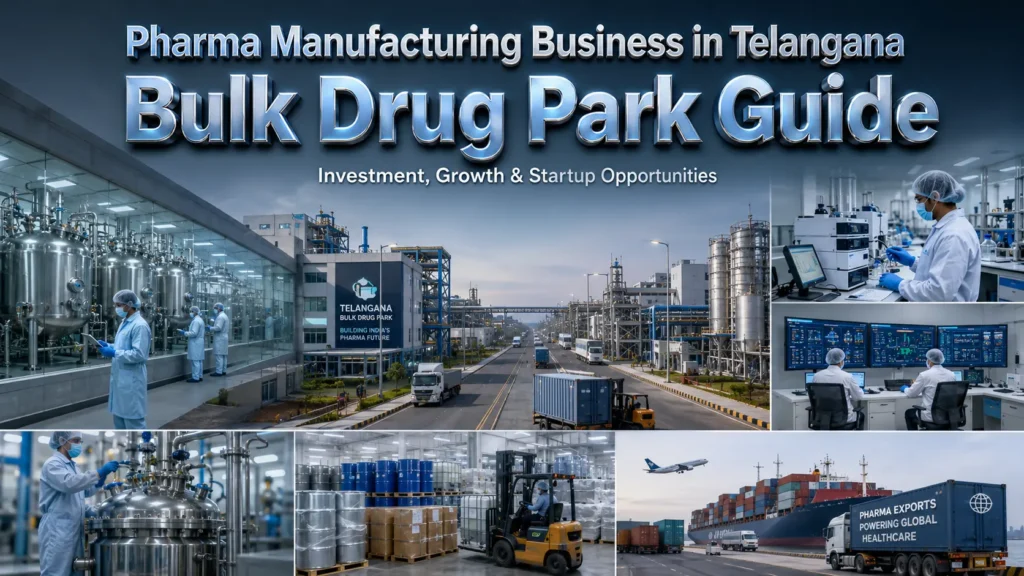
Pharma Manufacturing Business Telangana The Hyderabad alone produces about one third of India’s output of bulk drugs and APIs, with the core of these activities being Genome Valley and a pharma manufacturing base, which has been created over 30 years. It’s actually this concentration that makes the pharma manufacturing business that the Telangana entrepreneurs think about today appear daunting from the exterior: Dr. Reddy’s, Divi’s Laboratories and Hetero already possess the cake. But the state’s own Bulk Drug Park initiative, which has been aided by capital subsidy from the central government, has been created because the policy makers have realised that there is a room for new and specific players in the market, apart from the giants who are already working on a large scale. It is not an opportunity for a founder looking for a product for which every other unit in Hyderabad is doing business. It’s an invitation for one trouble-prone founder to focus on a single facet — one intermediate, one niche API, one contract manufacturing partnership — within a regulatory framework, a workforce, and a buyer base that other states take years to develop. Read the Complete Book Here: Business Ideas for Startup in Drugs & Pharmaceutical Industry with Project Profiles Why Telangana’s Pharma Cluster Is a Genuine Opening Get started with talent density. An advantage for Hyderabad over the pharma companies that have not built their capacity with API and formulation manufacturing in the city, is that a new startup can easily find experienced process chemists, regulatory affairs personnel and quality control staff, without having to import them from across the country. Add to this the government’s support. The special Bulk Drug Park developed with central PLI linked capital subsidy and allotted through Telangana State Industrial Infrastructure Corporation has plug and play infrastructure with shared effluent treatment specifically for API and intermediate manufacturing thereby reducing capex and approval time for the units to be located inside the park. The state’s own industrial policy with a focus on the pharmaceutical sector has another layer of capital and power tariff benefits that sit on top of central schemes implemented through the Ministry of Micro, Small and Medium Enterprises. The basic intermediate manufacturing unit costs start around fifteen to two dozen crore rupees for two hundred to three hundred tonnes per year, while API manufacturing for regulated markets is thirty to fifty crore rupees based on stringent quality and validation regulations. It takes around 10-14 months for the Telangana State Pollution Control Board to approve licenses and the Central Drugs Standard Control Organisation for drug manufacturing to approve infrastructure, specifically Bulk Drug Park. Business Selection Logic The margin structure is as elsewhere in the bulk drug industry in India: commodity intermediates, which a handful of existing firms in Hyderabad produce, trade at 12 to 18% margins, while specialty intermediates or niche APIs that cater to a single innovator molecule trade at 25 to 35%. The pharma cluster in Telangana is scalable because of the presence of well established buyers. A founder can launch with one multipurpose batch reactor, test one or two products with a local formulation company that doesn’t have to look far to find a qualified supplier, and then expand when repeat orders are received and the product has been proven to be in demand. The same risks identified in bulk drug manufacture in the country, such as regulatory clearance timelines and buyer concentration, apply in Telangana, however, the buyer search risk that the founders of companies in less pharma-dense states face is significantly less in Telangana due to the high concentration of buyers of bulk drugs in the state. Get Detailed Project Report (DPR): Business Opportunities in Telangana – Startup & Entrepreneurship Guide Product and Project Opportunities Worth Evaluating Antibiotic and Antiviral Intermediates Antibacterial and antiviral intermediates are being used by Hyderabad’s formulation units all the time and also the volume of customers within the state is such that if a new intermediate manufacturer wants to find a customer, they have to look within 50 km of Hyderabad. The capex for a plant of 150-250 tonne per annum is 18-25 crore rupees. The margins range from eighteen to twenty-two percent after the quality certification process with a formulation buyer is completed, which is quicker in Telangana than states with lesser concentration of pharma buyers because of their prior understanding of the qualification of suppliers. Contract Manufacturing for Global Innovator Companies With its proven regulatory track record, Telangana is a logical base for the CRAMS approach of contract manufacturing, offering global innovator pharma companies to explore India as a production partner for complex intermediates. A separate unit – one with capex of 12 to 20 crore rupees – enters into multi-year supply contracts instead of looking for volumes in the spot market. The margins are 22-28 per cent and the existing standing that Hyderabad has with the regulatory authorities is a good advantage in terms of trust building for the buyer than if the founder was coming from a lesser- established pharma hub. Niche API Manufacturing for Regulated Export Markets The best chance for a founder to carve out a niche in the Telangana pharma market is niche APIs which are molecules with a small number of qualified global manufacturers. A dedicated facility, the capex is in the range of Rs. 30 to 40 crore, which takes into consideration quality and validation infrastructure requirements, directly targets export formulation buyers in regulated markets. Once a Drug Master File (DMF) is filed and approved, the margins are twenty-eight to thirty-five percent, but the filing of a DMF takes between twelve to twenty-four months. Related Article: India’s ₹27,000 Crore API Import Problem Is Your Biggest Business Opportunity Pharma Packaging and Ancillary Component Manufacturing In addition to direct drug production, Telangana’s pharma density ensures a consistent demand for such special packaging and blister components, as well as ancillary manufacturing that every formulation and API unit in the state will need. The dedicated line requires capes expenditure of Rs 8-12
Dairy Processing Business in India: Complete Investment & Profit Guide
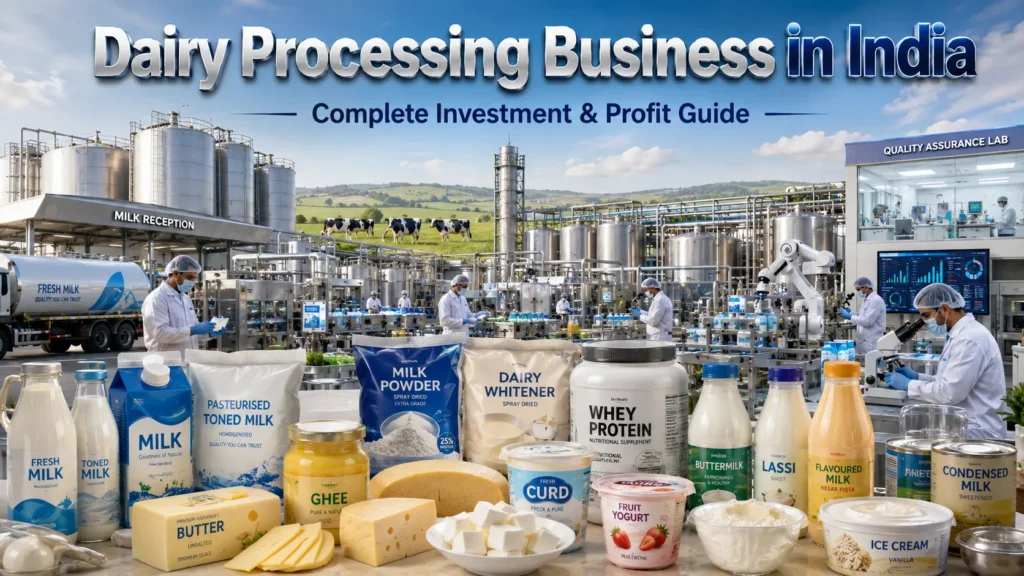
Dairy Processing Business in India The dairy sector is one of the most structurally sound sectors to invest entrepreneurial capital in India and the ideas for a dairy processing business at the investment level of Rs.10 Crore are some of the most interesting ones in the agricultural value chain. Despite being the biggest milk producer in the world as mentioned by the National Dairy Development Board (NDDB) the value addition chain from the farm gate to the end consumer is far from developed. The ideal location in this supply chain is a Rs.10 Crore raw milk processing plant, which maximizes the share of the consumer price, while simultaneously adding value to the raw milk producers. The Ministry of Animal Husbandry, Dairying and Fisheries (DAHD) has various subsidy and loan schemes in place for this investment category. Why Dairy Processing Is India’s Most Stable Agricultural Business Population growth, increasing income levels, and penetration of packaged dairy products in the urban markets are the major drivers of demand of dairy in India. The NDDB releases production and consumption statistics every year, which reveal that the organised dairy sector has been expanding at a much higher rate than production of raw milk, suggesting that value addition is the area that might offer the economy an additional economic opportunity. The rising middle-class in the city has resulted in a huge boom in paneer, yoghurt and cheese consumption. High margin product categories are created due to the premium ghee, especially the A2 ghee. All of these trend changes are driving demand for dairy process capacity which organised private entrepreneurs can cater to along with the cooperative giants like Amul and Mother Dairy. Read the Complete Book Here: Market Research Report on Milk Processing & Dairy Products in India Government Schemes for Dairy Processing Entrepreneurs Dairy Processing and Infrastructure Development Fund (DIDF) is a fund under the Ministry of Animal Husbandry, Dairying and Fisheries for provision of concessional loans at 6.5% per annum for the setting up of dairy processing infra. Private dairy entrepreneurs are eligible to avail capital subsidy up to 25% from NABARD under Dairy Entrepreneurship Development Scheme (DEDS). The Animal Husbandry Infrastructure Development Fund (AHIDF) provides a Rs.15,000 Crore loan at subsidised rates to dairy processors and cold chain investors. Units qualified as international Halal and cold chain standards are facilitated by APEDA for making dairy exports. To apply for FSSAI license for giving Dairy product for export markets, please refer to the FSSAI’s central licensing portal. Top Business Ideas in Dairy Processing at Rs.10 Crore Scale Paneer and Fresh Dairy Products for Organised Retail The fresh paneer has become one of the most popular consumables in India because of the number of vegetarians in urban households and the boom in Indian cuisine in restaurants. A modern paneer manufacturing unit at Rs.10 Crore with capacity of 20,000 to 40,000 litres of milk per day can provide the FMCG retailers such as D-Mart, Reliance Fresh, Spencer’s Retail etc. Defensible Differentiation is achieved by building a recognized regional brand, highlighting QR code traceability and natural ingredients. Exporters have to meet the standards laid down by the FSSAI for the labelling and quality of paneer. Ghee Manufacturing for Domestic Premium and Export Markets Premium ghee, which is made from desi cow breeds A2 variety, bilona-churned ghee and organic certified ghee, has increased by a huge fold with urban consumers willing to pay a steep premium for genuine production. Indian brand ghee is in good demand in the Gulf Indian diaspora market. A2 ghee fetches a premium in retail channels of Rs.1500 to Rs.3000 per kg. The main requirements for the ghee export to Gulf are its halal certification and APEDA registration. The technical assistance is offered to the small dairy processors to upgrade their quality management and processing system by the NDDB. Flavoured Milk and Probiotic Dairy Beverage Manufacturing Flavoured milk and probiotic dairy beverages are expanding at a rate of 20-25% per year. The volume of mango lassi, chocolate milk and probiotic yoghurt drinks that are sold in Tetra Pak or PET bottles is on the rise in today’s modern retail and vending outlets. Packaged dairy beverages are big volume purchases for institutional outlets such as schools and hospitals. In addition to the subsidies for the dairy manufacturers, the DAHD’s dairy development schemes also cover dairy beverage manufacturers who meet the criteria of the AHIDF. Get Detailed Project Report (DPR): Comprehensive Guide to Milk & Dairy Products Import-Export Opportunity Analysis Ghee, paneer and milk powder are exported to the markets of the Gulf countries, South East Asia, and the global diaspora. Indian Dairy market is well established in the Gulf. APEDA supports export of dairy products. For exports to the Gulf, it must be certified as Halal. Full compliance audit and listing of estates based on the EU standard for dairy products is required for export — handled via FSSAI’s export establishment certification programme. Indian MSME Success Stories in Dairy Processing Parag Milk Foods: Building a National Dairy Brand from Manchar The Bhosale family owner, at Manchar, Maharashtra, established one of the most innovative private dairy companies in India with the Pride of Cows premium milk brand and India’s first mozzarella cheese plant. The company’s commitment to product innovation, for instance, in the cheese category, where there was no Indian brand, meant that it had the opportunity to penetrate an emerging market before the category became competitive. Hatsun Agro Products: South India’s Dairy Champion South India’s biggest private sector dairy company was developed by RG Chandramogan of Hatsun Agro Products in TamilNadu. They have two ice cream brands, Arun, and two dairy brands, Hatsun, which have high recognition value among consumers thanks to the decades of investments made in both product quality and distribution. Hatsun proves that to be successful in dairy processing, one needs to invest heavily in milk procurement from the upstream and delivery capability from the downstream. How NPCS Can Help You Get Started At Niir Project Consultancy Services (NPCS), the
How to Start a Fasteners and Precision Parts Manufacturing Export Business in India
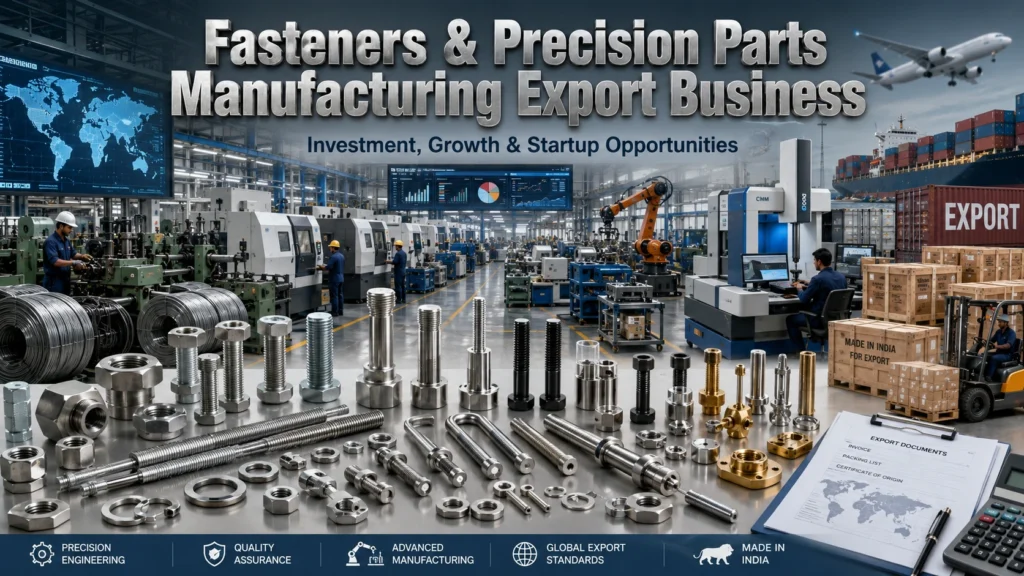
Fasteners and Precision Parts Manufacturing Export Business One of the most important and globally consistent engineering business ideas of EEPs portfolio is the manufacturing of fasteners and precision parts for exports. Bolts and nuts, screws and washers, rivets and specialty fasteners are the major products exported from India to more than 50 countries, and the Ludhiana, Rajkot, Mumbai and Pune clusters provide automotive, aerospace, construction, electronics and industrial equipment buyers around the world with both commodity and precision engineered fasteners. The demand for this category is structurally non-discretionary – all mechanical assemblies need fasteners and all engineering products produced around the world generate downstream demand. The world fastener industry is more than $100 billion per year and steadily expands in parallel with the growth of industry. Explore This Book: The Complete Technology Book on Steel and Steel Products (Fasteners, Seamless Tubes, Casting, Rolling of Flat Products & others) EEPC and Government Policy Support The Engineering Export Promotion Council (EEPC India) provides assistance to fastener exporters in the following areas: Buyer-seller meets for automotive and industrial OEM procurement managers, Fastener Fair Stuttgart and International Fastener Expo USA, and market intelligence on the trends in fastener demand in target markets. The EEPC RCMC facilitates RoDTEP benefit on exports of fasteners. The DGFT EPCG Scheme provides zero duty on importation of cold forging presses, thread rolling machines, CNC turning centre, CMM inspection machines and heat treatment furnaces – the core manufacturing equipment for the production of fasteners and precision parts. EPCG automated fastener production has great advantages in improving production efficiency and quality consistency. Business Ideas 1. Standard Fasteners for Construction and Industrial Use Carbon Steel and Stainless-Steel Hex bolts, Hex nuts, Washers, Threaded Rods, Anchor Bolts are exported in container loads to Hardware Distributors and Industrial MRO buyers in the Gulf, Africa, South East Asia and Latin America. Investment of ₹50 lakh to ₹1.5 crore in cold forging, threading, heat treatment and zinc plating. Must be DIN/ISO/ASME dimensional standards. Related Article: Business Ideas for Automobile Parts Manufacturing. Highly-Demanded Automotive Components Business 2. Automotive Grade Fasteners for OEM Supply High strength automotive fasteners used for vehicle assembly are the top-of-the-line export market for fasteners: Class 8.8, 10.9 and 12.9. India’s car component producers that get certified by IATF 16949 are eligible for multi-year supply contracts with key buyers worldwide that have volume commitments. The investment will be in range of ₹1 crore to ₹4 crore. A major quality requirement is hydrogen embrittlement test and zinc-nickel plating. 3. CNC Precision Turned Parts Precision turned parts (shafts, bushings, pins, connectors and fittings) used in automotive, electronics, medical device and industrial applications are the highest margin market segment. Modern CNC turning centres and grinding machines with tolerances as low as ±0.005mm to be built with investment ranging between ₹80 lakh and ₹3 crore. The export markets are Germany, US, Japan and Taiwan, where there are active lookouts for cost competitive Indian alternatives. 4. Stainless Steel and Specialty Fasteners The price of stainless-steel fasteners (grades 304 and 316) is much higher than the price of carbon steel fasteners used for the marine, chemical, and food industry equipment. The investment in a stainless-steel fastener unit is from ₹60 lakh to ₹2 crore. Stainless fastener conformance to BS, DIN and ASTM standards and material certification required. Process industries exports are to the US, EU, Australia and the Middle East. Get Detailed Project Report (DPR): Steel and Steel Products Projects Guide Import-Export Opportunity Analysis The exports of fasteners have steadily increased in India. Leading destinations include the USA, UK, Germany, UAE and Australia. Active effort by the US market to qualify nonchains suppliers, both due to the Section 301 tariffs on Chinese fasteners and due to security concerns in the supply chain, is generating opportunities for Indian fastener manufacturers to invest in quality certifications and testing to become qualified by the US market. Many Indian fastener suppliers have been successful in becoming primary suppliers to US hardware distributors and OEM procurement programs. Indian MSME Success Stories Sundram Fasteners developed a world-class automotive fastener business by meeting Toyota Supplier Quality Standards and continually developing their OEM customer base in automotive companies from Japan, Europe and North America. They have gone on a decades-long journey of quality improvements that led to a globally trusted brand of fasteners. Precision Camshafts and a few precision machining firms in Pune have created sizeable export businesses for the production of precision components for automotive buyers in Europe and America by investing in high-precision CNC machines and IATF quality certifications. Rajkot-based MSME fasteners manufacturers have developed export business in the range of ₹10 crore to ₹30 crore in the countries of the Gulf and Australia, by attending EEPC buyer-seller meets. How NPCS Supports This Business Niir Project Consultancy Services (NPCS) offers Professional Consultancy Services for Market Survey cum Detailed Techno-Economic Feasibility Reports (DPRs) for establishing new manufacturing/export businesses in this sector. We have complete reports which contain details of the manufacturing process, market research, and market demand analysis, process flow diagrams, product mix and capacity planning, details of machinery and raw materials, details of the project and complete financials with profitability analysis. We want to help entrepreneurs understand the feasibility, profit and scalability of their business before investing. Build a profitable business with the right idea Key Data Overview Product Category Investment Range Key Standard Target Markets Typical Margin Standard Construction Fasteners ₹50L – ₹1.5 Cr DIN/ISO + Zinc Plated Gulf, Africa, SE Asia 15–25% Automotive Grade Fasteners ₹1 Cr – ₹4 Cr IATF 16949 + OEM Spec Germany, US, Japan 20–35% CNC Precision Turned Parts ₹80L – ₹3 Cr ISO 9001 + CMM Certified Germany, US, Japan, Taiwan 30–55% SS and Specialty Fasteners ₹60L – ₹2 Cr ASTM/BS + Material Cert US, EU, Australia, ME 25–45% Rivets and Special Fasteners ₹40L – ₹1 Cr ISO + Customer Spec US, EU, SE Asia 22–38% Frequently Asked Questions (FAQ) 1. For what property class are fasteners? Property class refers to the strength of a fastener. Class 8.8
Adult Diaper Manufacturing Business in India: BIS IS:17015, SAP Technology, Market Demand and Investment Guide
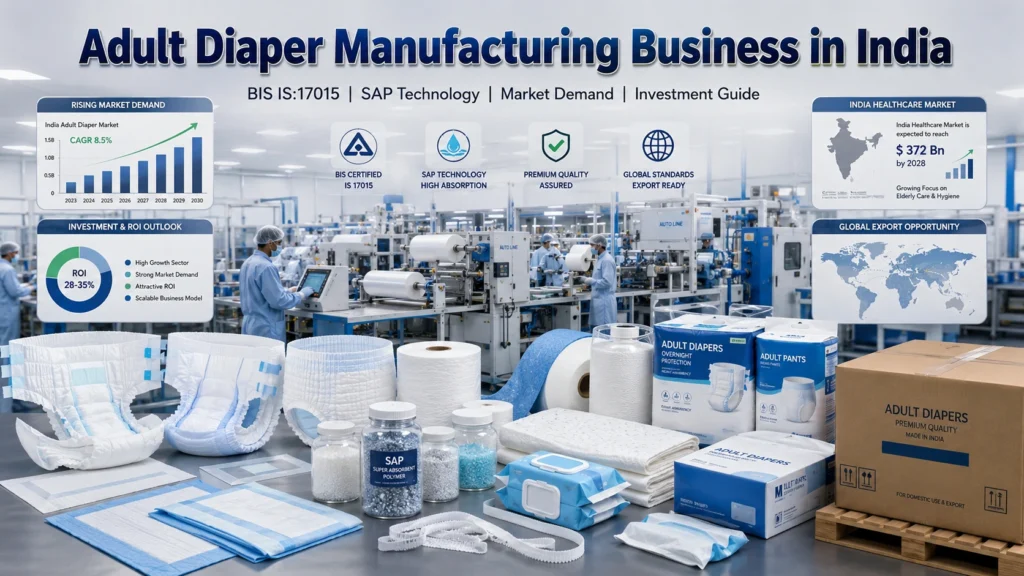
Adult Diaper Manufacturing Business in India The adult diaper segment is one of the fastest growing consumer healthcare product segments in India, owing to the increase in the aging population, awareness about incontinence, adoption of nursing/ post-surgical care in the hospital sector and formalization of home care for the elderly and nursing. The market value is estimated at Rs 1,500-2,000 crore and is growing at a healthier rate of 20-25 percent CAGR as compared to most medical consumable categories, with India importing a large proportion of its need even though it has the infrastructure, technology and expertise to manufacture medical-grade adult diapers, SAPs (superabsorbent polymer) and packaging. According to Research published in NCBI: Urinary Incontinence Prevalence in India, there is a massively under-served domestic market as it is estimated that 20-30 percent of the elderly population in India suffers from urinary incontinence. According to WHO Global Report on Ageing and Health, access to adult incontinence products is among the most important parameters of quality of life of the ageing population of middle-income countries. Market Opportunity: Why This Business Cannot Be Ignored Multinational brands such as Kimberly-Clark’s Depend and Tena by the Essity dominate the market of diapers for adults in India, with a few organised domestic producers. The majority of the Rs 2000 crore+ growth in the market is happening in institutional channels such as hospitals and home care, where quality is the main procurement criterion of choice, per the standards set by the Bureau of Indian Standards (BIS) under the IS:17015 (Adult Diaper Specification) standard. One that is growing rapidly is hospital and home care institutional supply. The growth of national programme initiatives such as elder care and palliative care provided by NHM and the growing market of registered adult care facilities under the Ministry of Social Justice is generating huge institutional buyer markets for the quality domestic producers of certified adult incontinence products, thereby opening up government procurement channels as well as consumer retail outlets. Get Detailed Insights from This Book: Sanitary Napkins, Baby and Adult Diapers Industry Analysis: Growth Drivers and Demand Outlook The adult diaper market in India is currently Rs 1,500-2,000 crore with a growth rate of 20-25 per cent per year. According to the FICCI’s Consumer Healthcare Report, India’s adult incontinence market will swell to Rs 5,000 crore by 2030, as the ageing population of 140 million +60 years will grow at 3 per cent every year, and there is a growing awareness across the country about the management solutions available for incontinence. The PIB: India Census and Elderly Population Statistics indicates that the ageing population is growing at a compound annual rate of 3 percent and by 2050, the number of elderly people in India will be more than 300 million and one of the world’s largest ageing populations. To get private label supply to the pharmacy chains (Apollo Pharmacy, MedPlus, Wellness Forever) is an effective way to enter the market, without burdening consumer brand building costs and with access to proven retail distribution channels on institutional rates. The PMEGP scheme of MSME Ministry offers up to a maximum of 25-35 percent capital subsidy for manufacturing a new manufacturing unit in the consumer healthcare product manufacturing sector, which brings down the net equity required for a new manufacturing unit by an adult diaper manufacturing entrepreneur. India’s consumer healthcare market is expanding at more than 15 percent per year and among the fastest-growing sub-categories are products for elder care and incontinence management, according to the IBEF: India Consumer Healthcare Market. India Adult Diaper Market Overview Parameter Market Data Notes India Adult Diaper Market Value Rs 1,500 – 2,000 crore Industry estimates Market Growth Rate 20-25% CAGR Ageing population and care awareness India Population Aged 60+ 140+ million people Growing at 3% annually BIS Standard IS:17015 (Adult Diaper Specification) Mandatory for institutional supply Core Technical Ingredient SAP (Superabsorbent Polymer) 250-300g/m2 in absorbent core Key Market Segments Hospital, nursing home, home care, retail Multiple buyer channels Market Leaders Kimberly-Clark, Tena, Romsons, Nobel Hygiene Domestic brands growing How to Start: Step-by-Step Guide for Entrepreneurs Step 1: Business Setup and BIS IS:17015 Certification Dedicate entity, get Udyam MSME registration, and factory licence and GST. Request the BIS IS:17015 (Adult Diaper) Certificate which is required for hospital / medical institution supply. The absorbency under pressure, acquisition time, rewet, pH and odour parameters are specified in IS:17015. No CDSCO Device Licence for incontinence management (wound care) diapers. Step 2: Technology: SAP Core and Absorbent Layer Design Adult diapers feature a superabsorbent polymer (SAP) core that absorbs urine 30 times its weight, surrounded by absorbent fluff pulp, and topped with a top sheet (nonwoven) and backed by a breathable PE or PP film. Absorbency capacity is dependent on SAP concentration (250 – 300 g/m2). Forging R&D partnership with domestic supplier of SAP (Nippon Shokubai India, SDP Global / imported specialty polymer distributors). The Wikipedia: Adult diaper encompasses international technology standards for adult incontinence products, such as SAP concentration, acquisition time and rewet performance. Get Detailed Insights from This Book: Our Books Step 3: Production Line: Diaper Converting Machine An integrated diaper converting machine is utilized for the production of adult diapers, which combines the process of creating the fluff pulp-SAP core, attaching top sheet and backsheet, adding leg cuffs, applying elastic waist bands, applying adhesive fastening tapes, cutting and folding into individual pads into one process. The typical production rate of an adult diaper machine is 200-400 per minute. Investment: Rs. 1-3 crore for a simple converting machine, which can be purchased from Chinese or European suppliers. Step 4: Product Range: Tape Style and Pull-Up Style Tape-type adult diapers (adhesive tabs) are used by bedridden patients at a hospital or nursing home. Pull-up adult diapers (underwear style, stretch panels) are used by ambulatory incontinent adults in home care and retail pharmacy. Pull-ups are retail priced at Rs 40-80 per piece, growing faster as retail awareness is increasing, compared to tape-style which is priced at Rs 25-50 per piece. Step 5:
THIN FILM PHOTOVOLTAIC (PV) MARKET: Global Landscape, India Demand-Supply Gap & MSME Startup Strategy
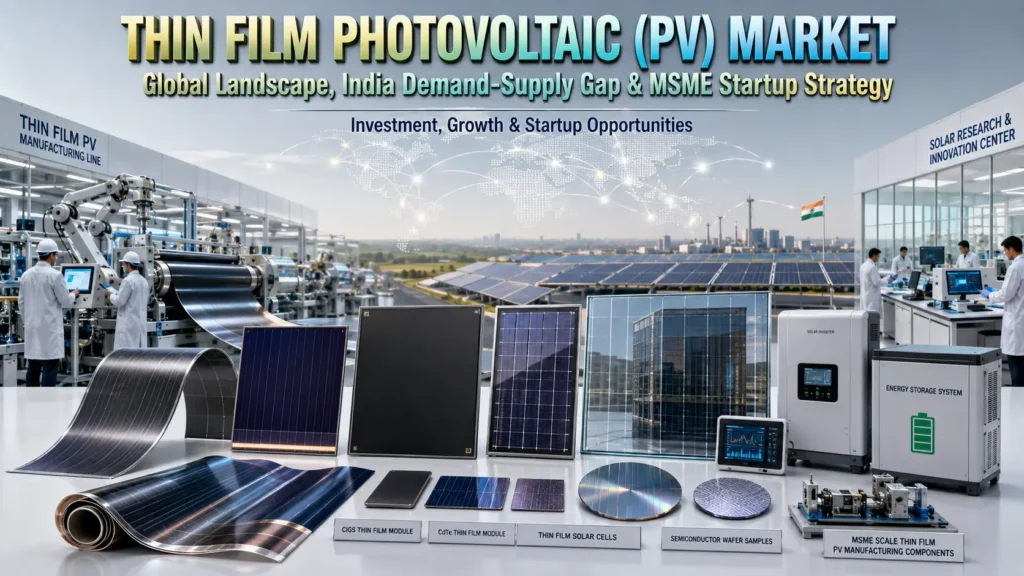
Thin Film Photovoltaic Manufacturing in India MARKET INSIGHT The worldwide thin-film PV (TFPV) market is worth more than USD 20 billion and is growing at more than 17% CAGR, fuelled by the growth of portable applications and building-integrated photovoltaic (BIPV) applications as well as utility-scale solar. The National Solar Mission (NSM) which aims to add one million MW of solar power by 2030, has created a high priority manufacturing opportunity for the thin-film PV industry with a significant import substitution potential. Structural demand-supply gap for thin-film modules is currently being met by imports from China, Japan and USA, which MSME manufacturers can close with the country. The Thin-Film PV Market: An Industrial Overview The solar energy market has experienced a fundamental change in the last 10 years, with thin film photovoltaic (PV) technology becoming a commercially viable and technically valuable alternative to traditional crystalline silicon solar modules in several high value applications. Thin-film PV cells are produced by depositing one or more ultra-thin layers of photovoltaic semiconductor material, usually in micrometres, onto a substrate like glass, metal foil or flexible plastic, and are not made by the energy-intensive ingot slicing and thick wafer processing used in conventional silicon wafer-based PV panels. This basic production disparity allows the production of significantly less material per watt of power output, power output flexibility, and distinctly superior performance characteristics under real world conditions. Get Detailed Insights from This Book: Solar PV Power and Solar Products Handbook The three major commercial types of thin-film technology are Cadmium Telluride (CdTe), Copper Indium Gallium Selenide (CIGS or CIS), and Amorphous Silicon (a-Si). Each of the technologies offers a specific set of efficiency, cost and application characteristics. The International Energy Agency (IEA) estimates that solar PV technology has become the world’s cheapest energy source to date in large parts of the world, and even thin-film PV technologies play a major part in this cost reduction trend, adding that solar PV has opened up new application categories besides the fixed-frame rooftop panel. The Indian solar market is at the cross-roads of energy security, climate change and manufacturing. India is a sizeable, ongoing, policy-driven and sunny market, both for PV equipment and as a manufacturing hub for PV energy supply. Global Manufacturing Landscape: Key Players Shaping the Industry Many vertically integrated technology conglomerates and a handful of thin-film innovators, all vertically integrated, are present in North America, East Asia and Europe that dominate the thin-film PV industry. The following table provides a summary of the key manufacturers active in this area, the country of origin for the manufacturer and the key technology that is used, as well as the main markets targeted. Company Country Technology Key Market Segment First Solar USA CdTe Thin-Film Utility-Scale Solar Jinko Solar China Multi-Tech including TF Utility & Commercial JA Solar Co. Ltd China Multi-Technology Global Utility Panasonic Corporation Japan HIT / Thin-Film Residential & Commercial Mitsubishi Electric Corp. Japan Amorphous Silicon Commercial & Industrial Sharp Corporation Japan CIGS Thin-Film Residential & BIPV Kyocera Corporation Japan Multi-crystalline & TF Commercial Systems Kaneka Corporation Japan Amorphous Si (a-Si) BIPV & Flexible MiaSole USA CIGS on Foil Flexible / Portable Solar Ascent Solar Technologies USA CIGS on Plastic Aerospace & Wearables Hanergy Mobile Energy China CIGS / GaAs Mobile & Portable Energy Yingli Green Energy China Multi-Technology Utility & Rooftop Trina Solar China Multi-Technology Global Utility ReneSola Co. Ltd China Thin-Film & Si Commercial Rooftop Suntech Power Holdings China Multi-Technology Utility Scale SUNQ China Thin-Film Consumer & Portable Trony Solar China Amorphous Silicon Commercial Solar Filsom AG Europe CIGS Thin-Film BIPV & Industrial Shunfeng Intl Clean Energy China Multi-Technology Utility Scale First Solar is the world’s leading technology company in large-scale, CdTe-solar, and has long been the low-cost leader in the U.S., European and portions of Asian utility-scale markets. The Chinese players (Jinko Solar, JA Solar, Trina Solar, Yingli, ReneSola, Suntech, SUNQ, Trony and Shunfeng) are the powerhouse behind the current 90%+ drop in PV module prices over the last 20 years. Meanwhile, the module efficiency and integration of BIPV products are still being dominated by Japanese technology companies, such as Panasonic, Sharp, Mitsubishi Electric, Kyocera, and Kaneka. Ascent Solar Technologies and MiaSole are pushing the envelope on the ultra-lightweight, flexible thin-film into defense, aerospace and wearable consumer applications. European specialist Filsom AG is taking the lead in the BIPV architectural segment, thanks to its precision CIGS deposition technology. Access Complete Business Plan: Start a Manufacturing Unit of Solar Panel. The Renewable-Energy Business is Expected to Keep High Growth. Technology Deep-Dive: CdTe, CIGS, and Amorphous Silicon Every type of thin film technology is in a different niche in the solar industry, with varying levels of capital intensity, manufacturing needs, and points of entry for MSMEs interested in entering this growing sector. Cadmium Telluride (CdTe) The non-silicon solar market is dominated by CdTe thin-film. It offers the lowest manufacturing cost per watt of any commercially available PV technology and has a particular advantage in high heat, high humidity applications which are common in much of the solar belt in India. First Solar’s position is well entrenched, but the patents available in the space are beginning to give other companies a chance to get in on tellurium and cadmium supply chains. The Ministry of New and Renewable Energy (MNRE) has declared CdTe and CIGS modules as priority category in the policy framework Approved List of Models and Manufacturers (ALMM) and the policy objective is to promote the domestic manufacturing of these modules. Copper Indium Gallium Selenide (CIGS) CIGS technology is the most efficient of all the thin-film technologies with laboratory cells now having efficiencies of over 23% and commercial modules are now achieving efficiencies of 14-18% in mass production. Its unique strength is its flexibility of the substrate that can be deposited onto a thin aluminium foil or polymer plastic, which means it can be used in curved glass facades, portable power packs, backpack-mounted chargers and wearable electronics. Mass-market applications are being led by companies such as MiaSole,
R717 Refrigerant (Ammonia): India’s Coldest Industrial Opportunity
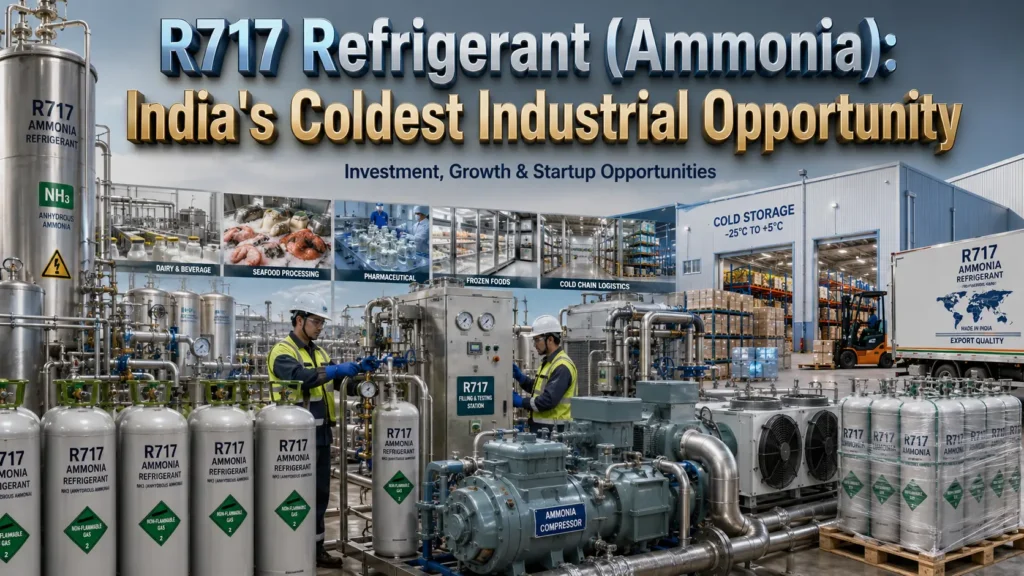
R717 Refrigerant Manufacturing Business in India Market Insight: The global R717 (ammonia) refrigerator market is valued at USD 1.8 billion and is expected to grow at 5.2% CAGR throughout the decade, thanks to the growth in cold chain infrastructure, food processing and fertiliser industry. India is estimated to be a USD 180 – 200 million market with the majority of demand in industrial refrigeration, food storage, breweries, and pharmaceutical cold chains. Why R717 Refrigerant Is Regaining Its Industrial Crown Known as R717 by the ASHRAE refrigerant classification, ammonia is one of the oldest and most thermodynamically efficient refrigerants used in industry. It has zero ozone depletion potential (ODP) and global warming potential (GWP) as compared to synthetic fluorocarbon refrigerants, now phased out under international climate accords. The Kigali Amendment on the Montreal Protocol will force countries, including India, to reduce the use of HFCs by more than 80% by 2047, making R717 the only ‘old-school industrial option’ again. The future proof solution that is attracting new investments and policy interest throughout the global cold chain supply chain. The industrial demand for industrial refrigerants is increasing with the expansion of food processing capacity, advancement of cold chain logistics infrastructure under various Government initiatives such as PM Kisan Sampada Yojana and the booming pharmaceutical manufacturing sector. R717 combines all the properties of efficiency, environmental friendliness and cost-economics and thus is the refrigerant for large-scale industrial applications. Entrepreneurs and MSMEs joining this market now will be at a competitive advantage to a structural change that India’s refrigeration industry will undergo in the next ten years. Related Article: Green Ammonia & Methanol from Odisha’s Coastal Ports: The Industrial Chemical That Could Power India’s Decarbonisation Global Market Landscape and Key Participants Essentially, the R717 refrigerant market is fragmented between a mix of multi-national industrial gas major companies and regionally dominant specialty chemical companies. The market is somewhat consolidated at the global level, with some large players controlling a significant capacity, but is rather fragmented at regional and national levels such as India, with ample opportunities for entry. The leading global players influencing R717 supply, pricing and technology specifications are: Company Country / Region Market Role Danfoss Group Denmark / Global Industrial refrigeration systems & ammonia-compatible components The Linde Group Germany / Global Largest industrial gas supplier; major R717 producer & distributor Dehon Group France / Europe Specialty refrigerant distributor; strong European market presence National Refrigerants USA North American R717 supply; reclamation & recycle services Sinochem Group China Leading Chinese producer; growing Asia-Pacific supply chain Tazzetti Italy / Europe Specialty gas and refrigerant distributor across EU A-Gas International UK / Global Refrigerant lifecycle management, recovery, and resale Harp International UK Specialty gas blending and distribution Aditya Air Products India Domestic industrial gas and refrigerant supplier Jai Maruti Gas Cylinders India Ammonia cylinder filling and distribution Brooktherm Refrigeration South Africa / Africa African market refrigeration gas supply Engas Australasia Australia / NZ Australasian industrial refrigerant distribution Hychill Australia Australia Natural refrigerant promotion and supply Data from the United Nations Environment Programme (UNEP) Ozonation indicates that more than 50% of the refrigerant capacity installed in large industrial refrigeration systems worldwide are ammonia (R717). This dominance is due to its superior Coefficient of Performance (COP), 0 climate impact and its well-established supply chain in industrial economies. India Market Overview: Consumption Trends and Growth Drivers The five end-use sectors namely food processing, cold storage, breweries and beverages, dairy processing, and fertiliser plant refrigeration systems are the key customers for R717 refrigerant in India. These sectors account for the majority of domestic ammonia refrigerant usage, and the cold chain logistic sector is the fastest-growing demand segment. End-Use Sector Estimated Demand Share (%) Growth Outlook Cold Storage & Warehousing 32% High — driven by PM Kisan Sampada Yojana & e-commerce logistics Food Processing & Dairy 26% High — National Mission on Food Processing support Breweries & Beverages 18% Moderate-High — rapid capacity expansion Pharmaceutical Cold Chain 13% Very High — post-pandemic pharma investment surge Fertiliser & Chemical Plants 11% Stable — existing captive ammonia infrastructure The cold chain industry in India, backed by the Ministry of Food Processing Industries (MoFPI) is gaining momentum in investments. According to government estimates, India requires more than 50 million metric tonnes of extra cold storage units to counter the losses of food in the post-production chain, which currently account for more than 15-18% of the total food produced. The moderate-size cold stores consume 50 to 150 MT of ammonia refrigerant, and the demand is recurring and increasing, which domestic cold store producers have not yet been able to meet on their own. Get Detailed Project Report (DPR): Fertilizers & NPK: A Complete Guide Demand–Supply Gap: India’s Critical Dependency Demand–Supply Gap: Domestic production of R717 in India is concentrated at a few small and big integrated fertiliser complexes and single small to medium-sized standalone industrial gas producers and is estimated to be covering only about 60–65% of the total addressable refrigerant-grade ammonia market. The situation is especially critical for the shortfall of high purity anhydrous ammonia as per IS 799:2002 and BIS requirement for precision refrigeration application. This disparity forces buyers in industry to find supplies from other sources, which adds to cost and supply assurance risks. Most of the ammonia produced in India is used in the production of fertilizers and purity requirements for the ammonia used for refrigerants is more stringent, while nitrogen-grade ammonia is produced in bulk. The supply chain of the dedicated R717 refrigerant (anhydrous ammonia) is not as well developed as the expanding industrial refrigeration market, covering aspects such as purification, pressurised filling of cylinders and cold chain distribution. Import data from the Directorate General of Foreign Trade (DGFT) and trade intelligence sources suggest that India imports large quantities of refrigerant grade ammonia and its related refrigerant gases every year from China, EU and Middle East. High purity anhydrous ammonia demand for precision cooling has increased the import dependency of this market, indicating a clear opportunity for investment in domestic production.
How to Find the Perfect Business Idea for Your Budget: NPCS Startup Selector Tool

Startup Selector Tool India Each year, thousands of career professionals, MSME investors, and first-time entrepreneurs find themselves with the same question to ponder: what business should I really start? Most people spend weeks, even months, reading through random blogs, YouTube videos and even old, outdated lists trying to correlate a business idea with available resources and come up with a solution and then end up even more confused than they were at the beginning. The problem is an issue that Niir Project Consultancy Services (NPCS) has hidden away until now — a free, instant Startup Selector tool that matches entrepreneurs to real, data-driven business ideas in terms of their own investment capacity and financial goals — and few entrepreneurs looking for business ideas online even realize it exists. If you are looking for how to choose a business to start, best manufacturing business ideas within my budget or a free startup idea finder tool in India, this article gives you a resource that can save a lot of your scattered research – NPCS Startup Selector, available free at niir.org/startup-selector. Explore This Book: Just For Starters: How To Start Your Own Export Business What Is the NPCS Startup Selector and Why It’s a Genuinely Useful Tool Designed to automatically generate a list of projects that match the criteria you enter, the Startup Selector is a quick and easy project identification and selection tool based on NPCS’s comprehensive database of over 12,000 project reports and business profiles covering manufacturing, agro-processing, chemicals, food processing, packaging, engineering, and dozens of other industrial sectors. It eliminates the need for entrepreneurs to sift through thousands of pages to find the right business ideas and instead allows them to input their own financial considerations and get a short list of business ideas that really align with them. The Startup Selector personalises to each entrepreneur’s actual budget — giving far more actionable content than the majority of lists of business ideas found online today, which are the same for every reader. How the Startup Selector Works: Five Simple Search Parameters The entrepreneurs can use any combination of the following inputs to search the entire NPCS project database: Plant & Machinery Cost (in Lakhs): these are filters to help narrow down ideas depending on the type of machinery investment that you are willing to make Total Capital Investment (TCI) (Lakhs): align concepts with the overall capital available, including working capital. This filter is useful for planning bank loan or subsidy applications and helps narrow down the projects by total project cost (in Lakhs). This filter is useful to help narrow down the projects by the overall cost of the project (in Lakhs) when planning bank loan or subsidy applications. The business ideas must have the rate of return (ROR) (%) that is above your minimum desired rate of return. Break Even Point (BEP) (%) — recognize ideas that have a breakeven profile that are consistent with your risk tolerance These parameters can be entered in seconds and the tool returns a short, carefully selected list of matching project ideas and project profiles – from small businesses to larger industrial projects – from NPCS’s ever-growing database of business opportunities. Why This Tool Solves a Real Problem for Indian Entrepreneurs There are a number of honest reasons why this is a good idea for anyone considering a new business venture: It’s a free tool: There’s no payment to access the shortlist, and no login to the Startup Selector in order to create a shortlist of business ideas. No payment or login: No fees required for accessing the Startup Selector, and no login to the Startup Selector for creating a shortlist of business ideas. Saves hundreds of hours of research: Entrepreneurs get a list of relevant and focused sources they can search on, rather than having to compare dozens of random sources found through the web. It’s based on real financial data: No guessing, each project idea that is returned is backed by NPCS’s actual data from the Techno-Economic Feasibility Report, including ROI and Break-Even Analysis. The database is updated continuously: The ideas which have appeared are based on the latest market data, not on outdated lists, but on the latest market data. It serves all budgets: If you’re investing ₹5 lakh or ₹5 crore, the tool filters the ideas with relevance to your capital range and not shows irrelevant large scale and micro scale ideas. Related Article: You Don’t Need a Business Consultant to Find Your First Business Idea — Here’s Why Who Should Use the Startup Selector Tool 1. First-Time Entrepreneurs Exploring Options Knowing that you want to launch a manufacturing or industrial enterprise, but not a specific industry, the Startup Selector is the quickest approach to view a realistic and budget comparable set of industries without beginning from scratch. 2. MSME Owners Looking to Diversify The tool can be used by existing business owners who want to pursue a second line of business or a new product line and need to quickly see what other business lines are complementary and what amount of capital investment is needed. 3. NRIs and Investors Seeking Indian Manufacturing Opportunities The tool can be used remotely by NRIs and investors for manufacturing projects in India to shortlist the projects prior to detailed feasibility report and project consultancy by NPCS. 4. Students and Young Professionals Planning Their First Venture For anyone who is still saving for their business or just thinking about investing in a long-term business venture, the tool can help clarify what businesses are viable at various levels of investment, which can help guide savings and business-planning objectives well before the capital is needed. View Full Project Details: Project Reports & Profiles From Business Idea to Bankable Project: What NPCS Offers Next The Startup Selector has been created as a starting point of the NPCS journey of entrepreneurship, and not as an end product. After narrowing down the list of business ideas that are matched, NPCS provides complete Market Survey cum Detailed