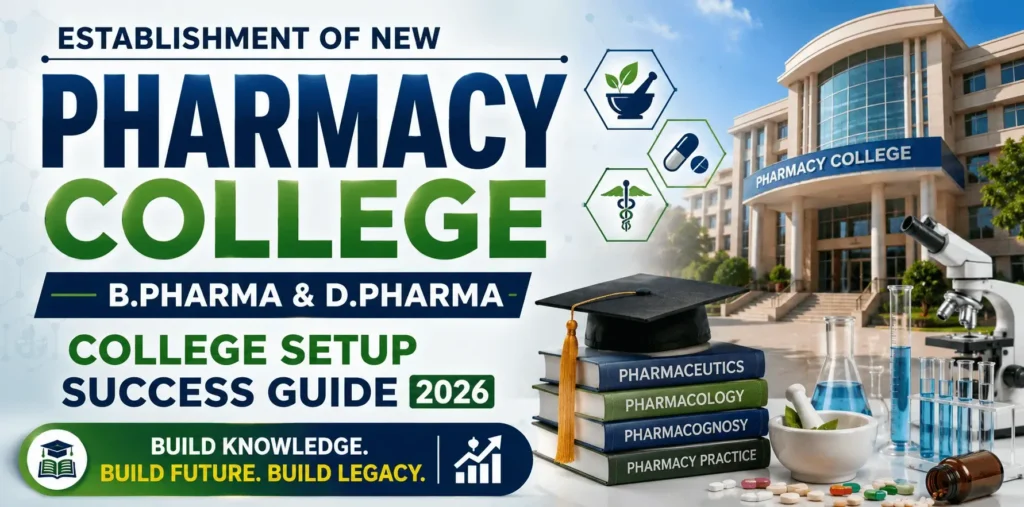

Establishing a B.Pharma and D.Pharma college in India is one of the most lucrative opportunities in the healthcare education sector. With the growing demand for qualified pharmacists, setting up a B.Pharma and D.Pharma institution offers immense potential. B.Pharma and D.Pharma colleges are witnessing unprecedented student interest, backed by regulatory reforms and industry demand. Whether you’re an investor, educationist, or healthcare entrepreneur, this comprehensive guide will walk you through every critical aspect of launching a successful B.Pharma and D.Pharma institution in 2026.
Contents
- 1. Comprehensive Overview of Pharmacy College Set Up for a B.Pharma & D.Pharma
- 1.1. 1. Regulatory Approvals and Affiliations
- 1.2. 2. Ideal Land and Infrastructure Requirements
- 1.3. 3. Faculty Recruitment and HR Planning
- 1.4. 4. Investment Requirements and Financial Planning
- 1.5. 5. Curriculum Design and Program Structure
- 1.6. 6. Marketing, Admission Strategy, and Branding
- 1.7. 7. Technology Integration and Smart Campus Initiatives
- 1.8. 8. Placement Cell and Industry Tie-ups
- 1.9. 9. Quality Assurance and Accreditation
- 1.10. 10. Sustainability and Future Roadmap
- 1.11. Conclusion
- 1.12. Frequently Asked Questions (FAQ)
- 1.13. First step to get the Pharmacy College for B.Pharma and D.Pharma College Setup
Comprehensive Overview of Pharmacy College Set Up for a B.Pharma & D.Pharma
To establish a pharmaceutical institution offering both Bachelor of Pharmacy (B.Pharma) and Diploma in Pharmacy (D.Pharma) courses, a well-structured approach involving regulatory approvals, infrastructural development, curriculum design, and skilled faculty recruitment is essential.
1. Regulatory Approvals and Affiliations
To start a B.Pharma & D.Pharma college in India, institutions must secure approvals from:
- Pharmacy Council of India (PCI) – Mandatory for both B.Pharma and D.Pharma.
- All India Council for Technical Education (AICTE) – Required for B.Pharma course.
- State Government Approval – Necessary to operate any professional institution.
- Affiliation to a Recognized University – Typically for B.Pharma programs.
- State Pharmacy Council Registration – Allows for recognized practice licenses post-graduation.
All applications must be submitted online via the PCI portal by the prescribed dates, usually by early March every academic year.
2. Ideal Land and Infrastructure Requirements
Setting up a B.Pharma & D.Pharma college requires significant land investment and modern infrastructure as per PCI norms.
- Land Area: Minimum 2 acres in metropolitan areas; 3 acres in non-metro regions.
- Built-up Area: Approx. 45,000–50,000 sq. ft. for combined B.Pharma & D.Pharma programs.
- Classrooms: Well-ventilated smart classrooms with audio-visual aids.
- Laboratories: At least 12 fully-equipped labs, including:
Pharmaceutics Lab
Pharmacology Lab
Pharmaceutical Chemistry Lab
Pharmacognosy Lab
- Library: Minimum 2000 reference books with subscriptions to pharmaceutical journals.
- Computer Lab: 1:5 student-computer ratio with internet connectivity.
- Additional Facilities: Auditorium, girls’ and boys’ common rooms, administrative offices, placement cell, hostel accommodation.
3. Faculty Recruitment and HR Planning
The PCI mandates stringent faculty-to-student ratios. A standard requirement for B.Pharma is 1:15. Each department should have a Head (Ph.D. preferred), associate professors, and assistant professors.
- Principal: Qualified with Ph.D. and minimum 15 years of experience.
- Professor/Associate Professors: Minimum 5–10 years experience.
- Supporting Staff: Lab technicians, non-teaching administrative staff, peons, and IT support.
Hiring experienced faculty boosts institutional credibility and attracts student admissions.
4. Investment Requirements and Financial Planning
Launching a B.Pharma & D.Pharma college typically involves an initial capital expenditure of ?6 to ?15 crore depending on location and infrastructure scale.
- Land & Building: ?3–7 crore
- Equipment & Lab Setup: ?1.5–3 crore
- Library & Digital Infrastructure: ?50–80 lakhs
- Faculty Salaries (Annual): ?1–2 crore
- Marketing & Branding: ?20–50 lakhs annually
Institutions can explore financial assistance from education loan schemes, private investors, or PPP (Public-Private Partnership) models. ROI is usually visible within 4–6 years with strategic student intake and efficient management.
5. Curriculum Design and Program Structure
Curriculum must strictly follow the syllabus prescribed by PCI. The B.Pharma course is of 4 years (8 semesters), while D.Pharma is a 2-year program (4 semesters).
Key subjects include:
- Human Anatomy & Physiology
- Pharmaceutical Organic Chemistry
- Pharmacognosy & Phytochemistry
- Pharmacology & Toxicology
- Biopharmaceutics & Pharmacokinetics
- Hospital & Clinical Pharmacy
- Pharmaceutical Jurisprudence
Focus should be laid on hands-on training, research projects, and industry exposure through MoUs with pharma companies and hospitals.
6. Marketing, Admission Strategy, and Branding
To attract quality students in a competitive environment, strategic marketing is essential. This includes:
- Offline Promotions: Seminars in schools, education fairs, newspaper ads.
- Online Campaigns: SEO-optimized website, social media ads, lead generation via Google Ads.
- Admission Helplines: 24/7 query support, virtual counseling sessions.
- Alumni Engagement: Build credibility through successful alumni case studies.
Admissions can be through entrance exams like GPAT, state-level pharmacy CETs, or direct management quotas as per norms.
7. Technology Integration and Smart Campus Initiatives
In 2026, the use of technology is vital in education. Your B.Pharma & D.Pharma college should integrate:
- Learning Management Systems (LMS): Moodle, Google Classroom, etc.
- Virtual Labs & Simulation Software: For pharmacology and chemistry.
- Biometric Attendance: For staff and students.
- ERP Solutions: For administration, academics, HR, and finance.
- AI Chatbots: For student support and automated query handling.
A tech-savvy campus improves operational efficiency and enhances student experience.
8. Placement Cell and Industry Tie-ups
An active placement cell is a major value addition. Partner with pharmaceutical companies, hospitals, and research firms for:
- Internships and industrial training
- Campus recruitment drives
- Guest lectures and workshops
- Industry-sponsored labs and research funding
Top recruiters include Cipla, Dr. Reddy’s, Sun Pharma, Apollo Hospitals, and Aurobindo Pharma.
9. Quality Assurance and Accreditation
Obtaining accreditations elevates institutional standards:
- NAAC Accreditation – Ensures overall academic excellence.
- NBA Accreditation – Specific to the B.Pharma program.
- ISO Certification – For administrative and service quality.
Regular audits, academic reviews, and feedback systems help maintain excellence and compliance.
10. Sustainability and Future Roadmap
A successful B.Pharma & D.Pharma institution should plan for:
- Postgraduate Courses (M.Pharm) in areas like Pharmaceutics, Pharmacology, and Quality Assurance.
- Research Centers for clinical trials, herbal medicine, and formulation studies.
- Skill Development Programs in medical coding, regulatory affairs, and pharmaceutical marketing.
- International Collaborations with pharma colleges abroad for faculty exchange and global exposure.
With the Indian pharma sector projected to touch $130 billion by 2030, such expansions will future-proof the institution.
Conclusion
The opportunity to establish a B.Pharma & D.Pharma college in 2026 is not just about infrastructure and curriculum—it’s about building a trusted academic brand. With regulatory compliance, excellent faculty, modern labs, and strategic outreach, your institution can become a benchmark in pharmaceutical education. Timely execution, proper funding, and quality focus will lead to a profitable and impactful venture in the healthcare education domain.
Frequently Asked Questions (FAQ)
Q 1: What are the regulatory approvals needed to start a B.Pharma and D.Pharma college? To establish a B.Pharma and D.Pharma college, you need approvals from the Pharmacy Council of India (PCI) for both programs, AICTE approval specifically for B.Pharma, state government permission, affiliation to a recognized university for B.Pharma, and State Pharmacy Council registration. All applications must be submitted through the PCI online portal by early March each academic year. Without these approvals, a B.Pharma and D.Pharma college cannot legally operate.
Q 2: What is the minimum land area required for a B.Pharma and D.Pharma college? The PCI mandates a minimum of 2 acres of land in metropolitan areas and 3 acres in non-metro regions for a B.Pharma and D.Pharma college. The built-up area should be approximately 45,000–50,000 sq. ft. for combined B.Pharma and D.Pharma programs. This includes smart classrooms, at least 12 fully-equipped laboratories, a library with 2000+ reference books, computer labs, and administrative facilities.
Q 3: How much investment is needed to set up a B.Pharma and D.Pharma college? The initial capital expenditure for a B.Pharma and D.Pharma college typically ranges from ₹6 to ₹15 crore, depending on location and infrastructure scale. The breakdown includes: Land & Building (₹3–7 crore), Equipment & Lab Setup (₹1.5–3 crore), Library & Digital Infrastructure (₹50–80 lakhs), and annual faculty salaries (₹1–2 crore). ROI is usually visible within 4–6 years with strategic student intake and efficient management of your B.Pharma and D.Pharma college.
Q 4: What are the faculty requirements for a B.Pharma and D.Pharma college? PCI mandates a faculty-to-student ratio of 1:15 for B.Pharma programs. Your B.Pharma and D.Pharma college must have a qualified Principal (Ph.D. with 15+ years experience), department heads with Ph.D. qualifications, associate and assistant professors, and supporting lab technicians. Hiring experienced faculty boosts institutional credibility and attracts student admissions to your B.Pharma and D.Pharma programs.
Q 5: What is the duration of B.Pharma and D.Pharma courses? The B.Pharma course is a 4-year program (8 semesters), while D.Pharma is a 2-year program (4 semesters). Both programs at your B.Pharma and D.Pharma college must strictly follow the curriculum prescribed by PCI. Key subjects include Pharmaceutical Organic Chemistry, Pharmacology, Pharmacognosy, Biopharmaceutics, and Hospital Pharmacy. Practical training and industry exposure are essential components of both B.Pharma and D.Pharma courses.
Q 6: How can a B.Pharma and D.Pharma college attract students? To attract quality students to your B.Pharma and D.Pharma college, implement strategic marketing including: SEO-optimized website, social media campaigns, Google Ads, seminars in schools, education fairs, and 24/7 admission helplines. Admissions can be through GPAT, state-level pharmacy CETs, or direct management quotas. A strong placement record and alumni network significantly boost the reputation of your B.Pharma and D.Pharma institution.
Q 7: What accreditations are required for a B.Pharma and D.Pharma college? Beyond basic approvals, your B.Pharma and D.Pharma college should pursue:
NAAC Accreditation – ensures overall academic excellence for your B.Pharma and D.Pharma institution.
NBA Accreditation – specifically for the B.Pharma program.
ISO Certification – for administrative and service quality of your B.Pharma and D.Pharma college.
These accreditations significantly enhance the credibility of your B.Pharma and D.Pharma institution.
Q 8: What are the career opportunities after B.Pharma and D.Pharma? Graduates from your B.Pharma and D.Pharma college can pursue careers in:
Pharmaceutical companies (Cipla, Dr. Reddy’s, Sun Pharma)
Hospital pharmacies and clinical research
Regulatory affairs and quality assurance
Drug inspection and pharmaceutical marketing
Higher education (M.Pharm, Ph.D.)
With the Indian pharma sector projected to reach $130 billion by 2030, B.Pharma and D.Pharma graduates from your institution will have excellent career prospects.