
Bioplastic Products Manufacturing Industry, Profitable Business Ideas on Biodegradable Products
The global demand for sustainable alternatives to traditional plastics has surged, ushering in a new era of innovation and opportunity. Among the most promising sectors is bioplastic manufacturing, a field at the intersection of biotechnology, environmental sustainability, and industrial scalability. As we move into 2025, the market for bioplastics is not just growing — it’s exploding with potential for entrepreneurs, investors, and manufacturers alike. Why Bioplastic Manufacturing Will Dominate in 2025 The rise of bioplastic manufacturing stems from an urgent global shift away from petroleum-based plastics. Governments across continents are introducing strict regulations to curb plastic pollution, and consumers are gravitating toward eco-friendly alternatives. Bioplastics, which are made from renewable biomass sources like corn starch, sugarcane, and algae, offer a promising solution to the world’s plastic waste problem. According to market projections, the bioplastics industry is expected to exceed USD 30 billion by 2025, propelled by innovation, governmental incentives, and the rising environmental consciousness among end-users. This growth provides a lucrative opportunity for entrepreneurs to build sustainable, future-ready businesses in the bioplastic space. Types of Bioplastics You Can Manufacture Understanding the various types of bioplastics is essential before venturing into production. These include: PLA (Polylactic Acid): Derived from fermented plant starch (usually corn), PLA is widely used in packaging, 3D printing, and disposable tableware. PHA (Polyhydroxyalkanoates): Produced by bacterial fermentation, PHA is biodegradable and used in medical devices, packaging, and agricultural films. Starch Blends: A mixture of starch and other biodegradable materials, used in bags and packaging. Bio-PET: A bio-based version of PET (polyethylene terephthalate) with up to 30% renewable material content, used in bottles and containers. Each variant has specific applications, processing techniques, and end-user markets, allowing manufacturers to target diverse sectors such as food & beverage, healthcare, retail, and agriculture. Profitable Business Ideas in Bioplastic Manufacturing 1. Biodegradable Packaging Units With e-commerce and FMCG industries striving to become green, launching a biodegradable packaging manufacturing unit can be immensely profitable. Products like compostable courier bags, food containers, and shrink films are in high demand. Focus on lightweight, strong, and cost-efficient designs to attract bulk buyers. 2. Bioplastic Cutlery and Tableware Disposable plastic cutlery has been banned in many countries, making way for bioplastic alternatives. Manufacturing compostable plates, forks, spoons, and cups from PLA and CPLA materials is a scalable business, especially for catering services, event organizers, and food chains. 3. Agricultural Bioplastic Films Biodegradable mulch films made from bioplastics improve soil health, reduce labor, and eliminate the need for post-harvest plastic collection. Target the agricultural sector with offerings like compostable seedling trays, greenhouse covers, and irrigation tubing. 4. Bioplastic Components for Medical Use The medical sector increasingly uses bioplastics in sutures, drug delivery systems, and implants. Though this niche requires more certifications and precision, it offers high-margin opportunities and long-term contracts with hospitals and health institutions. 5. Custom Bioplastic Injection Molding Startups and R&D firms need custom-designed bioplastic prototypes. Launching a service-based business offering prototyping and low-volume manufacturing using bioresins can fill a niche need while enabling innovation partnerships. Paper Water Bottles, Bioplastics & Biodegradable Products Manufacturing Handbook Setting Up a Bioplastic Manufacturing Plant 1. Site and Infrastructure Choose an industrial zone with easy access to raw materials (like corn or sugarcane), utilities, and transportation. Ensure compliance with local environmental laws and acquire necessary licenses such as a Pollution Control Board certificate. 2. Machinery and Equipment The equipment you need depends on the type of bioplastic you’re producing. Basic machines include: Extrusion units Injection molding machines Granulators and pelletizers Mixers and dryers Thermoforming equipment Investing in semi-automatic or fully automatic setups ensures consistent product quality and higher throughput. 3. Raw Materials Sourcing Bioplastics rely heavily on agricultural feedstocks. Form strong partnerships with local farmers and agro-processing units for a stable, cost-effective supply. Consider importing specialized biopolymers if needed for high-end applications. 4. Workforce and Technical Expertise Hire skilled operators, mechanical engineers, and quality control personnel. For advanced products, retain R&D experts and biotechnologists to develop custom grades of biodegradable polymers tailored to client needs. 5. Certifications and Standards Acquire international certifications such as: ASTM D6400 / EN 13432 for compostability ISO 17088 for biodegradability FDA approval if manufacturing food-contact items These credentials enhance marketability and foster trust among clients and partners. Cost and Investment Breakdown Starting a small-scale bioplastic manufacturing unit typically requires an initial investment of ?50 lakhs to ?2 crores, depending on production scale and automation levels. Here’s a typical breakdown: Machinery and Equipment: ?25–80 lakhs Raw Materials: ?10–30 lakhs (initial inventory) Licensing and Certifications: ?2–5 lakhs Manpower and Operations: ?5–15 lakhs per year Marketing and Branding: ?2–10 lakhs Seek funding via green loans, venture capital, or government startup schemes like India’s Startup India or MSME Sustainable ZED Certification program. Marketing Strategy for Your Bioplastic Business To penetrate and dominate the market, implement a multi-channel marketing strategy: SEO-Optimized Website: Create keyword-rich blogs, product pages, and educational content on bioplastic manufacturing. B2B Portals: List your products on IndiaMART, TradeIndia, and Alibaba to reach global buyers. Certifications Showcase: Display compliance certificates prominently to build credibility. Social Proof: Use LinkedIn and Instagram to share client testimonials, process videos, and sustainability milestones. Trade Shows and Events: Participate in green-tech expos, environmental summits, and industry fairs. Future Outlook and Trends By 2025, bioplastics will no longer be an alternative — they’ll be the norm. Innovations like seaweed-based polymers, bacterial cellulose, and fungi-derived plastics are expected to reshape the landscape. Those who invest in research and adaptability today will lead the eco-industrial revolution tomorrow. Moreover, government bans on single-use plastics and mandates on Extended Producer Responsibility (EPR) will funnel demand toward bioplastic manufacturing units, creating a vibrant supply chain ecosystem from farm to factory to shelf. Bioplastic manufacturing in 2025 presents one of the most exciting, impactful, and financially rewarding ventures of our time. By aligning environmental priorities with industrial innovation, we can build a cleaner, greener world — while securing robust, future-ready businesses. Contact Us
How to Start a Profitable A4 Size Paper Manufacturing Business
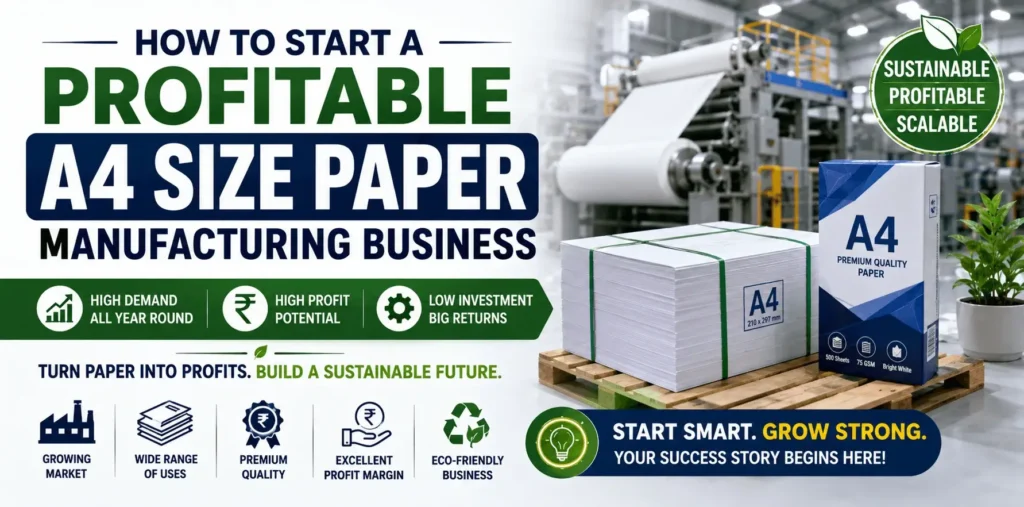
The A4 Size Paper Business is one of the most profitable and fast-moving opportunities in the paper and stationery industry due to continuous demand from schools, offices, government departments, photocopy centers, printing businesses, and corporate organizations. Despite increasing digitalization, the consumption of copier and photocopy paper continues to grow steadily across educational, commercial, and administrative sectors. With relatively low investment, simple machinery setup, and strong year-round market demand, many entrepreneurs are now exploring A4 size paper manufacturing business opportunities in India. Businesses involved in copier paper cutting, packaging, branding, and distribution can generate consistent recurring income through wholesale and institutional supply networks. What is an A4 Size Paper Business? An A4 size paper business involves cutting, packaging, branding, and distributing copier paper sheets commonly used for office printing, photocopying, educational work, and commercial documentation. This guide explains the complete A4 size paper business setup process including machinery, raw materials, manufacturing process, packaging methods, market opportunities, and profitability analysis. Why Starting an A4 Size Paper Manufacturing Unit is a Smart Investment The A4 size paper business has shown remarkable resilience over the years. Even as businesses shift toward digital, paper usage persists across multiple domains such as academic institutions, government sectors, corporate houses, and publishing industries. This specific paper size is considered the global standard for office documents, assignments, reports, photocopies, and formal communications. Why A4 Size Paper Business is Profitable Include: recurring office demand educational demand government supply demand low entry barrier scalable distribution B2B wholesale opportunities institutional contracts Understanding the A4 Size Paper Market Potential The A4 paper market is part of the global printing and writing paper industry, which has seen consistent demand due to its utility in formal documentation. In India alone, paper consumption is expected to reach over 30 million tonnes annually by 2030, and a substantial portion of this includes A4 sheets. This growth presents a golden opportunity for small and medium enterprises (SMEs) to establish localized units for manufacturing and supplying A4 size paper. The relatively low entry barrier in terms of capital investment and land requirement makes this a feasible venture for new entrepreneurs. Moreover, increasing awareness regarding eco-friendly practices has led to a rise in the demand for recycled A4 size paper, creating new niches within the sector. Machinery and Raw Materials Needed for A4 Paper Manufacturing Setting up an A4 size paper manufacturing unit requires some basic yet critical machinery and raw materials. The core components include: Slitting Machine: To cut large paper rolls into A4 dimensions. Ream Cutter Machine: For cutting and trimming the paper sheets accurately. Packaging Machine: To wrap and bundle paper sheets efficiently. Moisture Meter & Calibration Tools: To ensure quality and precision. The main raw materials required are: Jumbo paper rolls (Reel Form) Adhesive and ink (for branding and packaging) Packaging materials (boxes, shrink wraps) Sourcing raw materials from paper mills or wholesalers can reduce costs substantially, especially when purchased in bulk. Manufacturing Process of A4 Size Paper The production process involves several streamlined steps: Loading the jumbo rolls into the slitting machine. Cutting and trimming the paper to A4 dimensions. Counting and bundling the paper into standard reams (usually 500 sheets). Branding and packaging each ream with required labels. Packing the reams into cartons for distribution. Quality checks are performed during each stage to ensure consistency in thickness, brightness, and GSM (grams per square meter), which is a key indicator of paper quality. Legal Requirements and Licensing To establish a compliant unit, the following registrations and certifications are typically required: Udyog Aadhaar/MSME Registration GST Registration Factory License Pollution Control Board Clearance (if applicable) Trademark Registration (for branding) Adhering to these legal protocols ensures smooth operations and boosts the credibility of your business. Investment and Profit Margin in A4 Paper Business Starting a small-scale A4 paper cutting and packaging unit may require an initial investment of INR 10–25 lakhs, depending on the scale and automation of operations. A medium-sized unit can produce approximately 2,00,000 to 3,00,000 sheets per month. Profit margins range between 10% to 25%, depending on sourcing efficiency, operational costs, and distribution reach. With consistent orders and local dealership tie-ups, entrepreneurs can expect a return on investment (ROI) within 12–18 months. Target Customers and Market Strategies Target markets for A4 size paper include: Educational institutions Government offices Corporate houses Stationery wholesalers and retailers Photocopy and printing shops Effective strategies to penetrate the market: Offering bulk discounts to wholesalers and dealers. Establishing partnerships with schools and colleges. Participating in trade fairs to build visibility. Online B2B selling via platforms like IndiaMART, TradeIndia, and Amazon Business. Brand differentiation through eco-friendly or premium-quality paper offerings. Branding and Packaging Tips The look and feel of your paper packaging significantly affect the buying decision, especially in a saturated market. A well-branded ream of A4 size paper instills trust and signals quality. Key tips: Use eco-friendly packaging to attract sustainability-conscious customers. Include certifications or quality standards (like ISO, FSC) on the packaging. Highlight key features such as GSM rating, brightness, and suitability for inkjet/laser printing. Offer customized packaging for bulk corporate clients. Automation and Scaling Up Once the business reaches stability, investing in automated machines for stacking, cutting, and wrapping can enhance productivity. Automation reduces manpower dependency, improves accuracy, and enables higher output with lower operational costs. Scaling up can include: Expanding into A3 and legal size papers Manufacturing colored or recycled A4 sheets Launching a private-label brand and selling through e-commerce Exporting to nearby countries with paper demand Challenges and How to Overcome Them While the A4 size paper business offers lucrative returns, it is not without its set of challenges: Raw material price fluctuation High competition from established brands Logistics and distribution issues Solutions include: Entering into long-term supplier contracts to stabilize costs. Building a niche (such as recycled, sustainable paper). Developing a local distribution network to reduce transport costs. Sustainability and Future Trends The growing awareness of environmental impact is pushing manufacturers toward sustainable paper production. This includes: Using recycled pulp instead of virgin wood fiber.