
Profitable Manufacturing Business Ideas
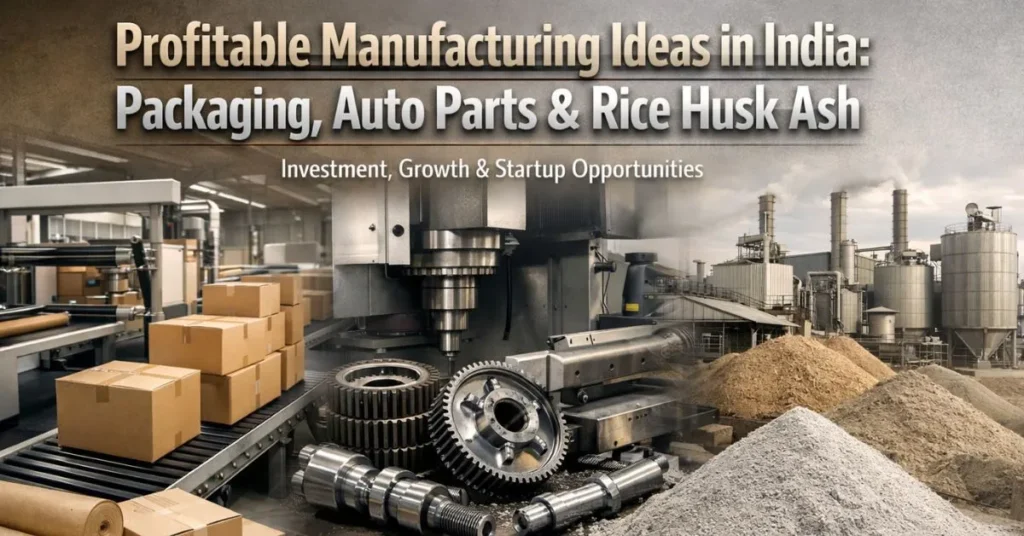
The manufacturing scene in India is undergoing a rapid set of changes, and the lucrative opportunities are becoming available for entrepreneurs, MSMEs and first-generation industrialists. The metal packaging industry for plant-based beverages and three-wheeler auto body parts and rice husk ash production have developed into profitable business sectors which exist outside traditional industrial operations. The industries provide products which maintain constant demand patterns together with investment requirements which business owners can manage and the potential for expansion which exists in both domestic markets and international markets.
For anyone looking into manufacturing businesses in India these three opportunities provide solid paths for success.
Contents
Get Detailed Project Report (DPR): White Cement Paper Bag Manufacturing Plant
Tin Cans Almond Drink Packaging
The plant-based beverage market in India has been growing at a steady pace. Increasing consumer interest in vegan diets and lactose-free alternatives as well as health-conscious options have fueled the demand for almond drink. To maintain the quality of the product and its shelf life, tin cans are the ideal packaging solution.
Tin cans protect contents from light and oxygen while extending product shelf life and enabling recyclability. While they are used to serve mainly almond drinks, they are also extensively used for cold coffee, protein shakes, energy drinks, and functional beverages. Beverage companies use tin-plated steel cans or aluminum cans for their consistency in quality and branding.
Why invest in the tin can industry?
- High demand by plant-based beverage brands
- Long term supply contracts and recurring orders
- Potential for Export to International Beverage Markets
The manufacturing process involves multiple stages which begin with sheet preparation and proceed to cup formation and continue through shaping and coating and printing and sealing. Modern Plants incorporate automated two-piece or three piece can production technologies. Key materials are tin-coated steel or aluminum sheets, food-grade lacquers, inks, adhesives and sealing compounds. Strict adherence to food safety standards is a must.
The Indian plant-based beverage market is expected to grow at more than 12% every year, so tin can manufacturing is one venture that is a good investment opportunity for any entrepreneur looking to scale up.
Auto Body Parts: Three-Wheeler
Three-wheelers are an integral part of India’s transport system. They are necessary for urban transportation, goods haulage and last mile delivery and for the widening e-commerce industry. With the emergence of electric three-wheelers, the need for a reworked body is on the rise.
Manufacturing auto body parts includes sheet metal cutting, pressing, welding, and surface finishing. MSMEs are often tier-2 or tier-3 suppliers of the larger vehicle manufacturers, and produce items such as driver cabins, roof panels, passenger compartments, doors, metal frames, and chassis covers.
Reasons that are responsible for this sector being attractive:
- Large domestic market- hundreds of thousands of vehicles sold annually
- Recurring demand of aftermarket replacement parts
- Opportunities to provide OEMs and e-mobility startups
Success requires good vendor networks, uniform product quality and supply chain reliability. Moderate investment and being part of India’s vast automotive ecosystem make this a sustainable manufacturing venture.
Get Detailed Insights from This Book: Manufacture of Value Added Products from Rice Husk (Hull) and Rice Husk Ash (RHA) (3rd Edition)

Rice Husk Ash Production
India is one of the biggest producers of rice worldwide producing millions of tons of rice husks every year. These husks, which are often considered agricultural waste, can be transformed into rice husk ash (RHA), and are very rich in amorphous silica. RHA has several industrial uses such as in cement and concrete production, refractory materials, rubber and plastics, and soil stabilization.
The production process is relatively simple but must be precisely controlled because rice husks are collected, dried and burned in specially designed furnaces to create ash with a high silica content. The ash is then ground, classified and packaged. Low raw material cost makes this venture very profitable.
Main benefits of RHA manufacturing:
- Low investment with high-profit margins
- Steady domestic industrial demand
- Export opportunities to cement industry, silica industry, and refractory industry
Government initiatives supporting waste-to-wealth and circular economy programs provide further support to its market potential. This makes RHA production a very attractive choice for small and medium enterprises.
Comparing Opportunities
While all three sectors are promising they differ in terms of investment, stability of demand and potential for export:
Sector | Investment | Demand Stability | Export Potential |
Tin Beverage Cans | High | Very High | High |
Three-Wheeler Body Parts | Medium | High | Medium |
Rice Husk Ash | Low-Medium | High | High |
A number of factors should be considered by entrepreneurs in selecting a venture, including the availability of raw materials, production technology, market demand, and long-term scalability. Detailed feasibility studies can help to mitigate risk and guarantee profitability
Conclusion
The industrial growth in India creates new business prospects which manufacturers can exploit. The health-conscious drinking market is growing because it increases demand for plant-based beverages packaged in tin cans. The three-wheeler auto body industry in India derives advantages from the country’s extensive transportation system. Rice husk ash production transforms agricultural waste into a valuable resource which industrial facilities can use.
The three sectors require efficient production systems together with reliable supply chains and strong buyer partnerships to achieve their objectives. The Indian manufacturing sector will develop sustainable businesses through proper planning and market research and a strong focus on quality.
Frequently Asked Questions (FAQ)
Which venture is most profitable for small scale startups?
Rice husk ash production often provides the quickest return on investment because of the low cost of raw material and the steady industrial demand.
Is auto component manufacturing conducive to MSMEs?
Yes. Many large automotive companies depend upon MSME for sheet metal components.
What are the Beverage Can Making Certifications?
Manufacturers have to meet strict food safety and packaging standards.
Can rice husk ash be exported?
High-quality RHA is in demand abroad especially in the cement industry and the silica industry according to Yes.
What are the major challenges in these industries?
Manufacturers face three major challenges which include maintaining product quality and sourcing dependable raw materials and developing strong relationships with industrial partners.