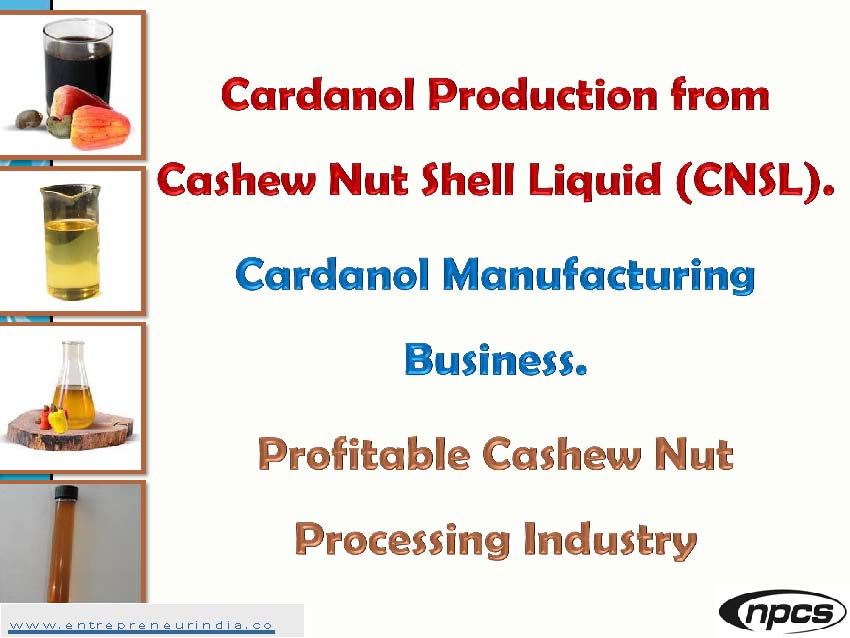
The rising interest in sustainable and bio-based industrial materials has given a fresh push to Cardanol Production from Cashew Nut Shell Liquid. Cardanol is a phenolic lipid derived from the shell of cashew nuts—an agricultural by-product often discarded. It has found significant demand in the production of surface coatings, adhesives, polymers, frictional materials, and specialty chemicals due to its excellent thermal stability, hydrophobicity, and chemical reactivity. As industries lean toward green alternatives, Cardanol Production from Cashew Nut Shell Liquid is emerging as a lucrative, eco-friendly opportunity for manufacturers and investors alike.
Growing Demand for Bio-Based Raw Materials
With increasing environmental concerns and regulations restricting the use of petrochemical-based resins, the demand for green raw materials is surging. Cardanol Production from Cashew Nut Shell Liquid offers a renewable alternative to fossil fuel-based phenols. Unlike synthetic sources, cardanol is biodegradable and derived from waste, making it highly sustainable.
Industries such as automotive, construction, electronics, and paints are now integrating cardanol-based products into their formulations. Additionally, its non-toxic and low VOC profile adds value in eco-certified applications. The Asia-Pacific region, especially India and Vietnam, is leading in cardanol production, backed by a strong supply chain of cashew processing units.
Understanding Cashew Nut Shell Liquid (CNSL)
Cashew Nut Shell Liquid (CNSL) is a reddish-brown viscous liquid obtained during the mechanical or thermal processing of cashew nuts. It contains several active compounds, including:
Anacardic Acid (70–80%)
Cardol (10–15%)
Cardanol (10–20%)
To extract cardanol, CNSL undergoes a process of decarboxylation and distillation. The result is a pale yellow, highly versatile phenolic compound. The entire value chain of Cardanol Production from Cashew Nut Shell Liquid is built on refining and isolating this compound for industrial use.
Process of Cardanol Production
Collect Raw CNSL
Manufacturers source CNSL from cashew processing plants, using methods such as hot-oil baths, roasting, or solvent extraction to recover the liquid from the shells.
2. Filter and Pre-Treat
Operators filter the raw CNSL to remove impurities like dust, fibers, and residual shell matter, ensuring a clean feedstock for thermal treatment.
3. Perform Decarboxylation
Technicians heat the filtered CNSL to temperatures between 180°C and 210°C. This thermal treatment causes anacardic acid to undergo decarboxylation, converting it into cardanol.
4. Distill Under Vacuum
The team distills the decarboxylated oil under reduced pressure to isolate pure cardanol. This vacuum distillation step removes residual cardol and unwanted by-products, improving product purity.
5. Cool and Store Safely
Once distilled, operators cool the cardanol and transfer it into airtight, inert containers to prevent oxidation. They then dispatch the product to end users or use it as a base for further chemical derivatives.
Modern cardanol production units utilize continuous decarboxylation reactors and multi-stage vacuum distillation systems to maximize efficiency, improve yield, and enhance product consistency.
Applications of Cardanol in Industry
Cardanol Production from Cashew Nut Shell Liquid supports a wide range of downstream applications:
Surface Coatings: Alkyd and epoxy resins made from cardanol are used in paints, primers, and varnishes due to their flexibility, water resistance, and corrosion protection.
Adhesives and Sealants: Cardanol-based epoxy systems are strong yet less brittle, ideal for wood, rubber, and industrial seals.
Polymer Industry: Used in the synthesis of polyurethanes, polyesters, and thermoplastics.
Brake Linings and Friction Materials: Due to its excellent thermal resistance and elasticity, cardanol improves wear properties.
Plasticizers and Additives: Acts as a stabilizer and flexibilizer in PVC and other plastic products.
Bio-lubricants and Surfactants: Eco-friendly formulations are being tested for automotive and marine use.
These applications make Cardanol Production from Cashew Nut Shell Liquid highly valuable for green technology innovation.
Machinery Required for Production
To set up a Cardanol Production from Cashew Nut Shell Liquid plant, the following machinery and equipment are essential:
CNSL Storage Tanks
Heating Reactors with Agitators
Decarboxylation Furnaces or Autoclaves
Vacuum Distillation Units
Cooling Condensers
Filtration and Separation Systems
Packing and Filling Machines
Pollution Control and Fume Extractors
Depending on the scale, a semi-automatic plant can produce 5–20 tons/month. Full automation with PLC control enhances process accuracy and yield consistency.
Investment and Setup Considerations
To establish a Cardanol Production from Cashew Nut Shell Liquid unit, here’s what’s needed:
Land Requirement: Minimum 5,000 sq. ft. for a small setup
Investment: ?30–50 lakh for a basic semi-automatic unit; ?1 crore+ for high-capacity automated units
Raw Material Supply: Continuous availability of CNSL from cashew processing clusters
Power and Water: Sufficient for heating, processing, and cleaning
Labor: Chemical engineers, machine operators, quality testers
Proximity to cashew-growing states like Kerala, Maharashtra, Odisha, and Tamil Nadu in India gives a logistical advantage.
Quality Standards and Certifications
For consistent and export-ready production, adherence to quality norms is essential. Recommended certifications include:
ISO 9001:2015 – Quality Management System
REACH Compliance – For exporting to Europe
RoHS Compliance – Restriction of hazardous substances
MSDS Documentation – Material Safety Data Sheets for chemical handling
APEDA or FSSAI – If targeting food-grade derivatives
Quality control is performed using GC-MS, viscosity meters, flashpoint testers, and spectrophotometers to ensure purity and performance.
Profitability and Market Scope
The global market for cardanol-based chemicals is growing at 6–8% CAGR, driven by demand in automotive, marine, electronics, and coatings industries. Profit margins in Cardanol Production from Cashew Nut Shell Liquid are attractive due to:
Low raw material cost (waste-derived CNSL)
High product value (cardanol fetches ?100–150/kg in bulk)
Strong export demand (Europe, Japan, U.S.)
Government support for bio-economy projects
A small-scale unit can earn net profits of ?3–5 lakh per month once stabilized. Large units have greater economies of scale and brand leverage.
Sustainability and Environmental Benefits
Cardanol Production from Cashew Nut Shell Liquid is a model for circular economy practices. It repurposes agro-waste, lowers dependency on petrochemicals, and offers biodegradable, non-toxic alternatives. Some of the environmental benefits include:
Low carbon footprint
No hazardous waste generation
Energy recovery from cashew shell combustion
Zero discharge possibilities with water reuse systems
It aligns with global sustainability goals and carbon neutrality initiatives, making it ideal for green investors and ESG-focused businesses.
Conclusion
Cardanol Production from Cashew Nut Shell Liquid is more than just a chemical manufacturing process—it is a high-value, sustainable business model built on renewable inputs and industrial innovation. With versatile applications, scalable technology, and growing demand for eco-friendly raw materials, this industry offers immense potential for startups, SMEs, and established chemical manufacturers. Whether targeting local markets or exports, investing in cardanol production is a smart, future-ready move.
Frequently Asked Questions (FAQs)
FAQ 1: What is cardanol and how is it produced from cashew nut shell liquid?
Cardanol is a phenolic lipid derived from cashew nut shell liquid (CNSL), a by-product of the cashew processing industry. It is produced by extracting CNSL from the shells of cashew nuts through various methods (roasting, solvent extraction, cold pressing) and then subjecting it to decarboxylation and vacuum distillation .
Production Process:
CNSL Extraction – CNSL is obtained from cashew nut shells using methods like roasting, solvent extraction, or mechanical pressing .
Filtration – Raw CNSL is filtered to remove impurities.
Decarboxylation – CNSL is heated (180°C–210°C) to convert anacardic acid into cardanol .
Vacuum Distillation – The decarboxylated oil is distilled to isolate pure cardanol.
Storage – Cardanol is cooled and stored in airtight containers.
India is one of the largest producers of CNSL, making it an ideal location for cardanol production .
FAQ 2: What are the main components of cashew nut shell liquid (CNSL)?
CNSL is a dark reddish-brown viscous liquid found inside the honeycomb structure of cashew nut shells . It contains several active phenolic compounds:
| Component | Percentage |
|---|---|
| Anacardic Acid | 70–80% |
| Cardol | 10–15% |
| Cardanol | 10–20% |
After decarboxylation, anacardic acid is converted into additional cardanol, increasing the cardanol content in the final product . The unique phenolic composition of CNSL makes it a valuable renewable resource for industrial applications.
FAQ 3: What are the main applications of cardanol?
Cardanol has a wide range of industrial applications due to its excellent thermal stability, hydrophobicity, and chemical reactivity :
| Application | Description |
|---|---|
| Surface Coatings & Paints | Alkyd and epoxy resins for corrosion protection |
| Adhesives & Sealants | Cardanol-based epoxy systems |
| Friction Materials | Brake linings, clutch facings |
| Polymer Industry | Polyurethanes, polyesters, thermoplastics |
| Laminates | Industrial laminates |
| Pharmaceuticals | Intermediate for specialty chemicals |
| Industrial Cleaning | Surfactants and cleaning agents |
| Home & Personal Care | Eco-friendly formulations |
Cardanol is a renewable, bio-based alternative to petrochemical-derived phenols .
FAQ 4: What are the different types of cardanol available in the market?
Cardanol is available in different grades based on distillation and refinement:
| Type | Description |
|---|---|
| Single Distilled | Basic grade obtained after one distillation |
| Double Distilled | Higher purity grade with superior quality |
Distillation removes residual cardol and unwanted by-products, improving product purity. The double-distilled grade commands higher prices and is preferred for high-end applications .
FAQ 5: What is the market size and growth potential for cardanol?
The global cardanol market is growing steadily. Key market insights include:
| Metric | Value |
|---|---|
| Market Size (2024) | USD 33.2 million |
| Projected Market (2031) | USD 64.4 million |
| CAGR | 10.1% during 2024-2031 |
Key Market Insights:
India is the largest market, accounting for approximately 36% share
Vietnam and China follow with 31% and 17% shares respectively
Global top 3 companies hold over 63% market share
Major players include Cat Loi, LC BUFFALO, Son Chau, Cardolite, and C.Ramakrishna Padayatchi
The market is driven by increasing demand for bio-based, sustainable alternatives to petrochemical-derived products .
FAQ 6: What are the environmental benefits of cardanol production?
Cardanol production from CNSL is considered a sustainable, green chemistry process:
| Benefit | Description |
|---|---|
| Waste Valorization | Repurposes cashew shell waste |
| Reduced Carbon Footprint | Renewable, bio-based source |
| Biodegradable | Non-toxic, environmentally friendly |
| Low VOC | Suitable for eco-certified applications |
| Circular Economy | Supports zero-waste manufacturing |
CNSL-based products can replace or partially replace phenol derived from petrochemicals, contributing to reduced dependency on fossil fuels . Companies like CardoChem Technologies are actively promoting “Green Technology” derived from this versatile, renewable resource .
FAQ 7: What machinery is required for cardanol production?
To set up a cardanol production unit, the following equipment is required:
| Machinery | Purpose |
|---|---|
| CNSL Storage Tanks | Store raw cashew nut shell liquid |
| Heating Reactors with Agitators | For decarboxylation process |
| Decarboxylation Furnaces/Autoclaves | Thermal treatment of CNSL |
| Vacuum Distillation Units | Isolate pure cardanol |
| Cooling Condensers | Cool distilled cardanol |
| Filtration & Separation Systems | Remove impurities |
| Packing & Filling Machines | Package final product |
| Pollution Control Systems | Fume extraction and emission control |
Depending on the scale, a semi-automatic plant can produce 5–20 tons/month. Full automation with PLC control enhances process accuracy and yield consistency.
FAQ 8: What is the investment required to start a cardanol production plant?
The investment for a cardanol production unit depends on the scale:
| Scale | Estimated Investment |
|---|---|
| Basic Semi-Automatic Unit | ₹30 – 50 lakhs |
| High-Capacity Automated Unit | ₹1 crore and above |
Cost Components Include:
Land (minimum 5,000 sq. ft.)
Machinery and equipment
Raw material procurement (CNSL)
Licensing and compliance
Working capital
Proximity to cashew-growing states like Kerala, Maharashtra, Odisha, and Tamil Nadu gives a logistical advantage.
FAQ 9: What are the emerging technologies for CNSL extraction?
Green extraction technologies are being developed to improve CNSL extraction efficiency:
| Technology | Advantage |
|---|---|
| Supercritical CO₂ Extraction | Pure product, no solvent residues, near-complete oil recovery |
| Ultrasound-Assisted Extraction | High yield in fraction of time, reduced energy usage |
| Microwave-Assisted Extraction | 33-35% yield, rapid and environmentally benign |
| Subcritical Water Extraction | Solvent-free, up to ~50% yield |
| Pressurized Liquid Extraction | Quantitative recovery (~50% yield) in minutes |
| Enzyme-Assisted Extraction | Nearly doubles yield, mild conditions |
Green methods avoid extreme thermal stress and toxic solvents, producing higher-quality CNSL while reducing environmental burden .
FAQ 10: What certifications are required for cardanol production?
For consistent and export-ready production, the following certifications are recommended:
| Certification | Purpose |
|---|---|
| ISO 9001:2015 | Quality Management System |
| REACH Compliance | For exporting to Europe |
| RoHS Compliance | Restriction of hazardous substances |
| MSDS Documentation | Material Safety Data Sheets |
| APEDA Registration | For export of agricultural products |
Quality control is performed using GC-MS, viscosity meters, flashpoint testers, and spectrophotometers to ensure purity and performance.
Ready to Start Your Cardanol Production Business?
The cardanol market is growing rapidly, driven by increasing demand for bio-based and sustainable alternatives to petrochemical products. With ₹30-50 lakh investment and 6-8% CAGR market growth, cardanol is the future of green chemistry. With growing demand in coatings, adhesives, and polymers, there has never been a better time to invest.
At NPCS, we help entrepreneurs navigate the complexities of manufacturing setup: from project feasibility and technology selection to regulatory compliance and market entry. We specialize in providing end-to-end project consultancy services:
✅ Detailed Project Reports – Comprehensive feasibility studies, market analysis, and financial projections
✅ Technology & Machinery Selection – Guidance on CNSL extraction, decarboxylation, and distillation equipment
✅ Plant Setup Support – End-to-end assistance from land acquisition to commissioning
✅ Regulatory Compliance – Expert advice on certifications and approvals
✅ Market Intelligence – Insights into demand trends, pricing, and export opportunities
Take the first step toward building a profitable and sustainable cardanol production business today!
📞 Call us now for a personalized consultation
📧 Email us to request a detailed project report
🌐 Visit our website to explore more business opportunities
Start Your Cardanol Production Business Today!