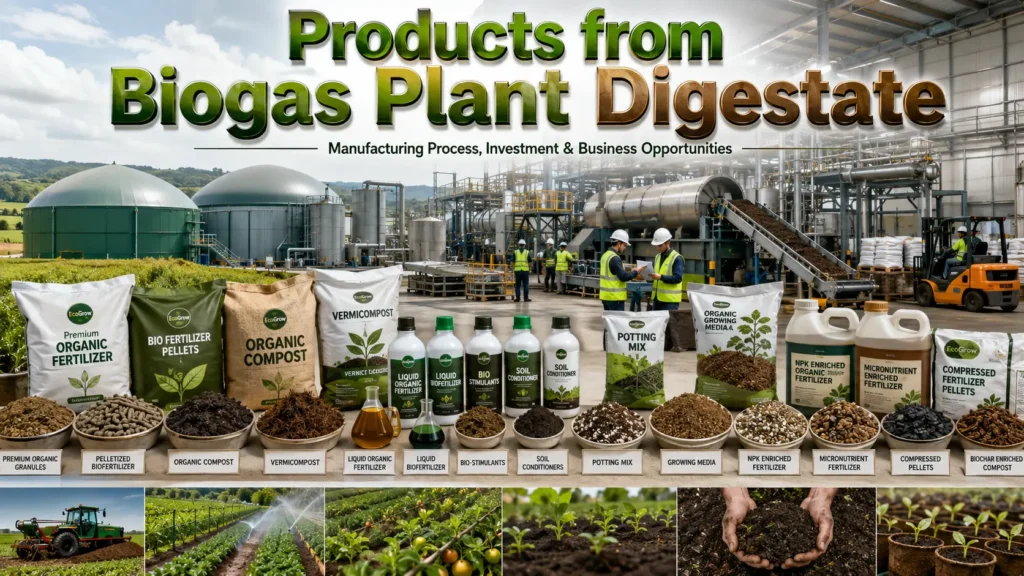

Biogas Digestate Products
India has one of the world’s highest installed bases of domestic biogas plants (about 5 million) and commercial biogas plants (hundreds) at dairies, food processors, distilleries and municipal waste sites. The Satat Scheme has also introduced a compressed biogas plant (CBG) and MNRE is supporting fresh biogas capacity. However, in this extensive installed base, the digestate (liquid and solid residue after the energy has been extracted from the waste material as biogas) is not adequately managed and monetized. Most biogas plants just release liquid digestate into the adjacent agricultural land or water bodies and solid digestate piles up in pits, without making any effort to utilise them commercially.
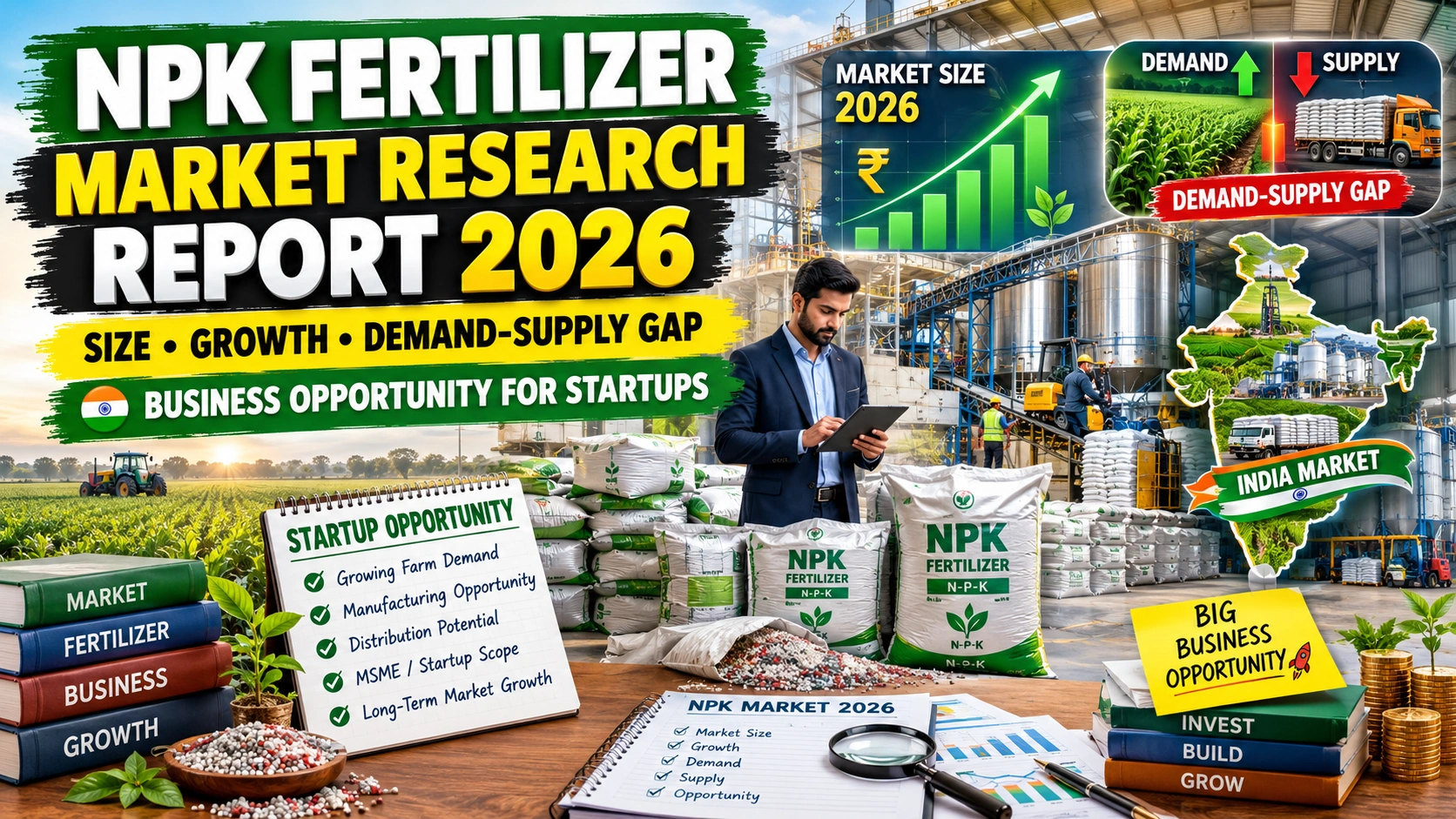
The digestate is not waste, but the best liquid organic fertilizer for Indian farmers. While composting and raw manure must undergo weeks of soil mineralisation before the available N can be absorbed by plants, anaerobic digestion breaks down complex organic nitrogen (protein and amino acids) quickly into ammoniacal nitrogen (NH₄-N) and is readily available for plant uptake without requiring weeks to mineralise the soil. Liquid digestates produced by well-managed biogas plants is a complete NPK fertiliser, consisting of 1.5–4% N, 0.8–2% P₂O₅ and 2–4% K₂O on dry matter basis.
It has been consistently proven that application of digestate increased crop yields by 15–30% compared to the same mineral fertiliser application, which is probably due to growth hormones and beneficial microorganisms present in digestate.
Explore This Book: Handbook on Biogas and Its Applications
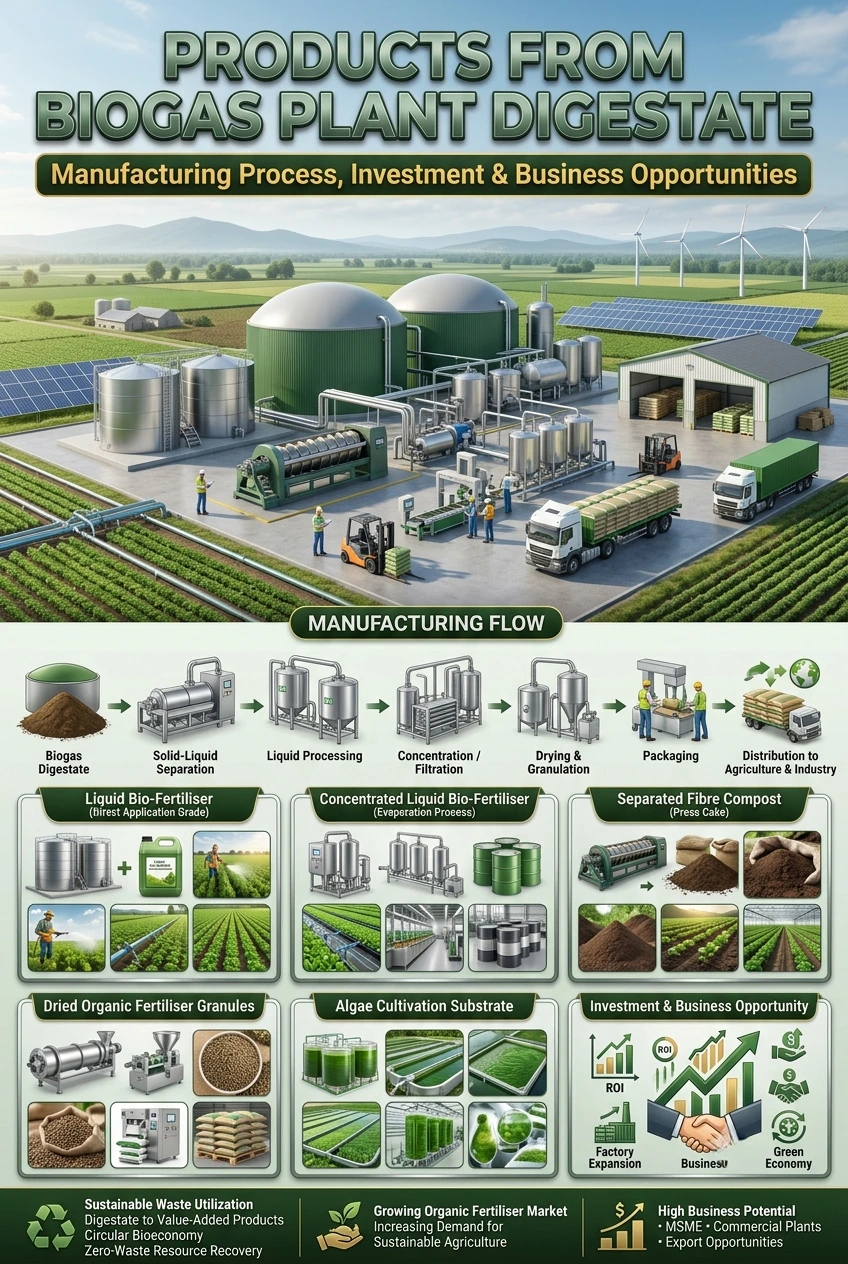
Top 6 Products from Biogas Digestate
1. Liquid Bio-Fertiliser (Direct Application Grade)
This is because the digestate of food, agricultural and dairy waste biogas plants can be filtered at the plant (to remove fibre >1 mm) and quality tested before being sprayed directly onto crops in both drip irrigation or sprinkler irrigation systems. Bulk liquid bio-fertiliser (Rs. per unit) 200–300 litre tankers at Rs. 2,000–5,000 per tonne (Rs. The biogas plant is serving the organic and conventional farmers within 50 km radius.
2. Concentrated Liquid Bio-Fertiliser (Evaporation)
The multi-effect evaporators enable digestate to be concentrated to 3-4 times its original concentration (from 1.5 % dry solids to 5-6 % dry solids) and allows for a more economic transport over longer distances for the bio-fertiliser. The digestate is produced in concentrated form (20–25% DS) in Rs. The cost of 20 litre containers is Rs. In urban horticulture and hydroponic crop production, premium prices are obtained for 150 – 300 per litre. A digestate concentration evaporation system: 50–150 lakh.
Get Detailed Project Report (DPR): Biotechnology, Enzymes & Organic Farming Guide
3. Separated Fibre Compost (Press Cake)
Organic compost material (25–30% DS) is produced by screw press separation of digestate to solid press cake and into liquid fraction, which can be stacked and transported. Granular Organic Compost for bagged retail is prepared by pressing the fibre cake and after drying and bulking agents, the compost is obtained at the retail price of Rs. 5,000–10,000 per tonne. Screw press separator and compost yard: Rs. 30–80 lakh.
4. Nutrient-Rich Irrigation Water (Fertigation)
Using filtered digestate in on-farm irrigation systems (such as drip and furrow irrigation) to contracted farmers provides a complete service which can replace 30-50% of mineral fertiliser need. The operators of biogas plants establish long-term agreements with farmer clusters within 5 km of the plant, providing digestate via stationary pipelines or mobile digestate tank systems.
5. Dried Organic Fertiliser Granules
Press cake from digesters is further dried (rotary dryer) to less than 10% moisture, and subsequently granulated to yield organic fertiliser granules which are easily spread mechanically and sold in the retail market. For the same, the FCO certified dried digestate granules sell for Rs. Premium organic fertiliser markets: 6-12 tonnes per tonne. Investment in the dryer and granulation line is Rs.: 40–120 lakh.
6. Algae Cultivation Substrate
Microalgae (Spirulina/Chlorella) cultivation in raceway ponds or photobioreactor systems can be done with high nutrient liquid digestates diluted with water which serve as a perfect growth medium. Nitrogen and phosphorus (nutrient polishing) removed by algae at digestate water is converted to algal biomass with economic value of Rs. Nutraceutical, animal feed, and biofuel applications: 200-800 per kg. A digestate fed algae pond system: 30–100 lakh.
Investment and Market Summary
| Product | Investment (Rs.) | Price | Key Buyer |
| Liquid Bio-Fertiliser | 10–30 lakh | Rs. 2,000–5,000/MT | Organic/Conv. Farmers |
| Concentrated Bio-Fertiliser | 50–150 lakh | Rs. 150–300/litre | Urban Horticulture |
| Fibre Press Cake Compost | 30–80 lakh | Rs. 5,000–10,000/MT | Organic Farmers, Export |
| Organic Fertiliser Granules | 40–120 lakh | Rs. 6,000–12,000/MT | Premium Organic Market |
| Algae Biomass (on Digestate) | 30–100 lakh | Rs. 200–800/kg algae | Nutraceuticals, Feed |
Farmer Contracts: Building the Digestate Market
Utilisation of digestate is only feasible if reliable farmer buyer relationships are established within the economic transport distance from the biogas plant. A 50 km radius around a large biogas plant contains tens of thousands of farmer fields, which however, need systematic market development, demonstration plots in which digestate crop response is demonstrated and infrastructure for delivery. The most successful digestate utilisation model in India is the biogas plant operators forming partnerships with Farmer Producer Organisation (FPO) where FPO provides farmer market aggregation, the operator supplies digestate at a cost below mineral fertiliser equivalent, and both parties benefit from the partnership. This FPO – biogas partnership model is being actively promoted by NABARD and the State cooperative departments.
Related Article: Compressed Biogas Export India Opportunities That Can Earn ₹8 Cr/Year
Digital Platforms for Digestate Marketing
The agri-tech ecosystem in India is maturing to create online platforms that allow organic fertiliser producers (biogas plant digestate suppliers included) to connect with farmer buyers directly instead of through the traditional distributing chain to enhance farmer and producer margins. DeHaat, Ninjacart, AgriBazaar etc. are developing organic input procurement wings that will link the organic input producers to their farmer network. Aqgromalin (an aquaculture focused agri-platform) collects fish and shrimp farm inputs such as organic fertilisers.
They offer the following services for biogas plant digestate producers: nationwide farmer buyer access beyond the geographical reach, digital payment and invoicing system, and quality test by the platform. Agri-tech platforms as the main distribution channels for biogas plant operators can provide them with nationwide market access, without the need to invest in sales force between different districts.
Digestate Quality Management: Ensuring Consistent Fertiliser Performance
Digestate fertiliser quality varies significantly with feedstock composition, digester operating conditions (temperature, retention time, pH), and seasonal factors. Farmers who invest in digestate-based fertigation systems — and whose crop performance then varies because of inconsistent digestate quality — quickly lose confidence in the product. Preventing quality inconsistency is the most important operational discipline for digestate fertiliser businesses. Key quality management practices include: weekly nutrient analysis (N, P, K, pH) of digestate leaving the digester; maintaining stable digester feeding ratios and retention times to minimise composition variation; batch documentation (date, feedstock, analysis) for every tanker delivery; and informing farmers of the current batch nutrient content with agronomic guidance on application rate adjustment.
Biogas plants that implement this quality management system and provide farmers with regular nutrient analysis documentation consistently outperform those supplying bulk digestate without characterisation. The cost of weekly digestate analysis (Rs. 500–1,500 per test at NABL labs) is trivially small relative to the commercial value of consistent farmer satisfaction and repeat purchase.
How NPCS Helps Entrepreneurs Enter This Sector
At Niir Project Consultancy Services (NPCS), we provide professional consulting for Market Survey cum Detailed Techno-Economic Feasibility Reports (DPRs) for setting up biogas plant digestate and slurry product manufacturing manufacturing businesses. Our reports cover the complete manufacturing process, market demand analysis, process flow diagrams, plant layout, machinery and raw material sourcing, and full financial projections with profitability analysis.
For entrepreneurs looking to enter waste-based manufacturing, NPCS project reports give you the technical and financial foundation to approach banks, investors, and government agencies with confidence. Visit www.niir.org to explore our full library of waste-based project reports.
Discover business ideas that actually make money
Conclusion: The Business Case for Biogas Digestate Manufacturing
India’s large biogas installed base — domestic, commercial, and the rapidly growing Satat Scheme CBG plants — generates millions of tonnes of nutrient-rich digestate that is currently being largely wasted. Converting this digestate into certified liquid bio-fertiliser, compost, and organic granules creates additional revenue streams for biogas plant operators while simultaneously improving agricultural soil health. The combination of growing organic farming demand, FCO regulatory framework for digestate fertilisers, and NABARD support for FPO-biogas partnerships creates a well-supported commercial ecosystem for digestate valorisation businesses.
Entrepreneurs who move early into waste-based manufacturing secure raw material relationships, buyer networks, and regulatory approvals that latecomers find difficult to replicate. The best time to act on these business ideas is before the sector becomes crowded — and for most waste streams profiled here, that window is still open.
Frequently Asked Questions (FAQ)
Q1. Is digestate quality consistent year-round?
Digestate quality varies with feedstock and seasonal biogas plant loading. Summer (high temperature) digestates typically have higher ammonia loss and lower ammoniacal N content. Winter digestates may have higher undigested organic N. Quality testing quarterly and informing farmers of current batch analysis is good practice. Adding concentrated sulfuric acid to digestate storage (pH reduction to 5.5) minimises ammonia volatilisation and preserves nitrogen value.
Q2. What FCO certification is required for digestate as fertiliser?
The Fertiliser Control Order recognises bio-digested slurry (spent slurry from biogas plant) as an organic fertiliser. Quality requirements: minimum 10% organic carbon, minimum 0.5% N, minimum 0.5% P₂O₅ on dry weight basis. Moisture: below 30% for solid product, or liquid as diluted fertiliser. State Agriculture Department fertiliser inspector registration is required for commercial marketing.
Q3. Can digestate be exported as organic fertiliser?
Yes. Dried and pelletised digestate compost meeting NPOP (National Programme for Organic Production) standards or equivalent international organic standards can be exported as certified organic fertiliser. Key markets: Germany, Netherlands, UK (premium organic farming sectors). Export quantity logistics require containerisation and moisture management for 30+ day transit.
Q4. What is the economic value of digestate compared to mineral fertiliser?
Digestate equivalent value (NPK content x mineral fertiliser price) at 3% N, 1.5% P₂O₅, 2% K₂O in liquid digestate at 10% DS is approximately Rs. 150–250 per tonne of liquid digestate — comparable to the cost of equivalent mineral fertiliser inputs. For biogas plants generating 10,000 litres of digestate daily, this represents Rs. 1,500–2,500 daily in fertiliser equivalent value that is currently being discarded.
Q5. How does NPCS support entrepreneurs in digestate valorisation?
NPCS project reports for liquid bio-fertiliser marketing, digestate concentration plant design, and organic fertiliser granulation from digestate cover manufacturing processes, quality testing protocols, FCO registration pathways, market demand analysis, and financial projections for digestate valorisation businesses.
Key References and Useful Links
- Ministry of MSME — Government of India
- Make in India — Official Portal
- DPIIT — Dept. for Promotion of Industry
- APEDA — Agricultural and Processed Food
- NPCS — Waste-Based Project Reports
- Ministry of Environment, Forest & Climate