
Top 10 Industrialists of Bihar: Success Stories, Business Ideas, and Future Vision
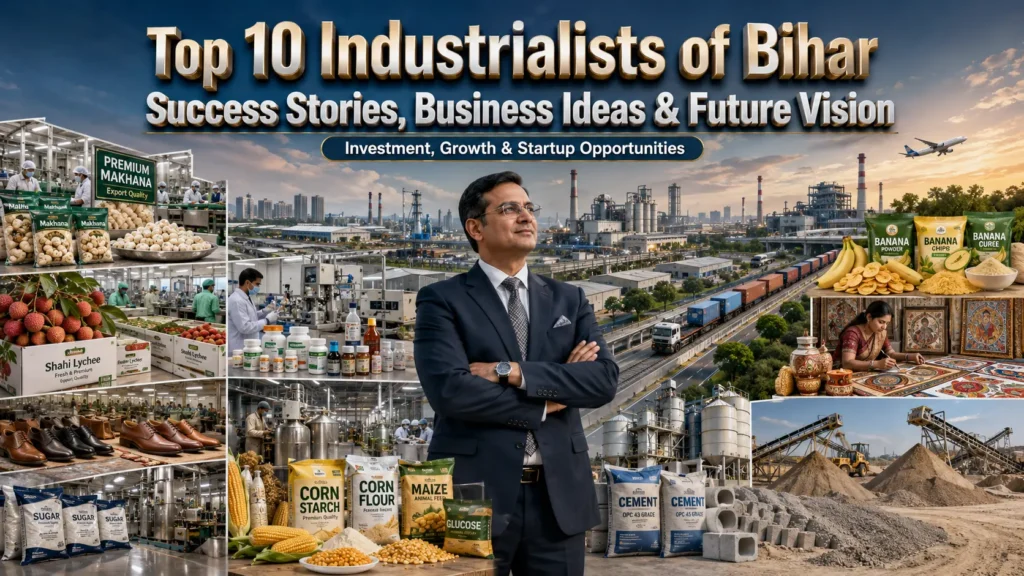
Industrialists of Bihar Awakening Bihar is going through its biggest economic metamorphosis in a century and a half, and a host of business concepts are taking shape. Bihar’s problems for decades have been: poverty, flood susceptibility, and not being industrialized. Presently, it is one of the fastest growing state economies and it is being promoted in a direction of food processing, agri-industrialisation, pharmaceuticals, light manufacturing, and construction of infrastructure. Bihar’s per capita income has seen a lot of improvement in the state due to sustained focus of the government and the commitment made by the Prime Minister for the development of the state’s infrastructure has been a huge boost to the increased interest in investment in the state. Bihar’s key strength lies in its scale – it is the third most populous state in India, and the population is young, both meaning a consumer market and a source of labour for manufacturing. The state is the top producer of vegetables in India, 2nd largest lychee producer in the country and a major contributor of maize, wheat and fish to national supply chains. These agricultural surpluses provide good feedstock for food processing industrial investments. This article talks about Bihar’s 10 industrialists, their contribution and future plans. IBEF Bihar Report offers an up-to-date sector analysis with respect to State data. Why Bihar Is an Emerging Industrial Opportunity There are a number of factors that are driving Bihar’s industrialization. Megaprojects are first of all, massive investments in infrastructure – a commitment by the Union government of over Rs. 58,900 crores of infrastructure investments for Bihar. The connectivity between inter-district and inter-state is drastically enhanced with the six national highway corridors, expressway projects like Patna-Purnia Expressway and Kosi River Bridge project. Second, the food processing opportunity: The vegetable, maize, makhana, lychee and fisheries surpluses in Bihar are almost entirely processed outside the state, providing an enormous opportunity for investment in the food processing sector within Bihar. Third, demographic dividend: Bihar’s youth population will have higher education levels, leading to skilled workforce which will be more preferred by labour-intensive manufacturing. The Ministry of MSME has a proactive approach to the development of the MSME sector and has been actively promoting the development of Bihar’s food processing, handloom, and light manufacturing sector. The Nalanda Agri-Business School has done research on the agricultural value chains in Bihar and found that the value of the chains is over Rs. The annual processing opportunity is 50,000 crore which is being exported to other states for value addition. The essence of Bihar’s future generation of industrial entrepreneurs is to capture a part of this opportunity. Access Complete Business Plan: Bihar Industry Startup & Entrepreneurship Guide Government Policies Supporting Bihar’s Industrial Growth Capital investment subsidy, concessional land and power tariff concession are provided in Bihar Industrial Investment Promotion Policy for new industrial investment. BIADA is the Industrial Estate Authority of Bihar that runs industrial estates in various districts. The Mega Food Park – under PM Sampada Yojana – for the food surplus districts of Bihar is a vital common infrastructure for food processing entrepreneurs. The export of makhana (fox nut), lychee and vegetables is promoted in Bihar by APEDA with the help of quality certification and market access programmes. Bihar has identified ‘food processing’, ‘Leather’, ‘Textile’ and ‘Manufacture of construction materials’ as priority sectors in ‘Make in India’. The central government has been investing in Bihar Special Package and the PMGSY (Pradhan Mantri Gram Sadak Yojana) for rural road connectivity which is helping to ease the last-mile logistics cost of agri-processing entrepreneurs in flood-prone districts. The state’s good land reform history offers a fairly good level of land security, which is one of the risks associated with industrial investment in Bihar. Top 10 Industrialists of Bihar: Profiles and Future Vision 1. Anil Agarwal (Bihar Origins) – Vedanta Resources Anil Agarwal, Founder of Vedanta Resources, was born at Patna, Bihar. From humble beginnings, trading in scrap metal in Mumbai, he was able to grow up into India’s largest diversified natural resource company with the help of a bank loan on the first cable company that he acquired. This is one of the great entrepreneurial origin stories in India, from Agarwal in Patna to London, via his days in the scrap yards in Mumbai. His industrial strategy, who would acquire resource assets and establish refining and processing facilities around them, established a zinc-copper-aluminium-iron ore-oil and gas conglomerate. Agarwal’s vision is to bring back substantial investments in the semiconductor and tech industry in India. 2. Food Processing Industry Leaders – Makhana and Lychee, Darbhanga Bihar is the leading state in the production of makhana (fox nut / water lily seed) which is in increasing demand in the country and abroad as a healthy snack food and accounts for 90% of the total production in the country. The benefit of these industrial entrepreneurs who have established organised businesses for the production of makhana, roasting and packing is that they are making a most unique product for export in Bihar. The government’s GI (Geographical Indication) tagging of Mithila Makhana and export promotion support from APEDA is opening up markets for health food retailers in the US, Europe and Middle East. The lychee processing from Muzaffarpur which has the largest lychee cultivation belt in India is also a potential opportunity in food processing. Get Detailed Insights from This Book: Handbook on Fruits, Vegetables & Food Processing with Canning & Preservation 3. Sitaram Jindal – Jindal Charitable Trust and Bihar Steel The Jindals’ industrial and philanthropic footprint in the Indian state of Bihar extends to steel manufacturing, construction materials, and substantial investments in the social sector through the Jindal Charitable Trust. Bihar is seeing capacity building by industrial leaders that have a link with steel and infrastructure sector, keeping in view the state focus on its huge capacity building plan. Bihar’s expressway, railway and bridge construction pipeline generates huge demand for rebar, structural steel, cement and construction equipment, where industrial entrepreneurs situated in the state enjoy
Products from Biogas Plant Digestate: Manufacturing Process, Investment & Business Opportunities
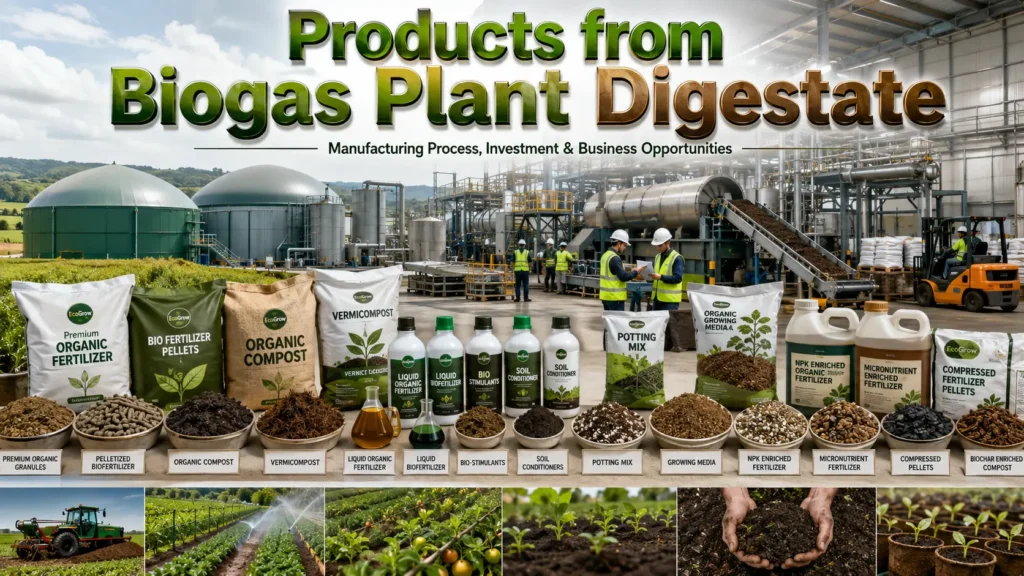
Biogas Digestate Products India has one of the world’s highest installed bases of domestic biogas plants (about 5 million) and commercial biogas plants (hundreds) at dairies, food processors, distilleries and municipal waste sites. The Satat Scheme has also introduced a compressed biogas plant (CBG) and MNRE is supporting fresh biogas capacity. However, in this extensive installed base, the digestate (liquid and solid residue after the energy has been extracted from the waste material as biogas) is not adequately managed and monetized. Most biogas plants just release liquid digestate into the adjacent agricultural land or water bodies and solid digestate piles up in pits, without making any effort to utilise them commercially. The digestate is not waste, but the best liquid organic fertilizer for Indian farmers. While composting and raw manure must undergo weeks of soil mineralisation before the available N can be absorbed by plants, anaerobic digestion breaks down complex organic nitrogen (protein and amino acids) quickly into ammoniacal nitrogen (NH₄-N) and is readily available for plant uptake without requiring weeks to mineralise the soil. Liquid digestates produced by well-managed biogas plants is a complete NPK fertiliser, consisting of 1.5–4% N, 0.8–2% P₂O₅ and 2–4% K₂O on dry matter basis. It has been consistently proven that application of digestate increased crop yields by 15–30% compared to the same mineral fertiliser application, which is probably due to growth hormones and beneficial microorganisms present in digestate. Explore This Book: Handbook on Biogas and Its Applications Top 6 Products from Biogas Digestate 1. Liquid Bio-Fertiliser (Direct Application Grade) This is because the digestate of food, agricultural and dairy waste biogas plants can be filtered at the plant (to remove fibre >1 mm) and quality tested before being sprayed directly onto crops in both drip irrigation or sprinkler irrigation systems. Bulk liquid bio-fertiliser (Rs. per unit) 200–300 litre tankers at Rs. 2,000–5,000 per tonne (Rs. The biogas plant is serving the organic and conventional farmers within 50 km radius. 2. Concentrated Liquid Bio-Fertiliser (Evaporation) The multi-effect evaporators enable digestate to be concentrated to 3-4 times its original concentration (from 1.5 % dry solids to 5-6 % dry solids) and allows for a more economic transport over longer distances for the bio-fertiliser. The digestate is produced in concentrated form (20–25% DS) in Rs. The cost of 20 litre containers is Rs. In urban horticulture and hydroponic crop production, premium prices are obtained for 150 – 300 per litre. A digestate concentration evaporation system: 50–150 lakh. Get Detailed Project Report (DPR): Biotechnology, Enzymes & Organic Farming Guide 3. Separated Fibre Compost (Press Cake) Organic compost material (25–30% DS) is produced by screw press separation of digestate to solid press cake and into liquid fraction, which can be stacked and transported. Granular Organic Compost for bagged retail is prepared by pressing the fibre cake and after drying and bulking agents, the compost is obtained at the retail price of Rs. 5,000–10,000 per tonne. Screw press separator and compost yard: Rs. 30–80 lakh. 4. Nutrient-Rich Irrigation Water (Fertigation) Using filtered digestate in on-farm irrigation systems (such as drip and furrow irrigation) to contracted farmers provides a complete service which can replace 30-50% of mineral fertiliser need. The operators of biogas plants establish long-term agreements with farmer clusters within 5 km of the plant, providing digestate via stationary pipelines or mobile digestate tank systems. 5. Dried Organic Fertiliser Granules Press cake from digesters is further dried (rotary dryer) to less than 10% moisture, and subsequently granulated to yield organic fertiliser granules which are easily spread mechanically and sold in the retail market. For the same, the FCO certified dried digestate granules sell for Rs. Premium organic fertiliser markets: 6-12 tonnes per tonne. Investment in the dryer and granulation line is Rs.: 40–120 lakh. 6. Algae Cultivation Substrate Microalgae (Spirulina/Chlorella) cultivation in raceway ponds or photobioreactor systems can be done with high nutrient liquid digestates diluted with water which serve as a perfect growth medium. Nitrogen and phosphorus (nutrient polishing) removed by algae at digestate water is converted to algal biomass with economic value of Rs. Nutraceutical, animal feed, and biofuel applications: 200-800 per kg. A digestate fed algae pond system: 30–100 lakh. Investment and Market Summary Product Investment (Rs.) Price Key Buyer Liquid Bio-Fertiliser 10–30 lakh Rs. 2,000–5,000/MT Organic/Conv. Farmers Concentrated Bio-Fertiliser 50–150 lakh Rs. 150–300/litre Urban Horticulture Fibre Press Cake Compost 30–80 lakh Rs. 5,000–10,000/MT Organic Farmers, Export Organic Fertiliser Granules 40–120 lakh Rs. 6,000–12,000/MT Premium Organic Market Algae Biomass (on Digestate) 30–100 lakh Rs. 200–800/kg algae Nutraceuticals, Feed Farmer Contracts: Building the Digestate Market Utilisation of digestate is only feasible if reliable farmer buyer relationships are established within the economic transport distance from the biogas plant. A 50 km radius around a large biogas plant contains tens of thousands of farmer fields, which however, need systematic market development, demonstration plots in which digestate crop response is demonstrated and infrastructure for delivery. The most successful digestate utilisation model in India is the biogas plant operators forming partnerships with Farmer Producer Organisation (FPO) where FPO provides farmer market aggregation, the operator supplies digestate at a cost below mineral fertiliser equivalent, and both parties benefit from the partnership. This FPO – biogas partnership model is being actively promoted by NABARD and the State cooperative departments. Related Article: Compressed Biogas Export India Opportunities That Can Earn ₹8 Cr/Year Digital Platforms for Digestate Marketing The agri-tech ecosystem in India is maturing to create online platforms that allow organic fertiliser producers (biogas plant digestate suppliers included) to connect with farmer buyers directly instead of through the traditional distributing chain to enhance farmer and producer margins. DeHaat, Ninjacart, AgriBazaar etc. are developing organic input procurement wings that will link the organic input producers to their farmer network. Aqgromalin (an aquaculture focused agri-platform) collects fish and shrimp farm inputs such as organic fertilisers. They offer the following services for biogas plant digestate producers: nationwide farmer buyer access beyond the geographical reach, digital payment and invoicing system, and quality test by the platform. Agri-tech platforms