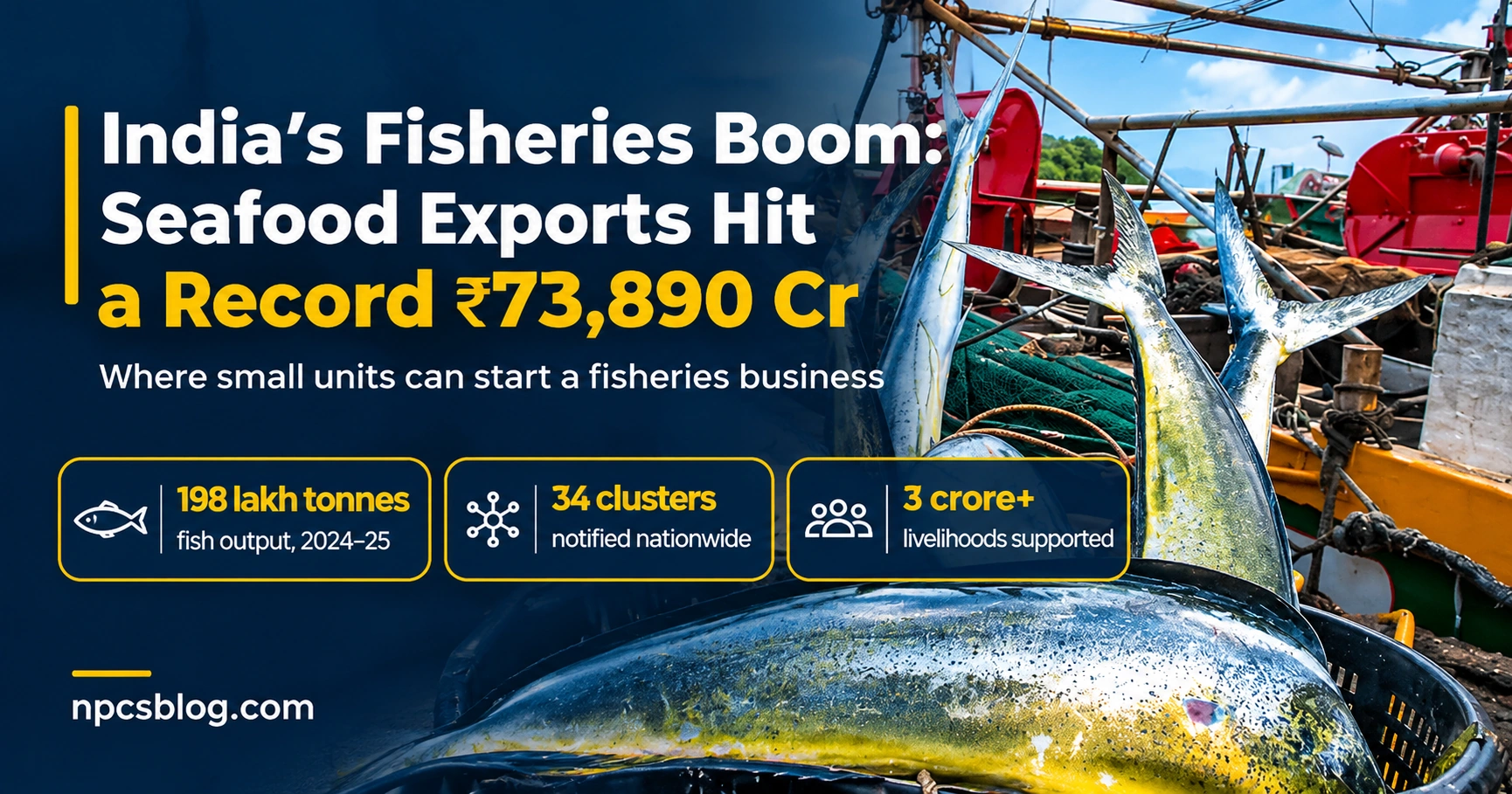
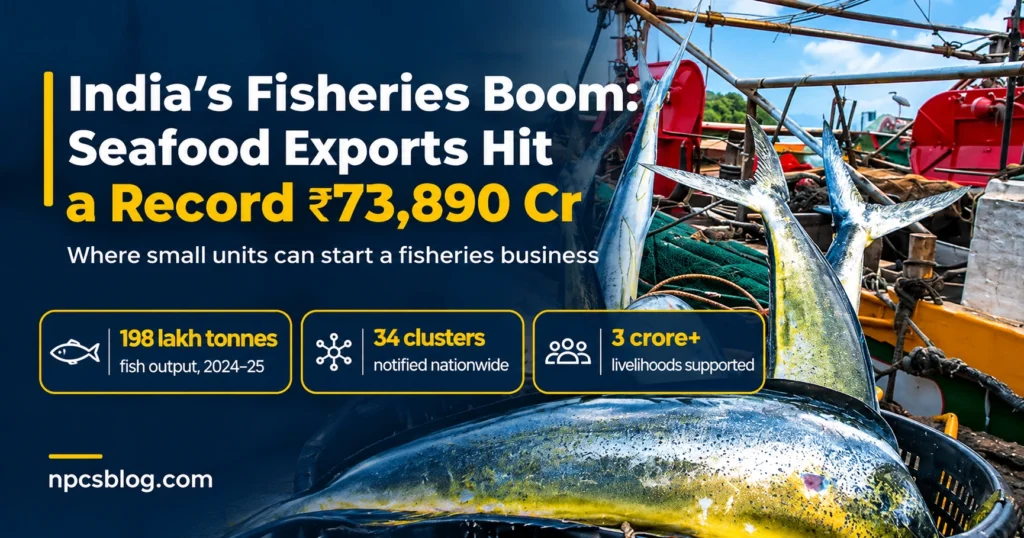

New Delhi, 27 November 2026: India now produces about 198 lakh tonnes of fish a year (2024-25) and sent out a record ₹73,890.46 crore (US$ 8.45 billion) of seafood in FY 2025-26, said Dr. Abhilaksh Likhi, Secretary, Department of Fisheries, while talking to students at the College of Fishery Science in Nagpur. He also said the government has notified 34 specialised fisheries and aquaculture clusters and wants young people, women’s groups and start-ups to take up the fisheries business through central schemes. The details come from a Press Information Bureau (PIB) release dated 27 November 2026.
For a small manufacturer or a first-time entrepreneur, the useful part is the list of gaps the Secretary named: processing units, cold chain, hatcheries, feed, seaweed, ornamental fish and pearl culture. Most of these are small-ticket projects, and many need no boat or sea access at all.
Contents
- 1. India’s fisheries sector in key numbers
- 2. What the Fisheries Secretary told students in Nagpur
- 3. The student interaction and the facility visit
- 4. The schemes behind the push
- 5. What the 34 clusters mean for small units
- 6. How big is Indian fisheries?
- 7. Fisheries business opportunities for small and mid-size units
- 8. Practical steps before you invest
- 9. How NPCS can help
- 10. Questions people ask
- 11. Sources
- 12. Related guides
- 13. More in Government Schemes & Projects
India’s fisheries sector in key numbers
These are the figures given in the PIB release.
| Total fish production (2024-25) | 198 lakh tonnes |
| Inland fisheries and aquaculture (2024-25) | 153 lakh tonnes |
| Share of world fish production | 8% (second-largest aquaculture producer) |
| Seafood exports (FY 2025-26) | ₹73,890.46 crore (US$ 8.45 billion), an all-time high |
| Export volume (FY 2025-26) | 19.32 lakh metric tonnes |
| People supported | Over 3 crore fishers and fish farmers |
| Specialised clusters notified | 34 |
| Fisheries Technology Complex, Nagpur | ₹19.69 crore under FIDF |
Two small differences are worth knowing. The release rounds production to 198 lakh tonnes, while the figure given to Parliament is 197.75 lakh tonnes (provisional). For inland fisheries the release says 153 lakh tonnes, but the Handbook of Fisheries Statistics shows about 151.60 lakh tonnes. We use the release figures and flag the gap, so check the latest data before quoting it in a bank report. By our own calculation, exports in FY 2025-26 are about 18% higher than the ₹62,408 crore recorded in 2024-25.
What the Fisheries Secretary told students in Nagpur
Dr. Likhi gave a presentation titled “India’s Initiatives in the Fisheries and Aquaculture Sector” and spoke about growth, aquaculture, entrepreneurship and the Blue Economy. The main points of the release:
- India is the world’s second-largest aquaculture producer and accounts for 8% of global fish production.
- The government has notified 34 specialised clusters covering tuna, shrimp, pearl spot, murrel, pangasius, tilapia, trout, seaweed, ornamental fish, reservoir, coldwater, cage culture, organic and riverine fisheries.
- Each cluster is meant to be an integrated hub covering pre-production, production and post-harvest work, with technology, market links and value addition. NABARD and private entrepreneurs are expected to bring finance and participation.
- Technology supported under PMMSY includes recirculatory aquaculture systems (RAS), biofloc, reservoir and sea cage culture, raceways, pen culture, and better hatchery and seed production.
- Digital tools such as AI, IoT, machine learning and drones are being used for water quality, fish health, feeding, disease surveillance and day-to-day efficiency.
- Fisheries start-ups, young entrepreneurs, Fisheries Farmer Producer Organisations (FFPOs), cooperatives and self-help groups can use PMMSY and PM-MKSSY. FFPOs and cooperatives are to get institutional credit, financial assistance, capacity building and digital markets such as ONDC.
- The National Fisheries Digital Platform (NFDP) is formalising the sector and helping fishers reach credit, insurance and scheme benefits.
- The sector needs smart and integrated fishing harbours, modern landing centres, wholesale and retail markets, cold-chain facilities, transport and logistics, processing units and value-added products.
- Seaweed cultivation, ornamental fisheries, pearl culture and other mariculture were named as segments with livelihood potential for youth and women.
- Post-harvest management, processing and value addition are key to fishers’ income and to India’s place in the global seafood market.
- He encouraged students to look beyond conventional jobs.
The student interaction and the facility visit
- Students from fisheries colleges and universities across the country joined by video conference, along with Krishi Vigyan Kendras (KVKs), ICAR institutes and state and UT fisheries departments.
- Students of the Nagpur college asked for a platform to share internship and job information, and showed interest in government schemes for self-employment and entrepreneurship.
- The Secretary toured the fish seed unit, hatcheries, exhibition and museum. The college stresses hands-on learning in fish breeding, hatchery and farm management, and value-added processing.
- He also visited the planned Fisheries Technology Complex, a one-stop facility for inland fisheries that will combine research, training, diagnostics and demonstration. It is being set up under the Fisheries and Aquaculture Infrastructure Development Fund (FIDF) at a project cost of ₹19.69 crore.
The schemes behind the push
The Pradhan Mantri Matsya Sampada Yojana (PMMSY) was launched in 2020 to raise production, upgrade quality, modernise technology and build post-harvest infrastructure. Its sub-scheme, the Pradhan Mantri Matsya Kisan Samridhi Sah-Yojana (PM-MKSSY), was approved by the Union Cabinet on 8 February 2024 with an estimated outlay of ₹6,000 crore (₹3,000 crore public finance and ₹3,000 crore private investment) for FY 2023-24 to FY 2026-27. It is meant to formalise the sector, improve access to credit and insurance, and support micro and small enterprises, with a target of 1.7 lakh new jobs including 75,000 for women. Since the scheme period runs to FY 2026-27, confirm with the Department of Fisheries what support is still open before you plan around it.
The Union Budget 2026-27 proposed the highest-ever annual budgetary support for fisheries, ₹2,761.80 crore. Separately, GST on key fish products was cut from 12% to 5%, which helps value-added products.
What the 34 clusters mean for small units
The first 17 clusters were notified earlier, and 17 more were added on National Fish Farmers Day in July 2025. They are built around one species or system, for example saline-water aquaculture in Sirsa (Haryana) and a tilapia cluster in Raipur (Chhattisgarh). Around a cluster, the same products are needed again and again: seed, feed, ice, packing, transport, cold storage and processing. That is where a small unit can find steady buyers, so check whether a cluster exists near you before you choose a product.
How big is Indian fisheries?
Fish production has gone from 95.79 lakh tonnes in 2013-14 to 197.75 lakh tonnes in 2024-25, a rise of about 106%. Most of it is now inland: roughly 77% of output comes from inland fisheries and aquaculture and 23% from the sea. Andhra Pradesh leads with about 55.39 lakh tonnes (28% of the total). Shrimp is the flagship export, with production at a record 11.84 lakh tonnes in 2023-24 and exports of about ₹43,334 crore in 2024-25.
Fisheries business opportunities for small and mid-size units
The ideas below follow the gaps named in the release. Use them as a starting list, then check demand in your own area. Our detailed reports on fisheries are in the fisheries and aquaculture sector guide.
Small, low-investment ideas
- Salted, dried, smoked and pickled fish: a village-level processing unit. Read how to start a fish processing business.
- Seaweed and marine algae products: named in the release for youth and women. See the seaweed products export guide.
- Ornamental fish breeding and pearl culture: small tanks and ponds, with demand from aquarium markets. Ideas are listed in selected fisheries projects.
Mid-size projects
- Fish and shrimp feed: every cluster needs feed close by. See fish feed manufacturing and fish and shrimp feed formulation.
- Freshwater fish processing: cleaning, cutting, fillets and packs for city markets. Read about freshwater fish processing and the fish processing project.
Larger projects
- Processing with cold storage: frozen and value-added seafood, ice and chilled transport. See fish processing and cold storage.
- Food parks and export-oriented units: processing hubs near clusters and ports. Read about the Mega Food Park scheme.
- State-wise ideas: coastal states such as Odisha have fish-based units in our Odisha manufacturing business ideas list.
Women’s groups can also read our news post on interest subvention for SHG loans, since SHGs are one of the groups the fisheries release names.
Practical steps before you invest
- Pick one product and one buyer type. Decide whether you will sell fresh, dried, frozen or as feed and inputs, and who will buy it.
- Check demand locally. Visit the nearest fish market, hatchery and feed dealer, and ask prices and volumes.
- Know the licences. Processing units generally need an FSSAI licence, a pollution board consent and Udyam registration. Exporters usually register with MPEDA, and export plants need Export Inspection Council approval. Rules differ by state and product, so confirm with the local office.
- Work out the cost on paper. A detailed project report gives machinery, raw material, working capital and returns for your product, and banks ask for it.
- Look at finance. Ask your bank and fisheries department about PMMSY, PM-MKSSY, FIDF, NABARD support and the Kisan Credit Card for fishers.
- Run a pilot batch. Test quality, shelf life and packing before you buy full machinery.
How NPCS can help
NPCS (NIIR Project Consultancy Services) prepares project reports and market research for fish processing, feed, seaweed and related projects. You can start here:
- Business Finder for project ideas by sector
- Market research reports
- Project reports and books
- WhatsApp us on 9097075054, call +91 9097075054 or write to npcs.india@gmail.com
Send us your enquiry
Questions people ask
What is the scope of the fisheries business in India?
India is the second-largest aquaculture producer, with about 198 lakh tonnes of fish in 2024-25 and record seafood exports in FY 2025-26. The Secretary named processing, cold chain, hatcheries, seaweed, ornamental fish and pearl culture as areas that still need investment.
How much did India export in seafood in FY 2025-26?
The release gives ₹73,890.46 crore (US$ 8.45 billion), with 19.32 lakh metric tonnes shipped. That is an all-time high.
What are the 34 fisheries clusters?
They are species- or system-based hubs notified by the Department of Fisheries, such as tuna, shrimp, tilapia, trout, seaweed, ornamental and cage culture. Each aims to join production, post-harvest work, technology and markets in one area.
Who can use PMMSY and PM-MKSSY?
The release names fisheries start-ups, young entrepreneurs, FFPOs, cooperatives and self-help groups. Exact eligibility and subsidy depend on the component, so check with your state fisheries department.
Can I start a fisheries business without sea access?
Yes. About 77% of Indian fish output is inland, and feed, seed, processing, packing and cold storage can all be set up inland.
Sources
- PIB, Ministry of Fisheries, Animal Husbandry and Dairying, 27 November 2026
- PIB backgrounder on fisheries, April 2026
- PIB backgrounder on fisheries, November 2025
- PIB on National Fish Farmers Day 2025 and the 34 clusters
- PM India, Cabinet approval of PM-MKSSY
- Lok Sabha reply on fisheries and aquaculture, 16 December 2025