Introduction: rail based export business India
For decades, Indian exports had been concentrated mostly around coastal manufacturing clusters. Businesses with a location near a port enjoyed natural logistical benefits and inland manufacturers were hindered by increased freight costs, unreliable transport schedules, and longer delivery times.
That geography is changing fast.
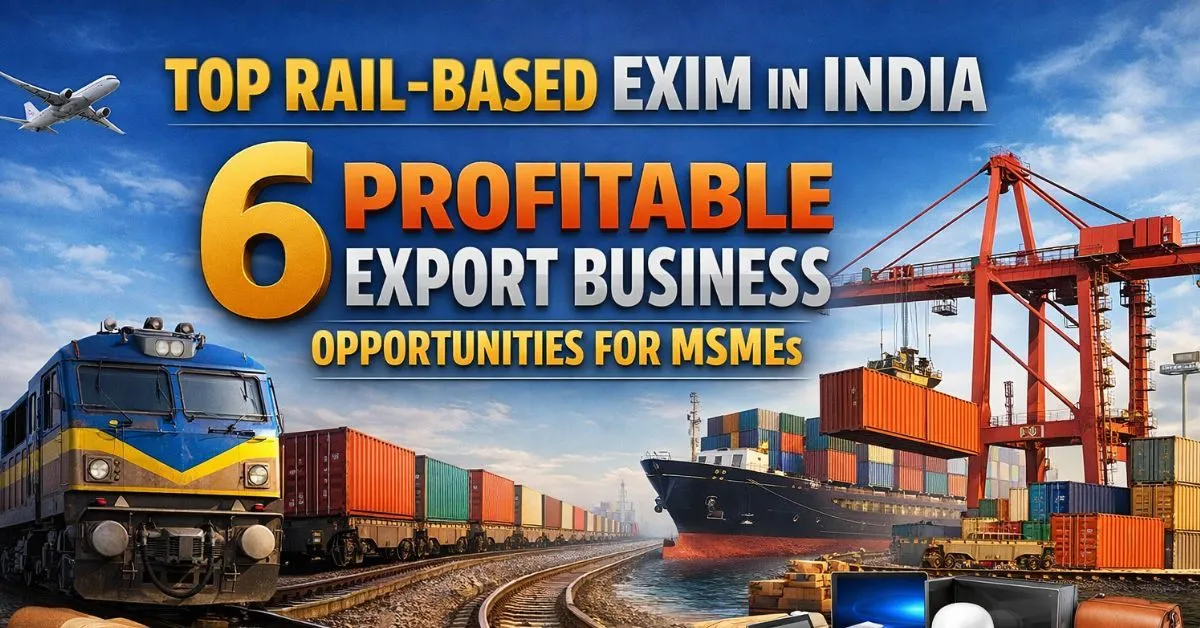
Rail-based EXIM logistics is changing the landscape of export in India by expanding global access of the market deep into the hinterland. With the growth in Dedicated Freight Corridors (DFC), Inland Container Depot (ICD), private freight terminals and PM Gati Shakti infrastructure initiative, railways have emerged as a strategic enabler of international trade.
In 2023-24, over 63 million tonnes of EXIM container traffic was transported using rail-linked systems. Total freight commodity transported 1,588 million tonnes, which fetched earnings of Rs. 1,65,880 crore. These numbers are indicative of a structural transformation – not a temporary spike.
For MSMEs and startups, this means one thing with power:
You can conduct an export-oriented business without being located close to a port.
Contents
- 1 The Structural Transformation in the Indian Trade Logistics
- 2 Why Rail Based EXIM Is Strategic Advantage for MSMEs
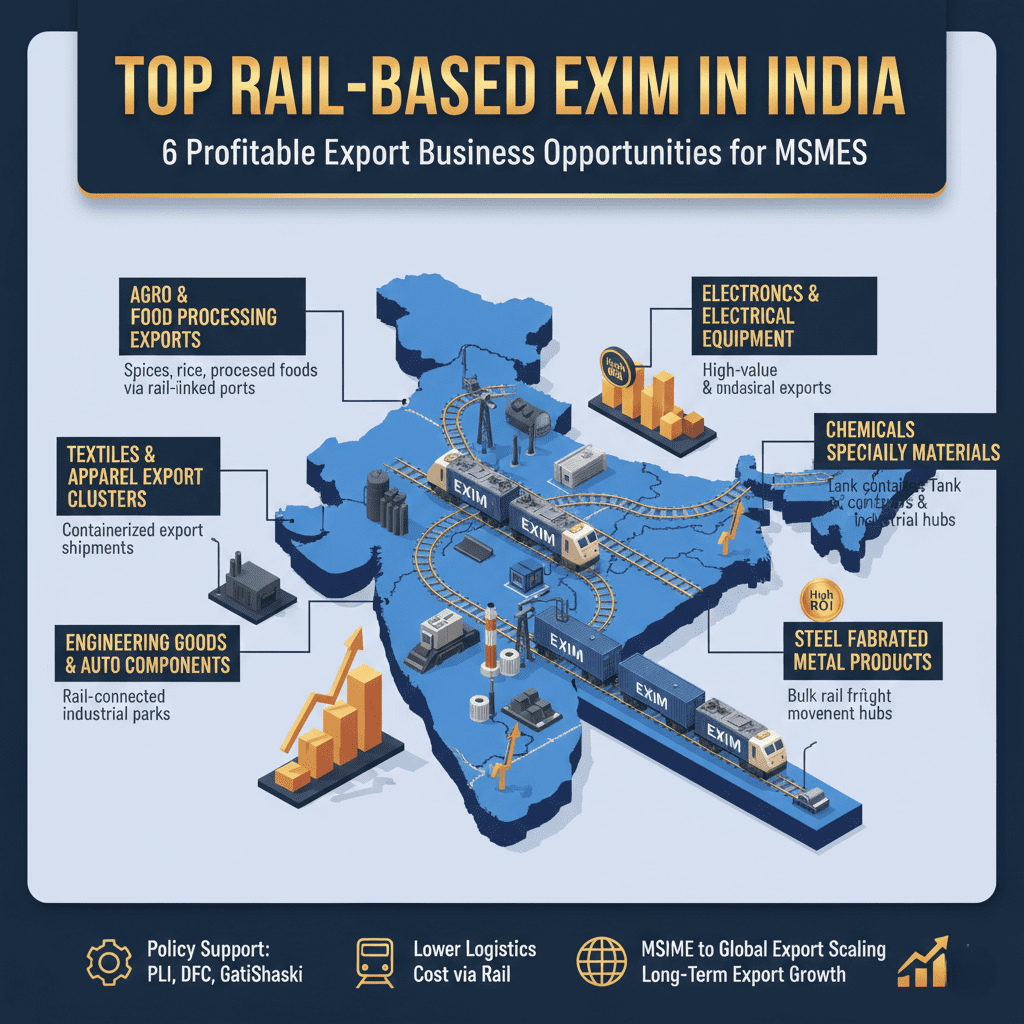
- 3 High Potential Export Sectors Applicable to Rail Logistics
- 3.1 1. Steel Products and Fabricated Structures
- 3.2 2. Cement and Clinker Based Products
- 3.3 3. Agricultural and Processed Food Products
- 3.4 Read More: IRON POWDER FROM MILL SCALE SCRAP – Manufacturing Plant, Detailed Project Report, Profile, Business Plan, Industry Trends, Market Research, Survey, Manufacturing Process, Machinery, Raw Materials, Feasibility Study, Investment Opportunities, Plant Layout
- 3.5 4. Fertilizers and Argo-Chemical mixtures
- 3.6 5. Engineering Goods and Industrial Components
- 3.7 6. Chemicals and Industrial Intermediary
- 4 The Dual Model: Import Substitution Plus Export
- 5 Why Is The Perfect Time Of Investment
- 6 Role of Feasibility Planning in Success of Export
- 7 Long-Term Outlook: A Structural Shift, Not a Temporary Trend
- 8 Conclusion
- 9 Frequently Asked Questions (FAQ)
Read More: Steel Structure Unit – Manufacturing Plant, Detailed Project Report, Profile, Business Plan, Industry Trends, Market Research, Survey, Manufacturing Process, Machinery, Raw Materials, Feasibility Study, Investment Opportunities, Cost and Revenue
The Structural Transformation in the Indian Trade Logistics
Indian Railways has gone beyond the conventional method of freight movement. It is now a unified logistic backbone linking production centres with global gateways.
Three major developments are leading to this transformation:
- Expansion of Inland Container Depots (ICDs)
- A number of intermodal publications in the SRI Library: – Operationalization of Dedicated Freight Corridors
- Multi-modal integration under Gati Shakti
ICDs enable exporters to do their customs clearance nearer to their factories. Containers are then sent directly to ports by rail, avoiding congestion and delays.
Dedicated Freight Corridors enhance the speed and reliability of transit by separating freight traffic from passenger lines. This adds predictability – and that is a key issue in export commitments.
The Gati Shakti initiative ensures improved coordination between the rail, road and port infrastructure which makes the supply chains more efficient and cost-effective.
For the inland states such as Uttar Pradesh, Madhya Pradesh, Rajasthan, Jharkhand and Chhattisgarh, this connection is opening up unprecedented export opportunities.(rail based export business India)
Why Rail Based EXIM Is Strategic Advantage for MSMEs
Export success requires a high level of logistics efficiency. Many businesses are not unsuccessful because their products are not of quality, but because their supply chain is not stable.
Rail based EXIM logistics has the following strategic advantages:
- Reduced per tonne transport cost of bulk and semi-bulk goods
- Predictable transit schedules
- Reduced risk of road congestion
- Better inventory planning
- Access to a number of ports from inland locations
For MSMEs, this reduces uncertainty of operation and enhances pricing competitiveness in the international markets.
High Potential Export Sectors Applicable to Rail Logistics
Rail-based EXIM naturally services the industries that deal with heavy, bulk, or semi-bulk goods. Below are the most promising sectors for startup and small manufacturers.
1. Steel Products and Fabricated Structures
Steel is weight intensive and also volume driven, so rail transport is ideal. Inland steel producers now have access to ports without having to move to coastal areas.(rail based export business India)
Promising export segments are:
- Structural steel sections
- Fabricated beams and frames
- Pre-engineered building components
- Infrastructure related steel parts
Rail connectivity is a great step to make exports cost viable.
2. Cement and Clinker Based Products
India transports more than 150 million tonnes of cement every year on rail. Clinker exports to Africa and the Middle East are still increasing.
Important export products in high demand include the following:
- Cement clinker
- Dry-mix mortars
- Precast concrete products
- Pavers and construction blocks
Rail transport makes inland freight cheaper, thereby making price-sensitive exports competitive.(rail based export business India)
3. Agricultural and Processed Food Products
Containerized rail movement has boosted bulk agricultural exports. With cold-chain improvement at terminals, value-added products are gaining ground.
Export-ready products include:
- Rice and cereals
- Pulses and grains
- Dehydrated vegetables
- Food processing ingredient
For Agri-MSMEs who are located away from ports, rail logistics opens up a major barrier.(rail based export business India)
4. Fertilizers and Argo-Chemical mixtures
Nearly 59 million tonnes of fertilisers are moved by rail every year. Bulk rail logistics improves the viability of export for:
- NPK blends
- Specialty fertilisers
- Micronutrient formulations
Cost efficiency is very important in this sector and rail offers that advantage.(rail based export business India)
5. Engineering Goods and Industrial Components
Engineering exports are one of the best performing segments in India. Many parts are heavy and wouldn’t be transported over long distances on the road.(rail based export business India)
High-potential exports are:
- Machinery components
- Industrial fasteners
- Electrical enclosures
- Fabricated assemblies
Rail-to-port movement allows for international buyers to be more reliable in their delivery.
6. Chemicals and Industrial Intermediary
Railways are used to transport chemicals in bulk and containerized forms. Organized handling systems minimize the risk of compliance and maximize safety.
Export opportunities are available in:
- Specialty chemicals
- Dyes and pigments
- Industrial resins
- Additives and intermediates
With proper planning, chemical MSMEs can go global.(rail based export business India)
The Dual Model: Import Substitution Plus Export
Many successful railway linked manufacturers use a two-stage approach. They start by replacing imports in their domestic markets. Once production stabilizes they look for export opportunities of surplus or value-added variants.
There are several advantages to this approach:
- Better capacity utilization
- Reduced dependency on a single market
- Improved financial stability
Rail logistics supports both domestic distribution as well as export movement over the same network of infrastructure.
Why Is The Perfect Time Of Investment
There are a number of macroeconomic and infrastructural factors that make this the right time to enter railway-linked export manufacturing:
- Dedicated Freight Corridors that are operational and expanding
- Inland container depots are growing in capacity
- Multi-modal logistic parks are being developed
- The move to diversify supply chains by global buyers
- Indian manufacturing policy is highly supportive of exports
Entrepreneurs that invest early in railway-linked industrial clusters may get a head start in terms of reduced competition and increased positioning.(rail based export business India)
Role of Feasibility Planning in Success of Export
While infrastructure is a source of opportunity, disciplined planning is the key to profitability.
Before starting an export oriented manufacturing unit, the entrepreneurs have to take stock of:
- Global demand trends
- Production scalability
- Compliance requirements
- Financial viability
- Logistics cost structure
A detailed techno-economic feasibility study reduces the risk of investment and enhances bankability. Export-backed projects that have stable logistics networks are frequently looked upon favourably by financial institutions.(rail based export business India)
Long-Term Outlook: A Structural Shift, Not a Temporary Trend
The development of rail-based EXIM services shows the need for basic changes to India’s trade system because current trade requirements cannot be met through existing systems. Industrial clusters located inland develop their global supply chain connections at an accelerated pace compared to previous times.
The traditional belief that coastal areas must be used for exporting goods has become outdated. Inland MSMEs can now reach international markets for their products because of the establishment of dependable rail systems.
Companies that view their logistics operations as essential business assets will achieve sustainable market advantage over their competitors.(rail based export business India)
Conclusion
Railmen EXIM logistics create an entirely new period of inland export development for India through its ability to decrease expenses while enhancing operational dependability and providing microscopic and small business enterprises with international market access without the need for coastal area operations.
Entrepreneurs who develop their manufacturing operations through railway-based logistics solutions will achieve sustainable business growth while gaining global market access.
The infrastructure is ready. The trade ecosystem is evolving. The opportunity is structural.(rail based export business India)
Frequently Asked Questions (FAQ)
Q1. Can small MSMEs export using rail-based logistics?
Yes. Inland Container Depots allow even small-scale manufacturers to complete customs procedures and ship goods efficiently via rail to ports.
Q2. Is rail transport more economical than road for exports?
For bulk and semi-bulk goods over long distances, rail is generally more cost-effective and predictable.
Q3. Which sectors benefit most from rail-based EXIM?
Steel, cement, agriculture, engineering goods, chemicals, and recycled materials are particularly well suited.
Q4. Can one factory serve both domestic and export markets?
Yes. A dual-market strategy improves stability and enhances capacity utilization.
Q5. Is rail-based EXIM a long-term opportunity?
Yes. Continuous infrastructure investment and rising freight volumes indicate sustained growth potential.