
HDPE Pipe Production Business Plan – Profitable Startup Guide
The demand for HDPE pipes has grown significantly over the past few decades due to their durability, flexibility, corrosion resistance, and cost-effectiveness. From irrigation and sewage to industrial and urban water supply systems, HDPE pipes serve diverse sectors. Launching an HDPE pipe production business is a smart move for entrepreneurs looking to enter the infrastructure and construction industry. This venture not only promises profitability but also contributes to sustainable development by supporting modern water management systems. Why Start an HDPE Pipe Production Business? With the increasing government focus on rural water supply, smart city development, and agricultural efficiency, the need for reliable piping systems is soaring. HDPE (High-Density Polyethylene) pipes are the most preferred alternative to traditional metal and PVC piping. They offer a longer lifespan, low maintenance costs, and environmental friendliness, which makes the HDPE pipe production industry highly lucrative. Market Demand and Scope The global HDPE pipe market is projected to surpass USD 20 billion in the next few years, with India being one of the key contributors due to massive infrastructure projects like Jal Jeevan Mission and PMKSY (Pradhan Mantri Krishi Sinchayee Yojana). In both urban and rural areas, water distribution systems are seeing a shift towards HDPE pipe production, pushing the market forward at an aggressive pace. Urbanization and industrialization are further adding to the demand for modern, durable pipe systems. Agricultural irrigation systems, bore wells, drainage systems, chemical transportation, and even telecom cable ducting rely on HDPE piping, opening a wide market for manufacturers. Business Model Overview Setting up an HDPE pipe production unit requires detailed planning, substantial investment, and a robust marketing strategy. Your business model should cover production, quality assurance, pricing, distribution, and customer service. Here’s how you can structure your business model: Manufacturing: Involves sourcing raw materials like HDPE granules and setting up a production line with extrusion machinery. Sales Channels: Direct sales to construction companies, dealers, and wholesalers, as well as tenders for government projects. Revenue Streams: Product sales (different diameters, pressure ratings), after-sales support, and customized solutions for industries or farmers. Investment and Machinery The initial investment to start an HDPE pipe production plant varies depending on the scale. A small-scale unit may need INR 30–50 lakhs, while a medium or large-scale plant could require over INR 1 crore. Key machinery required includes: HDPE pipe extrusion machine Vacuum sizing tank Cooling tank Haul-off (puller) Cutter Pipe coiler or stacker Mixer and granule feeder Additionally, space (2000–5000 sq. ft. minimum), labor, and power supply are essential for smooth operations. Raw Material Procurement HDPE granules are the primary raw material for pipe manufacturing. These granules can be sourced from petrochemical companies like Reliance, GAIL, IOCL, or imported if necessary. Ensure the material meets BIS (Bureau of Indian Standards) specifications for quality assurance. Besides granules, other materials like color masterbatches, anti-oxidants, and UV stabilizers may be added during processing to enhance pipe performance. Manufacturing Process The HDPE pipe production process includes several stages: Mixing and Feeding: HDPE granules are mixed with additives and fed into the hopper of the extrusion machine. Extrusion: The granules are melted and extruded into a pipe form using a die of specific diameter. Vacuum Sizing and Cooling: Pipes pass through vacuum and cooling tanks to set the shape and strength. Hauling and Cutting: The pipe is pulled continuously and cut to required lengths. Testing and Quality Control: Pipes are subjected to pressure, tensile, and elongation tests to ensure they meet national and international standards. Automating the line helps maintain consistency and minimizes human error, improving efficiency and output quality. Licensing and Legal Compliance To operate legally, your HDPE pipe production unit must comply with the following: Company Registration: As an MSME or private limited company. GST Registration Factory License and Pollution Control Board NOC BIS Certification (IS 4984:2016 for water supply pipes) Trade License from local municipality ESI & PF Registration for employee welfare These certifications ensure that your products are accepted in both public and private sector procurement. Marketing and Sales Strategy Marketing is essential to the success of your HDPE pipe production business. Focus on a multi-channel strategy to reach contractors, builders, farmers, and government agencies. Key approaches include: Website and SEO: A professional website with detailed product specs, certifications, and use cases helps build credibility. Dealer Network: Appoint regional distributors and retailers for regular supply. Direct Sales: Engage with large-scale consumers such as construction firms or irrigation departments. Participation in Trade Shows: Events like IndiaPlast, PlastIndia, or BuildTech provide excellent exposure. Online B2B Portals: Register on platforms like IndiaMART, TradeIndia, and JustDial to increase visibility. Also, maintain a portfolio of certifications, past projects, and client testimonials to boost trust. Financial Projections and Profit Margins On average, the production cost per meter of HDPE pipe ranges from INR 10 to INR 25 depending on size and grade. Selling price varies from INR 20 to INR 50 per meter, giving a decent profit margin of 20–35%. Assuming a moderate production capacity of 2000 kg/day and efficient operations, monthly revenue can reach INR 15–20 lakhs with net profits between INR 2–4 lakhs. Break-even is typically achieved within 12–18 months, provided there’s consistent demand and quality assurance. Challenges and Risk Management Despite its advantages, HDPE pipe production comes with its own set of challenges: Raw Material Price Fluctuations: HDPE granules prices vary depending on crude oil prices. Market Competition: You’ll be competing with both local and branded players. Product Rejection: Poor-quality production may result in large-scale rejections and financial losses. Power Interruptions: Production relies on consistent electricity; backup is necessary. To mitigate risks: Maintain strict QC (Quality Control) standards. Negotiate bulk raw material contracts. Diversify client base across agriculture, urban development, and industry. Implement lean manufacturing and cost control practices. Sustainability and Future Trends As the world shifts towards greener practices, HDPE pipe production aligns well with sustainability goals. HDPE pipes are recyclable and energy-efficient to produce. Innovations like solar-powered production units and recycled plastic granules are being introduced, reducing carbon footprint and boosting brand reputation. Government initiatives
10 Profitable Biotech Manufacturing Business Opportunities in India
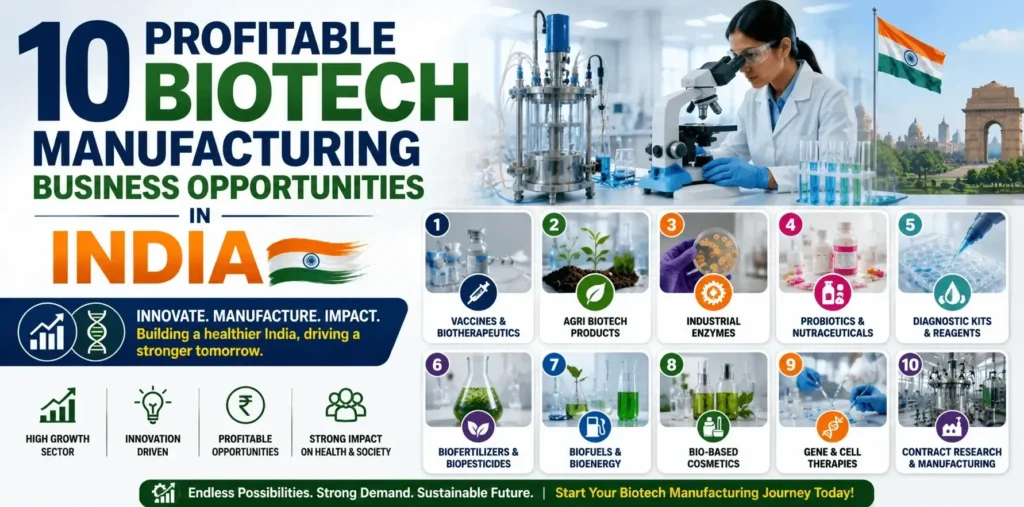
India’s biotechnology sector is rapidly emerging as one of the most profitable and future-focused industries for entrepreneurs, startups, and investors. With rising demand for healthcare innovation, sustainable agriculture, diagnostics, nutraceuticals, industrial enzymes, and bio-based products, biotech manufacturing business opportunities in India are expanding at an unprecedented pace. Today, small and medium-scale entrepreneurs can enter the biotechnology manufacturing industry with innovative and scalable business models. From biofertilizer production and diagnostic kits to probiotics and tissue culture labs, the biotech industry offers multiple high-growth opportunities for startups and investors. What are Biotech Manufacturing Business Opportunities? Biotech manufacturing business opportunities involve producing biotechnology-based products such as biofertilizers, probiotics, diagnostic kits, nutraceuticals, industrial enzymes, tissue culture plants, and sustainable bio-products for healthcare, agriculture, food processing, and environmental industries. This guide explores some of the most profitable biotech manufacturing business opportunities, startup ideas, investment sectors, and future-ready biotech industries in India. Top Biotech Manufacturing Business Opportunities in India Small investors looking to enter the biotech business space must focus on ideas that combine affordability with scalability. Thanks to outsourcing models, contract research organizations (CROs), and shared lab spaces, the initial barrier to entry has lowered significantly. Below are some of the most promising biotech startup concepts suited for small investors: 1. Tissue Culture Plant Nursery Setting up a tissue culture lab to propagate plants in a controlled environment is a lucrative biotech venture. This business model is suitable for small investors because it requires relatively low capital and can be operated in small spaces. The plants grown via tissue culture are disease-free and uniform in size and quality, which makes them ideal for commercial farming and exports. High-value crops like bananas, orchids, strawberries, and medicinal plants are particularly in demand. 2. Probiotic and Fermented Products With increasing awareness of gut health, demand for probiotic supplements and fermented foods like kefir, kombucha, and sauerkraut is growing. Entrepreneurs can establish a small-scale biotech business focused on manufacturing and marketing natural probiotic products. The formulation and fermentation processes are simple, and the startup costs are minimal. Additionally, partnerships with dietitians and wellness influencers can boost brand visibility and market reach. 3. Diagnostic Kits and Reagents Manufacturing The global pandemic has shown the world the importance of rapid diagnostics. Starting a diagnostic kit manufacturing unit is a profitable idea for small investors. These kits can be for infectious diseases, pregnancy testing, blood sugar monitoring, or food contamination. Manufacturing diagnostic reagents and kits under proper licensing and quality standards can serve local clinics, pathology labs, and government tenders. Moreover, localization reduces reliance on imported kits, boosting market demand. 4. Organic Bio-Fertilizers Production With the organic farming movement gaining traction, bio-fertilizers and bio-pesticides are in high demand. These are eco-friendly alternatives to chemical fertilizers and enhance soil fertility naturally. Starting a small production unit for bio-fertilizers made from nitrogen-fixing bacteria, mycorrhiza, or phosphate-solubilizing microorganisms is an excellent biotech business idea. This venture supports sustainable agriculture and aligns with government subsidies and eco-policy initiatives. 5. Microalgae Cultivation for Bio-products Microalgae such as Spirulina and Chlorella are rich in proteins, vitamins, and antioxidants. Cultivating microalgae is a scalable and profitable biotech business. Small investors can set up photobioreactors or open pond systems in rural or semi-urban areas. The harvested algae can be processed into food supplements, cosmetic ingredients, or even animal feed. With increasing vegan and health-conscious consumer bases, the demand for such natural ingredients is expected to rise. 6. CRISPR-Based Genetic Testing Startups Though slightly more technical, starting a small genetic testing service using CRISPR-based tools is feasible with the right partnerships. These startups can offer services like ancestry testing, inherited disease detection, or genome profiling. Investors can collaborate with academic researchers and laboratories for access to platforms and expertise. As this sector matures, licensing CRISPR-related applications can yield high returns for early adopters. 7. Bioinformatics Services and Data Analytics Not all biotech startups require wet-lab setups. Bioinformatics is a data-driven biotech business field involving software development, genome analysis, and drug discovery support. If you have a background in IT or can partner with a software expert, starting a bioinformatics consulting firm can be profitable. These services support pharmaceutical companies, research labs, and hospitals with customized data solutions. 8. Bioplastics and Biodegradable Packaging As plastic pollution becomes a global concern, bioplastics—derived from biological sources like starch, corn, or algae—are becoming essential alternatives. A small biotech business focusing on bioplastic production or biodegradable packaging materials can find ample buyers in the food, fashion, and e-commerce industries. The capital requirement is moderate, and innovations in material sciences continue to reduce production costs. 9. Stem Cell Storage and Therapy Advisory Services Although stem cell banks are capital-intensive, small investors can still benefit by providing allied services. These include stem cell therapy advisory, patient education, and collaboration with hospitals for lead generation. You can also offer logistics solutions for sample transport and storage coordination. This model allows entrepreneurs to participate in a highly promising sector without owning a full-fledged lab. 10. Nutraceutical Formulation and Packaging Nutraceuticals, which include dietary supplements, functional foods, and herbal products, combine nutrition and pharmaceuticals. With the rising demand for preventive healthcare, small-scale manufacturing or white-label branding of nutraceuticals is a good entry point into the biotech business. Entrepreneurs can focus on immunity boosters, anti-aging formulas, joint health supplements, and stress management products using naturally derived ingredients. 11. DNA-Based Personalized Nutrition Plans A highly trending concept in healthtech-biotech convergence is DNA-based diet recommendations. Businesses in this niche collect DNA samples from clients and offer diet charts based on genetic predispositions. The data is analyzed using genome sequencing services (outsourced) and interpreted through proprietary algorithms. Starting such a venture needs basic infrastructure, but once built, it allows scalability with low variable costs. 12. Aquaculture Biotechnology Biotech solutions for aquaculture include vaccines for fish, improved breeds, disease diagnostics, and feed supplements. A small biotech business in this area could focus on developing or distributing biotech-based inputs for fish farmers. India, China, and Southeast Asia are seeing a boom in fish farming, making this