
26 Small Manufacturing Business Ideas to Start with Investment of 60- 75 Lakhs
India’s booming industrial sector and favorable government policies make it an ideal destination for entrepreneurs looking to start a small manufacturing business. With an investment capacity of ?60–75 lakh, several lucrative opportunities are available that can generate good returns and contribute to job creation. Whether you are planning a semi-automated unit or a full-fledged production line, the scope for growth is immense. In this article, we explore the best small manufacturing business ideas with 60–75 lakh investment, providing insights into demand, profitability, and feasibility. Why Invest in Small Manufacturing Businesses? India’s small manufacturing sector contributes significantly to GDP and employment. The growing “Make in India” initiative, along with easy credit from banks and government subsidies through MSME schemes, makes the manufacturing ecosystem attractive. With ?60–75 lakh, entrepreneurs can establish a scalable business, invest in modern machinery, hire skilled labor, and ensure product quality with ample working capital. Let’s now explore the best small manufacturing business ideas with 60–75 lakh capital. 1. Paper Bag Manufacturing With the ban on plastic bags and increasing demand for eco-friendly alternatives, paper bag manufacturing is booming. You can start a semi-automated unit producing kraft paper, shopping bags, and customized branded bags. Estimated Investment: ?65–70 lakh (includes land, machinery, and raw materials)Profit Margin: 15–25%Target Customers: Retailers, supermarkets, clothing brands, restaurants This is among the best small manufacturing business ideas with 60–75 lakh due to low competition and rising demand. 2. LED Light Manufacturing The energy-efficient lighting industry is growing, especially in urban and rural electrification programs. LED bulbs, tube lights, and panel lights are in high demand. The business includes assembling circuits, housing units, and testing. Estimated Investment: ?70–75 lakhProfit Margin: 20–30%Target Market: Real estate projects, government tenders, commercial complexes The high return on investment and future-ready nature of this segment make it one of the best small manufacturing business ideas with 60–75 lakh investment. 3. Packaged Drinking Water Plant Clean water is a necessity, and with rising awareness of health, the packaged drinking water industry is flourishing. With proper BIS certification and hygienic bottling, this business can scale quickly. Estimated Investment: ?60–72 lakhProfit Margin: 25–35%Scalability: High, with options to expand into flavored water and soda Given the year-round demand, this is undoubtedly one of the best small manufacturing business ideas with 60–75 lakh capital. 4. Disposable Cutlery and Plates Manufacturing With increasing restrictions on single-use plastics and a shift towards biodegradable options, the market for disposable cutlery made from sugarcane bagasse, areca leaves, and cornstarch is booming. Estimated Investment: ?65 lakhProfit Margin: 20–30%USP: Eco-friendly and export potential This green initiative qualifies as a sustainable and profitable venture, ranking among the best small manufacturing business ideas with 60–75 lakh. 5. Agarbatti (Incense Stick) Manufacturing India is the world’s largest producer and consumer of incense sticks. The raw material is easily available, and the product has religious and cultural significance across regions. Estimated Investment: ?60–68 lakh (includes semi-automatic machines)Profit Margin: 30–40%Export Potential: High, especially to Southeast Asia and the US This culturally rooted and low-entry-barrier business is undoubtedly one of the best small manufacturing business ideas with 60–75 lakh for quick profits. 6. Furniture Manufacturing With rising urbanization and real estate development, the demand for custom and modular furniture has increased. Using a blend of CNC routers, polish machines, and skilled artisans, this business is highly scalable. Estimated Investment: ?70–75 lakhProduct Range: Office desks, kitchen cabinets, beds, wardrobesTarget Market: Retail, wholesale, B2B, interior designers Thanks to steady demand and customization trends, this is a long-term and stable venture—easily among the best small manufacturing business ideas with 60–75 lakh. 7. Detergent and Cleaning Products Manufacturing With increasing hygiene awareness, the market for liquid detergents, dishwash liquids, floor cleaners, and handwashes is growing rapidly. The sector also allows for private labelling opportunities. Estimated Investment: ?60–65 lakhProfit Margin: 20–35%Scope: Home care, hotels, hospitals, retail chains This FMCG product segment is recession-proof, making it one of the best small manufacturing business ideas with 60–75 lakh investment. 8. Garment Manufacturing Unit Textiles and garments remain India’s top export industries. You can set up a small unit producing t-shirts, uniforms, or women’s ethnic wear, using semi-automated machines and hiring tailors. Estimated Investment: ?70 lakhProfit Margin: 20–25%Target Markets: E-commerce, export, wholesale markets With good design, branding, and quality control, this can scale fast, making it one of the best small manufacturing business ideas with 60–75 lakh. 9. Solar Panel Assembly Unit As renewable energy adoption grows, small-scale solar panel assembly units are in demand. While manufacturing from scratch is capital-intensive, assembling parts locally is feasible in this budget. Estimated Investment: ?75 lakhCustomers: Residential buildings, schools, rural electrification, MSMEsSupport: Government subsidies and net-metering policies With environmental sustainability and market expansion, this is clearly one of the best small manufacturing business ideas with 60–75 lakh. 10. Ayurvedic and Herbal Products Manufacturing India’s wellness industry is booming. With licenses and certifications (FSSAI, AYUSH), one can manufacture face creams, oils, supplements, herbal juices, etc. Estimated Investment: ?60–70 lakhProfit Margin: 25–40%Sales Channels: E-commerce, Ayurveda clinics, retail stores Given the rise in natural product preference, this sector promises high returns and is among the best small manufacturing business ideas with 60–75 lakh investment. Key Factors to Consider Before Starting While exploring these best small manufacturing business ideas with 60–75 lakh, keep these essential factors in mind: Licensing & Compliance: Ensure all statutory registrations like MSME Udyam, GST, pollution control, factory license, etc., are completed. Location: Choose an industrial zone or semi-urban area with access to raw materials, manpower, and transportation. Machinery & Technology: Invest in reliable semi-automated or automated machinery for efficiency and scalability. Skilled Manpower: Hire or train staff for operating machinery and maintaining product quality. Marketing Strategy: Leverage B2B networks, local distributors, and digital platforms for brand visibility. Conclusion Starting a small manufacturing business with a ?60–75 lakh budget is a strategic decision with the potential to yield high returns if executed well. Whether you are inclined towards eco-friendly products, FMCG, or technological innovation, there are ample opportunities to explore. From LED lights to herbal products, these
Bottling of Country Liquor
Starting a Country Liquor bottling plant in India can be a highly profitable venture, especially in rural and semi-urban regions where demand for low-cost alcoholic beverages remains consistent. The business has gained immense popularity due to its comparatively low production costs, simple process, and high margins. However, due to the sensitive nature of the alcohol industry, it requires strict compliance with state laws and guidelines. If you’re planning to enter the Country Liquor business, this guide will walk you through all the key steps—from regulatory compliance to machinery setup and marketing strategies. Understanding the Basics of the Country Liquor Industry Country Liquor, also known as Desi Daru or local liquor, is distilled in rural distilleries using molasses, grains, or fruits. It caters to the lower-income segment of the population and is governed strictly by excise laws specific to each state. The consumption of Country Liquor is legal in many Indian states and is a significant source of revenue for state governments through excise duties and taxes. Market Potential The demand for Country Liquor is robust in tier 2 and tier 3 cities and rural belts. According to market reports, India’s alcoholic beverage market is growing at a CAGR of more than 7%, with country liquor accounting for nearly 30–40% of total volume consumption. Given the lower price point, the product sees consistent demand regardless of economic fluctuations, making it recession-resistant. Legal and Licensing Requirements Starting a Country Liquor bottling plant is not as straightforward as other manufacturing units. You must first ensure compliance with the excise policy of your state. Here are the necessary legal steps: Excise License: This is the most critical document, issued by the State Excise Department. The rules differ from state to state. Company Registration: Register your firm as an LLP, Private Limited Company, or Partnership. Environmental Clearance: Obtain NOC from the Pollution Control Board. Factory License: Issued under the Factories Act by the local inspectorate. FSSAI License (optional): Though not mandatory for alcohol, it’s good to maintain hygiene and quality standards. Trademark Registration: To protect your product branding and packaging design. Hiring a legal expert familiar with liquor laws in your state is highly advisable to navigate this complex framework. Location and Land Requirements Setting up a Country Liquor bottling plant requires substantial land depending on the production capacity. For a small to medium-sized unit: Minimum Land: 1–2 acres Preferable Location: Industrial zone, away from residential areas Infrastructure Needs: Access to water, electricity, and transportation Choosing a strategic location closer to your target market can reduce distribution costs and increase profitability. Plant Setup and Machinery The plant’s setup involves two major sections: bottling and packaging. Here is a basic list of machinery and equipment required: Fermentation Tanks Distillation Unit Storage Tanks Bottle Washing Machine Filling Machine Capping Machine Labeling Machine Packing Conveyor For a plant producing around 10,000 liters/day, the machinery investment can range between ?1.5 crore to ?3 crore depending on the level of automation and quality. Raw Material Sourcing The primary raw materials for Country Liquor production are: Molasses: A byproduct of sugar manufacturing Water: Clean and filtered for mixing Yeast: For fermentation Grains (optional): Some states allow grain-based spirits Glass/Plastic Bottles: Depending on state regulation Caps, Labels, and Cartons: For bottling and packaging Securing long-term contracts with molasses suppliers can reduce costs and ensure a consistent supply. Workforce and Staffing Manpower requirement depends on the scale of your operation. For a mid-sized unit, you may need: Plant Manager Quality Control Officers Machine Operators Packaging Workers Administrative and Sales Staff Legal Compliance Officer Training your staff in hygiene, safety, and regulatory standards is crucial for long-term success. Production Process The standard process flow in a Country Liquor bottling plant involves: Fermentation: Molasses is diluted with water and mixed with yeast for fermentation. Distillation: The fermented mixture is distilled to extract the alcohol content. Dilution & Flavoring: Alcohol is diluted to desired strength and flavored (if permitted). Bottling: The liquid is filled into cleaned and sterilized bottles. Capping and Labeling: Bottles are sealed, labeled, and date-coded. Packaging: Bottles are packed in cartons for dispatch. Each batch must go through quality testing before bottling to ensure compliance with excise standards. Branding and Packaging Branding plays a crucial role even in the Country Liquor market. Attractive bottle designs, clear labeling, and catchy brand names help in gaining customer attention. Most states have restrictions on advertising liquor products, so you must rely on: Point-of-Sale Promotions Word of Mouth Dealer Incentives Innovative Packaging Invest in anti-counterfeit labeling and tamper-proof seals to maintain brand credibility and reduce market duplication. Distribution and Sales Distribution of Country Liquor is largely controlled by government depots and licensed retailers. You must register with your state’s excise department to be part of the supply chain. Wholesale License: Required to supply liquor to retail shops. Transport Permit: For moving liquor across zones or districts. Bonded Warehouse: In some states, this is mandatory for stock storage. Working closely with government-run liquor corporations or agencies is key to ensuring stable sales and market access. Cost and Profitability Analysis Let’s assume you’re setting up a plant with a 10,000-liter/day capacity. Here’s a rough investment and earnings breakdown: Land & Building: ?1 crore Machinery: ?2 crore Licenses & Legal: ?20–30 lakhs Working Capital: ?50 lakhs–?1 crore Total Initial Investment: ?4–5 crore Monthly Revenue Estimation: Selling Price/Liter: ?100 (approx) Daily Sales: ?10 lakhs Monthly Sales: ?3 crore After subtracting production and operational costs (~60–65%), net monthly profit could range from ?80 lakhs to ?1 crore depending on scale and efficiency. Break-even may occur within 12–18 months. Challenges and Risk Factors While the Country Liquor business offers high ROI, it also comes with several risks: Legal hurdles and policy changes High taxation and excise duties Risk of black-market duplication Social and ethical concerns Seasonal demand variations Establishing a robust compliance and audit system is vital to mitigating legal and financial risks. Sustainability and Social Responsibility In today’s business environment, sustainability and ethical responsibility are important. To ensure your Country Liquor
Beer and Whisky Production
India’s alcoholic beverage industry is witnessing significant growth, with Beer and Whisky taking center stage in both domestic consumption and export potential. Entrepreneurs and enthusiasts alike are showing increasing interest in setting up breweries and distilleries, and understanding the production process is crucial. This guide explores everything from raw materials to bottling, offering insights into the fascinating world of Beer and Whisky manufacturing. Understanding the Core Differences and Processes Though both Beer and Whisky originate from grains, their production processes, aging requirements, and final taste profiles differ significantly. Beer is a fermented beverage, typically lower in alcohol content, consumed fresh or after short aging. Whisky, on the other hand, is distilled and aged in wooden barrels, leading to a stronger flavor and alcohol content. Raw Materials Used in Beer and Whisky At the heart of both Beer and Whisky production are cereal grains. For Beer, commonly used grains include barley, wheat, maize, and rice. Barley malt is a key ingredient, as it aids in the fermentation process by releasing fermentable sugars. Whisky also starts with grains—barley for Scotch, corn for Bourbon, or a mix for blended varieties. However, the grains are mashed and fermented in a manner that maximizes alcohol yield, since it will later be concentrated via distillation. Water quality is essential in both beverages. The mineral content can influence the flavor and clarity of Beer and Whisky, which is why many famous distilleries and breweries are located near natural water sources. Malting and Mashing In Beer production, malted barley is soaked in water and allowed to germinate. This process, called malting, activates enzymes that break down starches into fermentable sugars. After drying, the malt is mashed—mixed with hot water—to further extract sugars. Whisky production follows a similar process in its early stages. The grains are ground and mixed with hot water in large vats. This mixture, or mash, is stirred until the sugars dissolve, forming a sugary liquid called wort. Fermentation: The Backbone of Alcohol After mashing, the wort is transferred to fermentation tanks. Yeast is added to consume the sugars, producing alcohol and carbon dioxide. In Beer, this fermentation is typically carried out at lower temperatures for lagers and slightly higher for ales, and may take several days to a few weeks. In Whisky, the fermentation may last around 48 to 96 hours. Since Whisky will be distilled, a higher alcohol content is targeted. The resulting liquid, known as “wash,” has a beer-like consistency but is not drinkable as is. Distillation vs. Filtration Distillation is the critical differentiator in Whisky production. The fermented wash is heated in stills—usually copper pot stills or column stills—where alcohol evaporates and condenses to increase purity and strength. The final distillate, or “new make spirit,” is colorless and harsh, requiring maturation. Beer does not go through distillation. Instead, it is filtered, carbonated, and sometimes pasteurized before packaging. Beer production emphasizes flavor retention, freshness, and aroma, which can be affected by excessive heat or pressure. Maturation: Whisky’s Aging Secret One of the defining characteristics of Whisky is its aging process. The new make spirit is transferred to oak barrels—often previously used for Bourbon or Sherry—where it matures for years. The barrel imparts color, aroma, and complex flavors like vanilla, spice, or smokiness. In contrast, most Beer is consumed fresh, though some craft beers undergo short maturation in tanks or barrels for enhanced depth. However, aging is not a major requirement for Beer production. Flavoring and Blending While Beer flavor varies based on the type of hops, yeast strain, and adjuncts like fruits or spices, blending is generally not required. In Whisky, especially blended variants, multiple aged spirits are combined to achieve a specific profile. Master blenders use their expertise to maintain consistency across batches. Some Whisky producers also infuse unique flavors during aging by using different barrel types. This allows the emergence of specialty products like peated Scotch, honey-flavored Whisky, or single malt expressions. Packaging and Bottling Beer is commonly packaged in glass bottles, cans, or kegs. It may be pasteurized for extended shelf life or left unfiltered in the case of craft varieties. Carbonation is added either naturally through bottle conditioning or artificially in tanks. Whisky is bottled after aging, often at 40% ABV (alcohol by volume) or higher. Some premium Whiskies are bottled at cask strength without dilution. Labels highlight the age, distillery, and sometimes even the barrel number, adding to the product’s exclusivity. Licensing and Regulations in India To produce Beer and Whisky in India, obtaining the appropriate licenses is critical. These include: Distillery or Brewery License Industrial Alcohol License Pollution Control Board Clearance State Excise License Each state in India has its own excise policies. Setting up a unit requires significant capital investment, compliance with environmental and safety standards, and a thorough understanding of legal obligations. Beer and Whisky manufacturers must also comply with FSSAI norms for hygiene and labeling, along with GST registration for taxation purposes. Investment and Machinery Setting up a medium-scale Beer or Whisky production plant in India can cost between ?5 crores to ?30 crores, depending on capacity. Key machinery includes: Grain millers and mash tuns Fermentation tanks Distillation columns (for Whisky) Filtration and carbonation units (for Beer) Aging barrels (for Whisky) Bottling and labeling machines Automation and temperature control systems play a critical role in maintaining consistency and efficiency in both Beer and Whisky manufacturing. Market Demand and Export Potential India is one of the largest consumers of Whisky globally. Indian Whisky brands like Royal Stag, McDowell’s, and Amrut have captured global attention. Similarly, Beer brands such as Kingfisher, Bira, and Simba are making inroads into premium and craft segments. The export potential is also rising. Indian-origin Beer and Whisky are gaining popularity in the US, UK, and African markets. Craft distilleries focusing on small-batch production with distinct flavors are particularly well-positioned to tap niche demand. Sustainable Practices in Production With growing emphasis on sustainability, many Beer and Whisky producers are adopting eco-friendly practices such as: Water recycling and reuse Biomass-based boilers Waste-to-energy
Learn How To Do Best Sweet Scented Supari Manufacturing Business 2026
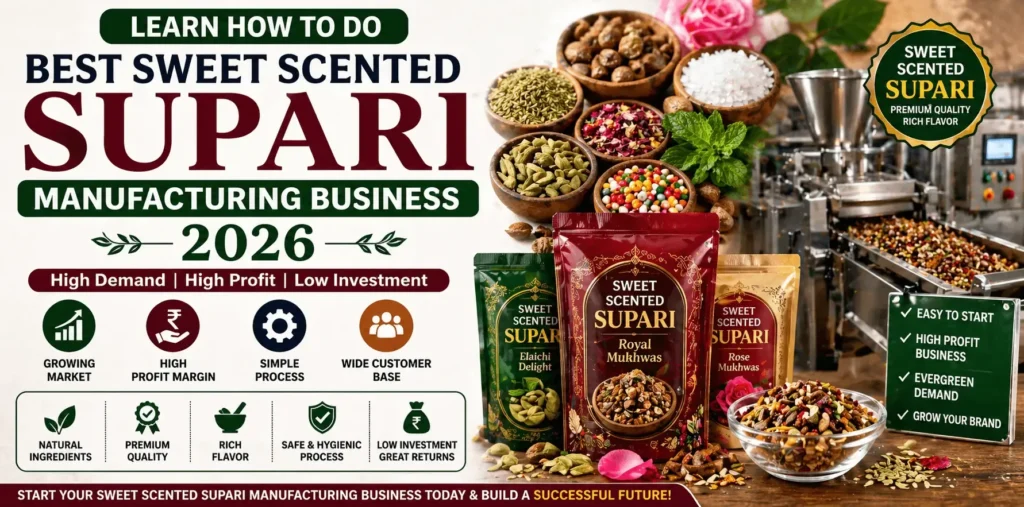
Starting a Supari Manufacturing Business in India can be a highly profitable venture, especially given the widespread use of supari (areca nut) in cultural, religious, and social practices across the country. Supari, also known as betel nut, is consumed in various forms—raw, scented, or processed—and is a key ingredient in products like pan masala and gutka. Due to its high demand and the relatively low investment needed for small-scale operations, this business is gaining popularity among budding entrepreneurs. This article will guide you step-by-step through how to start a Supari Manufacturing Business in India, discussing everything from market potential to machinery requirements, licensing, and profit margins. Market Potential and Scope of Supari Manufacturing Business The Supari Manufacturing Business has tremendous market potential in India and abroad. India is the largest consumer and producer of areca nuts, which are predominantly grown in states like Karnataka, Kerala, Assam, and West Bengal. The product is consumed in both urban and rural areas, and its use in religious rituals, hospitality, and social gatherings ensures a consistent demand throughout the year. Additionally, processed supari is exported to countries like the UAE, Nepal, Bangladesh, and the UK, opening up avenues for international trade. The industry also supports multiple layers of value addition—flavored supari, silver-coated supari, sweet supari, and branded products—each with its own pricing and market. Entrepreneurs can begin small and gradually scale operations depending on demand and capital availability. Given the rising preference for branded and hygienically packaged supari, there is also ample room for innovation and premium positioning. Steps to Start a Supari Manufacturing Business 1. Conduct Market Research Start with understanding the types of supari that are popular in your target market. Conduct surveys or talk to local traders and retailers to understand consumer preferences—flavored supari, scented supari, sweet supari, or plain chopped areca nuts. Check your competition, pricing strategies, and packaging trends to identify your business’s unique selling proposition. 2. Decide on the Business Model You can either go for a small-scale manual processing unit or set up a semi-automatic or fully-automatic manufacturing unit. For beginners, a semi-automatic setup is ideal—it offers a balance of cost-efficiency and operational ease. Depending on your capital, you may start with basic equipment and a workforce of 5–10 people. 3. Business Registration and Legal Compliance Before launching your Supari Manufacturing Business, ensure you complete all legal formalities. Some of the essential registrations and licenses include: Udyam Registration for MSME benefits GST Registration Trade License from local municipal authority FSSAI License if you plan to process and package flavored or sweet supari Factory License for medium or large-scale units Trademark Registration for branding If you’re planning to export, obtaining an Import Export Code (IEC) from DGFT is mandatory. 4. Choose a Suitable Location The ideal location for a Supari Manufacturing Business should be close to the source of raw materials (i.e., areca nut growing regions) or near the market where demand is high. Ensure proper water, electricity, and transportation facilities are available. A small-scale unit can be established in 1000–1500 sq. ft. of area, depending on the level of automation. 5. Procure Machinery and Equipment Depending on your budget and production capacity, the basic machinery required for supari manufacturing includes: Supari cutting machine Polishing drum Flavor mixing unit Roasting machine Dryer Weighing scale Packing machine (manual or automatic) Sealing machine A semi-automatic plant can cost anywhere between ?5 lakhs to ?15 lakhs. Make sure to buy machinery from reputed vendors who provide installation support and warranty. 6. Hire Skilled and Unskilled Labor You’ll need machine operators, flavoring technicians (if producing flavored supari), packagers, and quality control staff. Training them in hygiene, handling of machinery, and consistency in product quality is essential for a successful operation. 7. Source Raw Materials The primary raw material is raw areca nut (supari), which you can procure directly from farms or through wholesale markets. Other materials include: Flavors and sweeteners (cardamom, menthol, etc.) Silver leaves (optional for premium supari) Packing materials (plastic pouches, jars, labels, etc.) Quality raw material ensures a good product, which leads to customer retention and brand loyalty. 8. Manufacturing Process Here is a typical process flow for a small-scale Supari Manufacturing Business: Cleaning: Remove dust and impurities from raw areca nuts. Cutting: Use cutting machines to chop the nuts into uniform pieces. Roasting: Optional step to enhance flavor and shelf life. Flavor Mixing: Add flavors or sweeteners depending on product type. Polishing: Polishing in drums to improve texture and appearance. Drying: Ensures moisture-free supari, important for storage. Packaging: Final step involving sealing and labeling for retail. Each step must maintain hygiene and quality control. Keep records of batch production for consistency and traceability. 9. Branding and Packaging Branding is key to success in the Supari Manufacturing Business. Focus on attractive, tamper-proof, and food-grade packaging that stands out on retail shelves. Offer multiple pack sizes (2g, 10g, 50g, etc.) to cater to various market segments. Invest in a professional logo, design labels with proper FSSAI and manufacturing details, and build a distinct identity. 10. Marketing and Distribution Start with local markets—pan shops, general stores, tea stalls, and local distributors. Gradually expand to wholesale markets in nearby cities and states. Some effective marketing strategies include: Offering free samples Local newspaper or radio advertising Participation in trade fairs Tie-ups with wholesalers and distributors Social media promotion for urban reach If you’re making premium or flavored supari, you can even explore online selling through platforms like Amazon, Flipkart, or your own website. 11. Financial Planning and Investment Starting a small-scale Supari Manufacturing Business requires a modest investment, mostly in machinery, raw materials, and working capital. Here’s a rough estimate: Machinery and Equipment: ?5–15 lakhs Raw Materials (monthly): ?1–3 lakhs Packaging Materials: ?50,000–1 lakh Labor and Utilities (monthly): ?1–2 lakhs Marketing and Logistics: ?50,000+ Licensing and Registration: ?50,000 Total estimated initial investment: ?10–20 lakhs for a small to medium setup. 12. Profit Margin and ROI With proper planning and efficient production, you can expect a net profit margin of 20–30%. A small-scale
10 Powerful Tips to Start Castor Oil Manufacturing Business
Castor oil is a highly valuable vegetable oil obtained from castor beans, widely used across pharmaceuticals, cosmetics, lubricants, paints, and biodiesel industries. With India being one of the largest producers and exporters of castor oil, establishing a Castor Oil Manufacturing unit is a profitable business opportunity. It not only serves the domestic demand but also has significant export potential. If you are looking to enter the agro-based industrial segment with good returns and moderate investment, this guide will walk you through every essential step to start your own Castor Oil Manufacturing unit. Step-by-Step Guide to Start a Castor Oil Manufacturing Unit 1. Understanding the Castor Oil Industry The Castor Oil Manufacturing industry is driven by its diverse industrial applications. From being a vital ingredient in medicinal formulations to acting as a lubricant in the aviation industry, castor oil enjoys steady demand. India alone contributes over 85% of the world’s castor oil supply, making it an ideal country to launch such a unit due to easy access to raw material (castor seeds), skilled labor, and export infrastructure. The major by-products—castor cake and hull—also find use in fertilizers and fuel, enhancing the overall profitability of the plant. 2. Market Research and Business Plan Before setting up your Castor Oil Manufacturing unit, carry out extensive market research to identify the demand trends, competitor analysis, and export potential. Based on your findings, draft a detailed business plan that includes: Investment requirements Operational model (manual/semi-automatic/fully automatic) Target markets (domestic/export) Profit and loss projections Break-even analysis Regulatory framework and licenses This plan will not only serve as a roadmap but will also be essential for attracting investors or securing bank loans. 3. Selecting Location and Land Requirements Choose a location close to castor seed-producing regions such as Gujarat, Rajasthan, Andhra Pradesh, or Tamil Nadu. Being near the raw material source reduces transportation costs and ensures a steady supply chain. For a medium-scale Castor Oil Manufacturing unit, you will need around 1 to 1.5 acres of land. The land should have facilities for: Raw material storage Machinery installation Processing unit Quality control lab Packing section Office space Waste management and effluent treatment systems Ensure that the site has access to water, electricity, roads, and connectivity to markets or ports (for exports). 4. Legal Licenses and Registrations To start a legally compliant Castor Oil Manufacturing business in India, you must obtain the following licenses: Company registration (as proprietorship, partnership, or private limited company) GST Registration Factory License under the Factories Act Pollution Control Board (PCB) clearance Import Export Code (IEC) for exports FSSAI license (if selling for edible use) Trade License from the local municipal authority BIS certification for oil quality (optional but recommended) Additionally, if you plan to export, get your unit certified by APEDA (Agricultural and Processed Food Products Export Development Authority). 5. Machinery and Raw Material Procurement Machinery Required for Castor Oil Manufacturing: Depending on your scale, you will need the following equipment: Castor seed cleaning machine Cooking kettle or steam boiler Oil expeller or screw press Filter press Oil refining unit (for refined grade) Storage tanks Packaging machine (pouch or tin filling) Quality testing instruments Invest in semi-automatic or fully automatic machinery for efficient and continuous production. The cost of machinery for a medium-scale Castor Oil Manufacturing plant can range from ?30 lakhs to ?80 lakhs. Raw Material: Castor Seeds – Easily available in India; buy from local farmers or wholesale mandis. Packaging material – Tins, bottles, plastic pouches, and cartons for final products. Chemicals (if refining) – NaOH, bleaching earth, activated carbon. 6. Castor Oil Production Process The Castor Oil Manufacturing process involves the following stages: Seed Cleaning: Removal of impurities such as dirt, stones, and broken seeds. De-hulling: Separation of castor seed hulls from kernels. Cooking/Conditioning: Seeds are heated to loosen oil content and increase efficiency. Pressing/Extraction: Mechanical expellers are used to extract crude castor oil from seeds. Filtration: Oil is passed through a filter press to remove solid particles. Refining (Optional): For medicinal or cosmetic use, refining is done using chemicals to improve color, odor, and shelf life. Packaging: Final oil is filled in containers, sealed, labeled, and ready for market or export. 7. Manpower and Staffing You’ll need a mix of skilled and semi-skilled labor to operate your Castor Oil Manufacturing unit. For a medium-scale plant, the required workforce may include: 2-3 machine operators 1-2 quality control staff 3-5 helpers for loading/unloading and packaging 1 electrician and maintenance technician 1 production manager 1 accountant or administrative staff Provide training and safety equipment to ensure smooth operations and compliance with factory norms. 8. Marketing and Distribution Strategy To ensure profitability in your Castor Oil Manufacturing business, a strong marketing and distribution plan is essential: Domestic Markets: Sell to pharmaceutical companies, cosmetic brands, soap manufacturers, and lubricant makers. Export Markets: Target USA, China, Japan, Europe, and Brazil, which are large importers of castor oil. Online Sales: Create a website or tie-up with e-commerce platforms to sell refined castor oil in consumer packs. Branding: Invest in attractive labeling, proper certifications, and product quality to build customer trust. Bulk Supply Agreements: Partner with industrial users for regular, large-volume supply. 9. Financial Requirements and Profitability The total investment to set up a medium-scale Castor Oil Manufacturing unit may range between ?75 lakhs to ?1.5 crore depending on land, machinery, and production scale. Break-up includes: Land & construction – ?20–30 lakhs Machinery & installation – ?30–80 lakhs Raw materials – ?5–10 lakhs (initial inventory) Working capital – ?10–15 lakhs Licenses and miscellaneous – ?5–10 lakhs Profit Margins: Profit margins in the Castor Oil Manufacturing industry range between 15% to 25% depending on the quality, market, and scale. With an efficient supply chain and export deals, ROI can be expected within 2–3 years. 10. Challenges and Risk Mitigation Some common challenges in the Castor Oil Manufacturing industry include: Price volatility of castor seeds – Manage via long-term contracts with farmers. Competition from large players – Focus on niche markets like organic or medicinal-grade oil. Environmental regulations
Dairy Whitener, Milk Powder Manufacturing Business
The dairy industry in India is one of the largest and fastest-growing sectors, offering a broad spectrum of opportunities to entrepreneurs. Among the most profitable verticals in this segment is the production of Dairy Whitener and Milk Powder. With increasing urbanization, working-class lifestyle changes, and a higher demand for shelf-stable dairy products, the consumption of dairy whitener and milk powder has risen sharply. These products serve as an ideal alternative to liquid milk, especially in regions where refrigeration and fresh milk supply are inconsistent. Why Invest in the Dairy Whitener and Milk Powder Business? The Dairy Whitener and Milk Powder business presents a highly promising investment avenue due to its steady demand and wide application in households, foodservice industries, and FMCG sectors. Unlike raw milk, which has a short shelf life, dairy whitener and milk powder can last several months without refrigeration. This durability and convenience have made them a household staple in urban and semi-urban areas. Additionally, the demand is strong in export markets, making it a viable opportunity for global trade. Market Potential and Demand The Indian dairy market is projected to grow at a compound annual growth rate (CAGR) of over 6% in the next five years. Within this, dairy whitener and milk powder are registering consistent double-digit growth. The products are used extensively in tea and coffee vending machines, packaged foods, confectionery, bakeries, and in rural or remote locations with limited milk supply. States with higher working populations, such as Maharashtra, Tamil Nadu, Gujarat, and Delhi NCR, are key consumption hubs. Moreover, Indian milk powder is being exported to countries in the Middle East, Africa, and Southeast Asia. Key Ingredients and Product Types Dairy whitener is essentially a partially skimmed milk powder with added sugar and emulsifiers. It is specifically formulated to blend seamlessly with tea or coffee, giving the desired whiteness and taste. On the other hand, milk powder is available in whole milk powder and skimmed milk powder varieties, each used for different applications. Both products require pasteurized milk as the primary raw material and are processed using advanced drying technologies like spray drying or drum drying. Essential Steps to Start the Business To establish a Dairy Whitener and Milk Powder unit, follow a well-planned approach that involves the following key steps: 1. Market Research & Business Plan Before starting, conduct thorough market research to understand consumer behavior, price points, demand patterns, and competitor strategies. Prepare a detailed business plan outlining your investment budget, production capacity, target market, pricing model, and ROI expectations. 2. Location and Infrastructure Choose a location close to milk-producing centers to ensure a consistent supply of raw milk. The facility should have access to water, electricity, transport, and skilled labor. Ideally, a minimum of 3,000–5,000 sq. ft. is needed for a small to medium-scale setup. Areas like Punjab, Haryana, Uttar Pradesh, and Karnataka are ideal due to the high availability of milk. 3. Licenses and Approvals Get the necessary registrations and clearances from the concerned authorities. The main licenses include: FSSAI registration GST registration Factory license Pollution Control Board clearance MSME/Udyam registration 4. Machinery and Technology You’ll need specialized machinery for milk pasteurization, homogenization, evaporation, and spray drying. Key equipment includes: Milk Pasteurizer Homogenizer Evaporator Spray Dryer Powder Filling and Packaging Machines You can source these machines from reputed Indian manufacturers or international suppliers. Automation ensures consistent product quality and reduces labor costs. 5. Raw Material Procurement Raw milk should be sourced from trusted dairy farms or cooperative societies. You may also require sugar, emulsifiers, stabilizers, and food-grade packaging materials. Maintaining hygiene and cold chain logistics is crucial during procurement and initial processing stages. 6. Manpower and Workforce A team of skilled professionals including food technologists, machine operators, quality control analysts, and packers will be required. Training them in hygiene, machinery operation, and safety protocols is vital for smooth functioning. 7. Product Development and Branding Work with dairy experts to formulate products that match consumer taste preferences. Branding is a major differentiator in this space. A well-designed logo, attractive packaging, and a trustworthy brand name are essential for consumer recall. Ensure that the nutritional content, FSSAI license number, and usage instructions are clearly printed. Investment and Profitability Setting up a small to medium-scale Dairy Whitener and Milk Powder plant requires an investment of ?50 lakhs to ?2 crores, depending on capacity and automation level. Recurring costs include raw material procurement, electricity, wages, maintenance, and marketing. The profit margin in this business ranges from 15% to 25%, depending on product quality, distribution network, and branding efforts. Bulk buyers such as tea stalls, hotels, online retailers, and FMCG companies ensure recurring business, which improves the return on investment. Marketing and Distribution Strategies To achieve sales success, deploy a multi-channel distribution strategy: Retail Distribution: Tie up with local grocery stores, supermarkets, and online marketplaces. B2B Sales: Supply to cafes, tea vendors, hotels, and corporate vending services. Institutional Sales: Target government departments, schools, railways, and the defense sector. Export Markets: Secure APEDA certification and explore markets in Africa, Gulf nations, and SAARC countries. Digital marketing and influencer campaigns are also powerful tools to build awareness and trust among urban consumers. Quality Control and Certifications In the food sector, quality and safety are non-negotiable. Regular lab testing, shelf-life evaluation, and batch traceability are important. Obtaining certifications like ISO 22000 (Food Safety Management), AGMARK, and BIS can further boost brand credibility and expand market reach. Challenges and Solutions While the Dairy Whitener and Milk Powder business has immense potential, it also comes with challenges such as: Fluctuating milk prices Supply chain inefficiencies Seasonal milk shortages High competition from established brands These challenges can be overcome by building long-term supplier contracts, investing in cold storage, and offering competitive pricing and consistent quality. Future Prospects and Expansion With rising health awareness, there’s growing demand for low-fat, lactose-free, and organic milk powders. Entrepreneurs can expand their product line by introducing fortified milk powders, flavored milk powders, and ready-to-mix beverages. Setting up an R&D department or collaborating with food