
Water Purification Business for Rural India: A Low-Cost, High-Impact Industrial Opportunity
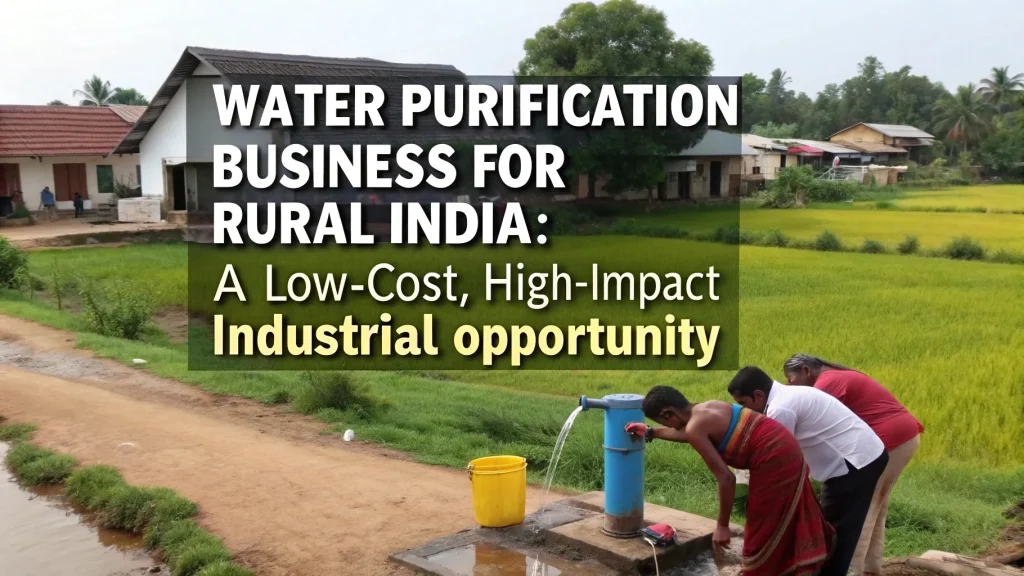
The Urban-Rural Divide in Drinking Water Access The division between urban and rural areas in India is evident in one area: the availability of clean drinking water by the Water Purification Business. While cities have sophisticated municipal systems in place, a large proportion of rural India relies on untreated groundwater, ponds, or hand pumps that are heavily contaminated with chemicals, bacteria, and heavy metals. Due to this, waterborne diseases continue to be one of the leading causes of illness and mortality in these regions. This situation does, however, present a significant chance for economic advancement. There is a rising need for convenient and economical options for water purification. For entrepreneurs and small to medium enterprises (SMEs) keen on entering the manufacturing arena, the region of rural India offers an unparalleled opportunity that combines low investment, high impact, and long-term growth potential. This situation transcends business considerations alone. The social impacts—improved public health, community progress, environmental conservation, and tapping into a blossoming market—are equally compelling. Market Demand and Industry Landscape The packaged and purified water industry in India has for so long been dominated by urban consumers as the packaged and purified water industry in India was dominated by urban consumers. This shift is now surging. With the increase of rural awareness, health concerns post-COVID-19, and government initiatives like Jal Jeevan Mission, rural households are prioritizing trusted water purification systems. Estimates from NITI Aayog suggests more than 600 million people in India face high to extreme water stress, the majority of which comes from rural regions. Furthermore, the World Health Organization indicates that 21% of the communicable diseases in India can be attributed to the consumption of unsafe water. Considering the scale, the business opportunity becomes even more apparent: over 180 million rural households, most of which do not have tap water or access to purified water systems. This creates an urgent need as the public health, the environment, and the economy are all simultaneously at risk. This indicates that the rural water purification market has the potential to experience rapid growth. Related: How to Start a Manufacturing Business of Flavored Drinking Water Forecasting Market Size: Anticipated Changes in the Next 5 Years The market for water purification solutions for the rural centers, including filtration units, community plants, and household kits, is anticipated to expand further and reach even greater heights with the support of innovation, government policies, and increased public and private partnerships. Predicted Expansion: Rural Water Purification Industry in India Year Predicated Market Size (? Crore) Annual Growth Rate Primary Influencers 2025 ?1,540 Cr – Cleansing COVID related health issues, water necessity 2026 ?1,930 Cr 25.3% Jal Jeevan Mission NGO initiatives aim at clean water and sanitation 2027 ?2,520 Cr 30.6% Increase in tech-adapted solar water-powered units 2028 ?3,240 Cr 28.6% CSR involvement coupled with adoption in rural areas 2029 ?4,160 Cr 28.3% Campaigns for rural health alongside local production These forecasts signify not only an emerging market but also highlight its fundamental importance, wherein the driving force remains need-based rather than lavish spending. Incentives for Potential Investors in the Market The Business of Water Purification lines up very well with the aspirations of budding entrepreneurs today. It presents the unique intersection of low startup cost, localized production, social return on investment, and predictable cashflow. Especially beginners or smaller players in the industry will appreciate the wide range of products available, such as solar-powered portable water plants and even simple gravity-based water filters. This sector is far removed from cumbersome heavy industries because there is quick prototyping and low-skill production completion within region-specific arrangements. Additionally, this is a business that welcomes collaboration with NGOs, the CSR arms of corporations, self-help groups, and government agencies, all of whom are looking for collaborators to achieve their rural water accessibility objectives. Manufacturing Water Purification Systems: Building a Scalable Rural Ready Product Rural water purification system engineering is not about fancy equipment but about efficiency, strength, and economical approaches. Solutions need to be rugged, low-maintenance, able to operate without electricity (in most cases), and must adhere to basic water safety requirements. The manufacture of community or household scale water purifiers includes the following stages: Design & Prototyping The initial step is picking a technology that is suitable for the geography in question. For regions with high TDS levels or excessive fluoride, a reverse osmosis (RO) design would be essential. While, in other situations, ceramic and activated carbon gravity filtration would suffice. This stage entails CAD modeling, pilot testing, and field verification. Entrepreneurs have the option to license models available or partner with R&D institutions for affordable designs. Component Sourcing The main components are filter cartridges (of carbon, UF, ceramic, or RO membranes), valves, water tanks, plastic casings, connectors, and sometimes even UV lamps or solar panels. These parts can be obtained from industrial suppliers in India or wholesale centers like Bhagirath Palace in Delhi and the industrial hubs of Ahmedabad. Assembly Line Operations The purifiers are assembled in a semi-automated or manual line, depending on the business scale. Casing molding, cartridge fitting, sealing, pressurization, and packaging are some of the steps in the workflow. Most units are lightweight and do not require heavy-duty fabrication. Quality Control and Testing Each unit must undergo basic water testing, especially microbial removal capability, TDS, and structural integrity. Sales to government bodies and NGOs are more credible with certification from NABL-accredited labs. Branding and Packaging Branding is crucial to sales in rural areas as purchases are made based on trust and visual representation. Local language instructions, pictorial guides for ease of use, and contact numbers for help lines should be provided. This alongside long-lasting eco-friendly materials enhances the perception of these products. Related: Business Opportunities in Water Sector in India Opportunities and Models for Business Development As a market, Rural India has several subdivisions. Each region has its own water problems, arsenic in Bengal or fluoride in Andhra Pradesh. Customization is an even more important aspect of business than advertising. Catering solutions
Why Cloud Kitchens Are the Smartest Low?Cost Food Business
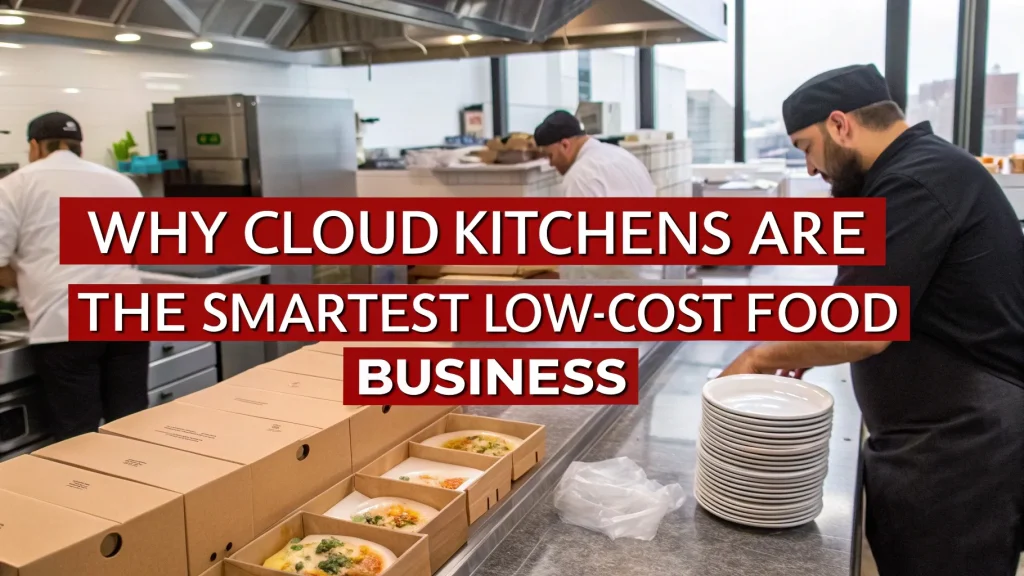
The Food Industry Revolution Without Dine-In Settings In India’s metro areas and even in Tier-II cities, a quiet transformation is happening in the food business. This transformation isn’t accompanied by big billboards or grand celebrations. Rather, it happens from humble industrial offices, cellars, and even shared kitchen workspaces. The reality of cloud kitchens has emerged. This new model not only transforms the way we consume food but also alters the way we set up food businesses in a digital driven economy. Cloud kitchens offer a flexible, smart, and easily scalable solution when compared to traditional restaurants that require a significant investment of capital, expensive real estate, staff, and other resources. For many people, such as home cooks and entrepreneurs in the food processing sector, cloud kitchens provide an efficient way to enter a low-budget expanding market. This article describes, with the help of market data, operational insights, demand forecasts and India’s evolving food economy, why cloud kitchens are the most intelligent low-investment food business of today. Understanding India’s Love for Delivery-First Dining: Current Trends and Market Size The emergence of cloud kitchens stems from urbanization in India. People are busier than ever with 9-5 jobs and the growing gig economy. The rise of food delivery services like Zomato and Swiggy also add to the convenience. Forecast India Cloud Kitchen Market Size and Growth Rate (INR Cr) 2025-2030 Year Estimated Market Size (INR Cr) Annual Growth Rate Key Growth Drivers 2025 ?7,300 Cr 17% Expansion of delivery apps, youth-driven market 2026 ?8,540 Cr 17% Health-focused menus, demand growth from tier-II cities 2027 ?10,000 Cr 17% Aggregator support, cloud catering models 2028 ?11,700 Cr 17% Tech innovation, franchise cloud kitchens 2029 ?13,600 Cr 16% B2B models, industrial-scale commissaries 2030 ?15,500 Cr 14% Regional cuisine expansion, cold-chain logistics This growth pattern suggests expansion towards Indian cloud kitchens catering to tier – II cities. The figure also indicate structural profitability as these businesses operate on a fictional scale. Cloud kitchens can begin and grow gradually, scaling over time without the hefty burdens that come with a physical restaurant. What Makes Cloud Kitchens So Cost-Efficient? Catering tier-ii cities can be more profitable. Opening a restaurant always comes with excessive overheads: expensive rent for shopfronts, décor, front-of-house staff, maintenance and much more. These are non-essential expenditures that can be avoided if a business shifts to food production and delivery only like cloud kitchens do. A cloud kitchen works from an off-site, backend, non-retail location, ranging from 300 to 1000 sq. ft. which includes packaging and processing stations as well as a fully equipped commercial kitchen. As there is no customer waiting area or staff seating area, there is no need for any seating or waiting staff. As a result, these businesses save on rent, labor, design, utilities, and a host of other factors. This is beneficial for new manufacturers looking toward a high-margin business with a small footprint or entrepreneurs who are short on capital. In addition to this, cloud kitchens can rapidly scale and lean start. An entrepreneur can begin with a single-brand kitchen offering health bowls or biryani, and later introduce multi-brand offerings, all from the same kitchen. The flexibility in branding and operations is what makes it a dream model for modern food entrepreneurs. Related: How to Start a Cloud Kitchen in India: Legal, Licensing & Cost Breakdown How a Cloud Kitchen Operates: The Manufacturing Process With respect to industrial operations, cloud kitchens serve as small-scale food manufacturing centers or units designed for efficient output and consistent quality to meet customer demands. As is the case with almost every business, these processes begin with raw materials procurement, which in this case includes meat, vegetables, spices, grains, and even packaging materials. These are procured from wholesalers or B2B sites, and inventory is managed on FIFO basis to reduce wastage. Upon receiving the ingredients, the kitchen adheres to strict SOPs. Recipes have to be sequenced into measurable steps including amounts, cooking temperatures, and time to ensure every order is identical. Depending on the complexity of the menu, some items may be partially pre-cooked in bulk and finished just before serving. Last-mile delivery requires the food to be placed in tamper-evident containers that retain heat. While container type can vary based on the food’s nature (dry vs. gravy, hot vs. cold), preservation of the food’s sensory attributes is crucial. Order intake and processing is fully automated. Orders can be placed via food aggregator applications or the kitchen’s own system. Once completed, orders are monitored for tracking, reviews, and automated feedback loops. In some scenarios, customer data is integrated with CRM tools for advanced menu and delivery experience customization. As we can see, a cloud kitchen is not just a kitchen. It is a tech-enabled, logistics integrated, regulated food manufacturing facility. Licensing & Legal Requirements: Cloud Kitchens Avoid Dine-In Compliance Contactless operations do not exempt cloud kitchens from food and business safety regulations. These food service establishments still require licenses, which are critical for a cloud kitchen’s credibility and legal standing. Understanding these licenses is equally important. Without an FSSAI license, your kitchen will not be recognized as compliant with food safety regulations. Depending on the turnover and scale, one can apply for Basic, State or Central licenses. In addition, FSSAI also refines hygiene standards, food inspection and labeling, and Has mandates to enforce inspections periodically. Moreover, a trade license for the municipality is also required. This ensures that your kitchen is in a commercially zoned area. Furthermore, registration under the Shops and Establishments Act is a prerequisite to formalize your workplace and to access labor and taxation incentives. For those kitchens that exceed a certain area or employ LPG cooking, a Fire NOC becomes essential. Likewise, if the kitchen discharges waste, employs ventilation chimneys, or is environmentally scrutinized, a clearance from the Pollution Control Board may be required. If the business is expecting a turnover above ?20 lakhs (or ?10 lakhs for some northeastern states), a GST registration is mandatory.