
How to Start an EV Station Franchise: A Complete Guide for Entrepreneurs
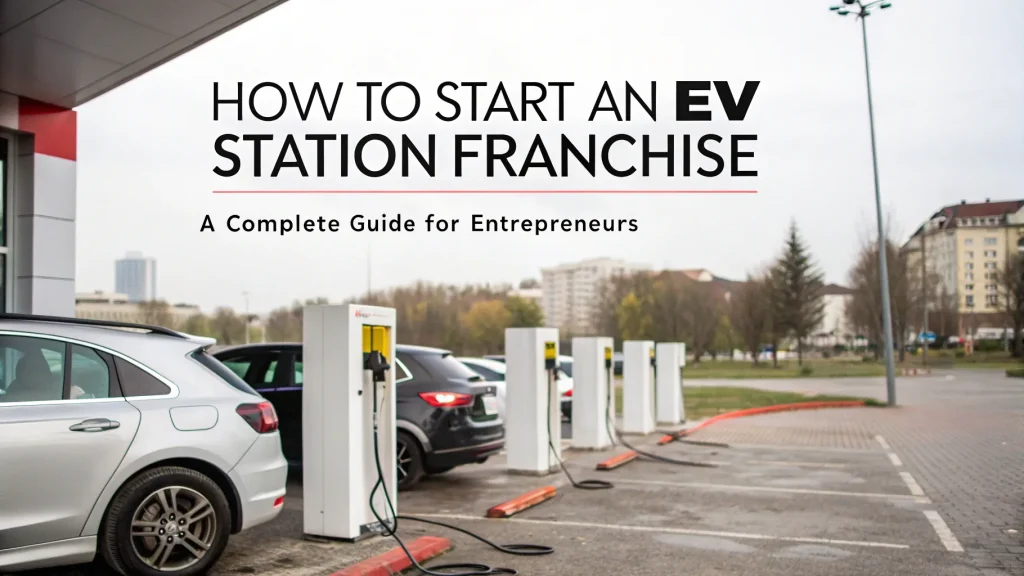
India is accelerating towards adopting electric mobility at an unprecedented rate. The electric vehicle (EV) revolution is no longer an aspiration; it’s in full swing, and entrepreneurs can actively participate in shaping its trajectory. The model of EV Station Franchise is a great entry point to this ecosystem. It allows aspirational industrialists to capitalize on the EV boom without major investments and with ample room for long-term growth. In this post, we cover everything an entrepreneur aspiring to start an EV charging franchise in India needs to know. You will discover the potential the market holds, the key drivers of growth, the underlying business model, its technical requirements, and a strategic outline of the steps to begin. It does not matter if you operate as a solo entrepreneur or as an MSME looking for diversification; this blog aims to guide you towards informed actions in one of the most dynamically evolving industrial sectors today. India’s EV Infrastructure Market: A Sector Accelerating Towards Breakneck Speed In the last five years, the electric vehicle market in India has witnessed unprecedented growth due to government policies, increasing fuel prices, and shifting consumer habits. With the current trend, electric vehicles are expected to account for more than 30% of all vehicle sales in India by 2030. However, the charging infrastructure lags behind in comparison to EV adoption. In lagging charging infrastructure, there lies a paradox: A tremendous market opportunity for the development of charging stations. There is a rampant need for EV charging services in highways, city centers and even in residential and corporate complexes. With projections stating 4.8 million EVs by 2025 and 1 million public chargers needed by 2030, the market still has great potential. Popularity for Franchise-based models stems from their provision of swift, uniform scaling across varied locations, service, and software integration. This is just the start since demand from Tier 2, Tier 3, inter-city routes, and commercial EV fleets further bolster a booming ecosystem. Related: Build a Profitable EV Station Franchise Why the EV Franchise Model Works for Entrepreneurs The EV charging sector is quite difficult to break into as a sole entrepreneur. Scaling such a business requires proprietary vendorship, hardware, integration to software systems, user-centered applications, as well as maintenance and billing systems, all while remaining within the bounds of regulatory compliance. This is where the franchise model helps as a simple, less risky method of making a business venture. When you integrate into a recognized brand, there is the advantage of access to the required backend systems, tech, proprietary frameworks, and experience. Usually, the franchise holder gives you the required chargers, software interface, mobile applications, relevant support systems, and training. You, as a business person, acquire the land, infrastructure, and running the business full-time. Under this model, the entrepreneurs do not have to bear the burden of reconstructing a tech-laden service business’s vastly complex system to a level where it is functional. Instead, they begin making money with far less effort. Demand Forecast: A Business Built for the Next Decade The charging infrastructure in India is still new. Per NITI Aayog’s report, India requires over one million public charging stations while currently sitting at a little over 100,000 mark. This is an enormous gap and provides a massive opportunity for carving out a charging infrastructure over the next 5-7 years. Demand for EVs is driven by: Adoption of EVs in two- and three-wheeler vehicles. Growing fleets of electric taxis and delivery vehicles. Automakers and logistics companies facing stricter emissions regulations. Smart city and electric highway infrastructure. Both the central and state governments are offering subsidies, access to land, low-interest loans, and priority power connections. This is one of the rare cases in India where the private sector and the government work in tandem. Franchise Business Models: Choosing the Right Path Within the EV franchise ecosystem, there are various business models, and the best options for you will depend on your capital, location, and goals. The most prevalent model is the ownership-plus-technology model. In this case, the entrepreneur purchases land and builds infrastructure, and the franchise company equips the location with chargers and provides mobile integration and remote monitoring. Revenue is earned for every vehicle charged. Some brands operate a hybrid revenue-sharing model, where space and basic facilities are provided, and the franchise brand operates the equipment in exchange for sharing profits. This is preferred in shopping malls, office and complex buildings, and highway motels where landowners seek passive income. Then there’s the host model, where your land is leased to the franchisor who owns and manages everything. While offering the bare minimum operational control, this model works for landowners who prefer not to engage in active business operations. Technical Summary: An EV Charging Station’s Requirements At a minimum, an EV station includes the charging equipment, a securely accessible and adequately located area, the requisite infrastructure for power supply, safety equipment, and software systems for billing and usage control. Each of these components, however, has distinct requirements that must be understood during the design phase. Your target market determines the type and size of chargers you install. Electric rickshaws and two-wheelers only need low-capacity AC chargers. For four-wheelers and buses, higher-capacity DC fast chargers are required, such as CCS2, CHAdeMO, or GB/T. You will also need sanctioned power loads from the local electricity distribution company, or DISCOM. For larger setups, you may need to apply for a high-tension connection. Most charging stations also include fire safety equipment, as well as surveillance and real-time monitoring systems from the franchise partner. Software integration is an important part of any business. Charging sessions need to be monitored and billed to users through mobile applications, and mobile apps need to be user-friendly. The franchise you choose should provide the full stack, including charger interface, real-time diagnostics, app integration, and customer service backend. View our handbooks on the Electric Vehicle Industry The Breakdown: Step-by-Step to Go Live Setting up your EV charging franchise starts with selecting a reputable franchisor. Focus