
Container, Trailer & Flatbed Manufacturing Business in India: High-Profit MSME Opportunity
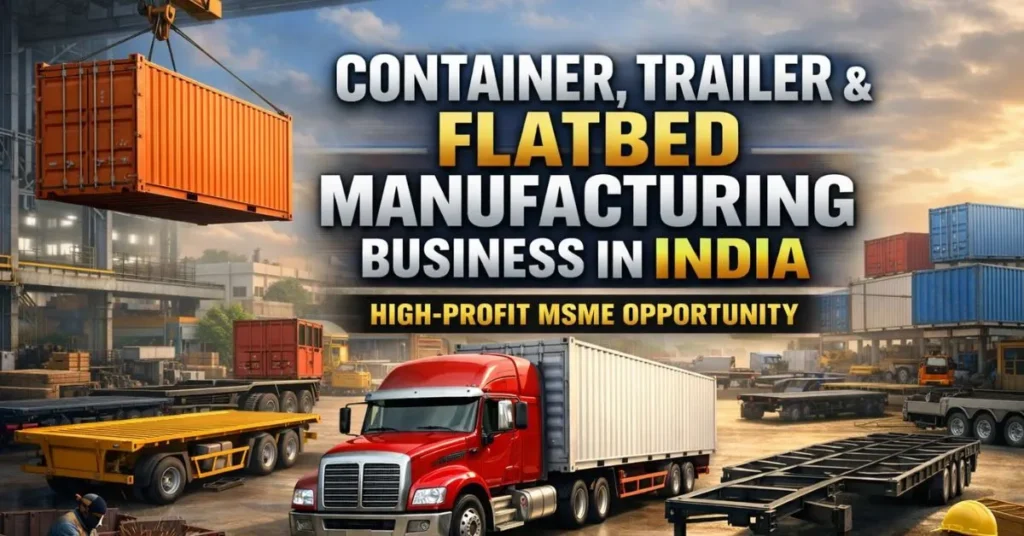
Introduction: Container manufacturing business in India In the logistics industry, profits are rarely made during the actual transportation process – they are made in the interface between goods being transported from road to rail, from rail to port, and from inland waterways to port. Containers, trailers and flatbeds are the backbone of these transitions as they allow for seamless cargo movement whilst reducing delays and handling costs. For MSME entrepreneurs and industrial investors, intermodal equipment manufacturing is a rare combination of stability and scalability. The advanced transportation equipment requirements of India increase as the country develops new freight corridors and multimodal logistics parks and export facilities. The industry functions according to permanent structural requirements because goods movement will always exist and organizations will continuously need equipment for their operations. This article delves into manufacturing opportunities, market potential, investment logic, processes and risks – to help entrepreneurs understand why containers, trailers and flatbeds are becoming strategic industrial investments.(Container manufacturing business in India) Read More: Our Books Market Demand Drivers: Infrastructure Supports Manufacturing India’s logistics ecosystem is in a process of structural transformation. Government initiatives like dedicated freight corridors, port modernization, inland waterways development and industrial corridors are adding a lot of capacity to the freight.(Container manufacturing business in India) For every kilometer of new freight infrastructure there is demand for transport equipment. As freight volume increases, logistics operators enlarge fleets, upgrade aging assets and invest in specialized equipment. This produces a strong feedback loop: Infrastructure investment helps to increase freight movement Higher freight volumes mean higher utilization of equipment Utilization increases the rate of replacement Manufacturing demand increases steadily For the MSME manufacturers, this translates to long-term institutional demand as opposed to fragmented retail buyers. The logistics companies together with EPC contractors and exporters and industrial fleet operators establish themselves as returning clients who generate steady income for the business. Understanding the Product Segments 1. Containers: Standardized Worldwide Assets Containers are the basis of modern intermodal logistics. ISO containers, high-cube containers, refrigerants, and specialized cargo boxes exist as worldwide standards which allow for simple international trade operations. Container manufacturing demands financial resources for steel production and stringent quality assessment procedures, yet standardization enables manufacturing at scale and international trade capabilities. With global supply chains looking for diversification in sourcing outside of traditional hubs, Indian manufacturers are having a growing export potential.(Container manufacturing business in India) 2. Trailers: Volume Domestic Opportunity Trailers are the link between the infrastructure and flexible road transportation. Skeletal trailers, container carriers & multi-axle logistics trailers are experiencing a high demand with the increasing e-commerce and industrial production and freight mobility. For MSMEs, trailer manufacturing is often the easiest gateway to get into the market because it can have relatively lower CAPEX and can offer faster order cycles. Fleet operators often expand and upgrade trailers, which assures repeat business. Read More: Business Plans / Project Profiles 3. Flatbeds: Customisation with Increased Margins Flatbeds function as transportation platforms which carry oversized goods that include machinery and steel structures and infrastructure components. The production of flatbeds results in fewer total units compared to trailers yet flatbeds generate higher profits because of their requirement for custom engineering work and their specific load handling methods.(Container manufacturing business in India) Together, these products constitute an interrelated manufacturing ecosystem that shares manufacturing infrastructure and engineering capabilities. Manufacturing Process: Engineering Discipline Over Complication Intermodal equipment manufacturing is not as much about innovation, but more about precision and process discipline. The manufacturing workflow usually consists of: Cutting steel plates and profiles on CNC plasma or laser machines Forming structural elements using hydraulic presses and roll forming Welding using Heavy Fabrication Techniques with Fixtures and Manulators Structural assembly using jigs to ensure dimensional accuracy Surface treatment – shot blasting and Corrosion resistant coating Final assembly and quality testing Success relies greatly on the quality of the weld, the load distribution, the alignment of the axles and the durability of the coating. Plants focusing on process consistency are beating those investing heavily in unnecessary automation. Read More: Project Reports & Profiles Machinery Needed in MSME Manufacturing Units Typical key equipment includes: CNC plasma or laser cutting machine for steel processing Hydraulic presses and roll forming machines Heavy welding set and fabrication fixtures Shot blasting lines, industrial painting lines Overheads and material handling equipment Instead of investing in cosmetic automation, MSMEs should prioritize machines that provide a better tolerance accuracy, throughput and production efficiency.(Container manufacturing business in India) Investment Logic and Profitability Factors Consultants are assessing intermodal manufacturing projects based on asset productivity and not simply profit margin. Important metrics include: Output per fabrication bay Equipment utilization rates Steel yield & scrap management Working capital cycle with logistics buyers After-sales services e.g. repair and refurbishment Manufacturers who integrate production with lifecycle services are often able to have better long-term cash flows. Refurbishment and retrofit services create recurring revenue and better customer retention.(Container manufacturing business in India) Read More: Steel Containers: Key Role of Cargo Containers in Global Trade Export Opportunities, Global Demand Transport equipment is internationally traded with a good export potential. The Indian manufacturers can target: International logistics fleet Coastal shipping operators EPC Contractors carrying out overseas infrastructure projects Markets in Africa, South East Asia and the Middle East Export participation does not always entail shipping full vehicles. Components, sub-assemblies and knock-down kits are possible entry strategies that minimize the complexity of logistics and open up global revenue streams. Strategic Lessons of Indian Industrial Leaders The transport manufacturers in India offer valuable insights: Tata Motors, put a focus to design the products not on technical specification, but to the operational use of the vehicle. Ashok Leyland developed robust fleet-centric service networks, which demonstrated that lifecycle value is more important than upfront pricing. Larsen & Toubro combined heavy engineering and infrastructure projects, proving the concept of how manufacturing increase relates to the growth of the nation. Intermodal equipment manufacturing employs similar strategic principles — durability, scalability and customer-focused engineering.(Container manufacturing business in India) Emerging MSME Project Opportunities Multiple
Port-Based Steel Manufacturing in India: Business Opportunity, Cost Advantages & Growth Potential
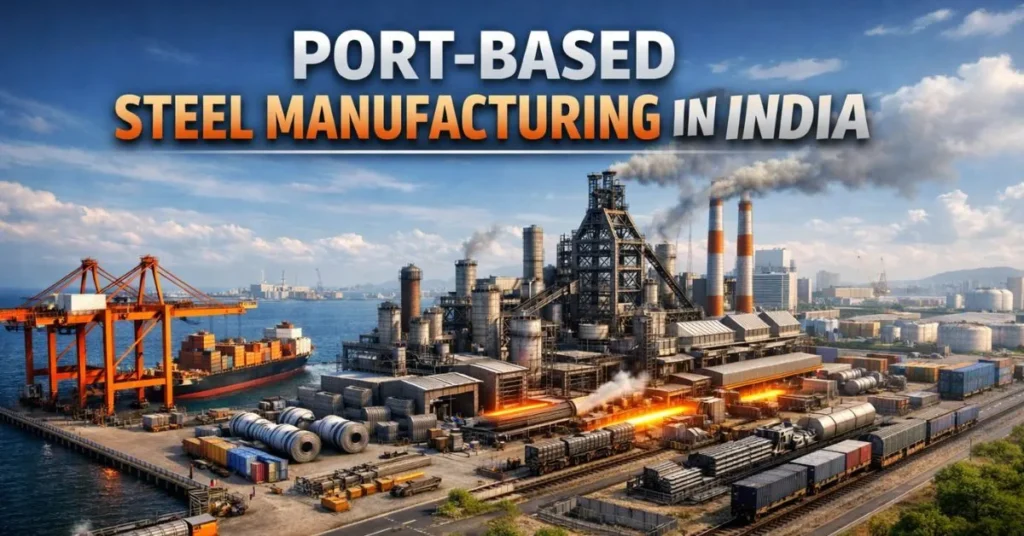
Introduction:Port-Based Steel Manufacturing in India Port-Based Steel Manufacturing in India is transforming the manufacturing sector through improved infrastructure, stronger global trade connections, and advanced logistics systems. The establishment of port-based manufacturing clusters has created integrated industrial ecosystems around major seaports, enabling businesses to enhance production efficiency, streamline transportation operations, and significantly boost export performance. In industries like steel and heavy fabrication, geography is increasingly becoming a strategic advantage, as opposed to just a logistical consideration. Port-based locations provide businesses with efficient access to both essential raw materials and international markets and institutional buyers which improves their ability to operate efficiently. For entrepreneurs, investors, and MSMEs looking for long term sustainability, steel manufacturing nearby ports is an attractive opportunity. The implementation of port-centric manufacturing models enables businesses to enhance their operational efficiency through two main methods which include reducing supply chain complexity and fulfilling their regular production needs. Read More: The Complete Technology Book on Hot Rolling of Steel (2nd Edition) The Concept of Ports Based Manufacturing Clusters Port-based manufacturing clusters are integrated industrial zones where production facilities are working in the close proximity to maritime infrastructure. These clusters create a complete system which combines all essential elements for manufacturing and logistics operations because they include facilities for production and storage and customs processing and distribution to international markets.(Port-Based Steel Manufacturing in India) The system creates an efficient value chain which enables direct port access to raw materials and requires minimal handling time to deliver finished products worldwide. Manufacturers benefit from reduced logistics expenses and faster delivery times and improved supply chain reliability. India’s increasing focus on the economic zones along its coast, port modernization and dedicated freight corridors has spurred the growth of such clusters. Ports are also evolving from transit points into more full-fledged industrial locations which facilitate long-term growth of manufacturing. Why Steel Manufacturing is the Perfect fit for Port Locations Steel production and fabrication are inherently logistics heavy activities. The industry depends on large raw materials such as iron ore, scrap metal and coal, while final products – everything from its structural components to its heavy equipment – also need efficient transportation. Port-based manufacturing solves these challenges by compressing the supply chain: raw materials may be acquired from anywhere in the world and transported directly to production facilities.” Finished steel products can be exported without the costly inland trucking requirement. Inventory storage requirements are reduced because of accelerated shipping cycles. Goods handling and material transfer costs are reduced to a great extent. For manufacturers, these advantages mean better margins and more constant operating expenses. In competitive markets where freight costs are often a major element in profitability, close proximity to ports can be a winning advantage.(Port-Based Steel Manufacturing in India) Read More: Steel Rolling Technology Handbook (2nd Revised Edition) Demand Stability through Institutional Buyers A high strength of the port-based manufacturing is found in its access to institutional and industrial buyers. Ports are complex environments of operation that need constant upkeep, infrastructure upgrade and equipment replacement. The primary factors which drive demand for this service include: Shipping lines & container operators Mariner Engineering and EPC Contractors Logistics and transportation companies Export-oriented manufacturers Infrastructure and maintenance agencies The institutional procurement process uses contract-based operations which operate differently from consumer markets that experience changes based on trends and economic fluctuations. The manufacturing process can create stable production schedules because the system produces consistent demand patterns which help manufacturers achieve constant machine operation throughout their production period. The current business environment assists MSMEs and mid-sized fabrication businesses to decrease their sales risk while they enhance their ability to predict their financial results.(Port-Based Steel Manufacturing in India) Steel Product Segments Most Suitable for Port Clusters Not all steel products have equal benefits from the proximity to the coast. The most successful categories have the following characteristics in common: they have high weight, they have an export orientation, and there is a continuous institutional demand.(Port-Based Steel Manufacturing in India) Read More: Steel Fabrication Industry Container and Container Component Production Shipping containers, corrugated panels and structural frames are directly related to port operations. Manufacturing these components in the vicinity of deployment areas curtails the turnaround time and allows for quicker servicing.(Port-Based Steel Manufacturing in India) Marine and Port Infrastructure Fabrication Ports require constant maintenance of safety and structural equipment such as bollards, fenders, access platforms, railings, crash barriers, etc. Replacement cycles create constant recurring demand. Structural Steel for Export Projects Prefabricated steel structures, which are used in international infrastructure projects, have the advantage of immediate access to the ports. Reduced shipping delay and logistics cost gives coastal fabrication units a strong competitive edge.(Port-Based Steel Manufacturing in India) Manufacturing of Logistics Equipment Trailers, skeletal carriers and cargo handling structures suffer intensive use within port ecosystems. Local manufacturing enables fast maintenance support and customer relationship building in the long run.(Port-Based Steel Manufacturing in India) Read More: Top 20 Steel Manufacturing Business Ideas Economic Benefits and Profitability Apricots, Avocados and Apples Port-based steel manufacturing has some structural advantages that lead to long-term financial soundness: Predictable Logistics Costs: With shorter transportation distances, there is less exposure to volatility and fuel price risk in freight. Improved Payment Discipline: Institutional clients tend to adhere to structured procurement cycles and contracts, resulting in more predictable payment schedules. Export Pricing Opportunities: Manufacturers who access international markets can use international pricing standards as their benchmark instead of competing only within their local markets through price wars. Consistent Production Utilization: A constant demand from industrial activities in setback offers better asset performance at low idle time. Instead of being at the mercy of volatile market spikers, manufacturers within port clusters tend to enjoy steady margin of EBITDA supported by operation efficiency. Infrastructure Development Building a Demand Flywheel The extensive Indian investments in logistics and coastal infrastructure development create more attractive opportunities for port-based manufacturing operations. Key developments include: Expansion of Coastal Shipping Networks Dedicated freight corridors between industrial regions Inland Waterway Connectivity projects Modernized systems of cargo handling and containerization The