
Why India Still Imports Sorbitol? Maize Processing Industry Capacity & Business Opportunity
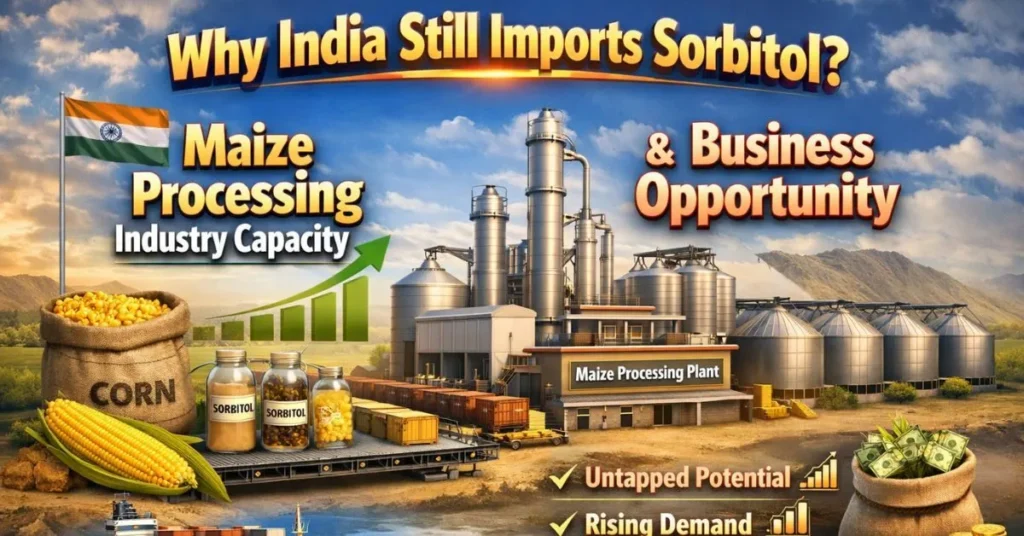
Introduction: Maize Processing Industry India India’s maize processing industry has undergone a tremendous transformation during the past decade from being primarily an agriculture-driven enterprise to being a strategic industrial sector. Processed maize derivatives like starch, liquid glucose, dextrose monohydrate and sorbitol have become key raw materials for pharmaceutical, food processing, textiles, paper, adhesives, fermentation, and personal care industries. Despite being one of the largest producers of maize in the world, India still has a structural deficit in industrial maize processing capacity. This demand-supply gap has led to persistent reliance on imports for refined maize derivatives, in particular, pharmaceutical-grade sorbitol and specialty glucose syrups. As a result, maize wet milling has become a high potential manufacturing and investment opportunity for organized sector players and MSME entrepreneurs.(Maize Processing Industry India) Read More: Maize (Corn) Products in India (Starch, Glucose, Dextrose, Sorbitol) Trends, Opportunities, Market Analysis and Forecasts (Upto 2030-31) Maize Production Scenario in India India is one of the leading maize producing countries in the world. According to the data released by the ministry of agriculture and farmers welfare, more than 36 million metric tonnes of maize is produced in the country every year. Maize cultivation is concentrated in states in: Karnataka Madhya Pradesh Maharashtra Telangana Andhra Pradesh Bihar These states have benefited from favourable agro-climatic conditions, availability of hybrid seeds and increasing mechanization. However, high agricultural production has not been matched by equivalent levels of industrial processing, and a disconnect of the farm production with the utilization of it in the industries has developed.(Maize Processing Industry India) Utilization Pattern of Maize in India The pattern of domestic consumption of maize reveals the limitations of the processing infrastructure in India: 55-60% used in poultry and animal feed 10–15% consumed directly as food 20-25% used for industrial processing Developed economies, on the other hand, use a much higher proportion of maize in value-added industrial products. India’s low processing share is the reason that industries are still importing refined derivatives despite good availability of maize domestically.(Maize Processing Industry India) Read More: Handbook on Maize (Corn) Processing and Manufacture of Maize Products Industrial Demand for Maize Products The demand for maize derivatives has grown steadily because of growth in a range of end use industries. Each derivative has a different and critical industrial function: Important Derivatives and Uses of Maize Maize Starch Used in textile sizing, paperboard manufacture, corrugated box adhesives and pharmaceutical tablets binding. Liquid Glucose Widely used in confectionery, bakery products, ice creams, jams and other medicinal syrups, and infant foods. Dextrose Monohydrate Essential for intravenous (IV) fluids, fermentation industries, nutraceuticals and energy supplements. Sorbitol Extensively used in toothpaste, oral care products, cosmetics, the development of vitamin C, pharmaceutical preparations; According to the industry insights from Ministry of Food Processing Industries, the increased intake of packaged and processed food items has directly increased the demand for starch and glucose syrups. Simultaneously, because of rapid expansion of pharmaceutical manufacture under the Department of Pharmaceuticals, there is a significant increase in the requirement for pharmaceutical grade sorbitol.(Maize Processing Industry India) Major Maize Processing Companies in India and Capacity The maize wet milling capacity in India is concentrated amongst a few organized players. Some of the major companies are: Gujarat Ambuja Exports Ltd. The largest player, with estimated processing capacity of more than 4000 tonnes per day, producing starch, liquid glucose, sorbitol and by-products. Riddhi Siddhi Gluco Biols Ltd. A leading supplier of starch derivatives to the food and pharmaceutical industries. Sukhjit Starch & Chemicals Ltd.The company employs one of its most experienced players who has extensive knowledge of both national and international markets. Roquette India Pvt. Ltd. Focused on Specialty starches and Pharmaceutical Excipients. Gulshan Polyols Ltd. A leading manufacturer of sorbitol and other polyols. Despite their combined output, existing capacity is too low to keep pace with the rapidly growing demand from the pharmaceuticals, food processing and personal care sectors.(Maize Processing Industry India) Read More: Maize, Corn and its By Products, value added Products, Derivatives, Maize Processing Industry, Corn Starch, Dextrose, Liquid Glucose, Sorbitol, Oil, Gluten, Germ Oil, Wet Milling, Maize Starch Plant & related Products, High-Fructose Corn Syrup (HFCS) Import Dependency & Regional Demand Gap However, India continues to import considerable amounts of refined sorbitol and specialty glucose syrups. Pharmaceutical manufacturing clusters in Gujarat, Telangana, Himachal Pradesh and Maharashtra often purchase sorbitol from Chinese, Indonesian and European suppliers. Due to this import dependence there are: Higher procurement costs Exposure to volatility of foreign exchange Longer lead times Vulnerability to Disruptions in Global Supplies For domestic manufacturers, this avails a significant import substitution opportunity. Industrial buyers receive faster product delivery because maize wet milling units operate closer to consumption locations. The units simultaneously provide customers with competitive pricing and reliable product delivery.(Maize Processing Industry India) Overview of the Maize Wet Milling Process The major steps in a typical, integrated maize wet milling plant are: Steeping – Maize kernels are put in a soaking phase to soften the endosperm Grinding and Separation – grinding and Starch gluten fiber and germ are separated Starch Refining – purification and concentration of starch slurry Hydrolysis – It is the conversion of starch to glucose syrup by the use of enzymes Crystallization – Dextrose Monohydrate Formation Hydrogenation – Glucose is converted to sorbitol Valuable By-Products Maize germ (edible oil) Corn gluten meal (animal feed) Corn Fiber – feed & industrial uses Sale of by-products makes overall project much more profitable.(Maize Processing Industry India) Read More: 3 Profitable Green Manufacturing Business Ideas in 2026: Bio-CNG, Maize Starch & Palm Oil Mill Importance of Techno-Economic Feasibility Studies Before investing in maize processing projects, entrepreneurs need to undertake a detailed technical and financial evaluation. A professional feasibility study is helpful to investors who want to know: Market demand and price trends Best product mix and capacity selection Technology alternatives and plant configuration Raw material sourcing and logistics Project cost, ROI and break even period Organizations like Niir Project Consultancy Services offer Market Survey-cum-Detailed Techno-Economic Feasibility Reports which go a long way