
Top 3 Profitable Manufacturing Business Ideas in India (Low Investment, High Demand)
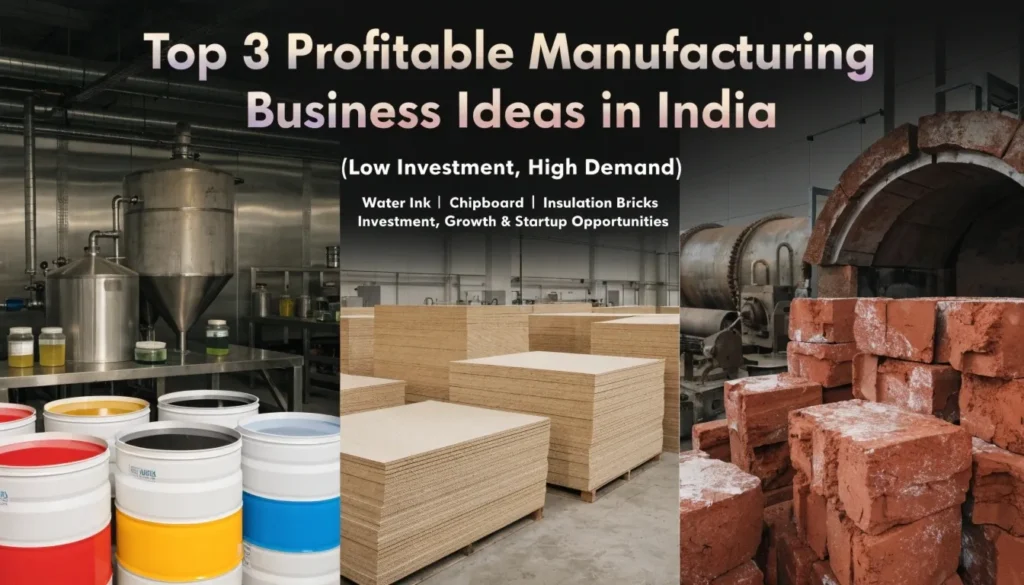
profitable manufacturing business ideas in India India’s manufacturing sector is rapidly growing as infrastructure projects, urban housing and industrial expansion continues to increase. Government initiatives for promoting domestic production in addition to a growing demand from the packaging, construction and furniture industries have generated great opportunities for entrepreneurs. For first time business owners and MSMEs, this is one of the most important decisions since it defines long-term profitability and business stability as they select the right manufacturing product. Successful manufacturing businesses typically have three things in common: consistent demand, scalable production and reliable access to raw materials. In the current market environment, there are three manufacturing segments which stand out because of their good growth potential and stable demand. These include water-based printing inks, melamine faced chipboard and high temperature insulation bricks. And each of these products serve important industries that continue to grow regardless of economic fluctuations. Download the Full Guide: The Complete Book on Water Soluble Polymers 1. Water Based Printing Ink Manufacturing Business Water-based printing inks are gaining more and more popularity due to the fact that industries are making a move towards environmentally friendly production methods. Unlike solvent-based inks, these inks use water as the main solvent, and because of this the harmful emissions are reduced and the safety is improved. The packaging industry is one of the biggest consumers of printing inks, and this industry growing rapidly, there is a big demand for their reliable ink suppliers. The growth of e-commerce, food delivery services and retail businesses has greatly increased the demand for packaging materials. As more products are shipped and delivered on a daily basis, the need for printing inks continues to increase. This makes the industry rather stable and amenable to new entrepreneurs. Common Applications Water based printing inks are used extensively in industries such as: Corrugated packaging boxes Paper bags and cartons Labels and stickers Food packaging materials Newspaper printing, commercial printing These applications guarantee repeat demand from clients, which is imperative to keep a steady cash flow. Manufacturing Process Overview The production process is easy to do technically, but requires careful quality control. Manufacturers start by mixing pigments with water and resins to produce the base formulation. The process requires grinding equipment to produce a mixture that achieves both consistent particle size and uniform colour distribution. The ink undergoes quality and performance testing before it gets packaged for delivery to customers. Typical equipment used in the production includes mixing tanks, grinding machines, filtration systems, and testing instruments. Most small and medium units are capable of setting up operations under a moderate level of investment and expand production as demand increases. Investment and Profit Possibilities This business is seen as one of the most accessible manufacturing businesses for beginners. The level of investment is manageable as compared to heavy industries and the margin of profit is attractive if the operations are efficient. Estimated figures: Investment: ?25 lakh to ?60 lakh Profit margin: 18% to 25% Break-even period: 12 to 24 months The recurrent demand for packaging companies makes this business financially stable. Access Complete Business Plan : Melamine Manufacturing Plant Guide 2. Melamine Faced Chipboard Manufacturing Business Melamine faced chipboard is a man-made wood product that is used extensively in the manufacture of furniture and in interior building. It offers a long-lasting and decorative surface that needs no extra finishing, saving time and money on labor and finishing. As urban populations begin to rise and the demand for housing continues to increase, the demand for low-cost furniture and interior materials is continually on the rise. In the past few years, the modular furniture market has grown quickly, particularly in cities. Consumers like to use ready-to-assemble furniture because it is cost-effective and easy to install. This trend has led to a large rise in demand for man-made products such as melamine faced chipboard. Where the Product Is Used The common uses of melamine chipboard include: Manufacturing of modular furniture Kitchen cabinets and wardrobes Office furniture and partitions Retail store fixtures Interior wall panels These applications make the product an essential product in both residential and commercial construction projects. Summary of the Manufacturing Process The manufacturing process is by compressing wood particles and laminating the decorative paper on the surface. The first stage is on making particle boards with wood chips and adhesive resins. In the second stage, melamine paper is applied under heat and pressure to give a smooth and durable finish. Entrepreneurs may opt to start with smaller lamination units by buying particle boards from suppliers. This lowers the cost of starting a business and lets businesses enter the market as fast as possible. Cost Structure Example Some of the major cost components in this business usually include: Raw materials: about 55% Energy and utilities: about 12% Labor costs: about 10% Machinery maintenance and depreciation: about 8% Administrative expenses, logistics: about 15% Efficient operations can produce steady profits and enable long-term growth. 3. High Temperature Insulation Brick manufacturing business High temperature insulation bricks are specialized kinds of bricks that are used in industries that have furnaces and kilns. These bricks help keep the temperature high and reduce heat loss, which helps to improve energy efficiency and save on operating costs. Industries such as steel, cement and glass manufacture make use of these products to a great extent. As the infrastructure development and industrial production are on the rise, the demand is likely to grow steadily for refractory materials. Unlike consumer products, industrial materials are often subject to long term contract, which means stable revenue for manufacturers. Major Industrial Applications High temperature insulation bricks are used in: Steel plants Cement factories Glass manufacturing units Cement works are highly complex and costly, and must be operated by experts Petrochemical refineries Power plants These industries run at all times of the year and this way there is a steady demand for refractory materials. Find high-return business ideas based on your budget & ROI Production Process The process of manufacturing the brick involves mixing raw