
Best Manufacturing Opportunities in India Under PM Modi: MSME Growth, PLI Scheme & High-Profit Sectors
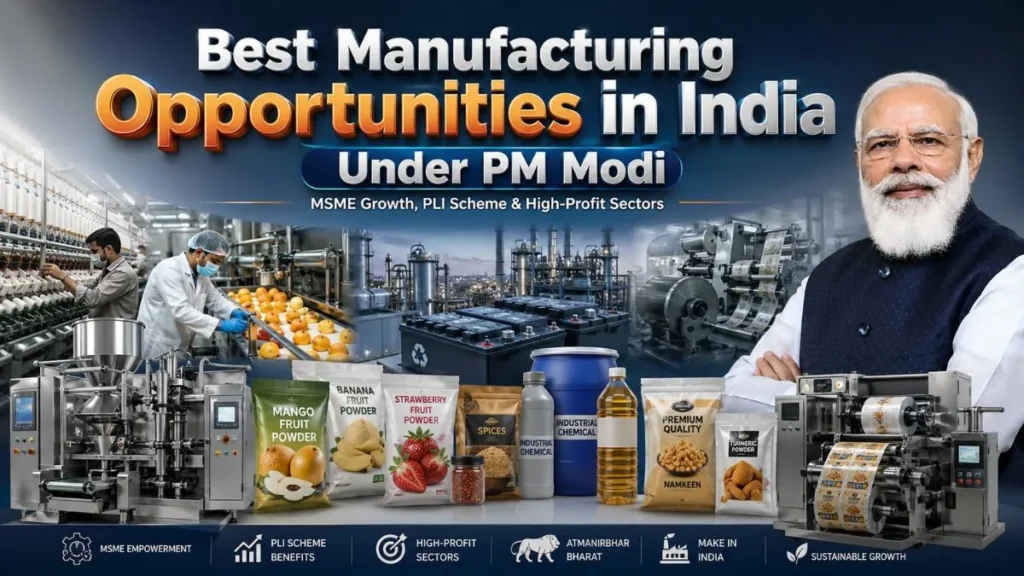
Introduction: Manufacturing Business Opportunities in India India is witnessing a transformation in its manufacturing and industrial sector. The new prime minister (PM), Narendra Modi, is leading the country into a period where industry is not only concentrated in traditional centres, but is also growing at a large pace in new industrial cities and clusters in India. This time it is not just a matter of policy announcements, but also the movement of capital, establishment of new factories and expansion of supply chains. The approach toward manufacturing is now more strategic, rather than traditional. Electronics, EV components, chemicals, food processing and medical devices are all growing today in India. MSMEs are playing a pivotal role in this growth. Related Article: Industrial Opportunity in India Under PM Modi: MSME Growth, PLI Scheme & Profitable Manufacturing Businesses Policy Drivers Behind India’s Industrial Growth The acceleration in India’s industrial production is not accidental but part of specific policy reforms that are working on improving efficiency in production, infrastructure and investment friendly nature. 1. Production Linked Incentive (PLI) Scheme The government’s most influential policy is the Production Linked Incentive (PLI) scheme. The PLI scheme is different from traditional subsidies as companies are rewarded based on the actual output. This has brought a massive amount of investment into: Electronics manufacturing Pharmaceuticals Automotive components Electrical appliances (ACs, refrigerators) This scheme has helped decrease imports and strengthened Indian indigenous manufacturing. 2. PM Gati Shakti Infrastructure Program The PM Gati Shakti programme ensures the holistic infrastructure planning by integration between railways, waterways, airways and roadways along with the logistics. Key benefits include: Reduced transportation delays Lower logistics costs Improved industrial corridor development Shorter execution times This has further accelerated the competitiveness of India’s manufacturing. 3. MSME Reforms and Financial Inclusion The policy support for MSMEs has been substantial and was directed towards: Udyam registration simplification Collateral-free credit schemes Credit Guarantee Fund Trust (CGTMSE) Online payment systems such as Tred’s These programs have helped with credit availability and formalized lending. Key Sectors Driving MSME-Led Industrial Growth Industrial growth in India has been uneven as various sectors have grown at varying rates influenced by the demand from these sectors and also by the possibilities of importing the substitute goods and further export. 1. Electronics Manufacturing India is a large importer of electronic components like semiconductors, PCBs (printed circuit boards), and connectors. The huge opportunity this is creating is in: PCB manufacturing Mobile components Consumer electronics assembly India offers a potential option as the world is shifting their supply chains out of China. Get Detailed Insights from This Book: Electronic Products Handbook With Circuit Diagrams 2. Electric Vehicle (EV) Ecosystem India’s EV industry is rapidly growing. Opportunities are in: Battery assembly and recycling Charging infrastructure Motor controllers and electronics Lightweight components The growth is also being helped by government subsidies. 3. Specialty Chemicals and Pharmaceuticals India is emerging as a leading pharmaceutical manufacturing and chemical intermediates hub. Growth is driven by: Export demand China relocation of supply chains Healthy domestic demand Access Complete Business Plan: Pharmaceutical Drugs and Fine Chemical Intermediates Guide 4. Food Processing Industry India has good raw material supply for food processing industries. High-potential segments include: Millet-based products Ready-to-eat foods Packaged snacks Organic processed foods 5. Medical Devices & Healthcare Manufacturing COVID-19 exposed India’s reliance on imports for medical devices. Now, there are good opportunities in: Surgical instruments Diagnostic kits Medical disposables Hospital equipment High-Growth Manufacturing Segments (Key Opportunities) There are a few MSME-favourable segments with low barriers and high demand visibility: Electronic parts such as PCBs and connectors EV battery packs and chargers Specialty chemical intermediates Medical disposables and surgical kits Millet and processed food products Valves and castings These industries offer both opportunities for import substitution and increasing domestic demand, and so represent a good choice for entrepreneurs. How MSME Founders Should Approach Manufacturing Manufacturing business in India needs planning, not just investment. First-time manufacturers may not fully appreciate operating complexities and working capital needs. Crucially, it’s the profitability. Even though gross margins in manufacturing may be appealing, net margins can be smaller due to raw material price variability, labour, logistics and interest expenses. Key planning principles for founders: Don’t go for full capacity setup Lock in at least 1-2 key buyers Keep tight control of working capital for 90-120 days Don’t over-rely on one supplier or customer Avoid delays in approvals for regulatory and environmental requirements This increases the likelihood of survival in the first 2-3 years. Import Substitution and Export Opportunity India imports a substantial number of industrial products including components for electronics, machinery and special chemicals. This may provide a useful import substitution avenue for Indian industry. The growth of demand for exports (in particular, engineering goods, pharmaceuticals and textiles) makes the manufacturing sector vital for Indian growth. Most promise will be for those who can supply to both. Risks Entrepreneurs Must Understand However, manufacturing has risks too-which need to be managed with caution. Some key challenges include: Import dependency for some industries Time-consuming and cumbersome environmental and regulatory clearances Late payments, particularly in government contracts Exchange rate variations impacting cost of inputs Seasonal demand in cyclical sectors Enterprising entrepreneurs may minimize risks by using multiple suppliers, phased expansion and locking in buyer orders. Identify high-growth industries before others do Role of NPCS in Industrial Project Planning NPCS (Niir Project Consultancy Services) is also the key functionaries for entrepreneur’s keen on manufacturing in India. NPCS provides with Detailed Project Reports (DPRs), feasibility reports and market research so that an investor can decide beforehand whether it is a profitable venture to invest in, or not. These reports typically include: Market demand analysis Details of machinery and processes Cost and financial analysis Sourcing suggestions for raw materials Risk and sensitivity analysis This will be very important for an entrepreneur making the first investment, and avoid a sub optimal or overpriced business model. NPCS provides with the ability for entrepreneurs to take decisions based on facts. Conclusion: Manufacturing Growth Depends on Execution, Not Just Opportunity India’s