
Compressed Biogas Export India Opportunities That Can Earn ₹8 Cr/Year
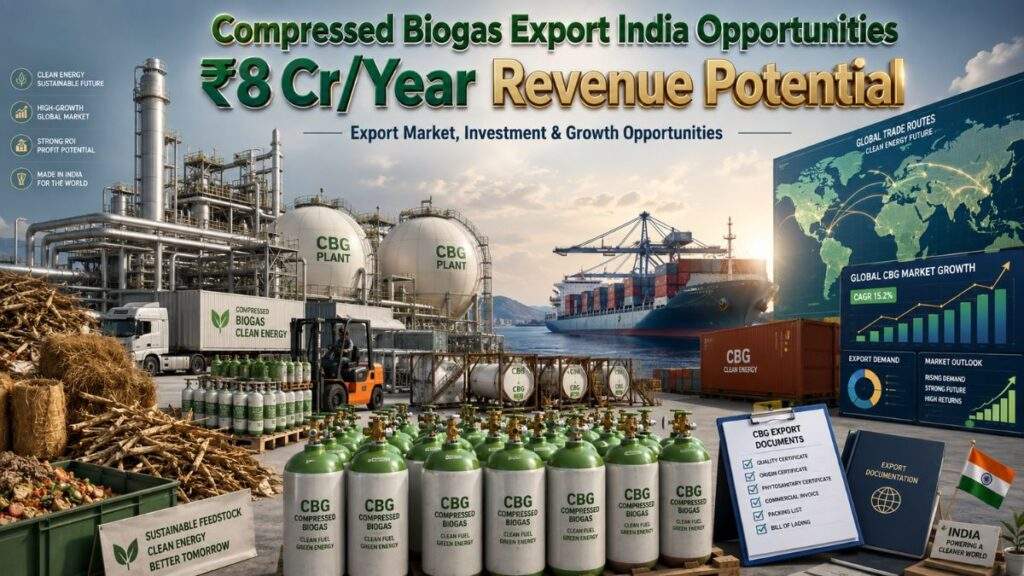
Compressed Biogas Export from India The export India story on compressed biogas is still in its nascent stages but the message is clear. The nation has a huge biomass surplus which can be harvested from agricultural waste, municipal solid waste, dung of cattle etc. which is something that most of the energy importing countries can only dream of. Domestic CBG production is growing and the policy machinery is already geared up for a much bigger play. The CBG-CGD synchronization scheme has led to the successful blending in 54 Geographical Areas of the City Gas Distribution network. The obligation to blend starts in FY 2025-26. Industry is getting regulatory support of this magnitude at an early stage and so is the export potential. India is now not only capable of producing enough CBG but whether entrepreneurs will outpace the other suppliers to catch the global opportunity in a CBG structured around them or not. Why CBG Deserves Serious Startup Attention Right Now The Domestic Foundation Is Being Laid at Speed By March 31st, 2025, the number of CBG and biogas plants commissioned in India is 100 and the total production capacity is around 700 MT per day. India has 100 CBG and biogas plants with an installed capacity of around 700 MT per day as on March 31st, 2025. Around 336 retail outlets have started the sale of CBG. Indian Oil has commissioned 44 plants and sold about 8.9 thousand metric tons of CBG so far under the SATAT initiative and has 714 active Letters of Intent. Get Detailed Insights from This Book: Biogas Applications Handbook These are not pilot numbers. This is industrial-scale momentum. The CBG Blending Obligation (CBO) framework stipulates that 1% CBG blending is required in total CNG/PNG consumption in FY 2025-26 and the target will be increased to 3% in FY 2026-27, 4% in FY 2027-28 and 5% from FY 2028-29 onwards. This is a form of domestic offtake that is guaranteed by law, and that’s what export-grade production needs as a financial backstop. The Export Logic Is Simple but Compelling There are also strong importers of green gas in Europe, Japan, South Korea and some Asian states in Southeast Asia. Germany has been a big producer of bioenergy in the form of biogas in Germany, but feedstock restrictions are slowing the growth. The cost of the LNG imports to Japan is in the tens of billions of dollars per year and the substitution of green gas is a national priority. With year-on-year biomass availability, different agriculture waste streams and now a policy supported CBG sector, India is well poised to take a bow. The compressed biogas export India opportunity is not about sending CBG in cylinders, the freight economics do not work at the current scale. The real export model is the conversion of CBG to liquefied biomethane (bio-LNG) in ISO containers and with the use of conventional LNG infrastructure. Bio-LNG is already being purchased in Europe for long-term contracts. Structural cost advantage on paddy price lies with Indian producers with access to near zero-cost feedstocks like paddy straw, press mud, and municipal waste, versus the European producers. Government Policy: What’s Actually on the Table More comprehensive than most sector founders realize, the Ministry of Petroleum and Natural Gas has developed an architecture of support. Several high-value enablers are confirmed by data from the Annual Report 2024-25 of the Ministry of Petroleum and Natural Gas, Government of India. The SATAT scheme offers a structure for Oil and Gas Marketing Companies to access CBG from private entrepreneurs through the bidding process under the EoI, thereby eliminating the above-mentioned major risk for the first-time CBG plant owner – the off-take question. In addition to procurement guarantees, the policy stack comprises central financial assistance under the National Bio Energy Programme of MNRE, classification of the sector as priority sector by the RBI, exemption from excise duty on payment of GST on CBG blended in CNG, development of pipeline infrastructure scheme for CBG injection into CGD network, and market development assistance of ₹1,500 per MT on Fermented Organic Manure produced as by-product. The subsidy for biomass aggregation machinery, which is applicable till FY 2026-27, tackles the biggest operational challenge for rural CBG units i.e., logistics of collecting biomass. Project Opportunities for Entrepreneurs Paddy Straw-Based CBG Plant (Tier-2 Agrarian Belts) The paddy straw is burnt in millions of tonnes in Punjab, Haryana and in western UP during rabi season. The capex for a 15 – 20 TPD CBG plant based on paddy straw ranges from ₹15 – 22 crores depending on the technology of anaerobic digestion. The gross margins could be as high as 28-34% in case of full utilization at the current OMC procurement price of ₹46-54 / kg along with FOM as a revenue co-stream. The current SATAT LOI are offered to Target Buyers like Indian Oil, BPCL and the HPCL. If the biomass is aggregated from day one in contract, then the scalability path is from 15 TPD to 50 TPD within 3 years. Capital recovery: 6-8 years on equity-based structure, 4-5 years with support from MNRE grant. Get Detailed Project Report (DPR): Industrial Biotechnology: Enzymes, Biofertilizers and Biogas Municipal Solid Waste (MSW) Based CBG Plant Wet waste is a problem for urban local bodies in Tier-2 cities due to Swachh Bharat Mission. This is a place that should be attractive to entrepreneurs who can obtain a long-term concession contract from a municipal corporation. The capex needed for the MSW based CBG plants of 5–10 TPD is ₹8–14 crore. Central assistance, apart from the MSW, is offered by the Ministry of Housing and Urban Affairs, which significantly enhances returns for CBG projects. EBITDA margin profile: 22–28% with tipping fees from the municipality factored in to the concession structure. Bio-LNG Production Unit for Export (Joint Venture Model) This is the most expensive and most profitable. Additional infrastructure cost of bio-LNG unit attached to a 50 TPD CBG plant comes to ₹12–18 crore. Total project cost: ₹35–50 crore. Under