
6 Green Manufacturing Business Ideas in Afghanistan with 35% Margins and Growing Demand
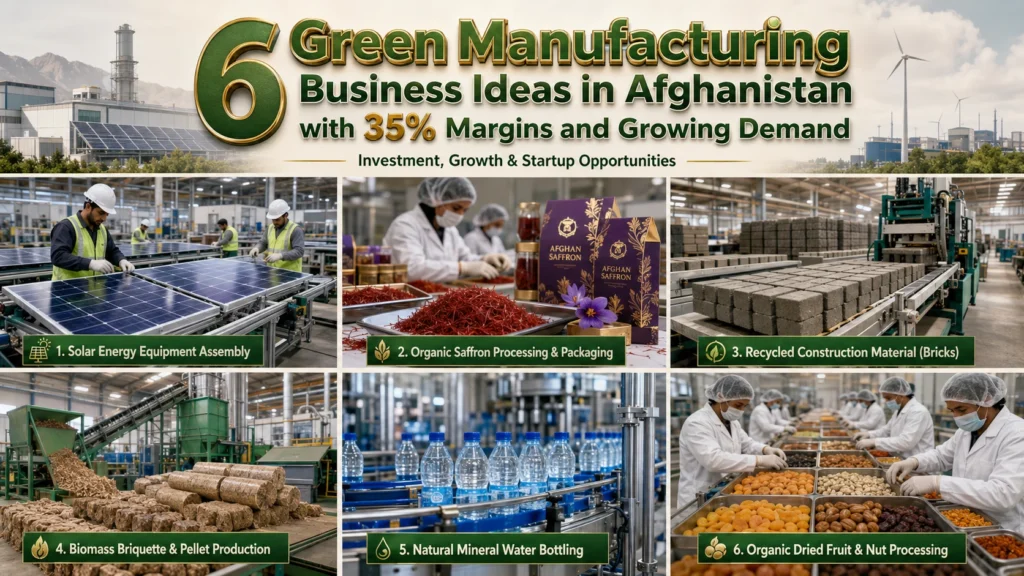
Green Manufacturing Business Ideas in Afghanistan In Afghanistan, the average annual amount of sunshine is over 300 days. It receives an average solar irradiance of more than 5.5 kWh/m2/day, higher than most of Europe and comparable to the belt of the deserts in Rajasthan, as per solar resource data available in the Global Solar Atlas published by World Bank. However, more than 70% of its citizens still do not have access to reliable electricity. Businesses run generators. Hospitals operate on borrowed electricity! For six to eight hours a day, factories sit idle due to the failure of the grid to deliver. This paradox, of a vast abundance of natural resources and a grinding poverty of industry, is no tragedy for those who merely look on. An investor or a green entrepreneur or a manufacturer, it is a signal. Such a market niche will not remain unoccupied for long. The Afghan country is also a major producer of saffron, the spice, which fetches INR 3.5–4 lakh per kilogram in international markets. The United States Geological Survey (USGS) has identified some of the most abundant deposits of lithium, copper and rare earth elements in the world in its mountains. It is an agriculture-based area that yields apricots, pomegranates, figs and almonds used in Central Asia and the Middle East. This is hardly processed locally. Related Article: Profitable Green Manufacturing Business Ideas in India: Waste to Wealth Opportunities The Market Gap: Resource-Rich, Processing-Poor Put it in numbers. The importation of manufactured consumer goods into Afghanistan accounts for approximately 80% of imports. Electricity generation capacity is less than 700 MW for a population of 40 million compared to Nepal’s 2,000 MW and Pakistan’s 40,000 MW for 300 and 220 million people respectively. Solar energy alone could power the entire electricity demand of Afghanistan multiple times while IRENA (International Renewable Energy Agency) has identified Afghanistan’s renewable energy potential as one of the least tapped in Central Asia. On the green side in particular: solar panel imports have been increasing by more than 18 per cent a year for several years now, but there is, to date, no significant solar panel assembly plant in the country. All panels are imported from China, India and UAE with import duty, freight charges and dealer margins. If assembled locally, even at a small scale, a 20-28% reduction in the landed cost of an imported unit can be achieved by a locally assembled panel. Saffron has a more pointed tale. There are approximately 20,000–25,000 tonnes of raw saffron filaments produced in Afghanistan every year. More than 85% of which is exported unprocessed to Iran and UAE, where much value is lost, as detailed by the Food and Agriculture Organization (FAO) . Iran cleans, grades, repackages it, gives it its own name and sells it to Europe at four to five times the farm-gate price. The benefits of the capturing in the Afghan units are currently enriching Iranian intermediaries. Another important gap is the lack of biomass briquettes. For more than 60% of Afghan households, wood fuel and animal dung fuel continue to be their main source of heat. These industrial briquettes, which are made from agricultural waste, such as wheat straw, cotton stalks, or almond shells, are burned with fewer pollutants, for a longer duration and to help significantly reduce indoor air pollution by up to 70%. Demand from urban areas is strong and growing. There is virtually no organized supply. Table 1: Key Green Manufacturing Sectors in Afghanistan — Opportunity Snapshot Green Business Sector Key Advantage Priority Regions Est. Investment (INR) Market Demand Solar Energy Equipment Assembly High solar irradiance (300+ days/yr) Kabul, Herat, Kandahar INR 42–65 Cr Growing rapidly Organic Saffron Processing & Packaging World’s top saffron producer Herat, Farah INR 8–18 Cr High — export-driven Recycled Construction Material (Bricks) Massive post-conflict reconstruction Kabul, Jalalabad INR 6–12 Cr Very High Biomass Briquette & Pellet Production Critical heating fuel shortage All major provinces INR 3–7 Cr Very High Natural Mineral Water Bottling Untapped aquifer resources Bamyan, Nuristan INR 5–10 Cr Moderate–High Organic Dried Fruit & Nut Processing Global demand for Afghan dried fruit Kandahar, Helmand, Farah INR 4–9 Cr High — USD-earning Source: UNAMA trade data, Afghan Ministry of Commerce, NPCS Market Research estimates. All INR figures are indicative investment ranges. Get Detailed Insights from This Book: Solar PV Power and Solar Products Handbook How to Set It Up: Solar Panel Assembly Unit Among the green manufacturing sectors presented above, the assembly of solar panels has the lowest technology risk, the highest local demand alignment, and the shortest payback period. This is a step-by-step guide to setting up a small to medium assembly unit. Minimum Investment The total capital expenditure needed for a functional assembly unit of 5 MW per year would be between INR 65-100 lakh, which includes the plant setup, machinery, and working capital for 3 months. The cost of the put together system is Rs. 22-30 lakh per MW/year in micro scale, and sharply improved at the 5 MW scale. Land and Space Requirements There should be 500–800 square metres of factory space available that is covered. Clean, dust-controlled environment is required for lamination and cell tabbing. There are industrial areas in Herat and Kabul where plots are available. The cost of a month in the industrial zone of Herat is currently USD 0.4 to USD 0.6 per sq metre. Key Machinery Equipment Cost Range (INR) Solar cell tabber and stringer machine ₹12–18 lakh Laminator (EVA film press) ₹6–9 lakh Solar simulator and IV curve tester ₹4–6 lakh Frame assembly jig and junction box attachment station ₹2–4 lakh EL imaging system for defect detection ₹3–5 lakh Raw Material Sourcing Solar cells are manufactured using monocrystalline or polycrystalline wafers from China (the leading world supplier) and usually have a lead time of 30-45 days. EVA encapsulant film, backsheet, aluminium frames and junction boxes also come in from their main supplier China. Logistics planning from the outset should include a reliable import route, either via the Herat–Islam