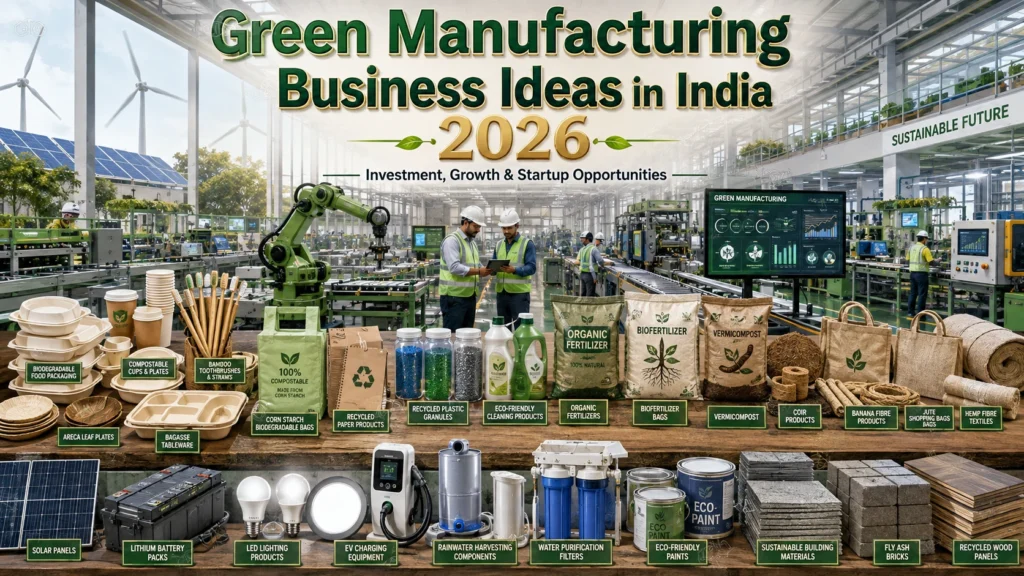
Green Manufacturing Business Ideas in India for 2026
Green Manufacturing Business Ideas in India for 2026 Read More »
Opportunities for Circular Economy, Recycling and Eco-Friendly Products that are Profitable. The concept of sustainability has grown from being a catch phrase into a viable business model. With India taking a step toward a circular economy, recycling and eco-friendly manufacturing have become regulated, financeable, and future-proof industries. This is a once-in-a-lifetime opportunity for entrepreneurs looking for new and innovative green manufacturing business ideas in India for 2026. There are several trends pushing demand toward sustainable products, including tighter plastic bags, longer producer responsibility regulations, and green-financing incentives. The purpose of this guide is to highlight the most viable manufacturing concepts that are green and circular economy that can be pitched to startups, MSMEs and investors. Where they are successful, they have both a positive environmental benefit and a strong economic return, and many have a steady source of raw materials because they are a waste stream others are willing to pay for. Size of investment is no restriction; it is the process know-how and compliance that is important. In addition, you’ll get practical advice on licensing, government assistance, and how to take your idea from concept to product throughout. The agricultural residue, e-waste, used batteries and plastic waste that India produces annually is immense and a significant proportion of which is unutilised. Every waste stream is a raw material opportunity to a green manufacturer. Meanwhile, extended producer responsibility regulations are making brands responsible for recycling and sustainable packaging, meanwhile, which offers an assured market for conforming units. Thus, it is that green manufacturing is structurally attractive in 2026, being cheap inputs and mandated demand. Related Article: The Green Manufacturing Revolution: Paper Water Bottles, Bioplastics & Biodegradable Products Why Green Manufacturing Is Booming in India The move towards a circular economic system in India has taken recycling to an increased degree of regulation, bringing it to an industry level with long-term demand. The E-waste, battery waste and plastic reprocessing now have the regulatory certainty that provides a consistent flow of raw materials and access to green financing. Meanwhile, there is an increasing consumer demand for biodegradable and compostable products from global brands and Indian consumers which creates export avenues for eco-friendly products. Green manufacturing’s strategic value is “waste to value economics”. If your raw material is agricultural residue, old electronics or used batteries, your margins will be low, your environmental branding will be high, and you’ve got a powerful combination. Top Green Manufacturing Business Ideas in India for 2026 1. E-Waste Recycling and Metal Recovery In India, electronic waste recycling has been now legally regulated and has made the raw material available to the electronics recycling units and also created a steady demand for the recycling industry. Dematerializing copper, gold, aluminium and reusable parts from waste e-waste is a viable, eco-friendly, economically valuable scalable business. Only a tiny percentage of e-waste is processed in India and there is a huge gap in between of the organised recyclers. Building a regulated e-waste recycling centre complete with the required pollution-control and extended producer responsibility authorisations is the professional way to begin a business to securely and reliable provide this service to companies that are legally required to recycle their own products. 2. Lithium-Ion Battery Recycling As automotive and consumer electronic batteries end their service, the extraction of high-value minerals like nickel, lithium and cobalt presents an eco-friendly and economic choice. Battery recycling truly is one of the new manufacturing frontiers in India for 2026, supported by policy, and increased volumes. With India importing close to 100% of these critical minerals, it is essential that there is a strategic interest in their recovery in addition to being profitable, and cell manufacturers are more willing to purchase recovered minerals to mitigate their import risk. The first to learn the chemistry to recover the materials and to be able to obtain a regular stream of spent batteries will be able to establish a position which will serve them for decades. Read the Complete Book Here: Handbook on Lithium-Ion & Lead-Acid Battery Production and Recycling 3. PLA Bioplastic and Biodegradable Cutlery Manufacturing Poly Lactic Acid (PLA) is a biodegradable plastic, the world’s fastest growing, made from renewable corn starch. As single-use plastic restrictions increase, there is a great opportunity for restaurants, caterers and cloud kitchens to brand their cutlery, plates and packaging with PLA, a material that’s being manufactured for export. 4. Biochar Production from Agricultural Waste Biochar tackles both agricultural productivity and waste management by turning crop residue into a soil amendment and water filtration material. Crop residue is utilized as biomass in millions of tonnes every year in India which leads to air pollution; hence the conversion of this residue into a useful product has both commercial and environmental benefits. Biochar is a low barrier, high relevance, green manufacturing concept with relatively low start-up costs and increasing market relevance in the field of sustainable and organic agriculture, which is particularly suitable for bioentrepreneurs in rural regions who are close to agricultural clusters. 5. Sustainable and Biodegradable Packaging Sustainable packaging is on the rise as companies move away from plastic packaging and towards biodegradable options in response to legislation and consumer demand. The applications for bagasse tableware, moulded-fibre packaging and compostable films are of huge and increasing importance for restaurants, food delivery, airlines and e-commerce. Biodegradable packaging benefits from government incentives and increased consumer demand as single-use plastics are increasingly subject to regulation and large buyers are increasingly adopting and requiring sustainability objectives, making it one of the most bankable sustainable manufacturing ideas for 2026. Get Detailed Project Report (DPR): Biodegradable Packaging & Bio-based Polymers Guide 6. Plastic Reprocessing and Recycled Granules Plastic reprocessing units convert post-consumer and industrial plastic waste into plastic granules which are used to make plastic product. This business is now subject to the extended producer responsibility norms that guarantee it a consistent and stable supply of raw materials and sustained demand from packaging and moulding plants. Recycled content is a legal requirement and assures a market for quality recycled granules.