
How to Start Electrical Transformer Manufacturing Business in India (Up to 20,000 kVA, 36 kV)
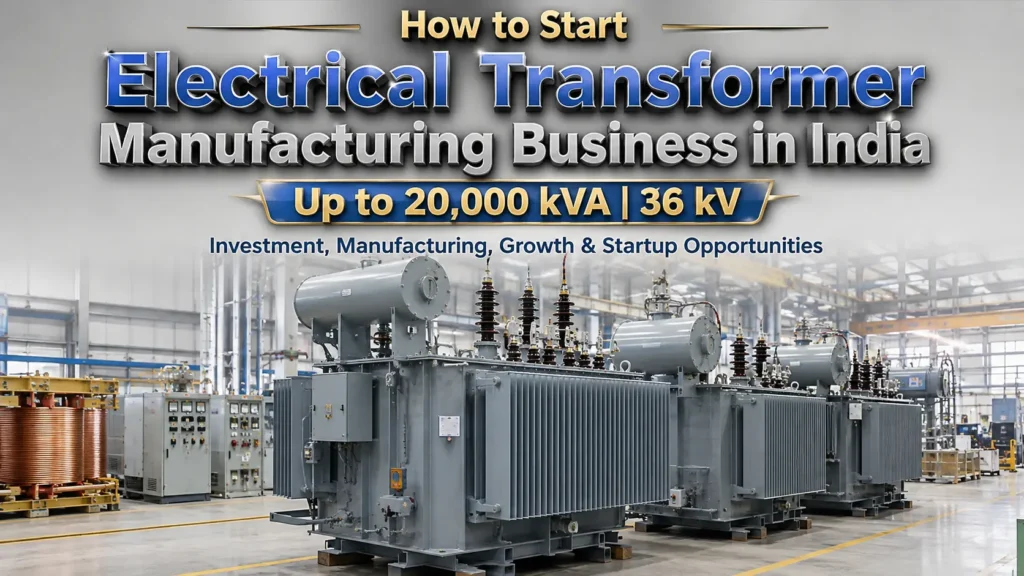
Electrical Transformer Manufacturing Business Simple as this is, India requires more power each and every year and this is where one of the most stable manufacturing business ideas of today is booming in the industrial sector; the manufacturing of electrical transformers. Transformers rated up to 20,000 kVA at 36 kV are needed by all distribution utilities, industrial plants, and renewable energy developers, and demand continues to grow, even in the wake of other sectors experiencing a slowdown. This is a unique combination of consistent orders, policy support, and long product life cycles for entrepreneurs looking into business ideas that have the active support of the government. This article provides insight into why time is crucial, the schemes that truly benefit new manufacturer, and the specific business ideas that fit a first-time promoter. Why This Sector Is Growing Fast The demand for power in India continues to grow. Peak electricity demand is already at 240 GW and will soon exceed 400 GW within this decade. This means that state utilities and private developers must purchase thousands of new transformers annually, simply to provide new connections, as well as to replace old transformers that are no longer efficient. This demand is being propelled in greater and greater numbers by three forces. First, the government’s distribution reform programme is upgrading old feeders and substations in various states, thereby generating new orders for transformers on an ongoing basis. Second, the number of inverter-duty and solar step-up transformer demand is huge for renewable energy projects, and this market was barely present 10 years ago. Third, the blooming growth in pharma, data centre, steel and cement industries is creating direct demand for dedicated power and distribution transformer. In the meantime, the fact of dependence on imports is an issue to consider. In the past, Chinese manufacturers have been known to secure a number of big tenders from utilities at cheaper rates, which has prompted the authorities to actively promote domestic capacity development. This means that new players that are interested in quality, test facilities, and on time delivery are able to secure contracts more easily than many other capital goods businesses. What’s rare about manufacturing business ideas is that the demand for transformer manufacturing is predictable and backed by the government instead of consumer sentiment. The demographic aspect can be a point of interest also. A number of well-known transformer producers were founded in a single generation and a few are now facing succession or capacity issues. This leaves space for new, efficient operators to be able to secure tender bids for units that can’t service them on time. That is, it’s not a market in need of consolidation, it’s an expanding pie that can be carved up by new entrants who deliver and are properly certified. Get Detailed Project Report (DPR): Electrical Transformer & Power Equipment Guide Government Policies Supporting New Businesses A capital-intensive manufacturing plan can make or break on the basis of good or bad policy support. Fortunately, transformer manufacturing is a field that falls into the crosshairs of multiple government programmes, and most first-generation business owners can connect two or three of them together at least. PLI Scheme for Electrical Equipment The Production Linked Incentive scheme for white goods and capital goods manufacturing directly helps the manufacturers of the components of transformers. The primary aim of the PLI scheme is the big manufacturer, but MSMEs can still benefit by being approved component or material suppliers to PLI linked companies. This is an indirect route suitable for a new winding or assembly unit, especially for a new one supplying to another larger original equipment manufacturer (OEM) under an approved PLI project. PMEGP for First-Generation Entrepreneurs New manufacturing units have been provided with margin money subsidy under the Prime Minister’s Employment Generation Programme (PMEGP) of Khadi and Village Industries Commission, Ministry of MSME. The 15 to 25 percent subsidy for General category applicants and 25 to 35 percent for women and special category applicants (SC, ST, OBC, etc.) will depend on the location of the unit. The costs for the manufacture of the units are up to fifty lakh rupees, at present, under this scheme, therefore it is a genuine option for a small distribution transformer plant. It is always advisable for the entrepreneurs to check the updated subsidy slabs on the official site before applying. Credit Guarantee Cover Without Collateral The Credit Guarantee Fund Trust for Micro and Small Enterprises wave offs the one most important obstacle in the way of most new entrepreneurs – collateral. In this scheme, these are loans of working capital or term loans that are disbursed without any property being pledged and this is of much importance in a business where the capital equipment is a significant portion of the total investment, especially in the case of machinery. State-Level Incentives In addition to central schemes, states like Gujarat, Maharashtra, Uttar Pradesh and Rajasthan have their own industrial policies for electrical equipment manufacturers. Usually, this involves capital subsidies, power tariff concessions and stamp duty exemption for land acquisition of new manufacturing units. In a few instances, state incentives, in addition to central schemes, can reduce the effective project cost by as much as fifteen to thirty percent for a qualified project. Make in India and Import Substitution Transformers have been identified as a component of high value addition required in India under the Make in India initiative by the Department for Promotion of Industry and Internal Trade. In the same way, the Revamped Distribution Sector Scheme is also compelling the state discoms to upgrade the infrastructure and this will directly mean new transformer procurement during the coming couple of years. Multiple Business Ideas for Startups Transformer making is not a monolithic industry. Rather, it is broken up into a number of distinct product lines and service niches, each with a different level of investment and buying profile. Here are some business ideas that you can consider before you finalize your project report. Small Distribution Transformer Unit (up to