
Biopesticide Market Research Report 2026: Size, Growth, Demand-Supply Gap and New Business Opportunity for Startups in India

Biopesticide Manufacturing Business in India Indian agriculture is faced with a dichotomy between the increasing pressure of pest and increasing resistance to conventional chemicals and at the same time the demand of the consumers, regulators and exporters for residue-free produce is also increasing. Biopesticides are exactly at that intersection and despite being on a strong tailwind of government support and export market driven adoption, India’s biopesticide sector is small in comparison to its farmland base and overall pesticide consumption. That’s the opportunity this report crosses. What Are Biopesticides? Biopesticides are substances that are used to manage pests and are derived from natural materials (plants, bacteria, fungi, viruses, and certain minerals) instead of synthetic chemical compounds. They can be generally divided into three types: In India, biopesticides are registered through the Central Insecticides Board & Registration Committee (CIB&RC) through BioRRAP (Biopesticides Registration and Regulatory Approval Process) portal, with 970 bio-registrants and approximately 28 different types of biopesticides registered in the country in microbial and botanical category. Read the Complete Book Here: Biopesticides Handbook Global and India Biopesticide Market Size and Growth There are some variations in the estimates, but they are not significant, and the trend is clear: this is one of the fastest-growing areas of crop protection, with estimates varying primarily in scope (whether biofertilizers and bio stimulants are counted as a single category or separated, and whether they are crop protection products or different categories of products) and base-year methodology. Global market: Estimates for the 2024/25 base year range from approximately USD 4.4–9.5 billion, and are projected to grow anywhere from USD 9.8 billion to more than USD 27 billion by the early/mid-2030s, with most of the projections within the 8–15% CAGR range. India market: Estimates for 2025 vary from approximately USD 242 million to 287 million, the vast majority of forecasts falling in the range of USD 380 million to USD 700+ million by 2030-2034, with a typical CAGR between 9.5% to 10.5%. As per estimates, the commercial formulation volume in India is around 35–38 thousand metric tonnes per year for 2025–26. Note on figures: Figures are approximate, and may vary greatly depending on the scope and methodology being used and are therefore directional. NPCS can develop a custom techno-economic feasibility study to your specific requirement for precise scope for your biopesticide category (microbial, botanical, or biochemical) and numbers for investors. Where India Stands Today Currently, the share of biopesticides in the Indian pesticide market is approximately 10-12% of total pesticide usage, which is expected to grow significantly as the acreage of organic farms increase (organic farms have grown at around 18% CAGR over the past few years) and as export markets implement increasingly stringent limits on pesticide residues. Despite all this, awareness is the real problem; according to ICAR studies, only 10–15% of Indian farmers are aware of biopesticides and how they can benefit their crops, indicating an under-saturated rather than over saturated market. The production is currently largely concentrated with over 50 big companies, primarily in Maharashtra, Gujarat, Tamil Nadu, Andhra Pradesh, Bengaluru is now becoming a hub for biopesticide research and development (R&D) as well as innovations in agriculture technology, including the University of Agricultural Sciences. Policy Tailwinds 1. Parampara at Krishi Vikas Yojana (PKVY): A scheme of Ministry of Agriculture & Farmers Welfare for the promotion of organic farming clusters which directly boosts the demand for biopesticides as an alternative to synthetic chemical inputs. 2. National Mission for Sustainable Agriculture (NMSA): Promotes the adoption of integrated pest management (IPM), including biopesticides. 3. Reduced time to market for new microbial strains: CIB&RC facilitated faster registration timelines which helped smaller producers and startups to come in with proven formulations. 4. State level organic inputs subsidies: There are a few states such as Punjab, Haryana, Maharashtra, Sikkim and Karnataka where certain inputs of biological crop protection are provided with subsidies and extension support. Sikkim has made itself as first state in India which adopted organic approach in totality. 5. Export residue-compliance requirements: Horticultural exporters (grapes, pomegranates, onions, basmati rice) face increasingly strict Maximum Residue Limit (MRL) norms in destination markets, making biopesticide adoption a practical export-enablement tool rather than a niche preference. View Full Project Details: Biopesticides Manufacturing Project Report India Demand-Supply Gap: Biopesticides Parameter Current Position Share of total pesticide use Biopesticides account for only ~10–12% of India’s total pesticide consumption today Farmer awareness Only an estimated 10–15% of Indian farmers are meaningfully aware of biopesticides, per ICAR-linked studies Domestic manufacturing base 50+ major producers concentrated in Maharashtra, Gujarat, Tamil Nadu, and Andhra Pradesh — a fragmented, largely regional industry structure Registered product base 970 bio-registrants with ~28 distinct biopesticide types under BioRRAP, a relatively narrow product range compared to the diversity of Indian cropping systems Nature of the gap Primarily an adoption and distribution gap rather than a raw material or capacity gap — India has the biological raw material base (agro-residue, native microbial strains) but limited farmer reach, cold-chain/shelf-life-appropriate distribution, and formulation diversity Opportunity for new entrants Significant white space in underserved crop segments, regional distribution, and shelf-stable formulation technology — not a mature market being fought over by entrenched incumbents Reading the gap: India is facing the Biopesticide gap as a penetration gap, since the market is small in comparison to the area being cropped and the Indian conventional pesticide market. The synergy of both (low current penetration + strong regulatory and export tailwinds) is exactly the type of category that new manufacturing capability and improved last-mile delivery forms the opportunity. Major Indian Biopesticide Manufacturers Company Base/Region Focus Area Notes Coromandel International Ltd. Hyderabad, Telangana Microbial and botanical biopesticides, biofungicides Major Indian fertiliser and agri-solutions company; launched “ECO Neem Plus,” a neem-extract biofungicide SOM Phytopharma India Ltd. Pune, Maharashtra Botanical extracts, pheromone-based products Established Indian biopesticide and biological crop-protection specialist, frequently profiled among global market players IPL Biologicals Ltd. Panchkula, Haryana Microbial biopesticides and biofertilizers Recognised domestic manufacturer with a diversified biologicals portfolio T. Stanes and Company Ltd. Coimbatore, Tamil Nadu Botanical
Acetic Anhydride Market Research Report 2026: Size, Growth, Demand-Supply Gap and Business Opportunity for Startups in India
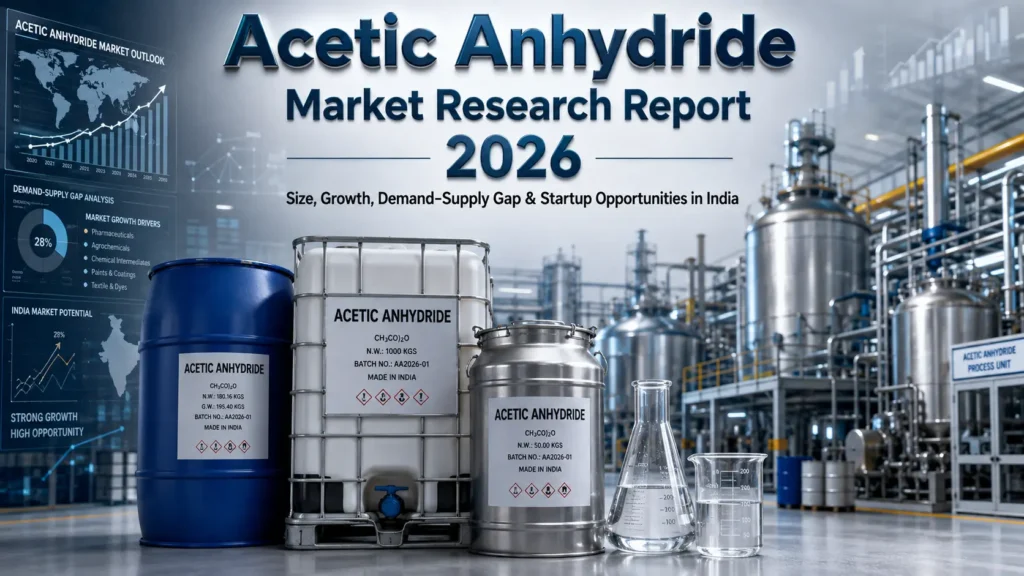
Acetic Anhydride Manufacturing in India India’s pharma sector is estimated to expand from USD 65 billion in 2024 to USD 130 billion by 2030 and acetic anhydride plays a central role in the synthesis process of some of the most widely consumed drugs produced by the industry, such as aspirin and paracetamol. However, the higher molecular weight acetyl chemical chain to which acetic anhydride belongs is one of the most import dependent industries in India as India imports over 85% of its need for upstream acetic acid. This opportunity is embedded in that dynamic: a growing demand for the pharma products downstream coupled with a highly import-dependent feedstock supply chain. What Is Acetic Anhydride? Acetic anhydride or ethanoic anhydride is a clear colourless liquid carboxylic acid anhydride produced mainly by the ketene process using glacial acetic acid as the raw material. It acts as a powerful acetylating agent (reacts with an alcohol or amine to add an acetyl group), which is useful in a number of key industrial value chains: Get Detailed Project Report (DPR): Acetic Anhydride Global and India Acetic Anhydride Market Size and Growth Global estimates for market value vary widely, depending on scope, from approximately USD 3.36 billion to USD 6.98 billion in 2025-26, rising to between USD 5.42 billion and USD 9.12 billion by the early-to-mid 2030s, with the CAGRs in the middle band. The size of India’s domestic market is estimated to be around USD 87–400 million (2024), with volume estimates ranging from approximately 76,000 metric tonnes (MT) in 2023, and most estimates of the Indian portion of the market CAGRs are significantly higher than the global average — ranging from 2.1% to as high as 7.8% across different studies — reflecting the country’s skewed higher growth pharmaceutical and agrochemical demand base compared to more mature global markets. Note on figures: Market studies of the acetic anhydride market differ in scope, some covering only the volume of the merchant market, others including the captive/integrated market. NPCS can develop an investor-grade numbers-based techno-economic feasibility study to suit your target application (pharma-grade vs. industrial-grade) and capacity. The Upstream Acetyl Chain Import Dependency The Indian supply position of acetic anhydride cannot be viewed in isolation as it is downstream of acetic acid and India’s acetic acid supply chain is extremely import dependent. India is the biggest consumer of acetic acid (around 1.2 million tonnes of acetic acid was consumed in 2024 ahead of China and the United States) but also imports over 85% of its acetic acid consumption, making the whole acetyl chain (including acetic anhydride, ethyl acetate and other derivatives) one of the most import dependent chemical sectors in India. The Indian acetyl chain market is estimated to be about USD 567 million, and could be significantly bigger by 2032 with the expansion of the downstream pharmaceutical and industrial market. This gives a unique strategic situation: domestic acetic anhydride capacity is growing (and recently has grown from established producers) – but even with this additional capacity, the production process still generally relies on the import of upstream acetic acid as feedstock – not just at the conversion stage of the process, but that stage is upstream. Explore This Book: Handbook On Chemical Industries (Alcohol Based) Policy Tailwinds 1. Pharmaceutical self-sufficiency push: India’s government emphasis on domestic API (Active Pharmaceutical Ingredient) production, aimed at reducing reliance on imports for critical drug intermediates, directly strengthens demand for domestically-manufactured, traceable, consistent-quality acetic anhydride. 2. PLI scheme of bulk drugs and key starting materials: Supporting the business case for backward integration investments for Acetyl chain – including Acetic anhydride – in indirect terms through PLI scheme for bulk drugs and key starting materials. 3. Expanding agrochemical export industry: India exports about 50% of its agrochemicals and the demand for acetic anhydride is closely linked to this export-intensive growth industry as it is used as a key raw material in the manufacture of organophosphate pesticides such as acephate. 4. Manufacturing relocation from stricter-regulation markets: Increasing environmental restrictions on pesticide manufacturing in the US and Europe are shifting agrochemical production toward India, further increasing domestic acetic anhydride demand. 5. Resurgent interest in cellulose acetate/bio-based materials: Revival of global interest in the use of cellulose acetate in the field of biodegradable plastics and sustainable textile products has generated new market opportunities for acetic anhydride in addition to the traditional cigarette filter tow market. India Demand-Supply Gap: Acetic Anhydride and the Broader Acetyl Chain Parameter Current Position India’s acetic acid position World’s largest consumption market (~1.2 million tonnes, 2024), yet imports over 85% of this requirement Broader acetyl chain market size ~USD 567 million (encompassing acetic acid, ethyl acetate, acetic anhydride, and related derivatives) India acetic anhydride market (2023) ~76,000 metric tonnes, growing at a CAGR estimated between 2.1% and 7.8% depending on the study Recent domestic capacity expansion IOL Chemicals & Pharmaceuticals expanded acetic anhydride capacity from 25,000 to 32,000 MTPA (March 2026); Laxmi Organic Limited has proposed further expansion at its Raigad, Maharashtra facility Nature of the gap A compound, two-tier import dependency — India’s acetic anhydride production capacity is growing, but much of it still relies on imported upstream acetic acid, meaning the more structural opportunity sits in backward integration across the full acetyl chain, not acetic anhydride conversion alone Downstream demand driver India’s pharmaceutical industry, projected to grow from ~$65 billion (2024) to ~$130 billion (2030), directly and substantially grows the addressable acetic anhydride market as a critical drug synthesis intermediate Opportunity for new entrants Strongest for integrated players capable of backward integration from acetic acid production through to acetic anhydride and downstream cellulose acetate/pharma intermediate manufacturing Reading in the gap: This is a multi-layered opportunity, not a one-and-done opportunity. India’s own government recognised acetyl-chain research explicitly states that the country is “one of the most import dependent chemical industries in India” since 85%+ dependence on Acetic Acid, and in turn, this is a constraint on realising self-sufficiency at the level of Acetic Anhydride with an increase in conversion capacity.