
Furfural Derivatives Market Research Report 2026: Size, Growth, Trends and New Business Opportunities for Startups in India
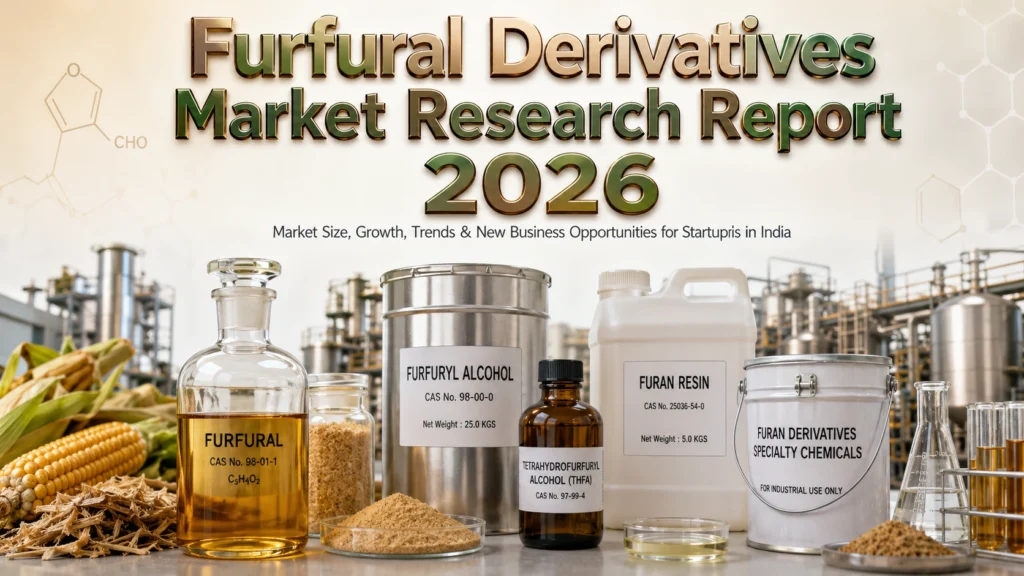
Furfural Derivatives Market in India In the specialty chemicals field, furfural derivatives have quietly emerged as one of the more intriguing sectors. They are at a crossroads that other chemical categories do not share, as they are created from agricultural waste such as corn cobs, sugarcane bagasse and rice husks but are utilised in a wide range of industries, including foundries, pharmaceuticals, agrochemicals and next-generation bioplastics. That’s a bit difficult to ignore in a nation of hundreds of millions of tonnes of crop residue – like India. This report explains the current state of the global and Indian furfural derivatives market, insights on market drivers, challenges and opportunities for new players, and why it is worth the attention of MSMEs and first-generation entrepreneurs looking into a manufacturing business. What Are Furfural Derivatives? (Meaning, Types and Production) Furfural (C5H4O2) is an organic aldehyde that is produced by the acid hydrolysis of pentosans, which are one of the hemicellulose components of lignocellulosic biomass. Furfural is not a petroleum-derived industrial organic chemical; it is only produced from plant residues like corncobs, sugarcane bagasse, rice husk, oat hulls and cottonseed hull. After its generation, furfural itself is used as a platform chemical that is subsequently transformed into a series of higher value derivatives such as: Since the raw material is farm waste and not crude oil, furfural derivatives are firmly in the “green chemistry” and circular economy dialogue which is becoming more relevant with regulators and buyers demanding lower carbon industrial inputs. View Full Project Details: Furfural Manufacturing & Project Report Furfural Derivatives Market Size 2026 and Growth Forecast (CAGR) The estimates of the furfural derivatives market vary significantly from research agency to research agency, partly due to the varying definitions of what is counted as furfural derivatives (some consider only furfuryl alcohol and THF to be furfural derivatives, while others extend the definition to the much wider furan-chemical family). Overall, the estimates converge on a similar growth trajectory, though not on exact figures. According to recent industry estimates, the global furfural derivatives market is valued in a broad range of roughly USD 13–15.4 billion for 2025–26, with most forecasts projecting expansion to somewhere between USD 22 billion and USD 28 billion by the early 2030s, at compound annual growth rates generally clustering between 6% and 8.3%. One recent 2026 study by Persistence Market Research places the market at approximately USD 15.4 billion in 2026, climbing to USD 25.7 billion by 2033 — a CAGR of 7.6%. A separate, narrower estimate focused specifically on furfural itself (the parent compound, excluding derivatives) puts that market closer to USD 700–770 million in 2025-26, underlining how much value gets added once furfural is converted downstream into furfuryl alcohol, THF, and specialty derivatives. Figures: Assume the numbers provided above are fairly approximate and should be used to gain a sense of scale and trajectory—not as exact numbers that you could present in a fundraising deck without following up with a cross-check on the scope definition from the published market study. If you need investor-grade numbers, NPCS can prepare a custom TEFS, with figures that are scoped very close to your product line and capacity. Regional Breakdown Asia Pacific leads the furfural derivatives market by a huge margin with estimated market share of 42-67% of the global market share which is primarily due to China’s production base and the availability of agricultural biomass in the region. Chinese Batch Process is estimated to account for a majority of global furfural production capacity, at a staggering 80% production rate, as it is the most cost-effective method of production (CVP), Grand View Research’s furfural market analysis showed and China is expected to produce an overwhelming 89% of the world’s furfural in 2025. In contrast, in the EU and North America, furfural and furfural derivatives are net imports and the local production capacity has been decreasing over decades, due to the high production costs compared to Asia. Thus, Western markets are not only the largest markets for the supply of bio-based chemicals through mechanisms such as the EU’s Carbon Border Adjustment Mechanism, but also are structurally dependent on imports — and India’s manufacturers are well poised to fill this gap in the Western markets. Furfural Derivatives Market in India: Import Dependence and the Manufacturing Opportunity The part of the story that is important to Indian entrepreneurs is that although India has some of the largest stocks of furfural feedstock in the world, the country is a net importer of furfural, largely from China and to a minor degree from Germany and other producers. More than 500 million tonnes of agricultural residue is produced in India on a yearly basis. Rice husk, sugarcane bagasse, corn cobs and wheat straw are produced in vast quantities in various agricultural states of Punjab, Haryana, Uttar Pradesh, Maharashtra, Odisha etc. A significant amount of this residue goes into burning in the field (which is a key source of seasonal air pollution in North India) or is used as a low value fuel in boilers where it could be transformed into a chemical intermediate valued roughly at ₹80 per kg to ₹500 per kg depending on the derivative and its purity level. Bagasse, in particular, is concentrated in Uttar Pradesh and Maharashtra which have dense clusters of sugar mills, which already produce bagasse as a byproduct of sugar and ethanol production; thus feedstock logistics for a furfural unit in close proximity to these sugar mills is much simpler than if a business were to establish a new sugar-based agriculture supply chain from scratch. India’s specialty chemicals industry as a whole is valued at more than USD 220 billion and growing at 9–12% annually — a growth trajectory tracked by the Department of Chemicals and Petrochemicals under the Ministry of Chemicals and Fertilizers — and furfural derivatives fit squarely inside that growth story as an underpenetrated, import-substitution opportunity rather than a saturated one. Policy Tailwinds There are a number of developments that relate to this opportunity from the government