
Hume Pipes (RCC Pipes) Market Research Report 2026: Size, Growth, Demand-Supply Gap and Business Opportunity for Startups in India
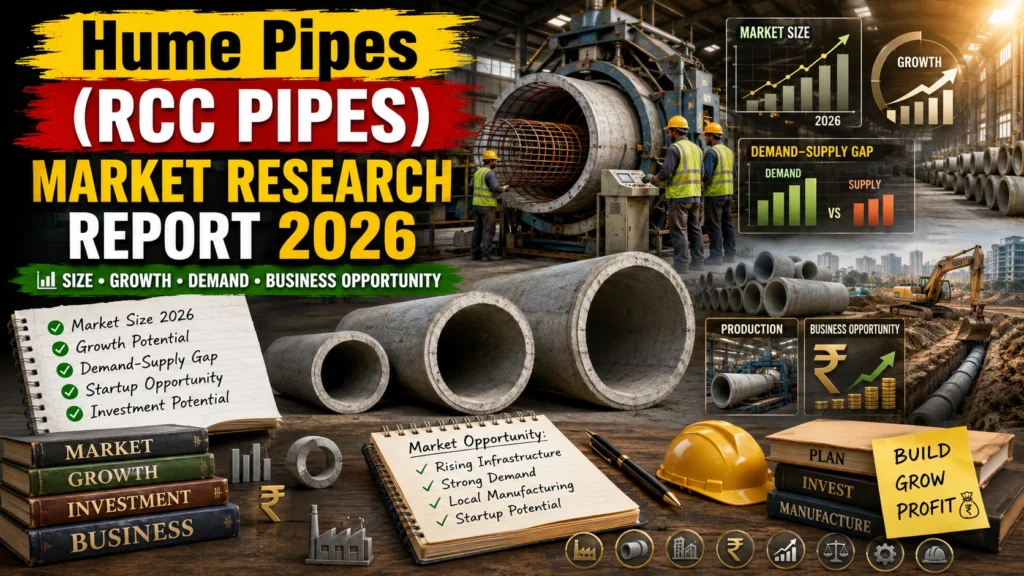
Hume Pipe Manufacturing Business The Hume pipe is one of the products that can be equated directly to India’s largest public infrastructure programme. Along with the expansion of AMRUT 2.0 water sewerage, India’s Jal Jeevan Mission is installing pipe networks in all the rural households in the country, the biggest water infrastructure programme in the world’s history with the spending of about ₹8.69 lakh crore till December 2028. The large diameter variety of reinforced concrete pipe is the backbone of stormwater drains, sewerage trunk lines and canal-lining projects, especially at large-scale, for which plastic pipe cannot match. That’s as close to a bottom floor as an entrepreneur can get. What Are Hume Pipes? Hume pipes, or also known as reinforced cement concrete (RCC) pipes, are pipes that have been precast with steel bars or steel mesh and are made by either centrifugal (spun) casting or vertical vibration-casting processes. It took its name from the patenting in 1910 of the centrifugal spinning process for making concrete pipes by the Hume brothers of Australia. They are produced in India to the Indian Standard specification IS 458 which is similar to the Australian, British and American standards and are available in strength grades (usually NP2, NP3, NP4) that are classified by the load-bearing requirements. There are several variants of the Hume pipe: Service life is typically specified as 50+ years (high grade concrete M30/M40) with good concrete installation. Diameters range typically from 150mm up to over 2600mm and lengths are typically from 2.5–3 metres. Related Article: Medium-Density Polyethylene (MDPE) Pipes Are A Lucrative Business for Any Entrepreneur Global and India Concrete Pipe Market Size and Growth The concrete pipe market is a well-established and a steady growing market in the world. It is estimated to be around USD 13.4-15.6 billion in 2025 and will reach USD 19.9 billion–USD 45.2 billion in 2034-2035, at beggar-taker rates of 3.5-4.5%, a mature-market rate, reflecting the balance of replacement-demand in developed markets and the new-build demand in urbanising economies. The story of India is a much more dynamic one. In total, the India pipes market (all materials) is expected to reach USD 16 billion by 2025 with a compound annual growth rate of more than 11% — and in this, concrete pipes will continue to hold a strong and non-substitutable position in irrigation canal projects, stormwater drainage, and sewerage trunk lines where plastic and HDPE pipes are not structurally viable at a large scale. Note on figures: This is not a stand-alone market segment for reinforced concrete pipes, but is a sub-segment of the “pipes” or “concrete pipe” market and can therefore be reported in different market studies. NPCS can provide a custom techno-economic feasibility study that can be developed for the diameter range you are interested in and can be tailored to the target customer (government water boards, PWD, private EPC) for investor grade numbers. The Government-Backed Demand Floor Concrete pipe demand in India is quite different from most of the manufacturing categories because it is not just a market demand but it’s a demand which is funded and policy-driven by the government. Policy Tailwinds 1. Mandatory BIS specification (IS 458): RCC pipes supplied to government water boards, PWD, and municipal corporations must conform to IS 458:2003, creating a quality-compliance barrier that favours established, certified manufacturers over informal producers. 2. Government direct project procurement: The concrete pipe demand is huge with government direct project tenders for multi years with empanelling of a manufacturer (Public Health Engineering Department, Public Works Department, municipal corporations, NHAI). 3. MSME manufacturing incentives: RCC pipe manufacturing units are labour and capital-intensive precast concrete units; therefore, they are eligible for MSME capital subsidy schemes in various states. 4. State industrial policies for precast concrete units: Some states provide land, power tariff and capital subsidy for the precast concrete product manufacturing due to its contribution towards the delivery of public infrastructure. View Full Project Details: Emerging Business of Ductile Iron Pipe Fittings India Demand-Supply Gap: Hume Pipes (RCC Pipes) Parameter Current Position Demand driver scale Jal Jeevan Mission 2.0 alone represents an ~₹8.69 lakh crore infrastructure programme through 2028, alongside AMRUT 2.0 urban sewerage expansion and PMKSY irrigation projects Domestic manufacturing base A mix of large organized players (The Indian Hume Pipe Co. Ltd., with 20+ factories) and hundreds of regional/MSME-scale manufacturers spread across nearly every Indian state Nature of the gap Primarily a regional capacity and logistics gap — concrete pipes are heavy, low-value-density products with high transport cost relative to product value, meaning demand often outpaces locally available capacity even where national aggregate capacity looks adequate Market structure Highly fragmented — organized players with pan-India reach coexist with a very large number of regional and local manufacturers; competitive dynamics are shaped by pricing, logistical proximity, and quality-standard adherence rather than brand power Opportunity for new entrants Strong for regionally-positioned manufacturers near government project clusters, given the product’s poor economics for long-distance transport and the sheer scale of ongoing government procurement Reading the gap: Hume pipes are a rare manufacturing category where the constraint is rarely “does demand exist” — government infrastructure spending guarantees that — but “is there enough locally-positioned, quality-compliant manufacturing capacity near where the pipe is needed.” Because transport cost is a large share of delivered price for a heavy, low-value-density product, a new regional manufacturer doesn’t need to compete nationally; it needs to be the best-positioned qualified supplier for its own district or state’s ongoing JJM, AMRUT, or PWD tenders. Major Indian Hume Pipe / RCC Pipe Manufacturers Company Base/Region Scale Notes The Indian Hume Pipe Co. Ltd. (IHP) Mumbai, Maharashtra (HQ); 20+ factories pan-India Large integrated national player Established 1926 by Walchand Hirachand; India’s original and largest Hume pipe manufacturer; also manufactures PSC pipes, PCCP, bar-wrapped steel cylinder pipes, and PSC railway sleepers; over 100 projects under execution; recently secured a ₹357+ crore water supply project from Madurai City Municipal Corporation Sneh Precast & ConstoSolutions Maharashtra Regional manufacturer Produces NP3/NP4-class RCC pipes for drainage and sewerage with spigot-socket joint configurations