
Plastic Business Ideas: 5 Profitable Manufacturing Units to Start in India
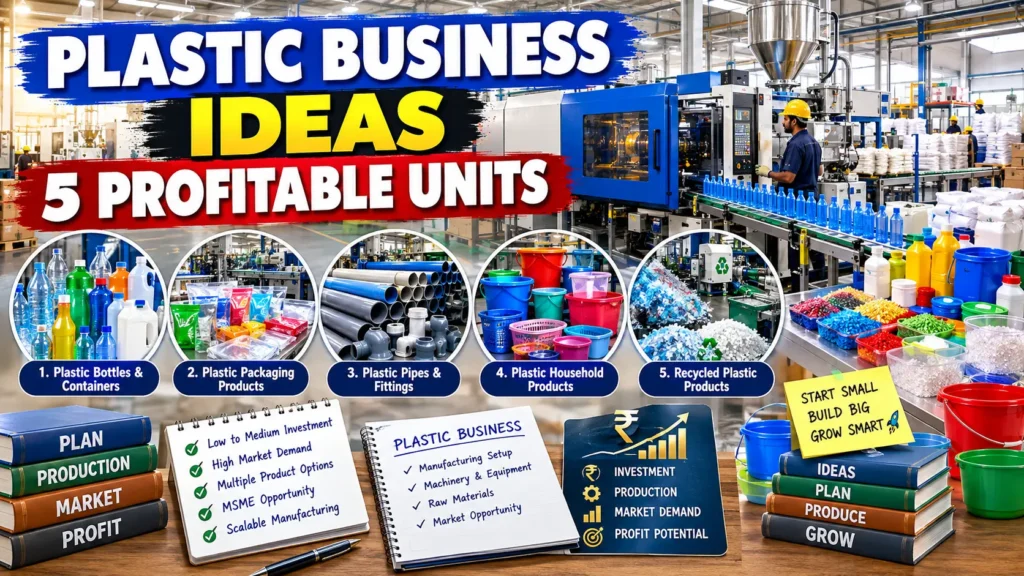
A feasibility-led look at where volume demand and value-addition meet in Indian plastics. Plastic Business Ideas in India Plastic is ubiquitous, and that’s why plastic business ideas are such a reliable choice for a first-time founder. From packaging and construction to agriculture and consumer products, we use plastic every day. And, as we move towards a more sustainable future, the demand for quality, responsibly sourced plastic products will only grow. For a founder who notices the change, the opportunity is real. This article examines plastics the way a project consultant would. We will weigh demand, policy support, and five practical manufacturing routes, then map trade openings and lessons from Indian founders. Why Plastics Remain a Strong Manufacturing Bet Volume Demand That Keeps Growing Plastic in many forms is an input to most sectors of the economy, providing diversity to withstand bad years in one part of the economy. Packaging alone accounts for massive quantities, while construction using plastic pipes, fittings and profiles is another large user. No one sector rises or falls enough to flatten the entire market, so niche units find customers from all quarters simultaneously. The phasing in of sustainable and biodegradable materials has created new opportunities. An innovator willing to champion responsible production will be riding the wave of change. Value-Addition Beats Commodity Play The smartest entry avoids pure commodity competition. Instead, value-added products such as engineered components or branded consumer goods earn better margins. Consequently, a producer who adds design, durability, or sustainability captures more value. Sector data through the Central Institute of Petrochemicals Engineering and Technology (CIPET) and Department of Chemicals and Petrochemicals helps founders target the right segments. Government Policies and Incentives Policy support flows through infrastructure, skilling, and MSME programmes. CIPET offers technical training and testing that lift product quality, while plastic park schemes provide ready industrial infrastructure. These reduce the fixed costs that once deterred small entrants. Founders should register on Udyam for collateral-free credit and priority lending. Environmental compliance runs through the Central Pollution Control Board, and early planning around recycling norms avoids disruption. Several states court plastics investment; the Tamil Nadu industrial guidance bureau is a strong example of state facilitation. 5 Plastic Business Ideas for Startups Idea 1 — Plastic Recycling Unit Recycling is at the very heart of the sector’s future, and the appetite for recycled granules is only growing. A recycling unit that gathers, cleans and recycles plastic waste into usable material provides manufacturers with a more environmentally friendly product. The low cost and ready availability of the raw materials mean that margins remain healthy. Environmental regulations encourage brands to incorporate recycled material into their products – further increasing demand. A founder benefits from the price advantage as well as the ability to position the product as environmentally friendly. Institutional customers also need recycled raw material and long-term contracts look assured. Idea 2 — PVC Pipes and Fittings Pipes and fittings are in even greater demand from construction and irrigation. With infrastructure and irrigation always growing, demand is from the need for a constant supply of the products. A single unit supplying PVC pipes reaches out to plumbers, builders and farmers all over, a much larger pool. To gain buyer confidence, a standard size and pressure rating are recommended. A founder can start with common sizes and add specialised fittings later. Local production shortens delivery and cuts freight, giving new units an edge. Furthermore, government water and housing programmes sustain demand. Reliable supply turns first orders into durable relationships with dealers and contractors. Idea 3 — Flexible Packaging Products Needs increase with every new consumer brand or e-commerce order. Flexible packaging (that can be pouches or film), is used for food, personal care and industrial products. This is a recurring revenue stream because brands are always reordering the unit. A founder should focus on print quality and food-safe standards, since these win contracts. Starting with a defined segment builds volume, while custom packaging adds margin. Moreover, sustainable and recyclable films now attract premium buyers. A packaging unit that combines quality with responsible materials can grow steadily alongside the fast-expanding retail and online economy. Idea 4 — Household and Consumer Plasticware Everyday plastic goods, such as storage boxes, buckets, and kitchenware, enjoy vast, price-sensitive demand. A unit making these products serves retail markets across towns and cities. Because volumes are large, disciplined production and cost control drive profits. A founder can begin with a focused range and grow through steady distribution. Attractive design and consistent quality win repeat retail orders. In addition, branding lifts margins above pure commodity pricing. Local manufacturing competes well against imports on cost and delivery. With careful design and reliable output, a consumer plasticware unit can build strong regional demand and expand its catalogue over time. Idea 5 — Injection-Moulded Industrial Components Why they are great: Injection moulding creates high-quality, accurate plastic pieces for appliances, automotive, or electronics. Demand for these parts is global and continual since everyone uses them. A founder designing for one industry can scale to all industries on the same machinery. Tooling quality and dimensional accuracy matter most, since buyers demand exact fit. Local supply shortens lead times, which industrial clients value highly. Over time, the catalogue can widen and margins improve with engineered grades. Furthermore, import substitution offers a clear opening, as many components still arrive from abroad. Consistent precision turns industrial buyers into long-term, repeat customers. Import–Export Opportunity Analysis Trade patterns favour capable new manufacturers. India imports several engineered plastic components and specialty films, so a reliable local producer can substitute that supply. At the same time, Indian packaging and moulded goods find buyers abroad, giving founders a two-way opportunity. Export readiness depends on consistent quality and compliance, and guidance from the DGFT helps founders align early. Consequently, a unit designed for both substitution and export builds resilience. When domestic demand dips, overseas orders help fill the gap, which steadies cash flow through the cycle. Indian MSME Success Stories Worth Studying Supreme Industries: Growth by steady segment-by-segment