Aquaculture is no longer a farm activity–it’s an industrial opportunity
Fish Processing and Cold Storage Business Opportunity in India has evolved far beyond ponds, nets, and fish. The industry is now structured, export-linked, and processing-driven, with strong integration in both directions. Scientific aquaculture, hatcheries and feed plants, cold chain, processing units, and export infrastructure are increasingly supporting what was once heavily dependent on capture fisheries.
This transformation is clearly evident in the industry publication that has been uploaded. The two activities are now viewed as engines of growth for rural manufacturing and employment, as well as foreign exchange earnings. Aquaculture-linked manufacturing is one of the sectors that is most attractive to new entrepreneurs and MSMEs due to a growing global demand for fish proteins, improved production systems at home, and strong government support.
Startups that are willing to look beyond primary agriculture will find the best opportunities in processing and cold chain, feed manufacturing, and value-added exports. These segments offer better margins, greater scalability, and more demand visibility.
Why aquaculture is a rising industry for manufacturing entrepreneurs
Aquaculture is one of India’s fastest-growing agri-based sectors.
- Rapid growth of inland aquaculture production
- Fish consumption per capita is increasing in the United States
- Export demand for processed, frozen, and ready-to-cook seafood
- Diversification of species and expansion of scientific farming techniques
- The government focuses on infrastructure, traceability,y and value addition
The publication reveals that India has shifted from a volume-focused fisheries industry to a value-focused aquaculture where processing and logistics are the determining factors of profitability.
The Missing Link: Why Processing and Cold Chain Matter
Despite a strong increase in production, a large portion of the value of fish is lost because:
- Lack of adequate cold storage near landing points and farming areas
- Limited processing capacity in production regions
- Dependence on raw and semi-processed products
- Post-harvest losses, quality degradation
This is the perfect place to start a new manufacturing business.
Related Article:- Fisheries and Aquaculture
Key Manufacturing Opportunities in the Aquaculture Value Chain
Here are high-potential, feasibility-driven business opportunities that emerge from aquaculture growth.
1. Fish Processing Plants (Fresh, Frozen & Value-Added Products)
Industry Overview
The value of aquaculture is based on the processing of fish. Processing converts raw fish into export-ready, shelf-stable, and branded products.
Products Manufactured
- Frozen whole fish
- Fillets and steaks
- Peeled and deveined Shrimp
- Products that are IQF (Individually quick frozen)
- Items that are marinated, fried, or ready to cook
Why Demand is Strong
Global buyers prefer:
- Products that have been processed and portioned
- Traceable, hygienically packaged seafood
- Retail and foodservice formats are ready-to-use
The publication highlights that seafood with added value earns significantly more than raw exports.
Startup Opportunity
Entrepreneurs can set up:
- Small- to midsize processing plants are located near agricultural clusters
- Units of a specific species (shrimp, freshwater, marine, or saltwater fish)
- Exporters can use contract processing facilities
The processing plants have strong links with the farmers, as well as forward and backward links with distributors, retailers, and exporters.
View Books on:- Handbook on Fisheries and Aquaculture Technology
2. Ice Plants and Cold Storage Infrastructure
Why Ice is Critical to Fisheries
Fish is one of the most perishable foods. From harvest to processing, ice and temperature control is essential.
Manufacturing & Service Area
- Block ice plants are located near landing centers and farms
- Flake ice units integrated with processing units
- Cold storage for raw, semi-processed, and finished fish
Market Reality
The publication highlights that gaps in the cold chain remain a major bottleneck for fisheries’ growth. The demand for ice storage and reliable ice services is therefore constant.
Why is it a good choice for new entrepreneurs
- Capital investment is lower than for full-processing plants
- Demand from farmers, traders, and processors is steady every day
- High asset usage during peak seasons
When entrepreneurs enter the fisheries industry, they often begin by establishing ice plants.
3. Aquaculture Feed Manufacturing Units
Importance of Feed in Aquaculture
Feed is the highest cost of production in shrimp and fish farming. The quality of feed has a direct impact on growth rate, farm profitability, and survival.
Products Manufactured
- Fish feed that floats and sinks
- Shrimp fed with precise protein and nutritional profiles
- Specialized feed for different growth stages
Industry Trend
This publication highlights the growing use of scientifically formulated feed and the decreasing dependence on traditional feeding methods.
Startup advantage
- Farmers continue to demand high-quality products
- Ability to build regional brands
- Benefits of integrating technical and advisory support
The feed manufacturing industry offers predictable cash flow and scalable volume to MSME investors.
4. Hatchery and Seed Production (Integrated Opportunity)
Why seed quality matters
For farm productivity, high-quality seeds are essential. Poor quality seed leads to diseases, mortality and losses.
Manufacturing-Linked Opportunities
Hatcheries are industrial units of bio-production that involve controlled breeding, water systems and technical protocols.
Entrepreneurial Scope
- Freshwater fish hatcheries
- Shrimp and brackish-water hatcheries
- Models that integrate seed, feed, and advisory services
The best results are achieved when this segment is integrated with downstream processing, feed supply, or both.
View Project Report:- Fish and Marine Products
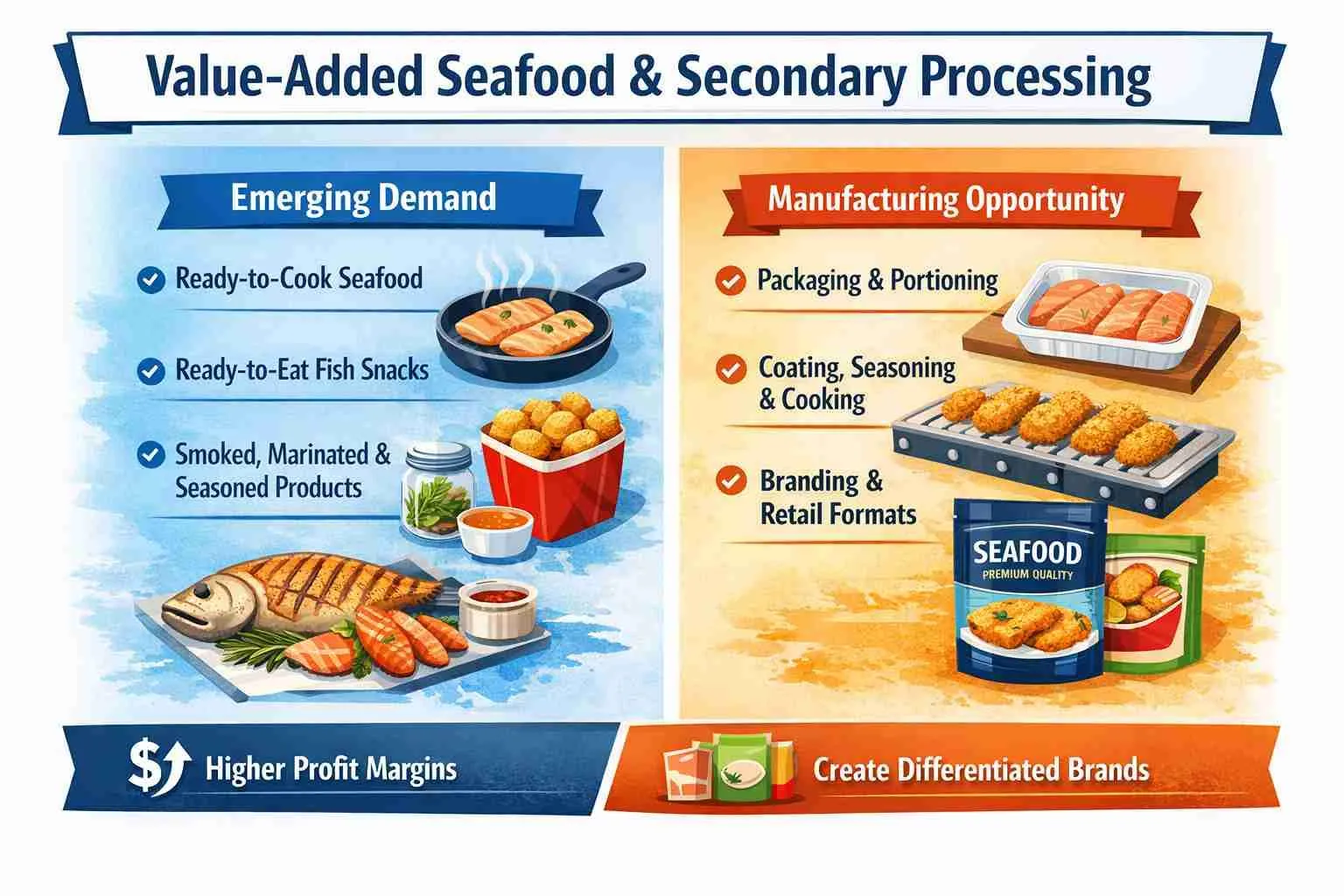
5. Value-Added Seafood Products and Secondary Processing
Emerging demand
Consumers in urban areas and on international markets are increasingly demanding:
- Seafood that is ready to cook
- Fish snacks are ready to eat
- Smoked, marinated, and seasoned products
Manufacturing Opportunity
The secondary processing unit focuses on:
- Packaging and portioning
- Coating, seasoning, and cooking
- Branding and retail formats
This segment offers higher profit margins than bulk imports and allows startups to create differentiated brands.
Import–Export Perspective: Why Global Markets Matter
India is one of the leading exporters of seafood in the world. The majority of India’s exports are low value frozen products.
The publication shows a clear shift towards:
- High processing standards
- Global food safety standards
- Expanding into premium markets
Start-up Opportunity from Export Data
- Contract manufacturing for exporters
- Ports are linked to regional processing hubs
- Export-oriented product lines with added value
Export competitiveness is gained by entrepreneurs who design their plants from the start to international standards.
Why New Entrepreneurs Should Enter Aquaculture Manufacturing
This industry offers many rare benefits:
- The demand for food is driven by protein consumption and food security rather than discretionary spending
- Scientific farming improves raw material supply
- Export markets allow for scale beyond domestic consumption
- Infrastructure development is a priority for the government.
Aquaculture manufacturing, unlike speculative industries, is demand-anchored and repeat-driven.
MSME Success Models Entrepreneurs Can Learn From
India’s aquaculture industry has been shaped by MSME entrepreneurs, who have focused on implementation rather than hype.
Typical success patterns include
- Start with feed units or ice plants before scaling up to processing
- Building relationships of trust with farmers
- Increase capacity in accordance with demand
- Quality and compliance discipline
The right foundation has allowed several MSME promoters to grow from regional operations into exporters that are globally compliant.
Government Ecosystem Supporting Fisheries & Aquaculture
The following institutions provide support to entrepreneurs in this sector:
- Department of Fisheries (Government of India)
- Marine Products Export Development Authority
- Ministry of Food Processing Industries
- National Fisheries Development Board
- State Fisheries Departments
These organizations support exports, infrastructure, skill development, and market access.
Practical Opportunity Snapshot Table
| Segment | Key output | Primary market | Startup suitability |
| Fish Processing | Frozen seafood & Value-added seafood | Export and domestic | High-quality |
| Ice Plants | Ice block/flake | Farmers and processors | Very High |
| Cold Storage | Frozen & chilled storage | Supply chain | High-quality |
| Feed Manufacturing | Fish & shrimp feed | Farmers | Very High |
| Value Addition | Products that are ready to cook | Retail & Export | Medium-High |
Why the Timing Is Right
The aquaculture industry is moving from production-led to infrastructure and processing-led growth. Entrepreneurs who enter the market now can position themselves not only as suppliers but also as key enablers in the value chain.
Closed Perspective
Aquaculture has evolved beyond the simple farming of fish. It’s about creating industrial systems that revolve around food, logistics, and quality, as well as global markets. Entrepreneurs who understand this shift, invest in cold chain and value-added processing, can build businesses that are export-oriented and resilient.
For manufacturing-focused startups seeking scale, stability, and global relevance, aquaculture offers not just an opportunity–but a long-term industrial pathway.
Watch:- Youtube Channel
Conclusion
Value-added seafood and secondary processing shift aquaculture from volume to value. By focusing on ready-to-cook and ready-to-eat products, better packaging, and branding, manufacturers can achieve higher margins, stronger market control, and more stable demand than bulk frozen exports. This segment rewards disciplined processing, compliance, and gradual brand building—making it a practical path for MSMEs to move up the value chain.
How NPCS Can Help
NPCS (Niir Project Consultancy Services) provides end-to-end support for entrepreneurs, including:
- Detailed Project Reports (DPR).
- Financial modeling & ROI analysis.
- Plant layout & machinery selection.
- Vendor & buyer connect.
- Licensing & compliance guidance.
With expert support, your chances of success in this high-growth sector increase significantly.
Niir Project Consultancy Services
106-E, Kamla Nagar, Opp. Mall ST,
New Delhi-110007, India.
Email: info@entrepreneurindia.co
Mobile: +91-9097075054
Website:https://www.entrepreneurindia.co
FAQs
1. What is value-added seafood?
Processed seafood formats such as ready-to-cook, ready-to-eat, smoked, marinated, and seasoned products that offer higher convenience and value than raw fish.
2. How is secondary processing different from primary processing?
Primary processing focuses on cleaning, filleting, and freezing, while secondary processing includes portioning, seasoning, coating, cooking, and retail-ready packaging.
3. Why does this segment offer higher margins?
Pricing is based on convenience, consistency, and branding rather than commodity rates, resulting in better margins and stronger market control.
4. Is value-added seafood suitable for MSME entrepreneurs?
Yes. MSMEs can start with basic secondary processing like portioning and packaging, then scale into seasoning, cooking, and branded products as capability and compliance maturity improve.
5. What markets drive demand for value-added seafood products?
Urban domestic consumers, foodservice and QSR chains, institutional buyers, and export markets where convenience, consistency, and shelf life are critical.