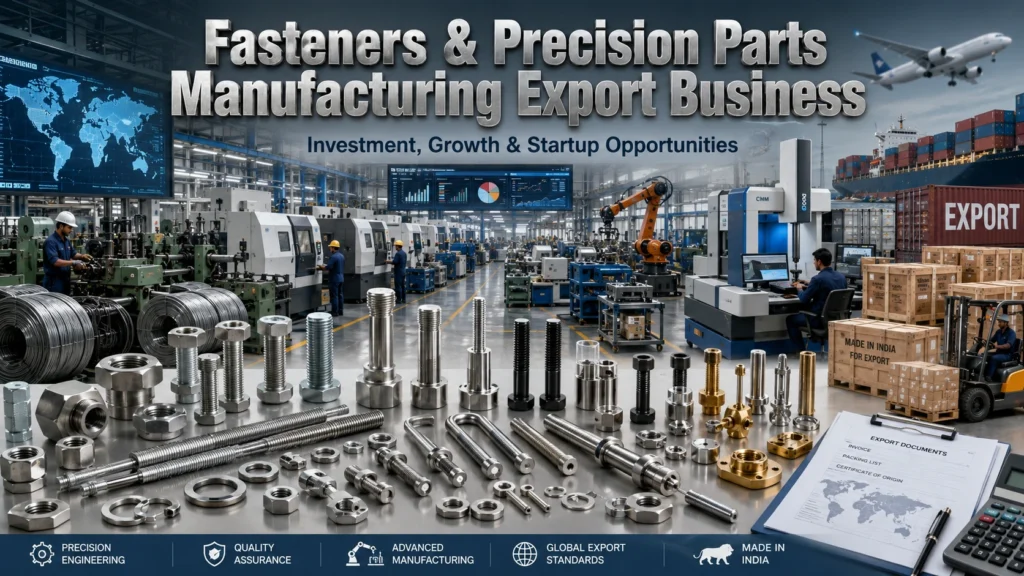

Fasteners and Precision Parts Manufacturing Export Business
One of the most important and globally consistent engineering business ideas of EEPs portfolio is the manufacturing of fasteners and precision parts for exports. Bolts and nuts, screws and washers, rivets and specialty fasteners are the major products exported from India to more than 50 countries, and the Ludhiana, Rajkot, Mumbai and Pune clusters provide automotive, aerospace, construction, electronics and industrial equipment buyers around the world with both commodity and precision engineered fasteners. The demand for this category is structurally non-discretionary – all mechanical assemblies need fasteners and all engineering products produced around the world generate downstream demand. The world fastener industry is more than $100 billion per year and steadily expands in parallel with the growth of industry.
Explore This Book: The Complete Technology Book on Steel and Steel Products (Fasteners, Seamless Tubes, Casting, Rolling of Flat Products & others)
EEPC and Government Policy Support
The Engineering Export Promotion Council (EEPC India) provides assistance to fastener exporters in the following areas: Buyer-seller meets for automotive and industrial OEM procurement managers, Fastener Fair Stuttgart and International Fastener Expo USA, and market intelligence on the trends in fastener demand in target markets. The EEPC RCMC facilitates RoDTEP benefit on exports of fasteners.
The DGFT EPCG Scheme provides zero duty on importation of cold forging presses, thread rolling machines, CNC turning centre, CMM inspection machines and heat treatment furnaces – the core manufacturing equipment for the production of fasteners and precision parts. EPCG automated fastener production has great advantages in improving production efficiency and quality consistency.
Business Ideas
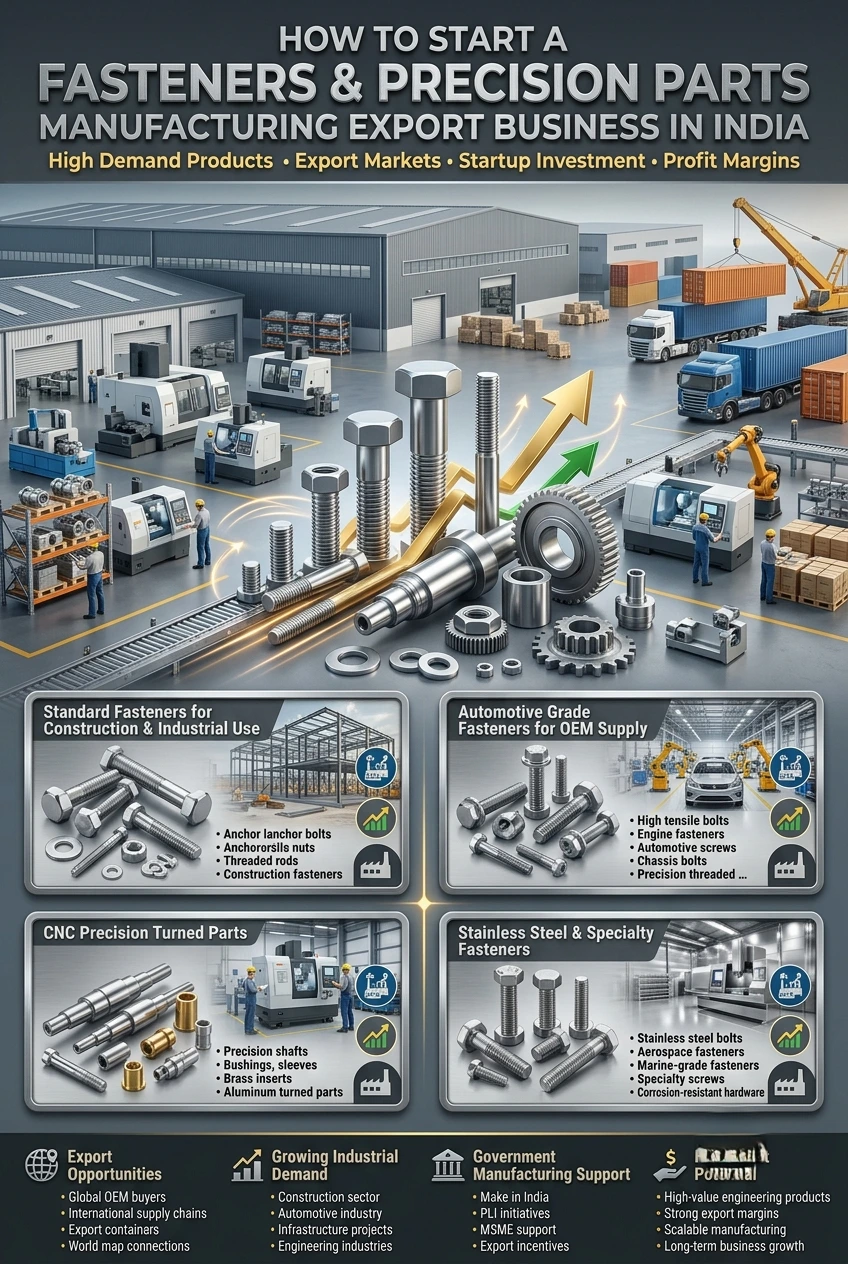
1. Standard Fasteners for Construction and Industrial Use
Carbon Steel and Stainless-Steel Hex bolts, Hex nuts, Washers, Threaded Rods, Anchor Bolts are exported in container loads to Hardware Distributors and Industrial MRO buyers in the Gulf, Africa, South East Asia and Latin America. Investment of ₹50 lakh to ₹1.5 crore in cold forging, threading, heat treatment and zinc plating. Must be DIN/ISO/ASME dimensional standards.
Related Article: Business Ideas for Automobile Parts Manufacturing. Highly-Demanded Automotive Components Business
2. Automotive Grade Fasteners for OEM Supply
High strength automotive fasteners used for vehicle assembly are the top-of-the-line export market for fasteners: Class 8.8, 10.9 and 12.9. India’s car component producers that get certified by IATF 16949 are eligible for multi-year supply contracts with key buyers worldwide that have volume commitments. The investment will be in range of ₹1 crore to ₹4 crore. A major quality requirement is hydrogen embrittlement test and zinc-nickel plating.
3. CNC Precision Turned Parts
Precision turned parts (shafts, bushings, pins, connectors and fittings) used in automotive, electronics, medical device and industrial applications are the highest margin market segment. Modern CNC turning centres and grinding machines with tolerances as low as ±0.005mm to be built with investment ranging between ₹80 lakh and ₹3 crore. The export markets are Germany, US, Japan and Taiwan, where there are active lookouts for cost competitive Indian alternatives.
4. Stainless Steel and Specialty Fasteners
The price of stainless-steel fasteners (grades 304 and 316) is much higher than the price of carbon steel fasteners used for the marine, chemical, and food industry equipment. The investment in a stainless-steel fastener unit is from ₹60 lakh to ₹2 crore. Stainless fastener conformance to BS, DIN and ASTM standards and material certification required. Process industries exports are to the US, EU, Australia and the Middle East.
Get Detailed Project Report (DPR): Steel and Steel Products Projects Guide
Import-Export Opportunity Analysis
The exports of fasteners have steadily increased in India. Leading destinations include the USA, UK, Germany, UAE and Australia. Active effort by the US market to qualify nonchains suppliers, both due to the Section 301 tariffs on Chinese fasteners and due to security concerns in the supply chain, is generating opportunities for Indian fastener manufacturers to invest in quality certifications and testing to become qualified by the US market. Many Indian fastener suppliers have been successful in becoming primary suppliers to US hardware distributors and OEM procurement programs.
Indian MSME Success Stories
Sundram Fasteners developed a world-class automotive fastener business by meeting Toyota Supplier Quality Standards and continually developing their OEM customer base in automotive companies from Japan, Europe and North America. They have gone on a decades-long journey of quality improvements that led to a globally trusted brand of fasteners.
Precision Camshafts and a few precision machining firms in Pune have created sizeable export businesses for the production of precision components for automotive buyers in Europe and America by investing in high-precision CNC machines and IATF quality certifications.
Rajkot-based MSME fasteners manufacturers have developed export business in the range of ₹10 crore to ₹30 crore in the countries of the Gulf and Australia, by attending EEPC buyer-seller meets.
How NPCS Supports This Business
Niir Project Consultancy Services (NPCS) offers Professional Consultancy Services for Market Survey cum Detailed Techno-Economic Feasibility Reports (DPRs) for establishing new manufacturing/export businesses in this sector. We have complete reports which contain details of the manufacturing process, market research, and market demand analysis, process flow diagrams, product mix and capacity planning, details of machinery and raw materials, details of the project and complete financials with profitability analysis. We want to help entrepreneurs understand the feasibility, profit and scalability of their business before investing.
Build a profitable business with the right idea
Key Data Overview
| Product Category | Investment Range | Key Standard | Target Markets | Typical Margin |
| Standard Construction Fasteners | ₹50L – ₹1.5 Cr | DIN/ISO + Zinc Plated | Gulf, Africa, SE Asia | 15–25% |
| Automotive Grade Fasteners | ₹1 Cr – ₹4 Cr | IATF 16949 + OEM Spec | Germany, US, Japan | 20–35% |
| CNC Precision Turned Parts | ₹80L – ₹3 Cr | ISO 9001 + CMM Certified | Germany, US, Japan, Taiwan | 30–55% |
| SS and Specialty Fasteners | ₹60L – ₹2 Cr | ASTM/BS + Material Cert | US, EU, Australia, ME | 25–45% |
| Rivets and Special Fasteners | ₹40L – ₹1 Cr | ISO + Customer Spec | US, EU, SE Asia | 22–38% |
Frequently Asked Questions (FAQ)
1. For what property class are fasteners?
Property class refers to the strength of a fastener. Class 8.8 = min tensile of 800 MPa. There are high strength automotive grades: Class 10.9 and Class 12.9. Purchase orders with property class requirements, and mechanical testing certificates from recognized testing laboratories are required to meet the requirements.
2. What is cold forging and why is it desired?
Cold forging is a process of forming fasteners at room temperature under high pressure by precise dies, achieving an excellent grain flow, dimension accuracy and surface finish of fasteners. Compared with the alternatives of machined from bar fasteners, cold forged fasteners have lower material usage, higher production rates and superior fatigue strength.
3. What standards should be the Indian exporters of fasteners support?
The ISO metric thread is the standard. In the U.S. and Canada, threads are standardized across the board and are referred to as Unified National (UN) threads. Attention to both metric and UN threads support widest international markets. For superior export quality thread rolled fasteners have advantage over cut threads, producing the harder and smoother thread.
4. Will hydrogen embrittlement be a problem for exports of fasteners?
Yes. Brittle fracture due to hydrogen absorption at the surface during electroplating is a possible failure mode for high strength fasteners (class 10.9 and 12.9). Hydrogen can be released by baking the plated product at 180°C – 220°C for 8 – 24 hours. For automotive OEM supply, it is required to document the baking process and test per ASTM F606.
5. How do I qualify as a fastener supplier for a US automotive OEM?
In order to be qualify by US automotive OEM: IATF 16949 is needed, PPAP must be submitted for all part number, company capacity report should be supplied and US facility requires on-site quality system audit. It will take between 6 months to 1.5 years. Hiring US based automotive supply chain consulting company can expedite the entire process.
6. What is the fastest growing Indian fastener export segment?
Stainless steel fasteners for marine, chemical and food service equipment, as well as CNC machined parts for automotive and electronics OEM, are leading high-growth sectors.Both command higher margins than standard carbon steel fastener exports and benefit from active supply chain diversification trends.
Conclusion
Fasteners and precision parts manufacturing for export is one of India’s most volume-consistent and globally proven engineering business ideas. Universal demand for fasteners across every manufacturing and construction activity, India’s established cold forging and machining expertise, EEPC’s international trade fair facilitation, and active OEM qualification opportunities driven by supply chain diversification trends create compelling commercial fundamentals. Entrepreneurs who invest in appropriate quality certifications — DIN/ISO for distribution channels, IATF 16949 for automotive OEM supply, and precision machining for high-value turned parts — build businesses that serve global customers with products no economy can function without.