
The Surprisingly Booming Business of Bamboo Charcoal
With sustainability becoming a global priority, eco-friendly businesses are no longer niche—they’re essential. One such opportunity gaining attention is the business of bamboo charcoal, a versatile and environmentally friendly product made by carbonizing bamboo at high temperatures. From water purification and air filtration to cosmetics and biofuel, bamboo charcoal is in high demand across industries. The best part? Bamboo is one of the fastest-growing plants in the world, making it a renewable and cost-effective raw material. India, with its abundant bamboo cultivation in states like Assam, Tripura, and Chhattisgarh, holds immense potential for this business. As consumers and industries shift toward green alternatives, starting a bamboo charcoal business offers a chance to align profitability with sustainability. This blog post explores the manufacturing process, market potential, applications, and financial scope of venturing into this high-demand green business. Related Business Plan: Bamboo and Bamboo Products, Value-Added Bamboo Products Scope of the Business of Bamboo Charcoal The business of bamboo charcoal spans multiple markets, such as: Agriculture (soil enhancer) Health and wellness (face masks, toothpaste) Air and water purification (activated charcoal) Energy (biochar, BBQ fuel) Home and lifestyle (dehumidifiers, odor absorbers) Global Market Insight: The global activated charcoal market is projected to reach USD 10.3 billion by 2030, with bamboo charcoal being a growing segment. Visit this Page for More Information: Start a Business in Bamboo Industry 1. Raw Materials and Sourcing The primary raw material is mature bamboo (3–5 years old). India grows over 150 species of bamboo, and government schemes under National Bamboo Mission promote bamboo cultivation and industry development. Pro Tip: Source bamboo directly from tribal regions or farmer collectives to ensure affordability and consistency. Read Similar Articles: ACTIVATED CHARCOAL 2. Manufacturing Process of Bamboo Charcoal There are two major production types: a) Raw Bamboo Charcoal Produced by slow pyrolysis in traditional or modern kilns at 600–1000°C. It’s used in fuel, filtration, and industrial applications. b) Activated Bamboo Charcoal This is processed charcoal treated with steam or chemicals to increase surface area and porosity. Used in cosmetics, medicine, and purification. Click here to send your queries/Contact Us Machinery Required: Bamboo cutting and chipping machines Carbonization kiln (brick-based or metal) Activation furnace Grinder and packaging unit 3. Investment and Setup You can start a small-scale bamboo charcoal business with an initial investment of ?10–15 lakhs, covering land, kiln construction, and basic machinery. For a medium-scale activated charcoal unit, the investment may range from ?30–50 lakhs. Land Requirement: Minimum 2000–5000 sq. ft. for a small plant setup Related Feasibility Study Reports: Activated Charcoal From Bamboo 4. Licensing and Certifications To run the bamboo charcoal business legally, ensure you have: Udyam/MSME registration Factory license Pollution NOC from State PCB GST registration FSSAI registration (if selling for edible or health purposes) Obtaining ISO 9001 and organic certifications will help you access premium and export markets. Read our Books Here: Wood, Bamboo, Coal, Lignin And Its Derivatives 5. Applications and End-Use Segments The business of bamboo charcoal caters to several industries: Personal care: Face masks, scrubs, soaps, and toothpaste Agriculture: Biochar improves soil fertility and water retention Energy: Eco-friendly BBQ fuel and odor-free incense sticks Air purification: Charcoal bags for moisture and odor absorption Industrial filtration: Used in water purifiers and chemical treatment units Bonus Idea: Create a brand offering bamboo charcoal wellness products. 6. Profit Margins and Revenue Bamboo charcoal sells at ?40–?60 per kg for raw charcoal and ?200–?600 per kg for activated charcoal depending on quality. With local sourcing and low-cost production, net profit margins can range from 25% to 35% in activated charcoal, and 15% to 25% in raw charcoal. Example: A small unit producing 3 tons/month of activated charcoal can earn ?4–5 lakhs in monthly revenue. 7. Marketing Channels B2B: Partner with cosmetic brands, water purifier companies, and agro input dealers B2C: Sell via Amazon, Flipkart, or your own D2C e-commerce store Wholesale: Distribute through Ayurvedic and organic product wholesalers Export: Southeast Asia, UAE, and Europe are major buyers of eco-charcoal Use eco-conscious branding, influencer marketing, and certifications to build trust and premium pricing. 8. Government Support and Subsidies Under schemes like: National Bamboo Mission (NBM) – Financial support for bamboo processing units SFURTI Scheme – Cluster development funds for tribal-based bamboo artisans MSME Credit Guarantee Scheme – Easier loan access for small enterprises Availing subsidies reduces upfront costs and encourages long-term sustainability. 9. Challenges and Solutions Challenge Solution High initial setup cost for activation plant Start with raw charcoal and upgrade in phases Need for quality consistency Use moisture control systems and skilled manpower Environmental compliance Invest in eco-kilns and pollution-free processes 10. Why Start the Business of Bamboo Charcoal? Renewable, sustainable, and eco-friendly Government incentives and growing awareness High-margin wellness and industrial applications Low competition in Indian market Exportable, globally in demand product Final Thoughts The business of bamboo charcoal is more than just a green opportunity—it’s a profitable, scalable venture suited for environmentally conscious entrepreneurs. With proper planning, modern production methods, and niche branding, you can build a sustainable business that serves both people and the planet. Whether you choose to start small with raw bamboo charcoal or dive into activated charcoal manufacturing, the future looks bright and green for this emerging industry. Niir Project Consultancy Services (NPCS) has prepared project report on – Bamboo Charcoal Manufacturing Plant, Detailed Project Report, Profile, Business Plan, Industry Trends, Market Research, Survey, Manufacturing Process, Machinery, Raw Materials, Feasibility Study, Investment Opportunities, Cost and Revenue, Plant Economics. The project report provided by NPCS gives a detailed market review. The report analyses the market confirms the availability of various necessities such as plant & machinery, raw materials and tells about the forecasting financial requirements. A lot of professionals have taken benefit from the project reports if you are interested in the manufacturing business of Bamboo Charcoal or any other business get in contact with us from the official website of NPCS. Click here to send your queries/Contact Us Reasons for Buying NIIR Report: Our research report helps you get a
How to start the Business of manufacturing 3-Chloropivaloyl Chloride
A chloropivaloyl chloride molecule consists of a 3-chloropivaloyl group and a chloride ion attached to each other by double bonds, as shown in the image above. 3-chloropivaloyl chloride is an important reagent in organic synthesis. The potential uses of chloropivaloyl chloride in chemical manufacturing make it an important part of the business world. Read Similar Articles: CHEMICAL INDUSTRY Uses and Application of 3-Chloropivaloyl Chloride 3-chloropivaloyl chloride is used to make dyes, pharmaceuticals, and an insecticide called sulfonilamide. It has also been used in research to evaluate the anticancer effects on the human breast cancer cell line MCF-7. The chemical was dissolved in a buffer solution before being applied directly onto the cells. The study found that when treated with this chemical, not only did it reduce cell proliferation but it also killed them as well as decreased their migration ability. While these findings are promising, further investigation into the safety of 3-chloropivaloyl chloride will need to be done in order for its potential use as an anticancer drug to be realized. Manufacturing of 3-Chloropivaloyl Chloride The synthesis of chloro pivaloyl chloride has been reported in many ways. The existing industrial production processes employ the following three methods: firstly, isobutene and carbon monoxide are used as initial raw materials to synthesize pivalic acid under high pressure, the pivalic acid is reacted with a chlorinating agent, and generated pivaloyl chloride is catalyzed and chlorinated by chlorine gas to generate chloro pivaloyl chloride. Visit this Page for More Information: Start a Business in Specialty Chemicals Manufacturing Industry Secondly, tert-butyl chloride and formic acid are used as initial raw materials to synthesize pivalic acid, the pivalic acid reacts with a chlorinating agent, and generated pivaloyl chloride is catalyzed and chlorinated by chlorine gas to generate substituted pivaloyl chloride. Thirdly, in the presence of a catalyst such as aluminum trichloride or ferric trichloride, tert-butyl chloride and carbon monoxide are used as starting materials, the tert-butyl chloride is subjected to carbonylation to prepare pivaloyl chloride, and then chlorination reaction is carried out to generate chloro pivaloyl chloride. Click here to send your queries/Contact Us Benefits of business 3-Chloropivaloyl Chloride The production process technology adopted has the advantages of simple process, low production temperature and pressure, easy operation, convenient control, good and stable quality and high yield, greatly reduces the production cost and provides guarantee for the large-scale production of the chloro pivaloyl chloride. Related Feasibility Study Reports: Chemicals (Organic, Inorganic, Industrial) Projects Indian Market Outlook of 3-Chloropivaloyl Chloride The Indian market for 3-chloropivaloyl chloride (CPC) will be the biggest in Asia. Production will largely be concentrated around Gujarat, Maharashtra and Uttar Pradesh. Most companies supplying this chemical to India will come from the Middle East, Thailand and Europe. China has a similar demand but is not as dominant in the industry; their import suppliers are Japan, South Korea and Taiwan. It is important to note that the raw material needed for manufacturing CPC, adiponitrile and ammonia nitrate, is mainly imported into India. The majority of 3-chloropivaloyl chloride manufacturers have at least one plant in India to produce these chemicals locally. Major players include GlaxoSmithKline Plc., Honeywell International Inc., DuPont de Nemours & Co., Dow Chemical Co., Union Carbide Corp. and Chemische Fabrik Griesheim-Elektron. Furthermore, CPC finds its use in different products including PVC resin which finds major use in construction applications, synthetic resins and plastics. In addition to India, other emerging markets also rely heavily on this product including Pakistan and Vietnam. Read our Books Here: Chemical Technology (Organic, Inorganic, Industrial), Fine Chemicals Global Market Outlook of 3-Chloropivaloyl Chloride There is a high demand for 3-chloropivaloyl chloride in many countries due to the increase in electronics and healthcare. Recently, this has caused an upward trend on the price and supply of it, with a steady demand forecasted. The projected growth rate for 2017 is about 4%. The major suppliers are located in China, India, Taiwan and Japan. To meet demand from the market, China produces over 80% of world’s 3-chloropivaloyl chloride while other manufacturing locations include Taiwan (5%), India (3%), South Korea (2%) and Japan (1%). Countries like Vietnam, Malaysia and Indonesia are also potential manufacturers of 3-chloropivaloyl chloride. Furthermore, China’s most important clients come from North America and Europe with strong import needs as well as East Asia with increasing export rates. Related Business Plan: Chemicals (Organic, Inorganic, Industrial) With such high demand for 3-chloropivaloyl chloride, there will be future increased production output by these regions. The top producers are China, India, Taiwan and Japan which have the ability to produce sufficient amounts of the product to keep up with demand. All four countries account for 90% of total global production capacity for 3-chloropivaloyl chloride. Even though China produces 80% of the world’s 3-chloropivaloyl chloride, they don’t consume more than 20% of their own production. India has been expanding its production facilities to try and meet demands not just for their country but also other nations around the globe. Niir Project Consultancy Services (NPCS) has prepared project report on – 3-Chloropivaloyl Chloride Manufacturing Plant, Detailed Project Report, Profile, Business Plan, Industry Trends, Market Research, Survey, Manufacturing Process, Machinery, Raw Materials, Feasibility Study, Investment Opportunities, Cost and Revenue, Plant Economics. The project report provided by NPCS gives a detailed market review. The report analyses the market confirms the availability of various necessities such as plant & machinery, raw materials and tells about the forecasting financial requirements. A lot of professionals have taken benefit from the project reports if you are interested in the manufacturing business of 3-Chloropivaloyl Chloride or any other business get in contact with us from the official website of NPCS. Click here to send your queries/Contact Us Reasons for Buying NIIR Report: Our research report helps you get a detailed picture of the industry by providing an overview of the industry along with the market structure and classification. Our report provides market analysis covering major growth driving factors for the industry, the latest market trends and the regulatory framework of
Good Time to Start Your Own Zinc Ingots Manufacturing Business
India’s rapid industrialization and infrastructure growth have consistently increased the demand for base metals like zinc. Among the various forms of zinc, zinc ingots play a critical role in several sectors such as galvanization, die-casting, alloy production, and even pharmaceuticals. Starting a Zinc Ingots Manufacturing Business can be a highly profitable venture for entrepreneurs looking to enter the metal and materials industry. Zinc is the fourth most widely used metal in the world after iron, aluminum, and copper. According to the International Lead and Zinc Study Group (ILZSG), global demand for zinc is expected to exceed 14 million tonnes by 2025. In India, the growth is fueled by the construction, automobile, and electrical industries. The good news? India has one of the largest zinc reserves in the world and a strong domestic refining infrastructure, offering both raw material availability and market access. If you’re aiming to launch a stable, scalable, and industrial business, the zinc ingots manufacturing business is a smart and strategic choice. Visit this Page for More Information: Start a Business in Metals Industry Business Overview of Zinc Ingots Manufacturing Zinc ingots are refined solid forms of zinc that are typically 99.9% pure. These are produced through electrolysis or thermal processes and then cast into standard-sized ingots. These ingots are then used as a base material for: Galvanizing steel structures Zinc die-casting Making alloys like brass Battery components Pharmaceutical and cosmetic uses Industrial Insight: Galvanizing accounts for nearly 50% of zinc consumption globally, making it the biggest downstream application. Download PDF: High Demandable Business of Zinc Ingots | Manufacturing Business of Zinc Ingots 1. Raw Materials and Sourcing The major raw materials required include: Zinc concentrate or zinc oxide dust (primary or secondary sources) Coal or petroleum coke (for thermal process) Sulfuric acid (used in leaching for electrolytic zinc extraction) Flux and binders (for purification and casting) India is home to large mining companies like Hindustan Zinc Ltd, making local sourcing feasible for MSMEs and mid-scale producers. Related Business Plan: ZINC INGOTS Manufacturing Business Plan 2. Manufacturing Process There are two main processes for zinc ingot manufacturing: a) Pyrometallurgical Process Involves roasting, reduction, and smelting of zinc ore or oxide to extract molten zinc, which is then cast into ingots. b) Electrolytic Refining Zinc is extracted by leaching concentrate in sulfuric acid, followed by purification and electrolysis, producing high-purity zinc. Note: The electrolytic process yields purer zinc but has higher setup costs. Read Similar Articles: ELECTROPLATING AND METAL PROJECTS 3. Plant Setup and Machinery For a small to medium-sized zinc ingots manufacturing business, the setup requires: Roaster and smelting furnace Electrolytic cell (if refining) Casting machine (ingot mold and conveyor system) Pollution control units (scrubbers, chimney, ash collector) Crucibles and ladles Testing and quality control lab Investment Estimate: ?1.5 crore to ?5 crore for a medium-scale unit depending on automation level and production capacity. Related Feasibility Study Reports: Ferrous and Non-Ferrous Metals Projects 4. Licensing and Legal Compliance Since it involves heavy metal processing, several licenses and clearances are required: Udyam MSME Registration Factory License Consent to Establish and Operate (Pollution Control Board) GST Registration Hazardous Waste Handling Authorization Explosive/boiler license (if using thermal furnaces) ISO 9001 and ISO 14001 certifications enhance credibility and environmental compliance. Read our Books Here: Electroplating, Anodizing, Metal Treatment 5. Applications and End-Use Sectors Zinc ingots have diverse applications across industries: Steel and Infrastructure: Galvanizing rebar, structural steel, fencing Automobile: Zinc die-casting for engine parts Electronics: Battery casings and components Consumer Goods: Zinc alloy in locks, handles, and accessories Pharmaceuticals: Used in zinc supplements and topical creams India Trend: Zinc consumption in India has grown by over 7% annually in the last five years. Watch other Informative Videos: Ferrous and Non-Ferrous Metals Projects 6. Profit Margins and Revenue Model The average price of zinc ingots ranges between ?200–?250 per kg (depending on purity and market). A medium-scale unit producing 100–200 MT per month can generate revenues upwards of ?2–4 crore monthly. Profit Margins: Net margins range from 10% to 18% after raw material, labor, and energy costs. Tip: Add value by offering custom ingot sizes or zinc alloy variants to specific sectors. 7. Market and Sales Channels B2B: Sell directly to galvanizing plants, auto-parts makers, and steel manufacturers Bulk Traders: Partner with non-ferrous metal wholesalers Online Platforms: Register on IndiaMART, TradeIndia, and Metal Junction Export Market: Zinc ingots are in demand in Southeast Asia, Middle East, and Africa Export Fact: India exported over $200 million worth of zinc ingots in FY 2022–23. 8. Government Support and Subsidies Under various government schemes, the zinc ingots manufacturing business may benefit from: MSME Credit Guarantee Scheme Technology Upgradation Fund Make in India Incentives Duty Drawback on exports State-level Capital Subsidies 9. Challenges in Zinc Ingot Manufacturing Challenge Solution High energy consumption Use energy-efficient furnaces and explore solar-assisted heating Pollution control Install scrubbers, chimneys, and follow environmental norms Raw material price fluctuation Secure long-term supply contracts with mining firms or recyclers Skilled labor requirement Hire trained metallurgical and chemical engineers 10. Why Invest in Zinc Ingots Manufacturing Business? Ever-growing demand from steel and automotive sectors Excellent return on investment with consistent cash flow Government support for MSMEs in metal production High export potential Opportunity to scale into zinc alloy manufacturing Final Thoughts The zinc ingots manufacturing business offers a solid industrial opportunity with both domestic and international growth potential. With a structured setup, proper licenses, efficient production, and sustainable practices, entrepreneurs can establish a successful and long-term business in the non-ferrous metals industry. Whether you plan to start with primary zinc smelting or secondary recycling-based manufacturing, this business model is scalable, profitable, and essential to modern industrial supply chains. Click here to send your queries/Contact Us See More Links: NIIR PROJECT CONSULTANCY SERVICES, DELHI An ISO 9001:2015 Company ENTREPRENEUR INDIA 106-E, Kamla Nagar, Opp. Mall ST, New Delhi-110007, India. Email: npcs.ei@gmail.com info@entrepreneurindia.co Tel: +91-11-23843955, 23845654, 23845886 Mobile: +91-9097075054, 8800733955 Website: https://www.entrepreneurindia.co https://www.niir.org Contact Us
Start Your Own Manufacturing Business of Linear Alkyl Benzene Sulphonic Acid
The global demand for cleaning agents and surfactants is rising rapidly, especially in developing countries like India. At the core of this demand lies a vital raw material—Linear Alkyl Benzene Sulphonic Acid (LABSA). It is one of the most widely used synthetic surfactants, particularly in the production of household detergents, industrial cleaners, and personal care products. Starting the business of Linear Alkyl Benzene Sulphonic Acid offers a strong opportunity in the chemical sector with long-term industrial relevance. LABSA is biodegradable, cost-effective, and compatible with other surfactants, making it a preferred choice for detergent manufacturers. With India’s expanding FMCG and cleaning product markets, the domestic demand for LABSA is on the rise. This blog post will cover the manufacturing process, raw materials, investment, market scope, and reasons why the business of Linear Alkyl Benzene Sulphonic Acid is a high-potential opportunity in the chemical sector. Visit this Page for More Information: Start a Business in Specialty Chemicals Manufacturing Industry Scope of the Business of Linear Alkyl Benzene Sulphonic Acid LABSA is a crucial ingredient in: Powder and liquid detergents Dishwashing liquids Toilet cleaners Industrial degreasers Emulsifiers in agriculture and textiles Market Insight: India’s LABSA market is valued at over ?6,000 crore and growing annually at 5–6%, driven by rising hygiene awareness and FMCG growth. Related Business Plan: Chemicals (Organic, Inorganic, Industrial) 1. Raw Materials and Sourcing To start the business of Linear Alkyl Benzene Sulphonic Acid, the following raw materials are required: Linear Alkyl Benzene (LAB) – the primary base raw material Sulphur Trioxide (SO?) or Oleum – for sulphonation Sulphuric Acid (H?SO?) – catalyst and reaction medium Caustic soda or neutralizing agents – for post-processing (if required) Water – for cooling and washing Sourcing Tip: LAB can be sourced from petrochemical industries; India has domestic producers like Reliance and IOCL. Read Similar Articles: CHEMICAL INDUSTRY 2. Manufacturing Process of LABSA There are two primary processes for producing LABSA: a) Sulphonation Process This is the most widely used technique where LAB is sulphonated using SO? gas or oleum in a sulphonation reactor. The reaction is highly exothermic and needs cooling. b) Falling Film Reactor Method This modern method allows continuous sulphonation with better product quality and less waste. End Product: A clear brown viscous liquid with 90%–96% active content. Related Feasibility Study Reports: Production of Linear Alkyl Benzene Sulphonic Acid 3. Plant Setup and Machinery A standard LABSA production plant will include: Sulphonation reactor (stainless steel) Acid circulation system Chillers or heat exchangers Storage tanks (for raw materials and final product) Neutralization tank Scrubbers for emission control Filling and packing unit Land Requirement: Minimum 3000–5000 sq. ft.Investment Estimate: ?80 lakh to ?2 crore depending on plant capacity (5 to 20 tons per day). Read our Books Here: Chemical Technology (Organic, Inorganic, Industrial), Fine Chemicals 4. Licenses and Legal Compliance To legally operate a Linear Alkyl Benzene Sulphonic Acid business, obtain: Udyam/MSME Registration Factory License GST Registration Pollution Control Board NOC (mandatory due to acid usage) Hazardous Waste Handling Authorization Fire and safety clearance ISO 9001 and ISO 14001 certifications add value, especially for B2B contracts. 5. Market and Applications LABSA finds applications across several industries: Home Care: Soaps, shampoos, and dishwashing liquids Laundry Detergents: Powder and liquid forms Industrial Cleaners: Degreasers, hard surface cleaners Agrochemicals: Used as an emulsifying agent in pesticides Textile Industry: For scouring and wetting operations Indian FMCG brands using LABSA: Hindustan Unilever, Nirma, Patanjali, Godrej, Jyothy Labs 6. Revenue Potential and Profit Margins The selling price of LABSA ranges between ?75 to ?110 per kg (based on purity and order quantity). A medium-sized plant producing 10 tons/day could generate: Monthly Production: ~300 tons Monthly Revenue: ?2.5 crore to ?3 crore Net Profit Margins: 10% to 18% Example: Even with moderate pricing, you can break even within 12–18 months. 7. Sales Channels and Marketing Strategy B2B Supply: FMCG companies, detergent manufacturers, chemical suppliers Bulk Distributors: Sell to chemical traders across industrial zones Online B2B Portals: IndiaMART, TradeIndia, Alibaba Export Market: Africa, Middle East, Southeast Asia – huge demand for surfactants Marketing Tip: Position your product based on consistent quality, high active content (above 90%), and on-time delivery. 8. Government Support and Subsidies The business of Linear Alkyl Benzene Sulphonic Acid falls under the chemical manufacturing category, which is supported by: MSME Sector Schemes: Credit Guarantee, Interest Subsidy State Industrial Policies: Capital and power subsidies Export Incentives: Under MEIS and RoDTEP schemes Technology Upgradation Funds: For process automation and pollution control 9. Challenges and Risk Factors Challenge Solution Hazardous materials handling Train workers and use safety gear; install emission controls Environmental compliance Use gas scrubbers, closed-loop systems, and waste recycling Raw material volatility Sign bulk supply contracts with LAB suppliers Market price fluctuations Diversify client base and lock annual orders 10. Why Start the Business of LABSA? Essential chemical used in daily household and industrial products Consistent demand from detergent and cleaner manufacturers Export potential with minimal branding requirements High scalability with modular plant setup Government incentives for chemical sector MSMEs Final Thoughts The business of Linear Alkyl Benzene Sulphonic Acid is a highly viable and lucrative opportunity for entrepreneurs seeking to enter the specialty chemical manufacturing industry. With proper infrastructure, safety protocols, and B2B marketing, you can establish a stable business that serves one of the most essential consumer segments—cleaning and hygiene. Whether you’re a first-time chemical industry investor or an expanding MSME, LABSA manufacturing can offer attractive returns and long-term growth potential.
Flourishing Business of Graphite Electrodes: Why This Industry is Booming
As the steel industry continues to expand globally and in India, the demand for critical consumables like graphite electrodes has surged. These high-conductivity carbon-based rods are essential for electric arc furnace (EAF) steel production, which is gaining popularity due to its energy efficiency and eco-friendliness. With India targeting to become the second-largest steel producer globally, the business of graphite electrodes is emerging as a highly profitable and industrially strategic opportunity. Graphite electrodes are cylindrical rods used to conduct electric current into the furnace during the steel melting process. Their high thermal resistance, strength, and conductivity make them indispensable. The global graphite electrode market is projected to grow at a CAGR of over 6.5% till 2030, driven by steelmaking, foundries, and the battery industry. With India’s push for infrastructure and green energy, the business of graphite electrodes offers excellent potential for MSMEs and mid-sized enterprises ready to step into high-tech manufacturing. Visit this Page for More Information: Start a Business in Mechanical and Engineering Goods Industry Overview of the Graphite Electrodes Industry Graphite electrodes are used primarily in: Electric Arc Furnace (EAF) steel production Foundry and smelting applications Ferroalloy manufacturing Electric discharge machining (EDM) Lithium-ion battery production (as anode materials in synthetic form) India Insight: India produced over 135 million tonnes of steel in FY 2023–24, with EAF methods accounting for 35% of total capacity—a number expected to rise. Related Business Plan: Graphite Electrode for Arc Furnace 1. Raw Materials for Graphite Electrode Manufacturing High-quality, low-ash carbon materials are needed, including: Needle Coke (Petroleum or Coal-based): ~60% of cost Coal Tar Pitch: Used as a binder Petroleum Coke (Pet Coke) Additives: Iron oxide, silica, carbon black Electricity: High-energy processes Note: Needle coke is the most critical and costly raw material. India currently imports a significant portion, but local production is being encouraged. Read Similar Articles: ENGINEERING GOODS PROJECTS 2. Manufacturing Process The business of graphite electrodes involves a multi-step, high-temperature process: Mixing: Raw materials blended in fixed proportions Molding: Formed into cylindrical shapes using extrusion or pressing Baking: First baking at 800–1000°C to carbonize the pitch Impregnation: Pores filled with coal tar pitch Rebaking: Repeated to increase density Graphitization: Heated to 2800–3000°C to convert to crystalline graphite Machining: Threads and dimensions finished as per industry standard Duration: Full cycle may take 2–3 months, making planning and inventory management crucial. Related Feasibility Study Reports: Graphite Electrode For Arc Furnace 3. Required Land, Machinery & Setup A typical medium-sized plant will need: Land: 1 to 2 acres minimum Machinery: Mixers and kneaders Pressing/extrusion equipment Baking furnace Graphitization furnace (Acheson or LWG type) Impregnation unit CNC lathes for machining Utilities: High-power transformers, water cooling, dust filters Capital Investment: ?20–50 crore for a medium-scale unitProduction Capacity: 5,000 to 10,000 MT per year (depending on scale) Read our Books Here: Electroplating, Anodizing, Metal Treatment 4. Legal Approvals and Compliance As this falls under heavy industry and hazardous materials, approvals include: MSME/Udyam Registration Factory License and Fire Clearance Consent to Establish/Operate from Pollution Control Board Hazardous Waste Authorization Power Load Sanction (typically >1 MW) BIS Certification for product quality (IS 1895) 5. Market Demand and Applications Graphite electrodes are used across: Steel Manufacturing (EAF route) Ferroalloy Plants Foundries and Metal Recycling Units Automotive Industry (EDM electrodes) Battery Manufacturing (synthetic graphite use for anodes) Export Scope: Countries like Turkey, Japan, South Korea, and the USA import large volumes of graphite electrodes due to their dependency on EAF. 6. Revenue Model and Profitability Selling Price: ?1,00,000 to ?2,00,000 per MT depending on size and quality Monthly Production (for 500 MT capacity): ?5–10 crore turnover Profit Margin: 15% to 22% after energy, raw material, and labor costs Key Revenue Drivers: High-purity large-diameter electrodes Repeat contracts from steel plants Export at premium pricing 7. Sales Channels and Buyers Direct to Steel Plants: Primary buyers (JSW, Tata Steel, SAIL) Foundries and Forging Units Industrial Distributors Exports via merchant exporters and OEMs Online B2B Platforms like IndiaMART, Alibaba for visibility Business Tip: Offer machining and threading services along with the product to increase value. 8. Government Support and Schemes PLI Scheme for Specialty Materials and Graphite Credit Linked Capital Subsidy Scheme (CLCSS) Technology Upgradation Fund (TUFS) State Industrial Promotion Subsidies (especially in Gujarat, Odisha, Chhattisgarh) Import Duty Benefit for raw materials like needle coke 9. Challenges and Solutions Challenge Suggested Solution Needle Coke Price Fluctuation Secure long-term supply contracts or explore import alternatives High Power Usage Invest in energy-efficient furnaces and consider solar backup Environmental Regulations Use emission scrubbers, closed-loop water systems Long Production Cycle Forecast demand accurately and maintain staggered production lines 10. Why Start the Business of Graphite Electrodes? Strategic component for steel and foundry industries High product value with limited domestic manufacturers Strong global demand with export potential Scope for product differentiation (UHP, HP, RP electrodes) Government push for domestic manufacturing of critical inputs Final Thoughts The business of graphite electrodes is capital-intensive but immensely rewarding. With India’s growing steel production and electric arc furnace adoption, the domestic demand is set to increase steadily. Entrepreneurs entering this space with a strong production plan, quality control, and strategic partnerships can establish a scalable and high-revenue enterprise. Whether you’re a large investor or an MSME seeking industrial expansion, graphite electrode manufacturing is a future-facing opportunity with global relevance. If you need information about the Business of Graphite Electrodes, then contact NPCS. The project report from Entrepreneur India enables you to choose a profitable project for investing. If you are thinking about starting a business, one of the first things you should do is contact NPCS. They offer a range of services that can help you get your business off the ground, including project management, feasibility studies, and market research. Now is the time to do it. NPCS can help you get started. Click here to send your queries/Contact Us Reasons for Buying NIIR Report: Our research report helps you get a detailed picture of the industry by providing an overview of the industry along with the market structure and classification.
How to Start Business of Aluminum Extrusion Plant in India in 2026
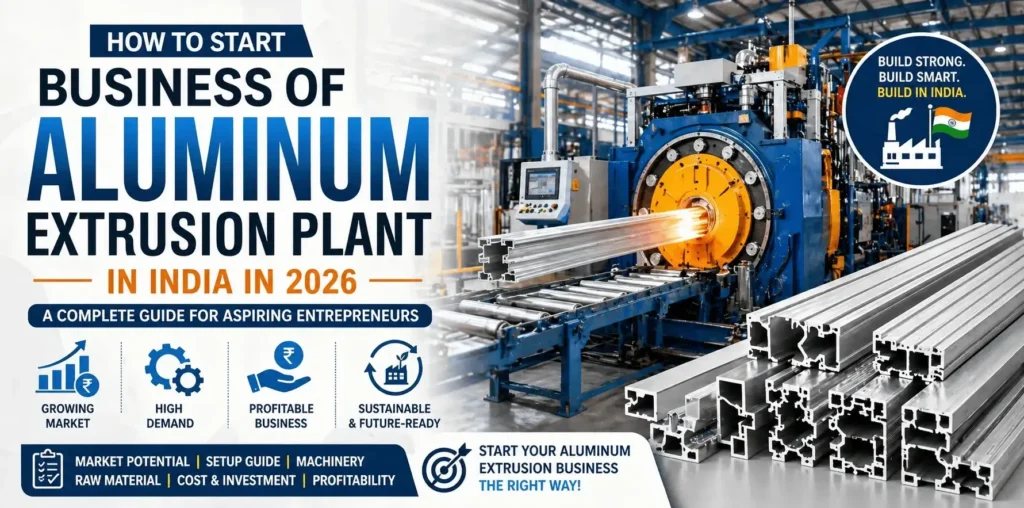
Aluminum is one of the most versatile and widely used non-ferrous metals in the world. Its lightweight, corrosion-resistant, and high-strength properties make it an ideal material for construction, transportation, consumer goods, solar panel frames, electronics, and more. One of the most important processes in the aluminum industry is extrusion, which allows the metal to be shaped into complex profiles for countless applications. With rapid urbanization, infrastructure growth, and the electric vehicle boom, the business of aluminum extrusion plant is becoming an increasingly attractive opportunity for entrepreneurs and MSMEs in India. Aluminum extrusion involves heating aluminum billets and forcing them through a die to create long, uniform profiles like channels, angles, rods, tubes, and custom designs. With growing demand from industries like real estate, automotive, railways, and electronics, starting a business of aluminum extrusion plant offers excellent growth and revenue potential. In this blog, we’ll explain the setup process, machinery, investment, market trends, and profitability of entering this sector. Visit this Page for More Information: Start a Business in Aluminium Downstream Sector Scope of the Business of Aluminum Extrusion Plant The global aluminum extrusion market is expected to reach USD 130 billion by 2030, growing at a CAGR of over 6%. In India alone, aluminum consumption is projected to reach 10 million tonnes by 2030, with extrusions making up 25–30% of this usage. Key Application Sectors: Construction and infrastructure Renewable energy (solar and wind) Automobiles and electric vehicles Electrical and electronics Consumer products and modular furniture Starting the business of aluminum extrusion plant gives you access to both B2B and B2C markets with high customization flexibility and growing demand. Read our Books Here: The Complete Technology Book on Aluminium and Aluminium Products
Thriving Business of Manufacturing Alu-Alu Blister Packaging for Medicines
In the highly regulated and quality-sensitive pharmaceutical industry, packaging plays a vital role in preserving the potency, integrity, and shelf life of medicines. Among various types of pharmaceutical packaging, Alu-Alu blister packaging for medicines has emerged as the gold standard, especially for moisture-sensitive and high-value drugs. This packaging solution not only ensures extended product protection but also complies with stringent international regulatory norms. Due to the rising demand for durable, contamination-free packaging, the business of manufacturing Alu-Alu blister packaging for medicines is thriving and offers remarkable growth opportunities for MSMEs and large-scale investors alike. Alu-Alu blister packs are formed using aluminum-based cold-forming technology that provides an impermeable barrier to light, oxygen, and moisture. As India’s pharmaceutical exports grow year after year, the demand for high-grade packaging materials like Alu-Alu foil is also expanding rapidly, making this a highly profitable and essential B2B venture. Visit this Page for More Information: Start a Business in Packaging Industry Why Alu-Alu Blister Packaging for Medicines is in High Demand Alu-Alu packaging is preferred for: Heat- and moisture-sensitive medicines High-end tablets and capsules Export-quality pharmaceutical products Long shelf-life drug formulations Due to its multi-layer barrier properties (aluminum + nylon + PVC), Alu-Alu blister packaging for medicines provides the highest protection level in the pharma sector, ensuring that drugs remain effective till the expiry date. Related Business Plan: Packaging Industry 1. What is Alu-Alu Blister Packaging? Alu-Alu blister packaging (also known as cold-form foil packaging) consists of: Aluminum Foil (Alu) – Provides full light and gas barrier Nylon Film – Adds flexibility and puncture resistance PVC or PVdC Film – Provides formability It involves a cold-forming process where the foil is shaped into cavities without heat and sealed with another aluminum foil to create an air-tight blister pack. Common Products: Antibiotics, cardiovascular drugs, hormone tablets, nutraceuticals, and export pharmaceuticals. Read our Books Here: The Complete Technology Book on Aluminium 2. Growing Market Opportunity India’s Pharma Packaging Market is projected to reach $3.2 billion by 2026, with blister packaging holding the lion’s share Exports: Over 200 countries import Indian medicines, requiring international-grade packaging like Alu-Alu Regulatory Push: Alu-Alu is often a compliance requirement under US FDA, EMA, and WHO-GMP standards for sensitive formulations The demand for Alu-Alu blister packaging for medicines is expected to grow at a CAGR of 6.8% globally till 2030. Read Similar Articles: How to Start Packaging Business 3. How to Start Alu-Alu Blister Packaging Manufacturing Business To begin this venture, you’ll need: Land & Infrastructure: Covered space: 5000–8000 sq. ft. Controlled environment for GMP compliance Separate areas for raw material, processing, and storage Key Machinery: Alu-Alu Blister Packing Machine Cold Forming Station Roller Sealing Station PVC/Alu Feeding Unit Dehumidifier and Dust Control Systems Die Set and Punch Tools Automatic Cutting and Stamping Machine Cost of Machinery: ?50 lakh – ?2 crore based on speed and automation level Click here to send your queries/Contact Us 4. Raw Materials Used Aluminum Foil (45–60 microns) Nylon Film PVC/PVdC Film Heat-Seal Lacquer Printing Ink (for brand labeling) Desiccants (optional for packing) All raw materials must be of pharmaceutical-grade quality as per Pharmacopeia standards. Related Feasibility Study Reports: Aluminium Foil (food Packaging And Pharmaceuticals Foils) 5. Manufacturing Process Cold Forming: Laminated film is fed and formed into cavity blisters using cold-forming dies Filling: Tablets or capsules are automatically dropped into cavities Sealing: Top aluminum foil is heat-sealed over the cavity Printing: Batch number, expiry, and brand details are printed Cutting & Packing: Packs are cut into standard sizes and packed in cartons 6. Licensing & Regulatory Requirements Udyam/MSME Registration Factory License GMP Certification FSSAI License (if for nutraceuticals) Pollution Control Board NOC BIS or ISO 15378:2017 Certification (optional but recommended) 7. Estimated Investment & ROI Cost Component Estimated Range Land & Setup ?50 lakh – ?1 crore Machinery ?50 lakh – ?2 crore Raw Material (initial stock) ?20 lakh – ?50 lakh Utilities, Staff, Licensing ?15 lakh – ?30 lakh Total Startup Cost: ?1.5 crore – ?3.5 croreProfit Margins: 15%–25%Monthly Revenue Potential (for 10 lakh blister capacity): ?50 lakh – ?1 crore 8. Clients & Marketing Strategy Pharmaceutical Companies Third-Party Drug Manufacturers Exporters and Contract Packers Hospitals and Government Tender Vendors B2B Marketing Channels: Pharma exhibitions (CPHI, IPHEX) IndiaMART, TradeIndia, ExportHub LinkedIn B2B Campaigns Pharmaceutical consultants and sourcing agents 9. Challenges in the Industry Challenge Solution Strict quality norms Adopt ISO and GMP systems Price pressure from large pharma buyers Offer value-added services (custom dies, printing) Limited access to pharma companies Partner with PCD franchise distributors Fluctuating raw material costs Bulk procurement contracts or long-term supplier tie-ups 10. Advantages of Alu-Alu Packaging Business High demand and recurring ordersLow product rejection if GMP is followedLucrative B2B marginsScope for automation and scaleExport opportunity with compliant setup Final Thoughts The business of Alu-Alu blister packaging for medicines is one of the most promising industrial ventures aligned with India’s booming pharmaceutical exports and healthcare growth. With the right setup, compliance, and connections, this venture can deliver sustainable profits and global relevance. It’s a capital-intensive business but comes with high credibility, brand partnerships, and long-term growth. Click here to send your queries/Contact Us Alu-Alu Blister Packaging for Medicines Manufacturing Industry Is one of the project reports by Niir Project Consultancy Services (NPCS). The project report covers all the aspects of business, from analyzing the market, confirming availability of various necessities such as plant & machinery, raw materials to forecasting the financial requirements. The project report by NPCS has benefited engineers, project consultants & industrial consultancy firms not only in India but worldwide. With the project reports on various business plans, NPCS also publishes technology, technical, reference, self-employment and startup books, directory, business and industry database, and a lot more which you can check on the official website. Reasons for Buying NIIR Report: Our research report helps you get a detailed picture of the industry by providing an overview of the industry along with the market structure and classification. Our report provides market analysis covering major growth driving factors for the
The Complete Book on Coconut Products
The coconut tree, often referred to as the “Tree of Life,” offers a wide variety of high-value products ranging from food and beverages to cosmetics, industrial raw materials, and biofuels. With increasing demand for health-conscious, natural, and eco-friendly alternatives globally, coconut products have gained immense popularity in both domestic and international markets. The Complete Book on Coconut Products versatility of this tropical fruit enables entrepreneurs to explore numerous profitable ventures with high market scalability and export potential. The Complete Book on Coconut Products is designed for aspiring entrepreneurs, agro-based manufacturers, and investors who wish to dive into the thriving world of coconut processing. Whether it’s virgin coconut oil, coconut water, coir, activated carbon, or flour, this book covers every major coconut-based product, its processing, market trends, investment requirements, and profitability. Visit this Page for More Information: Start a Business in Food Processing and Agriculture Based Industry Chapter 1: Understanding the Coconut Value Chain Overview of coconut cultivation and production Coconut-producing states in India and key global regions Seasonal harvesting and yield potential Export hubs and processing clusters Read Similar Articles: FOOD PROCESSING AND AGRICULTURE PROJECTS 2: Virgin Coconut Oil (VCO) Manufacturing What is VCO and its benefits Cold pressing vs fermentation method Machinery required Investment estimate and ROI Packaging, shelf life, and FSSAI norms Domestic and export market Download PDF: The Complete Book on Coconut & Coconut Products Chapter 3: Coconut Water Bottling Business Nutritional value and demand in the health beverage sector Processing and preservation (pasteurization, aseptic bottling) Packaging options (PET, tetra packs) BIS & FSSAI licensing Market channels: modern retail, airlines, exports Read our Books Here: Modern Technology of Food Processing 4: Desiccated Coconut Powder Manufacturing Grating, drying, and powdering process Industrial uses in confectionery, bakery, and snacks Required plant area and machinery Profit margins and buyer segments Related Feasibility Study Reports: Coconut and Coconut Products Chapter 5: Coconut Milk & Cream Production Differences between milk and cream Applications in vegan and lactose-free diets UHT processing and packaging Export compliance for US, EU, and Asian markets Chapter 6: Copra and Coconut Oil Extraction Dry copra and edible oil varieties Traditional expeller units vs modern continuous plants Quality standards (FFA value, moisture) Price volatility and oilcake by-product sales 7: Coconut Shell Activated Carbon Use in air/water purification, gold recovery, pharma Carbonization and activation process High-margin export-oriented business Environmental compliance and pollution control Chapter 8: Coir and Coir-Based Products Extraction of coir fiber and pith Products: mats, ropes, geo-textiles, grow bags High demand in agriculture, gardening, and erosion control Coir board schemes and machinery subsidy Chapter 9: Coconut Sugar & Neera Products Health benefits over regular sugar Evaporation and drying process Neera tapping and fermentation risks Licensing and sweetener market potential 10: Tender Coconut Processing (RTD Drinks & Snacks) Ready-to-drink (RTD) tender coconut juice Coconut chips, ice cream, and jelly Shelf-stable products using cold chain or preservatives Branding and FMCG marketing strategies Chapter 11: Packaging and Branding for Coconut Products Labeling norms, expiry, and storage Eco-friendly packaging trends Brand positioning and online/offline sales channels Export labeling (USFDA, EU organic, Halal) Chapter 12: Business Setup, Investment & Profitability Land, infrastructure, and machinery cost Working capital estimate Project report templates and loan assistance Government subsidies and MSME schemes (SFAC, Coconut Development Board, PMFME) 13: Export Opportunities and Compliance Top coconut product importing countries Trade HS codes and export registration Quality certifications: ISO, HACCP, FSSAI, APEDA Participation in global trade fairs Chapter 14: Success Stories & Industry Insights Case studies of successful coconut startups in India and abroad Interviews with coconut farmers turned entrepreneurs Challenges and solutions in scaling coconut ventures Chapter 15: 50 Coconut-Based Product Ideas You Can Start Virgin coconut oil Flavored coconut water Coconut milk ice cream Desiccated coconut for bakery Activated carbon tablets Coir pots for gardening Organic coconut flour Coconut sugar sachets Coir-based biodegradable planters Coconut shell handicrafts… (List continues to 50 items) Conclusion With its deep cultural roots and massive commercial potential, the coconut is not just a fruit but a full-fledged industry. From food and beverage to health, beauty, agriculture, and export, the opportunities are vast and increasing rapidly. This complete book on coconut products provides actionable knowledge, real-world business models, and the latest insights that can help you build a profitable coconut-based business from scratch. Click here to send your queries/Contact Us See More Links: NIIR PROJECT CONSULTANCY SERVICES, DELHI An ISO 9001:2015 Company ENTREPRENEUR INDIA 106-E, Kamla Nagar, Opp. Mall ST, New Delhi-110007, India. Email: npcs.ei@gmail.com info@entrepreneurindia.co Tel: +91-11-23843955, 23845654, 23845886 Mobile: +91-9097075054, 8800733955 Website: https://www.entrepreneurindia.co Contact Us
How Can We Start A Business Of Disposable Plastic Syringes?
The business of disposable plastic syringes is a highly profitable and scalable venture in the medical device industry. With the global rise in healthcare awareness, immunization programs, chronic disease treatments, and demand for hygiene-based consumables, disposable syringes have become essential in hospitals, clinics, and diagnostic centers. India, being one of the leading producers and exporters of medical disposables, offers immense opportunity to manufacturers entering this segment. A disposable syringe is a single-use device used to inject or withdraw fluids and is made primarily from medical-grade polypropylene (PP). These syringes are produced in high volumes with precision molding technology, ensuring sterile, accurate, and safe medical usage. Starting a business of disposable plastic syringes involves technical setup, regulatory compliance, and a focus on consistent quality and supply reliability. Visit this Page for More Information: Start a Business in Medical Disposables Industry Why Invest in the Business of Disposable Plastic Syringes? The business of disposable plastic syringes is one of the fastest-growing sectors due to: Rising global healthcare expenditure Government-led vaccination and health programs Increased use of single-use sterile equipment post-COVID Growing hospital and diagnostic infrastructure in Tier-II & Tier-III cities India exports syringes to over 120 countries. The domestic market alone is expected to cross ?3,000 crore by 2026, offering a reliable revenue stream for manufacturers. Related Business Plan: Disposable Plastic Syringes 1. Understanding the Product Disposable plastic syringes come in various sizes (1ml, 2ml, 5ml, 10ml, 20ml, etc.) and types (with or without needles). Key components include: Barrel – Holds the medication Plunger – Allows injection/withdrawal Needle Hub – Connects the needle Rubber Gasket – Ensures vacuum-tight seal Most manufacturers focus on auto-disable syringes and luer lock types due to growing safety and compliance requirements. Read Similar Articles: Profitable Business Ideas in Disposable Plastic Syringes Manufacturing 2. Market Demand and Scope India: Consumes over 2 billion syringes annually Global Market: Expected to reach $19.4 billion by 2030, growing at a CAGR of 5.2% Export Hotspots: Africa, Southeast Asia, Middle East, South America Government Demand: Health departments, vaccination drives, army hospitals, etc. The business of disposable plastic syringes benefits from both public and private sector demand. Click here to send your queries/Contact Us 3. Investment Required to Start Syringe Manufacturing Component Estimated Cost (INR) Land & Building (Rent/Owned) ?20 – ?50 lakh Injection Molding Machines ?40 – ?75 lakh Molds and Dies ?25 – ?50 lakh Assembly Line Equipment ?30 – ?60 lakh Sterilization Unit (ETO) ?40 – ?80 lakh Clean Room Setup (ISO 14644) ?50 – ?1 crore Quality Lab Equipment ?15 – ?30 lakh Working Capital ?25 – ?50 lakh Total Estimated Investment: ?2 crore – ?5 croreProfit Margin: 20–30%Break-even period: 18–24 months (depending on scale) Related Feasibility Study Reports: Disposable Plastic Syringes 4. Machinery and Manufacturing Setup Injection Molding Machines – For making barrel and plunger Mold Sets – Cavity molds for different syringe sizes Tip Assembly Machine – To attach the needle hub Siliconization & Lubrication Unit – To reduce friction inside barrel ETO Sterilization Plant – For sterilizing finished syringes Cleanroom Environment – Class 100,000 or 10,000 area with airlocks Automatic Packing Machine – For blister/sealed pouch packing Ensure temperature and humidity control in sterile areas for best results. Read our Books Here: Medical Devices & Disposables Industry in India 5. Raw Materials Used Medical Grade Polypropylene (PP) Stainless Steel Cannula (Needles) Rubber for Gasket Silicone Oil Packaging Material (PE/PVC Films) Sterilization Chemicals (ETO) All materials must comply with ISO 7886 and BIS standards. Watch other Informative Videos: Disposable Syringes Manufacturing | Disposable Syringe & Needle Production 6. Manufacturing Process Injection Molding – PP pellets melted and molded into syringe parts Tip & Needle Assembly – Luer lock/tip with optional fixed needle Siliconization – Internal coating for smooth plunger action Assembly – Plunger insertion, gasket fitting Sterilization – Using Ethylene Oxide (ETO) or Gamma radiation Packing – Blister sealed or plastic pouch packed Batch Coding and Quality Control 7. Legal Compliance and Licensing To start the business of disposable plastic syringes, you must obtain: MSME/Udyam Registration Drug Manufacturing License (Form 28D) BIS Certification (IS 10258) ISO 13485:2016 for Medical Devices CDSCO Registration (India’s regulatory authority) Pollution Control Board NOC Factory License and Fire NOC Exporters may also need CE certification and US FDA 510(k) approval. 8. Marketing & Sales Strategy Your clients will include: Government Health Departments (via tenders) Private Hospitals and Clinics Pharmaceutical Distribution Companies E-commerce platforms (for B2B sales) International Exporters and Traders Marketing Tips: Attend medical expos (Medical Fair India, Arab Health) Register on platforms like IndiaMART, TradeIndia, Alibaba Offer bulk deals to pharma procurement houses Collaborate with NGOs, UN projects, WHO tender partners 9. Challenges and How to Overcome Them Challenge Solution High initial investment Apply for MSME loans, CGTMSE, SIDBI support Regulatory barriers Hire an experienced pharma consultant for approvals Competitive pricing Automate production to reduce unit costs Export compliance Get certifications (ISO, CE, FDA) early 10. Future Scope & Scalability Manufacture insulin syringes, auto-disable syringes, or safety syringes Offer OEM services to pharmaceutical brands Expand into surgical kits and diagnostic devices Set up export-focused units in SEZs or medical parks Conclusion Starting a business of disposable plastic syringes offers promising returns with steady demand in the medical sector. With rising healthcare access and global immunization drives, the need for sterile, disposable medical products is more significant than ever. While the initial setup requires considerable investment and regulatory effort, the long-term rewards in both domestic and global markets make this business one of the most lucrative in the medical manufacturing space. Click here to send your queries/Contact Us Reasons for Buying NIIR Report: Our research report helps you get a detailed picture of the industry by providing an overview of the industry along with the market structure and classification. Our report provides market analysis covering major growth driving factors for the industry, the latest market trends and the regulatory framework of the industry. Our Report provides an analysis and in-depth financial comparison of major Players / Competitors. Our Report
The Perfect Business to Start Your Journey in Aluminum Industry
The business of aluminium beverage cans has emerged as a highly scalable and eco-friendly venture in the global packaging industry. With the rapid increase in consumption of soft drinks, energy drinks, ready-to-drink juices, and alcoholic beverages, aluminium cans are now the preferred choice for beverage companies due to their lightweight, recyclability, and extended shelf life. As the demand for sustainable packaging grows, aluminium beverage cans offer entrepreneurs a golden opportunity to enter a booming sector with long-term profitability and export potential. India’s beverage packaging market is expanding at a CAGR of over 5.4%, and the market for aluminium cans is a significant contributor. Giants like Coca-Cola, PepsiCo, Red Bull, and several Indian startups prefer aluminium packaging due to its convenience and environmental benefits. Whether you’re looking to set up a manufacturing unit or invest in a contract packaging facility, the business of aluminium beverage cans offers high margins, scalable operations, and a future-proof market. Visit this Page for More Information: Start a Business in Aluminium Downstream Sector Why the Business of Aluminium Beverage Cans Is Profitable The business of aluminium beverage cans is profitable due to several factors: High demand from the beverage industry (soft drinks, juices, beers, energy drinks) Eco-conscious consumers preferring recyclable packaging Durability and transport-friendliness of aluminium cans Growing export demand from Asia-Pacific, Middle East, and Europe Support from government initiatives like Extended Producer Responsibility (EPR) and Swachh Bharat Aluminium is 100% recyclable without loss in quality, which makes this business sustainable and future-ready. Related Business Plan: Aluminium and Aluminium Downstream Projects 1. Market Scope and Demand Overview India consumes over 20 billion beverage cans annually Aluminium can market is expected to surpass ?4,000 crore by 2027 Recyclability rate of aluminium is over 90%, making it a preferred material Growing trend of ready-to-drink (RTD) beverages and premium drinks in cans Export market potential: UAE, Bangladesh, Nepal, African countries Read Similar Articles: ALUMINIUM PRODUCTS PROJECT 2. Investment Required for Aluminium Can Manufacturing Unit Component Estimated Cost (INR) Land & Factory Setup (30,000+ sq. ft.) ?1 – ?2 crore Aluminium Sheet Rolling Line ?2 – ?3 crore Cupper Press and Bodymaker Machine ?4 – ?6 crore Trimmer, Necking & Flanger Units ?1.5 – ?2.5 crore Inside Coating and Printing Line ?2 – ?4 crore Curing Oven and Packing Line ?1 – ?1.5 crore Utility Equipment (Compressor, ETP) ?50 – ?70 lakh Working Capital ?1 – ?2 crore Total Investment: ?12 crore to ?20 croreROI: 18–25% annually depending on capacityBreak-even: Within 3–4 years Related Feasibility Study Reports: Aluminum Cans Production 3. Types of Aluminium Cans You Can Produce Standard 250ml and 330ml cans (used for soft drinks and beer) Sleek 180ml energy drink cans 500ml and 1L large-sized cans Aerosol-type aluminium containers for deodorants or sprays (diversification) You can also offer printed cans as OEM for beverage companies or produce plain blanks for third-party printers. 4. Raw Materials Required Aluminium Coil (Sheet stock): Main raw material for cup making Lacquers and Inks: For inner coating and exterior branding Pull tabs and ends (lids): With ring-pull mechanisms Lubricants and gas (for forming process) Packaging Materials: Cardboard trays, shrink wrap Most raw materials can be sourced domestically, or imported from China, UAE, or Europe. 5. Manufacturing Process of Aluminium Beverage Cans Sheet Feeding & Cup Making: Aluminium coil is fed into a cupping press Body Forming: Cups are drawn and ironed into long cylindrical can shapes Trimming & Necking: Height is trimmed; top portion is necked for lid Washing & Drying: Cleaned to remove any lubricant or particles Inside Coating: Special lacquer is sprayed inside and cured Outside Printing: High-speed rotary offset printing for brand labels Curing & Drying: High-temperature ovens to cure ink and coating Lid Seaming: Cans are fitted with pull-tab lids (after beverage filling) Packing & Palletizing: Cans are shrink-wrapped or tray-packed Read our Book Here: The Complete Technology Book on Aluminium and Aluminium Products 6. Licensing and Registration Needed To start the business of aluminium beverage cans, you’ll need: MSME/Udyam Registration Factory License and Pollution Control NOC FSSAI (if filling with beverages as a co-packer) GST Registration Fire Safety and Electrical Clearance ISO 9001 and ISO 22000 for quality and food safety (optional) BIS certification for raw materials (if required) For exports, obtain IEC code and comply with destination country labeling laws. 7. Clientele and Target Market Beverage manufacturers (Coca-Cola, Pepsi, Paper Boat, Bira, Kingfisher) Bottling companies and co-packers Energy drink brands (Red Bull, Monster, Tzinga) Export buyers for plain/printed cans Craft beer and RTD beverage startups 8. Marketing and Distribution Participate in packaging expos and food & beverage trade shows Register on IndiaMART, TradeIndia, Alibaba for B2B buyers Offer custom printing services for beverage startups Tie-up with regional beverage bottlers for bulk orders Leverage green packaging trend in your brand messaging 9. Challenges and How to Overcome Them Challenge Solution High capex Consider leasing equipment or JV with a beverage brand Raw material price fluctuations Secure long-term aluminium contracts Regulatory compliance Hire legal consultant for EPR and food safety Need for constant bulk orders Diversify into aerosol or food-grade containers 10. Future Scope and Expansion Start co-packing RTD juices or cold brews in your own cans Expand into bi-metallic cans or eco-friendly variants Sell printed cans as a value-added service Collaborate with brewery chains and startups Conclusion The business of aluminium beverage cans is booming with the rising demand for sustainable, transport-friendly, and consumer-preferred packaging solutions. Though capital-intensive, this business offers strong margins, repeat demand, and global scalability. With the right technology, regulatory setup, and partnerships, you can build a successful venture in one of the fastest-growing segments of the packaging industry. If you need information about the Business of Aluminium beverage cans, then contact NPCS. The project report from Entrepreneur India enables you to choose a profitable project for investing. If you are thinking about starting a business, one of the first things you should do is contact NPCS. They offer a range of services that can help you get your business off