
Railway Sleepers Manufacturing
The railway sleepers manufacturing industry is a crucial segment in railway infrastructure, playing an indispensable role in the safe, smooth, and long-lasting support of railway tracks. With growing investment in railways worldwide—especially in emerging economies—the demand for quality railway sleepers is rising steadily. Entrepreneurs and industrial investors can explore this business as a sustainable and highly profitable manufacturing opportunity with the right setup, resources, and strategy. Understanding the Railway Sleepers Manufacturing Process Railway sleepers, also known as railroad ties, are horizontal supports made of concrete, wood, steel, or composite materials, placed beneath railway tracks to hold them upright and correctly spaced. The process of manufacturing varies slightly depending on the material used but largely involves industrial precision, heavy machinery, and rigorous quality control. Types of Railway Sleepers To succeed in this industry, we must first understand the types of railway sleepers: Concrete Sleepers – Dominant in modern rail infrastructure due to their durability and low maintenance. Wooden Sleepers – Traditional and still used in certain geographies, especially in lower-speed rail tracks. Steel Sleepers – Durable and recyclable, but used selectively due to cost. Composite Sleepers – Made from recycled plastics or polymers and used as an eco-friendly option. Among these, concrete railway sleepers are the most commercially viable for large-scale production. Land, Factory Setup & Machinery To start a railway sleepers manufacturing business, we must acquire a minimum of 2–5 acres of industrial land with proximity to transportation hubs. The factory infrastructure includes: Casting Beds and Molds Batching and Mixing Plants Steam Curing Chambers Demolding and Handling Equipment Crane Systems for Material Movement Quality Testing Lab Storage Yards for Raw Materials and Finished Sleepers A typical plant with a production capacity of 200 sleepers/day requires an investment between ?10–?25 crore depending on automation level and scale. Mini setups can start at ?3–?5 crore. Raw Materials and Procurement Major raw materials required for railway sleepers manufacturing include: Portland Cement (OPC 53 Grade) Coarse Aggregates Fine Sand Admixtures for Strength and Durability High Tensile Steel Wires or Rods Water All materials must adhere to the Indian Railway Standards (IRS) or equivalent, and sourcing from certified vendors ensures compliance and reliability. Manufacturing Process Step-by-Step Designing & Molding: Using steel molds, the design and size of sleepers are customized as per railway norms. Reinforcement Placement: Steel rods or tensioned wires are placed accurately inside molds. Concrete Mixing: High-grade concrete is prepared using automated batching plants to ensure consistent strength. Pouring & Compaction: Concrete is poured into molds, and vibration systems ensure proper compaction. Steam Curing: Sleepers are cured under steam to achieve rapid strength gain. Demolding & Finishing: Sleepers are removed from molds and any excess material is trimmed. Quality Testing: Each sleeper undergoes ultrasonic testing, dimensional checks, and load-bearing tests. Storage & Dispatch: After certification, sleepers are stacked and transported to railway projects. Licensing and Approvals Before starting, we must obtain the following: Factory License Pollution Control NOC Approval from Indian Railways / RDSO GST Registration Company Incorporation (Private Limited / LLP / Partnership) Electricity & Water Connection Labour and Safety Compliance Certification Approval from Research Designs and Standards Organisation (RDSO) is critical as they set the technical guidelines for Indian Railways. Manpower and Technical Staff A plant needs a skilled and semi-skilled workforce including: Civil Engineers Production Supervisors Quality Control Inspectors Machine Operators Maintenance Staff Logistics & Admin Team Training is essential to maintain production efficiency and reduce rejects in railway sleepers manufacturing. Marketing and Sales Strategy The primary clients are government agencies and large infrastructure companies. Strategies include: Registering with Indian Railways & Contractors Participating in Public Tenders Building Partnerships with EPC Companies Demonstrating Capabilities via Pilot Batches Joining Infrastructure Trade Associations Digital presence through a website showcasing technical capability, certifications, and testimonials can build brand authority. Investment and Profitability Analysis Initial investment (?5–25 crore) includes land, plant & machinery, working capital, approvals, and manpower. Operating costs involve: Raw Material Procurement Labour Power & Water Maintenance Transportation Profit margins in railway sleepers manufacturing are 20–30% depending on economies of scale and production efficiency. A well-run facility can break even within 2–3 years. Challenges in Railway Sleepers Manufacturing While the business is lucrative, challenges include: Strict Regulatory Compliance High Capital Requirement Logistics of Heavy Products Seasonal Demand Based on Railway Projects Technological Upgradation Mitigating these through smart partnerships, quality automation, and skilled workforce is key to long-term success. Future Growth and Expansion Opportunities With Indian Railways’ modernization and global rail investments, demand for sleepers is expected to grow. Scope includes: Exporting to Neighboring Countries Manufacturing High-Speed Rail Sleepers Offering Customized Sleepers for Metro Projects Diversifying into Precast Infrastructure Products The shift toward sustainable railway sleepers manufacturing, including use of recycled composites and green cement, also opens up new revenue streams. Conclusion The railway sleepers manufacturing business is a powerful opportunity for industrial entrepreneurs. With strong infrastructure, adherence to quality standards, and efficient management, the business not only serves national infrastructure but also creates a steady source of income with high returns. Visit the page Select and Choose the Right Business Startup for You for sorting out the questions arising in your mind before starting any business and know which start-up you can plan. We, at NPCS, endeavor to make business selection a simple and convenient step for any entrepreneur/startup. Our expert team, by capitalizing on its dexterity and decade’s long experience in the field, has created a list of profitable ventures for entrepreneurs who wish to diversify or venture. The list so mentioned is updated regularly to give you a regular dose of new emerging opportunities. Contact Us
30 Profitable Small Scale Business Ideas Under ₹50 Crore in India

India’s rapidly growing industrial ecosystem is creating massive opportunities for entrepreneurs and investors seeking profitable business ideas under ₹50 crore. With increasing demand for locally manufactured products, government support for MSMEs, expanding export markets, and rising infrastructure development, medium-scale manufacturing and industrial businesses are becoming highly attractive investment opportunities. From food processing and pharmaceuticals to renewable energy, specialty chemicals, medical devices, and packaging industries, businesses under ₹50 crore can offer strong scalability, recurring demand, and long-term profitability. Entrepreneurs investing in plant and machinery-based industries can also benefit from government incentives, industrial subsidies, and Make in India initiatives. What are the Best Business Ideas Under ₹50 Crore? Some of the best business ideas under ₹50 crore include: Food processing units Pharmaceutical manufacturing Solar equipment assembly Biodegradable packaging Medical devices manufacturing Specialty chemicals production EV charging infrastructure Nutraceutical manufacturing CNC precision machining Agro warehousing and cold storage This guide explores some of the best business ideas under ₹50 crore in India that provide excellent growth potential, industrial expansion opportunities, and sustainable returns for investors and startups. Why Small Scale Businesses Are Thriving in India India presents a favorable ecosystem for small scale businesses. The government’s “Make in India” initiative, coupled with MSME schemes and startup-friendly policies, makes launching a business easier than ever. Additionally, the rise in digital infrastructure, improved logistics, and increased demand for specialized goods and services has enabled entrepreneurs to find success in niche markets. Moreover, India’s demographic dividend – a large, young population – provides both a robust workforce and a growing consumer base. Whether it’s food processing, health and wellness, renewable energy, or digital services, there’s a wide spectrum of opportunity awaiting the smart investor. Let’s explore a variety of sectors and ideas for small scale businesses that can be established with an investment between ?1 crore and ?50 crore. 1. Food Processing and Packaging Units India’s agri-rich landscape and large population make food processing one of the most profitable small scale businesses. Setting up a unit to process fruits, vegetables, spices, dairy, or ready-to-eat meals can provide high margins. Investment varies based on automation levels, but a well-equipped facility can start from ?3 crore and go up to ?50 crore for export-standard infrastructure. You can also focus on niche products like organic snacks, cold-pressed oils, or millet-based foods, which are trending among health-conscious consumers. 2. Pharmaceutical and Nutraceutical Manufacturing The pharmaceutical sector in India is globally competitive and ripe for small scale entry. Setting up a tablet, capsule, or syrup manufacturing unit under Good Manufacturing Practices (GMP) standards can be achieved in ?5–25 crore, depending on capacity. Likewise, nutraceuticals – such as dietary supplements, herbal products, and protein powders – offer excellent returns. These businesses benefit from recurring demand and can be scaled with contract manufacturing or private labeling. 3. Recyclable Packaging and Bioplastics With India pushing for sustainability, setting up a business in biodegradable or recyclable packaging is future-proof. Bioplastics, paper straws, molded fiber packaging, and compostable bags are in growing demand. With an investment of ?2–10 crore, a unit using eco-friendly technology and automated machinery can be launched. This is one of the most innovative small scale businesses with export potential and government support under the green initiatives. 4. Solar Equipment Assembly or Installation Business The renewable energy sector is booming, and small scale businesses can thrive by assembling solar panels, inverters, or providing end-to-end solar rooftop installation services. With an initial investment of ?5–20 crore, one can set up a solar component unit or even enter EPC (Engineering, Procurement, and Construction) services for residential and industrial solar setups. Given India’s renewable energy goals, this sector promises long-term viability. 5. Specialty Chemicals or Adhesives Manufacturing The specialty chemical sector serves industries such as textiles, paints, construction, and automobiles. Establishing a plant to manufacture adhesives, water treatment chemicals, or coatings can be capital intensive but rewarding. With ?10–30 crore, you can set up a plant with R&D capability and ISO compliance. These small scale businesses often enjoy high margins and repeat clientele from B2B markets. 6. D2C Cosmetics and Personal Care Manufacturing With rising digital commerce and beauty consciousness, launching your own direct-to-consumer (D2C) cosmetic brand is now more viable. You can either manufacture in-house or invest in a small scale unit to produce skincare, haircare, and wellness products. Investments of ?1–5 crore can cover equipment, R&D, branding, and distribution. With strong online marketing, your small scale businesses can achieve rapid scalability. 7. Precision Machining and CNC Components for Auto/Defense India’s push for indigenization in defense and electric vehicles creates demand for precision-machined parts. CNC-based small scale businesses can serve aerospace, defense, EVs, and industrial machinery. A typical setup can be achieved with ?10–40 crore depending on the machines and certifications required. Once certified, such businesses can supply to OEMs and defense contractors with high value orders. 8. Cold Storage and Agro Warehousing Post-harvest losses in India are significant due to the lack of cold chain infrastructure. Setting up cold storage, especially in regions with fruit and vegetable production, can be highly lucrative. Investments of ?5–50 crore depending on capacity and temperature control technology are common. You can also include ripening chambers, packaging lines, and digital inventory management systems to offer complete agri-logistics services. 9. Electric Vehicle Charging Infrastructure India’s transition to electric mobility opens up new investment opportunities. Installing EV charging stations across urban and highway corridors can be a smart move. With around ?1–3 crore, you can set up a network of fast-charging stations. Tie-ups with commercial real estate, parking lots, and municipal bodies can provide long-term leases and user footfall. These futuristic small scale businesses combine energy and transport tech. 10. Medical Devices and Disposables Unit The Indian government is strongly pushing for Atmanirbhar Bharat in healthcare. Small scale businesses in medical devices like syringes, IV sets, surgical gloves, or diagnostic kits are in high demand. Setting up a compliant plant requires ?10–25 crore. Once certified by Indian or global medical standards (like ISO 13485 or CE), these units can cater
30 Business Ideas to Start with Investment of 1.25 Crore (Plant and Machinery).
India’s expanding economy and entrepreneurial ecosystem offer a broad range of lucrative business opportunities for those ready to invest between ?1 to ?1.25 crore. This investment bracket opens the door to ventures that are not only profitable but also scalable. In this article, we explore 30 lucrative business ideas that are both innovative and viable for long-term growth. Why ?1–1.25 Crore is a Game-Changing Investment Bracket With an investment of ?1–1.25 crore, aspiring entrepreneurs can enter industries that were previously out of reach due to high capital requirements. This budget allows for state-of-the-art machinery, skilled workforce, marketing outreach, and even franchise tie-ups. From manufacturing to service-based industries, this range unlocks possibilities in both urban and semi-urban markets. Here’s a comprehensive list of the most promising businesses in this range: 1. Packaged Drinking Water Plant A highly regulated yet rewarding business, the packaged water industry sees massive demand from urban and rural areas alike. Invest in ISI-certified plants and automated bottling lines. 2. Ready-Mix Concrete (RMC) Plant A vital component in modern construction, RMC businesses are booming in Tier 1 and Tier 2 cities due to rising infrastructure demands. 3. Microbrewery Urban youth culture and growing social acceptance of craft beers make microbreweries a hot investment. Licensing, equipment, and interior design fall within the ?1–1.25 crore range. 4. Solar Panel Manufacturing As India transitions to renewable energy, solar panel production units are emerging as a high-growth sector. Government subsidies make this even more appealing. 5. Diagnostic Center Healthcare diagnostics are witnessing a surge. With advanced medical equipment and specialized staff, this business assures high margins. 6. Food Processing Unit Setting up a unit to produce packaged snacks, frozen foods, or organic products can be extremely profitable due to growing health consciousness. 7. Cold Storage and Warehousing With the growth of agriculture exports and e-commerce logistics, a cold storage unit can deliver solid returns on investment. 8. Automobile Service and Repair Center A multi-brand car and two-wheeler service station, equipped with advanced diagnostic tools, caters to India’s massive vehicle population. 9. Laundry and Dry Cleaning Franchise Brands like UClean and TumbleDry offer profitable franchise models that fit well in the ?1–1.25 crore budget. 10. Ice Cream Manufacturing With consistent demand throughout the year, especially in warm regions, an ice cream unit ensures steady cash flow and scalability. 11. Organic Fertilizer Production Given the government’s push for sustainable agriculture, this sector is receiving increasing attention and funding. 12. Modular Furniture Manufacturing With booming real estate and urban migration, the demand for modular and space-saving furniture is rising rapidly. 13. Digital Printing and Packaging Industries like food, pharmaceuticals, and FMCG rely on high-quality digital printing and packaging solutions. 14. Hotel or Boutique Resort Locations near tourist hotspots or pilgrimage centers can yield very high occupancy rates and strong ROI. 15. Commercial Kitchen for Cloud Kitchen Brands Support the rise of food delivery platforms by leasing kitchens to delivery-only restaurant brands. 16. EV Charging Station As electric vehicles increase on Indian roads, EV charging infrastructure presents a new wave of growth. 17. Water ATM and Purification Plant Serving rural and semi-urban populations with clean drinking water is both a social and profitable venture. 18. Pet Care and Grooming Center As pet ownership increases in urban areas, premium grooming services are rapidly gaining popularity. 19. Wooden Pallet Manufacturing Used in logistics and transport sectors, wooden pallets are a high-demand, low-maintenance manufacturing idea. 20. Ayurvedic Product Manufacturing India’s traditional medicine market is growing internationally. Investment in an ayurvedic product unit is future-proof and export-oriented. 21. Battery Recycling Plant The surge in electronics and EVs means battery disposal and recycling are becoming increasingly vital. 22. Cloud-Based IT Services Company With minimal physical infrastructure and the right talent, software development, cybersecurity, or SaaS businesses are lucrative. 23. Co-Working Space With hybrid work models becoming the norm, co-working spaces in Tier 2 cities are filling up rapidly. 24. Plastic Recycling Unit A business with both environmental and monetary value. Plastic recycling has potential in urban and industrial zones. 25. Printing Ink Manufacturing Used across packaging, publications, and promotional materials, ink production can be a high-margin niche. 26. Bottling Plant for Juices or Beverages Fruit juice bottling or health drink plants are a big hit among young consumers, especially in summer-heavy regions. 27. Paper Cup and Disposable Cutlery Manufacturing A business that is eco-friendly and high-demand due to the shift away from plastic utensils. 28. Mushroom Farming Setup With a growing demand for unfamiliar mushrooms like shiitake and oyster, controlled-environment mushroom farming is profitable and scalable. 29. High-End Salons and Wellness Centers Branded beauty salons with premium offerings see strong footfall and client loyalty in metro and Tier 1 cities. 30. Franchise of a Renowned Food Chain Investing in franchises of brands like Domino’s, KFC, or Subway assures brand pull, training, and support, reducing risk and improving profitability. Why These 30 Lucrative Business Ideas Make Sense for ?1–1.25 Crore Investment These business opportunities are well-aligned with India’s evolving consumer behavior, digital evolution, and policy direction. The key lies in selecting a domain that resonates with local demand, resource availability, and market saturation levels. Whether it’s a tech-oriented startup, sustainable manufacturing unit, or consumer service brand, the potential for high returns is very real. Moreover, investing ?1–1.25 crore allows for leveraging economies of scale and acquiring professional talent. Unlike low-budget ventures, these enterprises allow for branding, automation, and scalability, which directly impact profitability and sustainability. With the right planning, mentorship, and market analysis, each of these 30 lucrative business ideas has the capacity to build wealth, generate employment, and create a lasting impact. Visit the page Select and Choose the Right Business Startup for You for sorting out the questions arising in your mind before starting any business and know which start-up you can plan. We, at NPCS, endeavor to make business selection a simple and convenient step for any entrepreneur/startup. Our expert team, by capitalizing on its dexterity and decade’s long experience in the field, has created a list of
10 Profitable Small Scale Manufacturing Business Ideas Under ₹60 Lakhs
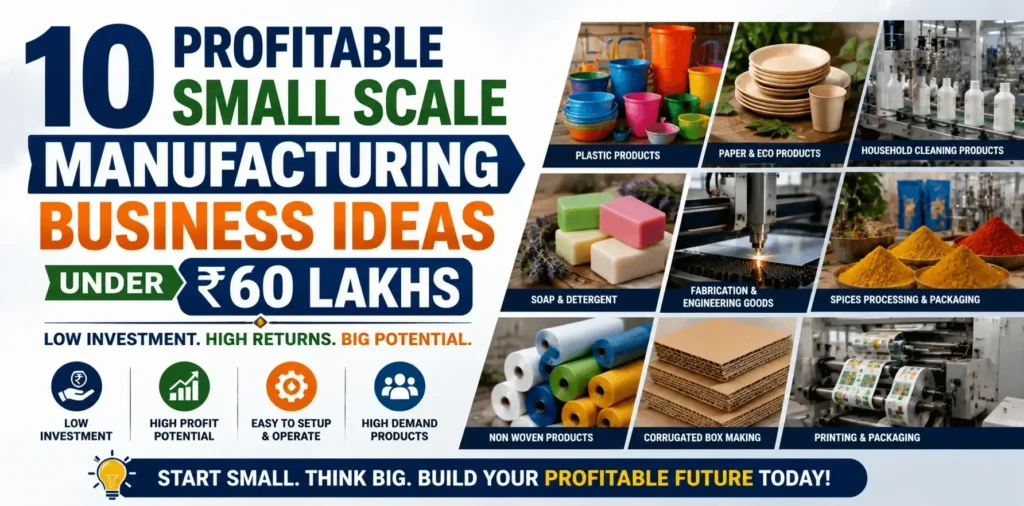
India’s growing economy, rising demand for locally manufactured products, and strong government support for MSMEs have created massive opportunities in the small scale manufacturing sector. Entrepreneurs and investors are increasingly exploring profitable small scale manufacturing business ideas that require moderate investment and offer long-term growth potential. With an investment of ₹50–60 lakhs, it is possible to establish scalable manufacturing units in sectors such as food processing, eco-friendly packaging, detergents, furniture, LED lighting, garments, and household products. These businesses benefit from rising consumer demand, low operational costs, and expanding domestic and export markets. What are Small Scale Manufacturing Businesses? Small scale manufacturing businesses are production units that manufacture products using limited capital, moderate machinery, and small operational teams. These businesses usually focus on local, regional, or niche markets while offering scalable growth opportunities. Why Small Scale Manufacturing Businesses Are Profitable in India government MSME support Make in India rising local demand export opportunities low setup costs scalable operations employment generation Home-Based Small Scale Manufacturing Business Ideas Include: candles detergents agarbatti paper bags soaps handmade foods Small Scale Manufacturing Industries with High Future Demand Include: eco-friendly products electric products organic products biodegradable packaging LED products cleaning products This guide explores some of the best small scale manufacturing business ideas in India that can be started with plant and machinery investment under ₹60 lakhs. Top Small scale Manufacturing Business Ideas with Investment of 50-60 Lakhs When thinking about small scale manufacturing, it’s crucial to focus on sectors with consistent market demand, relatively low overheads, and scalable potential. Below are some of the best business ideas under a ?60 lakh investment bracket: 1. Paper Bag Manufacturing Unit With increasing environmental concerns and a ban on plastic in many Indian states, paper bags have seen a surge in demand. A small scale manufacturing unit can produce kraft paper bags, carry bags, and customized printed paper bags for retail outlets, restaurants, and packaging suppliers. An investment of ?25–?40 lakhs can cover semi-automatic machinery, raw material, setup, and working capital. Why It’s Worth It: High demand due to eco-friendliness Government support for sustainable businesses Easy marketing to retail and wholesale clients 2. Agarbatti (Incense Stick) Manufacturing A traditional yet thriving sector, agarbatti production is a low-technology, high-demand business that aligns well with the ?60 lakh budget. The raw materials include bamboo sticks, charcoal powder, wood powder, and essential oils. With semi-automatic or fully automatic machines, one can manufacture thousands of sticks daily. Benefits: Large domestic and export markets Simple machinery and raw material procurement Fast break-even period 3. Packaged Drinking Water Plant The need for clean and safe drinking water continues to rise across India. A packaged drinking water plant typically requires filtration units, bottling machinery, labeling machines, and a basic quality control lab. For ?50–?60 lakhs, you can set up a medium-capacity unit and get the necessary BIS and FSSAI certifications. Advantages: Continuous market demand Opportunity to expand to flavored and mineral water Sell to retailers, supermarkets, and offices 4. Spice Powder Manufacturing India is a land of spices, and there is massive demand for packaged spice powders both domestically and internationally. With ?40–?60 lakhs, you can invest in grinding machines, packaging units, branding, and marketing. Raw materials like turmeric, chili, coriander, and cumin can be procured from local farmers or wholesalers. Why Choose This: Potential for strong brand identity Export opportunities Value addition with blends and organic options 5. Detergent and Cleaning Product Manufacturing Soaps, liquid detergents, and toilet cleaners are essential household items. A small scale manufacturing business producing these products can be started with an investment of ?30–?50 lakhs, covering mixing machines, formulation expertise, and packaging solutions. Perks: High repeat purchase rate Customizable formulas Brand-building potential in local and regional markets 6. LED Light Assembly Unit With a focus on energy efficiency and “Make in India” initiatives, LED lights are replacing traditional lighting solutions. An assembly unit requires tools, testing equipment, and packaging. A ?60 lakh investment allows you to hire skilled technicians and build inventory. Why It’s Profitable: Urban and rural market expansion Increasing demand for affordable LED solutions Government subsidies for energy-saving products 7. Phenyl and Floor Cleaner Production Phenyl and disinfectants are essential items used in homes, offices, schools, and hospitals. The setup requires mixers, tanks, and packaging machines and can be established within ?15–?25 lakhs. The remaining capital can be utilized for marketing and bulk production. Advantages: Large institutional buyers Low production cost Potential for creating a brand 8. Furniture Manufacturing Unit Custom and modular furniture is always in demand due to rising urbanization and housing projects. A ?60 lakh investment can set up a workshop with carpentry tools, wood polish equipment, and labor to produce beds, wardrobes, and office furniture. Highlights: Rising demand from real estate and commercial sectors Customization brings high margins Potential to supply to e-commerce furniture platforms 9. Garment Stitching and Embroidery Unit A small scale manufacturing business in garments can cater to ethnic, western, or kidswear segments. With ?50–?60 lakhs, you can set up stitching machines, embroidery units, ironing and packaging sections, and create your private label. Opportunities: Strong export potential Growth of e-commerce platforms High employment generation 10. Organic Fertilizer Manufacturing As organic farming gains popularity, so does the demand for compost-based fertilizers. A plant producing vermicompost, cow dung compost, or biofertilizers can be set up under ?60 lakhs, including compost pits, shredders, and packaging machines. Why Go Organic: Government incentives for organic farming Tie-ups with agricultural cooperatives Sustainable and eco-friendly approach Licensing and Legal Aspects Every small scale manufacturing unit must adhere to state and central regulations. Some key licenses you might require include: GST registration Udyam (MSME) registration Factory license Pollution Control Board clearance (for applicable sectors) FSSAI license (for food and water units) Early compliance helps build credibility with clients and ensures smooth operation. Funding Options for Small Scale Manufacturing In addition to personal capital, here are common sources of funding: Mudra Loan Scheme: For small business owners under PMMY SIDBI Assistance: Loans and equity support for manufacturing Startup
26 Small Manufacturing Business Ideas to Start with Investment of 60- 75 Lakhs
India’s booming industrial sector and favorable government policies make it an ideal destination for entrepreneurs looking to start a small manufacturing business. With an investment capacity of ?60–75 lakh, several lucrative opportunities are available that can generate good returns and contribute to job creation. Whether you are planning a semi-automated unit or a full-fledged production line, the scope for growth is immense. In this article, we explore the best small manufacturing business ideas with 60–75 lakh investment, providing insights into demand, profitability, and feasibility. Why Invest in Small Manufacturing Businesses? India’s small manufacturing sector contributes significantly to GDP and employment. The growing “Make in India” initiative, along with easy credit from banks and government subsidies through MSME schemes, makes the manufacturing ecosystem attractive. With ?60–75 lakh, entrepreneurs can establish a scalable business, invest in modern machinery, hire skilled labor, and ensure product quality with ample working capital. Let’s now explore the best small manufacturing business ideas with 60–75 lakh capital. 1. Paper Bag Manufacturing With the ban on plastic bags and increasing demand for eco-friendly alternatives, paper bag manufacturing is booming. You can start a semi-automated unit producing kraft paper, shopping bags, and customized branded bags. Estimated Investment: ?65–70 lakh (includes land, machinery, and raw materials)Profit Margin: 15–25%Target Customers: Retailers, supermarkets, clothing brands, restaurants This is among the best small manufacturing business ideas with 60–75 lakh due to low competition and rising demand. 2. LED Light Manufacturing The energy-efficient lighting industry is growing, especially in urban and rural electrification programs. LED bulbs, tube lights, and panel lights are in high demand. The business includes assembling circuits, housing units, and testing. Estimated Investment: ?70–75 lakhProfit Margin: 20–30%Target Market: Real estate projects, government tenders, commercial complexes The high return on investment and future-ready nature of this segment make it one of the best small manufacturing business ideas with 60–75 lakh investment. 3. Packaged Drinking Water Plant Clean water is a necessity, and with rising awareness of health, the packaged drinking water industry is flourishing. With proper BIS certification and hygienic bottling, this business can scale quickly. Estimated Investment: ?60–72 lakhProfit Margin: 25–35%Scalability: High, with options to expand into flavored water and soda Given the year-round demand, this is undoubtedly one of the best small manufacturing business ideas with 60–75 lakh capital. 4. Disposable Cutlery and Plates Manufacturing With increasing restrictions on single-use plastics and a shift towards biodegradable options, the market for disposable cutlery made from sugarcane bagasse, areca leaves, and cornstarch is booming. Estimated Investment: ?65 lakhProfit Margin: 20–30%USP: Eco-friendly and export potential This green initiative qualifies as a sustainable and profitable venture, ranking among the best small manufacturing business ideas with 60–75 lakh. 5. Agarbatti (Incense Stick) Manufacturing India is the world’s largest producer and consumer of incense sticks. The raw material is easily available, and the product has religious and cultural significance across regions. Estimated Investment: ?60–68 lakh (includes semi-automatic machines)Profit Margin: 30–40%Export Potential: High, especially to Southeast Asia and the US This culturally rooted and low-entry-barrier business is undoubtedly one of the best small manufacturing business ideas with 60–75 lakh for quick profits. 6. Furniture Manufacturing With rising urbanization and real estate development, the demand for custom and modular furniture has increased. Using a blend of CNC routers, polish machines, and skilled artisans, this business is highly scalable. Estimated Investment: ?70–75 lakhProduct Range: Office desks, kitchen cabinets, beds, wardrobesTarget Market: Retail, wholesale, B2B, interior designers Thanks to steady demand and customization trends, this is a long-term and stable venture—easily among the best small manufacturing business ideas with 60–75 lakh. 7. Detergent and Cleaning Products Manufacturing With increasing hygiene awareness, the market for liquid detergents, dishwash liquids, floor cleaners, and handwashes is growing rapidly. The sector also allows for private labelling opportunities. Estimated Investment: ?60–65 lakhProfit Margin: 20–35%Scope: Home care, hotels, hospitals, retail chains This FMCG product segment is recession-proof, making it one of the best small manufacturing business ideas with 60–75 lakh investment. 8. Garment Manufacturing Unit Textiles and garments remain India’s top export industries. You can set up a small unit producing t-shirts, uniforms, or women’s ethnic wear, using semi-automated machines and hiring tailors. Estimated Investment: ?70 lakhProfit Margin: 20–25%Target Markets: E-commerce, export, wholesale markets With good design, branding, and quality control, this can scale fast, making it one of the best small manufacturing business ideas with 60–75 lakh. 9. Solar Panel Assembly Unit As renewable energy adoption grows, small-scale solar panel assembly units are in demand. While manufacturing from scratch is capital-intensive, assembling parts locally is feasible in this budget. Estimated Investment: ?75 lakhCustomers: Residential buildings, schools, rural electrification, MSMEsSupport: Government subsidies and net-metering policies With environmental sustainability and market expansion, this is clearly one of the best small manufacturing business ideas with 60–75 lakh. 10. Ayurvedic and Herbal Products Manufacturing India’s wellness industry is booming. With licenses and certifications (FSSAI, AYUSH), one can manufacture face creams, oils, supplements, herbal juices, etc. Estimated Investment: ?60–70 lakhProfit Margin: 25–40%Sales Channels: E-commerce, Ayurveda clinics, retail stores Given the rise in natural product preference, this sector promises high returns and is among the best small manufacturing business ideas with 60–75 lakh investment. Key Factors to Consider Before Starting While exploring these best small manufacturing business ideas with 60–75 lakh, keep these essential factors in mind: Licensing & Compliance: Ensure all statutory registrations like MSME Udyam, GST, pollution control, factory license, etc., are completed. Location: Choose an industrial zone or semi-urban area with access to raw materials, manpower, and transportation. Machinery & Technology: Invest in reliable semi-automated or automated machinery for efficiency and scalability. Skilled Manpower: Hire or train staff for operating machinery and maintaining product quality. Marketing Strategy: Leverage B2B networks, local distributors, and digital platforms for brand visibility. Conclusion Starting a small manufacturing business with a ?60–75 lakh budget is a strategic decision with the potential to yield high returns if executed well. Whether you are inclined towards eco-friendly products, FMCG, or technological innovation, there are ample opportunities to explore. From LED lights to herbal products, these
List of Profitable Small Manufacturing Business Ideas with Investment of 50 Lakhs (Plant and Machinery)
India’s economy is rapidly expanding, and entrepreneurship is being celebrated like never before. Aspiring business owners are increasingly exploring manufacturing opportunities, particularly in the small-scale sector. One of the most promising investment brackets for first-time entrepreneurs is under ?50 lakhs. This budget is enough to establish a production unit, buy essential machinery, and begin operations while keeping risks relatively low. With the right planning and execution, small manufacturing ideas can evolve into profitable ventures with long-term sustainability. Top Small Manufacturing Ideas Under 50 Lakhs in India When it comes to small-scale industries, innovation, market demand, raw material availability, and government support play a major role in deciding success. Here are some of the most viable and profitable small manufacturing ideas that can be launched with an investment of ?50 lakhs or less: 1. Paper Bag Manufacturing With the ban on plastic in many Indian states and the growing preference for eco-friendly alternatives, paper bag manufacturing is a highly lucrative option. The process requires minimal manual labor and basic semi-automatic machinery. Investment Range: ?10-15 lakhsKey Requirements: Kraft paper, printing unit, cutting machineTarget Market: Retailers, shopping malls, restaurants, grocery stores This is one of the most sought-after small manufacturing ideas due to low raw material costs and high demand. 2. Spice Powder Manufacturing India is one of the world’s largest consumers and exporters of spices. Starting a spice powder manufacturing business involves sourcing raw spices, drying, grinding, packaging, and marketing the final product. Investment Range: ?20-30 lakhsKey Requirements: Pulverizer machine, packaging equipment, drying chamberTarget Market: Local supermarkets, restaurants, export markets Among the small manufacturing ideas, spice powder production is scalable and has a consistent market throughout the year. 3. Sanitary Napkin Manufacturing As awareness about menstrual hygiene rises, so does the demand for affordable sanitary pads. This sector is also supported by several government subsidies and NGO partnerships. Investment Range: ?30-40 lakhsKey Requirements: Semi-automatic pad making machines, sterilization units, soft cotton & absorbent gelTarget Market: Rural areas, schools, women welfare organizations This venture is not only profitable but also contributes to a social cause, making it one of the most impactful small manufacturing ideas. 4. Handmade Soap Production Handmade and herbal soaps have become extremely popular due to the rise of organic and chemical-free personal care products. This business is easy to start and allows high customization. Investment Range: ?8-12 lakhsKey Requirements: Soap molds, mixing equipment, oils, essential oils, herbal extractsTarget Market: Urban consumers, spas, hotels, e-commerce platforms Being a low-cost entry, it’s one of the most ideal small manufacturing ideas for home-based entrepreneurs. 5. Disposable Cutlery and Plates The shift towards sustainable food packaging has opened a vast market for biodegradable cutlery made of areca leaf, bamboo, sugarcane bagasse, etc. This industry has enormous growth potential in both domestic and export markets. Investment Range: ?25-35 lakhsKey Requirements: Molding machines, raw plant material, packaging unitTarget Market: Restaurants, food stalls, wedding planners, eco-friendly stores This eco-conscious business option is among the top small manufacturing ideas for the future. 6. Agarbatti (Incense Stick) Manufacturing India’s cultural and religious diversity ensures a massive and ongoing demand for agarbattis. This business is labor-intensive but can be started with a small team and limited equipment. Investment Range: ?5-10 lakhsKey Requirements: Agarbatti making machine, bamboo sticks, essential oils, perfumesTarget Market: Temples, households, retailers, exporters It is a traditional yet evergreen option among small manufacturing ideas, especially in semi-urban and rural areas. 7. Detergent Powder and Liquid Manufacturing The cleaning product industry is recession-proof. People need detergents year-round, which makes this business a consistent revenue generator. Investment Range: ?15-20 lakhsKey Requirements: Blender machine, mixing vessel, packaging system, raw chemicalsTarget Market: Households, laundries, hotels, wholesalers It is a highly recommended model for anyone researching dependable small manufacturing ideas with fast market entry. 8. LED Bulb Assembly Unit With government support for energy-saving products, the LED market has exploded in India. Starting a small LED bulb assembly plant can be an economical and scalable business. Investment Range: ?20-25 lakhsKey Requirements: Soldering machines, PCB boards, LED chips, testing equipmentTarget Market: Electrical shops, wholesalers, B2B suppliers One of the fastest-growing small manufacturing ideas with the added benefit of helping reduce carbon emissions. 9. Ice Cream Cone Manufacturing Ice cream cones are always in demand, especially in summers. The cone-making business requires a small setup but offers good profit margins when tied up with ice cream parlors and brands. Investment Range: ?10-15 lakhsKey Requirements: Cone baking machines, mixing equipment, packaging toolsTarget Market: Ice cream manufacturers, dessert parlors, cafes A niche yet fun-filled venture among small manufacturing ideas with opportunities to diversify into waffle cones and edible cups. 10. Ready-to-Cook Food Packaging With fast-paced lifestyles, the ready-to-cook meal segment is rapidly growing. From pre-cut vegetables to frozen parathas, this industry offers immense potential. Investment Range: ?30-45 lakhsKey Requirements: Cold storage, packaging unit, sealing machine, hygiene certificationTarget Market: Working professionals, college students, grocery retailers, online delivery platforms Perfect for urban areas, this idea is among the top trending small manufacturing ideas in the food sector. Tips to Succeed with Small Manufacturing Business Final Thoughts Manufacturing is one of the strongest pillars of economic growth and employment in India. With the right planning, even small entrepreneurs can make a big impact. The options listed above not only offer great returns but also allow you to contribute to employment generation and import substitution. The most important factor is to choose an idea that aligns with your skills, passion, and the market demand. These small manufacturing ideas under ?50 lakhs are just the beginning. With consistent effort, a commitment to quality, and smart marketing, any of these ventures can grow into a well-established enterprise. Whether you are a first-time entrepreneur or someone looking to expand your income streams, small-scale manufacturing presents a golden opportunity. Visit the page Select and Choose the Right Business Startup for You for sorting out the questions arising in your mind before starting any business and know which start-up you can plan. We, at NPCS, endeavor to make business selection a simple and convenient
Instant Tea Manufacturing Business
Instant tea has emerged as a fast-growing product in the global beverage industry due to its convenience, long shelf life, and growing popularity among health-conscious consumers. As people seek easy-to-prepare yet refreshing drinks, the demand for instant tea continues to rise in India and across international markets. Entrepreneurs exploring food and beverage ventures may find instant tea manufacturing a highly promising and scalable business idea. This article provides a step-by-step guide to help you understand how to start an instant tea manufacturing business in 2025. Market Scope and Demand for Instant Tea The instant tea manufacturing industry is thriving globally, with substantial growth observed in markets like India, China, the U.S., and Europe. The rise in urbanization, changing lifestyles, and increased consumption of convenience food and beverages are key growth drivers. According to industry analysts, the global instant tea market is expected to grow at a CAGR of 5-7% over the next five years. From herbal teas and flavored teas to green and black variants, the segment offers a diverse range of products catering to various health preferences. India, being one of the largest producers and consumers of tea, offers a competitive edge for manufacturers due to the availability of raw materials, skilled labor, and a strong domestic demand. With the “Make in India” initiative and increased government support for food processing industries, now is a great time to invest in instant tea manufacturing. Key Steps to Start an Instant Tea Manufacturing Unit 1. Conduct Market Research and Product Planning Start by analyzing your target market. Understand consumer preferences, ongoing trends (e.g., demand for sugar-free or organic variants), and competitors. Decide on your product range: will you offer instant black tea, green tea, herbal blends, or flavored options like lemon, cardamom, or masala? Based on your market study, develop a business plan outlining investment requirements, pricing, and marketing strategy. 2. Business Registration and Legal Compliance Register your business under a suitable structure (e.g., proprietorship, partnership, or private limited company). Obtain the necessary licenses and certifications: FSSAI registration for food safety GST registration Factory license Pollution control clearance Trademark registration for brand protection 3. Location and Infrastructure Setup Choose a location close to tea-growing regions like Assam, Darjeeling, Nilgiris, or Dooars to reduce transportation costs of raw materials. A medium-scale instant tea manufacturing unit requires about 1000–2000 sq ft space for processing, packaging, and storage. Ensure the site has access to utilities like water, electricity, and waste management systems. 4. Machinery and Equipment Required The core of instant tea manufacturing lies in tea extraction, concentration, drying, and packaging. Some essential machinery includes: Tea extractor Evaporator Spray dryer or freeze dryer Blending unit Packaging machines (sachet, pouch, or jar packing) Quality testing equipment You may also consider semi-automatic or fully automatic machines based on your budget and production scale. 5. Raw Materials and Supply Chain Key raw materials for instant tea manufacturing include: High-quality tea leaves (black, green, or herbal) Natural flavorings and additives Anti-caking agents Food-grade packaging material (PET jars, pouches, sachets) Establish contracts with reliable suppliers and explore bulk procurement from tea estates or auctions to minimize costs. 6. Manufacturing Process Overview The typical process of instant tea production involves the following stages: Extraction: Tea leaves are brewed using hot water to extract the soluble contents. Filtration: The brew is filtered to remove solid residues. Concentration: The filtered solution is concentrated using evaporators. Drying: Concentrated liquid is dried into powder or granules using spray drying or freeze drying. Blending and Flavoring: The dried tea is blended with flavors and additives. Packaging: The final product is packed in consumer-friendly formats and labeled. Each stage of the process must follow strict hygiene and quality control standards to ensure food safety and customer satisfaction. 7. Manpower and Staffing Hire skilled and semi-skilled personnel for production, quality control, packaging, and logistics. A small-to-medium scale instant tea manufacturing unit typically requires: 1-2 production supervisors 4-6 machine operators and helpers 1 quality analyst 1-2 staff for packing and dispatch 1 marketing or sales executive Provide training to ensure safety protocols and process efficiency are maintained. 8. Quality Assurance and Certifications Maintaining high quality is vital for brand reputation and customer trust. Implement Good Manufacturing Practices (GMP) and regular quality checks. Consider obtaining ISO 22000 (food safety management) and HACCP certifications for credibility, especially if you plan to export. Consistent lab testing ensures your instant tea meets all regulatory and safety guidelines. 9. Branding and Packaging Strategy Attractive and informative packaging plays a crucial role in consumer purchase decisions. Design your labels to highlight the ingredients, health benefits, usage instructions, FSSAI license number, and manufacturing/expiry dates. Choose packaging types suitable for your target audience: small sachets for travelers, zip-lock pouches for home users, or glass jars for premium buyers. Develop a compelling brand identity with a memorable name, logo, and color scheme. Position your brand around themes like health, convenience, traditional flavor, or premium quality. 10. Marketing and Sales Channels Effective promotion is necessary to penetrate both B2C and B2B markets. Here’s how you can grow visibility: Retail Distribution: Tie up with supermarkets, tea shops, and local grocery stores. Online Sales: List your product on platforms like Amazon, Flipkart, BigBasket, and your own website. Corporate/Bulk Orders: Supply to hotels, airlines, restaurants, or vending machine companies. Export: Register with APEDA and explore markets in the U.S., Middle East, and Southeast Asia where Indian tea is appreciated. Use digital marketing strategies like SEO, influencer marketing, and social media campaigns to engage customers. Highlight your USP—whether it’s organic ingredients, instant preparation, or Indian-origin flavors. 11. Cost of Setting Up an Instant Tea Manufacturing Unit The startup investment depends on your production scale and level of automation. Approximate cost for a small-to-medium unit: Land and building (rented): ?3-5 lakhs Machinery and equipment: ?12-20 lakhs Raw materials (initial stock): ?2-3 lakhs Packaging and branding: ?1-2 lakhs Licenses and registration: ?50,000 – ?1 lakh Working capital (3 months): ?3-5 lakhs Total estimated cost: ?20–35 lakhs for a moderate setup. A detailed business
Ball Bearings Production Business
Starting a ball bearings manufacturing business offers a lucrative opportunity in the industrial, automotive, aerospace, and machinery sectors. As global demand for precision-engineered mechanical components continues to grow, investing in this sector can deliver consistent profitability. With the right knowledge, planning, and execution, we can tap into a market that powers every rotating part in machines across industries. Market Potential and Industry Overview The global ball bearings market is projected to surpass USD 40 billion in the next few years, driven by automation, industrial machinery upgrades, and demand for fuel-efficient vehicles. The market is expanding due to the increase in electric vehicles, robotics, and aerospace innovations. The Asia-Pacific region, particularly India and China, is experiencing rapid growth due to expanding infrastructure and domestic production initiatives. Types of Ball Bearings and Their Applications Ball bearings come in various types, each suited for specific functions: Deep groove ball bearings – Most commonly used in electric motors and household appliances. Angular contact ball bearings – Designed to handle both axial and radial loads, ideal for high-speed motors. Self-aligning ball bearings – Used in applications where shaft misalignment is an issue. Thrust ball bearings – Suitable for low-speed, low-weight axial load applications like turntables or car transmissions. Understanding the right type of bearing for target industries helps in product development and marketing. Business Setup and Licensing Requirements To legally start a ball bearings manufacturing business, we need the following registrations and licenses: Company registration (Private Limited/LLP) Factory license under the Factories Act GST registration Pollution Control Board clearance Import-Export Code (IEC) if planning to export Trademark registration for brand protection Securing these certifications builds business credibility and compliance with national industrial regulations. Location and Infrastructure Setup The success of a ball bearings manufacturing unit heavily depends on its infrastructure: Location: Preferably in industrial zones near raw material suppliers and transport hubs. Space Requirements: At least 10,000 to 20,000 sq. ft. for medium-scale production. Utilities: Uninterrupted power supply, water, and waste disposal system. The layout must include space for raw material storage, forging section, machining, assembly, heat treatment, quality control, packaging, and dispatch. Raw Materials Required Key raw materials include: High carbon chromium steel (SUJ2 / AISI 52100) Ceramic balls (for specialized applications) Lubricants and grease Brass or polyamide cages Steel tubes and rings Quality of the raw materials defines the performance and durability of ball bearings, making supplier vetting a crucial process. Machinery and Equipment List To begin a production unit, essential machines include: Turning machines (CNC lathes) Grinding machines (for outer/inner rings) Heat treatment furnaces Centerless grinders Ball making and polishing machines Cage making and assembly machines Quality control and inspection equipment (micrometers, hardness testers, CMM) Automated machinery is preferred for large-scale and consistent manufacturing. A fully equipped line ensures high-precision output. Production Process of Ball Bearings The ball bearings manufacturing process involves several detailed stages: Forging: Cutting and heating steel rods to shape inner and outer rings. Turning: Machining the rings to precise measurements. Heat Treatment: Hardening the rings for durability. Grinding: Final shape and finish for the inner/outer rings. Ball Formation: Balls are made and hardened through grinding and polishing. Assembly: Rings, balls, and cages are assembled with extreme precision. Lubrication: Bearings are lubricated to reduce friction. Sealing and Packaging: Final product is sealed and packed for delivery. Each step must meet strict tolerance levels to ensure product reliability. Workforce and Human Resource Planning For a mid-scale ball bearings manufacturing business, required staff includes: Machine operators Quality inspectors Mechanical engineers Packaging workers Maintenance technicians Administrative and logistics staff Continuous training in safety standards and precision manufacturing is essential to maintain quality and safety. Quality Control and Standards The bearings industry demands adherence to international standards such as: ISO 9001:2015 – Quality Management System ISO/TS 16949 – Automotive sector requirements ISO 281: Bearing life calculations Using non-destructive testing (NDT), surface finish analysis, vibration tests, and endurance tests ensures product excellence. Cost of Starting Ball Bearings Manufacturing Unit An estimated capital breakdown for a medium unit: Land and Building: ?40-60 lakhs (leased/purchased industrial shed) Machinery and Equipment: ?1.5 – 2 crores Raw Material Inventory: ?30 – 50 lakhs Working Capital: ?50 lakhs – 1 crore Licensing, Branding, Marketing: ?10 – 20 lakhs Total investment: Approx ?3 – 4 crores for mid-level unit. Financial planning and cash flow projections are essential. Marketing and Sales Strategy To penetrate the ball bearings market, we must: Participate in B2B expos and trade fairs. Collaborate with distributors and machinery OEMs. Offer product samples and custom manufacturing options. Build a strong online presence with SEO-optimized website. Target sectors like railways, automotive, agriculture, and industrial machinery. Digital marketing, combined with a direct sales force, helps establish industry visibility. Export Potential and Opportunities India’s ball bearings manufacturing sector has strong export potential. Countries in Southeast Asia, the Middle East, Africa, and even Europe seek cost-effective, quality bearings. For export, compliance with global certifications, competitive pricing, and reliable delivery timelines are key. Challenges in Ball Bearings Manufacturing Challenges we must prepare for include: High competition from established global brands Fluctuation in raw material costs Requirement for skilled labor and precision QC Need for constant innovation in product design Customer demands for zero-defect quality By focusing on automation, R&D, and customer support, we can overcome these challenges and position ourselves as a trusted manufacturer. Sustainability and Environmental Responsibility Environmentally responsible production processes involve: Wastewater treatment and recycling Using eco-friendly lubricants Minimizing heat and chemical emissions Energy-efficient machinery adoption Adopting sustainable practices not only helps regulatory compliance but also builds brand trust. Future Scope and Growth Projections With increasing focus on domestic manufacturing, electric vehicles, and advanced engineering applications, the demand for high-quality ball bearings will continue to rise. Integrating IoT and smart monitoring in bearings is a growing trend. We must invest in R&D to create innovative, high-performance bearings that serve futuristic needs, thereby ensuring long-term success and market leadership. Conclusion Setting up a ball bearings manufacturing business is capital-intensive but promises strong long-term returns. With the right combination of precision engineering,
Industrial Township
An industrial township is a self-sustained urban and industrial ecosystem meticulously planned to support the growth of industries along with providing housing, infrastructure, and essential services to workers and businesses alike. Designed to facilitate manufacturing, logistics, and commercial development, industrial townships promote a healthy balance between productivity and quality of life. These townships are increasingly seen as the backbone of modern industrialization, especially in fast-developing economies like India. By blending industrial zones with residential, educational, medical, and recreational facilities, industrial townships create a seamless work-life experience for employees and a hassle-free environment for industries to operate efficiently. Understanding the Concept of an Industrial Township An industrial township is a well-planned urban settlement designed primarily to host a cluster of industries along with the necessary amenities required for smooth operations and habitation. It goes beyond being a mere industrial zone by incorporating housing, educational institutions, healthcare centers, transport systems, entertainment, and green spaces—all within a unified infrastructure model. These townships aim to provide a balanced work-life ecosystem for both employers and employees. The intention is to eliminate the stress of long-distance travel, improve productivity, and ensure better living standards for the workforce. More than just a concentration of factories or manufacturing units, industrial townships are about urban planning that integrates industry with livability. Key Features of an Industrial Township 1. Strategic Location and Connectivity An ideal industrial township is strategically located close to highways, ports, airports, or railway junctions to facilitate the seamless transport of goods and labor. Easy access to logistics and trade routes is a critical consideration in the planning phase. 2. Zoning and Land Use Industrial townships are often spread over thousands of acres with clear zoning guidelines. Areas are demarcated for manufacturing, warehousing, residential buildings, schools, hospitals, recreational zones, and commercial establishments. This zoning ensures minimal conflict between residential comfort and industrial activity. 3. Integrated Infrastructure A robust network of roads, power supply, water systems, drainage, and internet connectivity forms the backbone of a successful industrial township. Infrastructure is developed with a long-term vision, considering future expansion and technological advancement. 4. Residential and Social Facilities Unlike traditional industrial areas, townships provide housing options for various income groups, including affordable housing for laborers and luxury villas for senior management. Facilities such as schools, colleges, hospitals, shopping complexes, entertainment centers, and parks make the township more appealing for residents. 5. Sustainability and Green Spaces Modern industrial townships emphasize eco-friendly development, incorporating rainwater harvesting, solar power, efficient waste management, and expansive green belts. These practices help maintain environmental balance and ensure regulatory compliance. 6. Ease of Doing Business Industrial townships offer a single-window clearance system, dedicated support from government bodies, and customized incentives to attract investments. The ease of land acquisition, approvals, and operations creates a favorable business environment. 7. Employment and Economic Growth By clustering industries and support services, these townships generate direct and indirect employment on a massive scale. They become centers for economic activity, often catalyzing regional development and uplifting nearby rural areas. Benefits of Developing Industrial Townships Improved Productivity When workers live closer to their workplace and enjoy quality amenities, their overall productivity increases. Companies benefit from lower attrition, improved morale, and fewer delays caused by commute issues. Attracting Global Investment Industrial townships, particularly those aligned with special economic zones (SEZs) or smart city initiatives, attract both domestic and international investors. Their plug-and-play infrastructure reduces setup time and operational hurdles. Urban Decongestion By creating industrial townships away from congested urban centers, cities can reduce their population pressure, traffic load, and pollution. This decentralized development leads to balanced urban growth. Skilled Workforce Availability These ecosystems often include skill development centers and technical institutes, ensuring a steady pipeline of trained workers tailored to the specific needs of the industries located within. Examples of Prominent Industrial Townships in India 1. GIFT City, Gujarat The Gujarat International Finance Tec-City is a state-of-the-art industrial township focused on finance and IT services. It includes commercial zones, residential areas, educational institutions, and a transport network built to international standards. 2. Sri City, Andhra Pradesh Sri City is a major integrated business city spread over 7,500 acres, housing multiple global manufacturers. It features industrial zones, social infrastructure, and residential complexes. 3. Mahindra World City, Chennai & Jaipur Developed by the Mahindra Group, these townships showcase how private players can build world-class industrial environments. Each city combines manufacturing units, IT parks, logistics hubs, housing, hospitals, and education institutions. 4. Khed City, Pune This is a joint venture between Kalyani Group and MIDC (Maharashtra Industrial Development Corporation), designed for engineering and manufacturing firms. It integrates industrial plots with residential zones and recreational spaces. 5. Dholera Special Investment Region (DSIR), Gujarat Part of the Delhi-Mumbai Industrial Corridor (DMIC), Dholera is poised to become India’s first greenfield smart city and a global manufacturing hub, featuring smart governance, smart infrastructure, and high livability index. Government Policies Supporting Industrial Townships The Indian government, under initiatives like Make in India, Smart Cities Mission, and National Industrial Corridor Development, actively supports the development of industrial townships. Incentives such as 100% FDI in industrial townships, tax exemptions, and policy support further ease their growth. Additionally, state governments offer special packages, land banks, and subsidies to attract industries to these zones. Single-window systems for approvals, fast-tracked environmental clearances, and customized labor regulations are becoming the norm. Challenges in Implementation While the concept of industrial township development holds tremendous potential, certain hurdles need attention: Land Acquisition Issues: Delays in acquiring large contiguous land parcels can stall progress. Regulatory Delays: Multiple permits and coordination among various authorities can cause implementation lags. Funding Constraints: Large capital investment is required for infrastructure development. Balancing Industrial and Residential Needs: Ensuring that industrial activity doesn’t negatively impact the quality of life for residents is a complex task. Future of Industrial Townships in India With India set to become a global manufacturing and export hub, the future of industrial townships looks promising. Smart technologies, AI-based governance, IoT-enabled infrastructure, and renewable energy systems will define the next generation of townships. As
Estate Management Services
In an era where property ownership is more than just a financial investment—it’s a lifestyle, legacy, and liability rolled into one—Estate Management Services play a critical role. Whether you own residential property, a commercial complex, farmland, or a large estate, managing it efficiently can be both complex and time-consuming. That’s where professional estate management services step in—to safeguard the value of your asset while easing the burden of day-to-day operations and long-term planning. Understanding Estate Management Services Estate Management Services refer to a suite of professional solutions designed to oversee, maintain, and enhance the value and utility of a property or a group of properties. These services are often employed by individuals, families, businesses, and trusts who own significant real estate assets and wish to manage them effectively without handling every detail themselves. The scope of estate management varies depending on the nature and size of the estate. It may include everything from tenant management and rent collection to security, repair, and long-term financial planning. In high-net-worth families or corporate environments, these services often extend to legal advisory, financial reporting, and succession planning as well. Key Components of Estate Management Services Let’s break down the core components offered by professional estate managers: 1. Property Maintenance and Upkeep This is the most fundamental service. Estate management ensures that the property is always in excellent condition—structurally sound, aesthetically maintained, and compliant with legal and municipal regulations. Regular inspections, repairs, and upgrades fall under this category. 2. Tenant and Lease Management For income-generating properties, estate managers handle tenant acquisition, background checks, lease negotiations, rent collection, and conflict resolution. These services help maintain high occupancy rates and tenant satisfaction. 3. Security Management From installing surveillance systems to hiring and managing security personnel, estate managers ensure the safety of the property and its occupants. This is especially important for luxury estates and commercial properties. 4. Financial Management Professional estate managers maintain transparent financial records, manage operating budgets, plan for capital improvements, and ensure timely payments of taxes, insurance, and other dues. They also provide regular reports to the property owner. 5. Legal Compliance and Documentation Managing property includes navigating a maze of legal requirements such as land use permits, tax filings, and zoning laws. Estate management services keep all documents updated and ensure compliance with the law. 6. Staff Management Large estates often employ housekeeping staff, gardeners, cooks, and other personnel. Estate management services take responsibility for recruiting, training, and managing these human resources. 7. Event and Guest Management For heritage homes and event-friendly estates, management services may include organizing functions, preparing the property for guests, and handling logistics such as catering and decor. Why Are Estate Management Services Important? Real estate is an appreciating asset, but only if managed well. Without professional oversight, maintenance can become inconsistent, revenue streams can dry up, and legal issues may arise unexpectedly. Here’s why Estate Management Services are essential in today’s property landscape: Preservation of Value: Regular maintenance and timely upgrades ensure that the estate retains or increases its market value. Operational Efficiency: Streamlined management systems mean fewer errors and faster resolution of issues. Legal Protection: Proper documentation and regulatory compliance shield property owners from potential lawsuits or penalties. Time Savings: Owners can focus on other priorities without worrying about everyday management tasks. Enhanced Profitability: Optimized rental yields, low vacancy rates, and efficient budgeting result in better financial returns. Types of Clients Who Need Estate Management Services Not everyone requires estate management services, but they are invaluable for: High-Net-Worth Individuals (HNIs) who own multiple properties across locations. Corporate Investors who manage commercial real estate portfolios. NRIs (Non-Resident Indians) who want to ensure their Indian properties are well-maintained. Landowners and Farmers who need help with agricultural estate operations. Heritage Property Owners who must preserve, promote, or monetize ancestral estates. Choosing the Right Estate Management Company Hiring a professional for estate management is a significant decision. Look for a service provider who: Has proven experience with properties similar to yours. Offers customized service packages rather than one-size-fits-all solutions. Employs certified professionals like property managers, lawyers, and accountants. Uses technology-driven tools like smart maintenance systems, digital dashboards, and cloud-based reporting. Maintains transparent communication and regular reporting. Has a solid reputation with verifiable client testimonials and case studies. Estate Management Services vs. Property Management Services Though often used interchangeably, these two terms have subtle differences: Estate Management Services are more holistic and often encompass legal, financial, and staff management in addition to property upkeep. Property Management Services are generally limited to managing rental units or buildings, focusing mainly on tenants and maintenance. In short, all estate managers are property managers, but not all property managers are estate managers. Technology and Innovation in Estate Management Modern estate management services are no longer just about employing a few caretakers and handymen. Today’s firms use smart technologies to enhance efficiency: IoT-based monitoring systems for real-time surveillance and utility management. AI tools for predictive maintenance scheduling. Cloud-based documentation for easy access and secure storage. Mobile apps for owner updates, financial tracking, and service requests. These tools are especially helpful for absentee owners who need transparency and control despite physical distance. Future Trends in Estate Management Services As property ownership becomes more complex and dynamic, estate management will evolve to meet new demands. Emerging trends include: Sustainable Property Management: Focusing on energy-efficient solutions, water conservation, and green practices. Blockchain in Land Records: Offering transparency and tamper-proof documentation. Specialized Services for older people: Managing retirement homes or estates tailored for older people care. Smart Estate Planning: Combining financial, legal, and succession planning under a single service umbrella. Conclusion In the increasingly competitive and regulated property market, Estate Management Services provide peace of mind, maximize property value, and streamline operations for owners. Whether it’s a sprawling estate or a boutique property portfolio, professional management transforms a passive investment into an actively performing asset. From maintenance to compliance, staffing to finances, estate managers bring structure, security, and strategy to property ownership. So, if you’re looking to preserve your estate’s