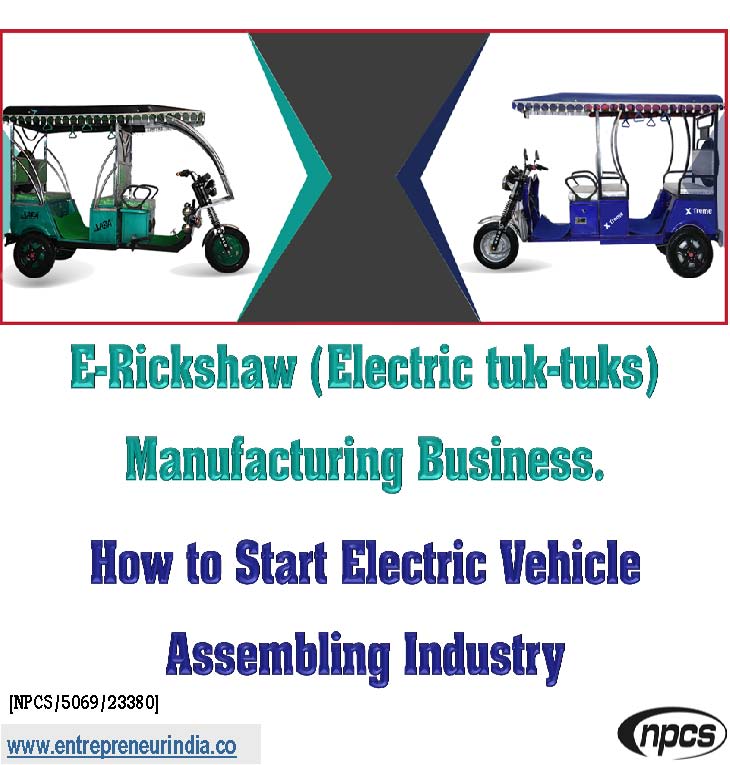
The E-Rickshaw manufacturing business has emerged as a lucrative and sustainable venture in India’s evolving transportation landscape. As the government and consumers alike push for eco-friendly mobility solutions, electric rickshaws have become a preferred mode of transport in urban and semi-urban areas. Affordable, efficient, and emission-free, e-rickshaws are transforming last-mile connectivity while creating thousands of micro-entrepreneurial opportunities.
Contents
- 1 Surge in Demand for Electric Mobility Solutions
- 1.1 What is an E-Rickshaw?
- 1.2 Types of E-Rickshaws in the Market
- 1.3 Raw Materials and Components Required
- 1.4 Manufacturing Process of E-Rickshaws
- 1.5 Plant Setup and Machinery Required
- 1.6 Licensing and Compliance Requirements
- 1.7 Marketing and Distribution Strategy
- 1.8 Profitability and ROI
- 1.9 Sustainability and Future Outlook
- 1.10 Conclusion
Surge in Demand for Electric Mobility Solutions
India’s rising focus on electric vehicles (EVs), coupled with fuel price volatility and pollution control efforts, has significantly increased the demand for E-Rickshaws. These battery-powered three-wheelers provide an economical and clean alternative to traditional auto-rickshaws, especially for short-distance transport. Major state governments have also initiated subsidy programs and eased policies to promote the manufacturing and adoption of e-rickshaws.
What is an E-Rickshaw?
An e-rickshaw is a battery-operated three-wheeler designed for passenger or goods transport. It typically runs on a 48V or 60V lead-acid or lithium-ion battery and offers a range of 80 to 120 kilometers per charge. Lightweight, silent, and cost-effective, e-rickshaws require minimal maintenance and are easy to operate, making them ideal for small-scale drivers and fleet owners.
Types of E-Rickshaws in the Market
The e-rickshaw industry caters to diverse consumer needs. Major types include:
-
Passenger E-Rickshaws – 4+1 seating, mostly used for city rides
-
Loader E-Rickshaws – For transporting goods, with a payload of 300–500 kg
-
Customized Rickshaws – Designed for vending, cargo, delivery services, or school transport
-
Solar-powered E-Rickshaws – Integrated with rooftop solar panels for auxiliary charging
Manufacturers can choose to specialize or offer a range of variants under a single brand.
Raw Materials and Components Required
To set up an e-rickshaw manufacturing unit, the following components are needed:
-
Mild Steel Chassis and Frame
-
Electric Motor (850W to 1500W)
-
Controller Unit and Throttle System
-
Lead-Acid or Lithium-Ion Battery Pack
-
Tyres and Alloy Wheels
-
Suspension and Shock Absorbers
-
Axles, Brakes, and Wiring Harness
-
Roof, Windshield, Seats, and Cabin Accessories
-
Digital Meters, Lights, and Indicators
Most of these components are available from domestic suppliers, although some high-performance batteries and controllers are imported.
Manufacturing Process of E-Rickshaws
The e-rickshaw manufacturing process involves multiple assembly stages:
-
Chassis Fabrication
Mild steel pipes and sheets are cut, welded, and shaped to form the base frame. -
Motor and Suspension Installation
The electric motor, axles, brakes, and suspensions are mounted on the chassis. -
Battery and Electrical Assembly
Battery packs, wiring harness, lights, and digital systems are installed. -
Bodywork and Painting
Roof, windshield, seating, and doors are added, followed by paint and finishing. -
Quality Check and Test Drive
Each unit undergoes performance testing, load testing, and braking analysis. -
Branding and Packaging
Final assembly includes company branding, registration documentation, and logistics planning.
Manufacturing can be done in semi-automated units or manual assembly workshops depending on investment levels.
Plant Setup and Machinery Required
A basic e-rickshaw plant setup includes:
-
Welding and Fabrication Tools
-
Hydraulic Press and Pipe Bending Machines
-
Spray Paint Booth or Powder Coating Station
-
Battery Charging and Testing Station
-
Motor and Controller Testing Bench
-
Assembly Line with Trolleys and Jigs
-
Inspection Tools and Quality Testing Instruments
A plant area of 5,000 to 10,000 sq. ft. is sufficient for a unit manufacturing 200–500 rickshaws per month. The investment ranges from ?25 lakhs to ?2 crores depending on automation and scale.
Licensing and Compliance Requirements
To legally operate an e-rickshaw manufacturing business, the following registrations and certifications are essential:
-
Company Registration and GST Number
-
MSME/Udyam Registration
-
BIS Certification for Product Quality
-
Central Motor Vehicles Rule (CMVR) Compliance
-
Type Approval from ARAI/ICAT
-
Pollution Control NOC (for paint booth)
-
Insurance and Road Worthiness Certificates
Each model must pass approval tests for road safety, braking, lighting, and structural integrity.
Marketing and Distribution Strategy
E-rickshaws are sold through:
-
Dedicated Dealership Networks in cities and towns
-
Tie-ups with Microfinance Institutions for driver financing
-
B2B Sales to Aggregators and Fleet Operators
-
Direct Sales to Retail Buyers via Exhibitions and Online Platforms
-
Government Tenders for Public Transport Initiatives
Marketing strategies include social media campaigns, showroom demonstrations, EMI offers, and on-road test drives.
Profitability and ROI
The e-rickshaw manufacturing business offers excellent profit margins:
-
Production Cost per Unit: ?80,000 – ?1,25,000
-
Selling Price per Unit: ?1,40,000 – ?2,00,000
-
Gross Margin: ?30,000 – ?70,000 per vehicle
-
Break-even Period: 1.5 – 2 years for small units
Value-added services like after-sales support, spare parts, and extended warranties boost customer retention and revenue.
Sustainability and Future Outlook
E-rickshaws contribute significantly to sustainable mobility by:
-
Reducing CO? emissions in congested cities
-
Lowering dependence on imported fuel
-
Offering cost-effective transport for low-income commuters
-
Creating green jobs and empowering rural entrepreneurship
The future outlook remains strong with government incentives under FAME II, state EV policies, and rising battery innovations.
Conclusion
The E-Rickshaw manufacturing business is a future-ready opportunity aligned with India’s EV revolution. With rising demand, policy support, and market acceptability, it promises strong profits and long-term sustainability. Entrepreneurs who combine quality engineering with smart branding and robust distribution will find great success in this high-potential sector.
Niir Project Consultancy Services
An ISO 9001:2015 Company
106-E, Kamla Nagar, Opp. Spark Mall,
New Delhi-110007, India.
Email: npcs.ei@gmail.com , info@entrepreneurindia.co
Tel: +91-11-23843955, 23845654, 23845886, 8800733955
Mobile: +91-9811043595
Website: www.entrepreneurindia.co , www.niir.org